•  
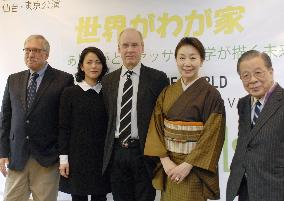
UK stage director Caird to produce drama for quake-hit kids

UK stage director Caird to produce drama for quake-hit kids

TOKYO, Japan - British stage director John Caird (C) and other people pose on Feb. 25, 2014, to promote a stage drama, "Sekai ga Wagaya" (The World Is Our Home). He will produce the drama to help support children who lost their parents because of the 2011 earthquake and tsunami. On his left is Mikiko Otonashi who will narrate the drama.

  •  
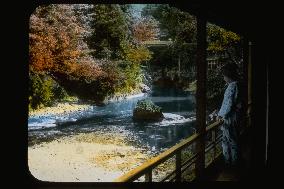
Autumn tints of Takinogawa, Oji

Autumn tints of Takinogawa, Oji

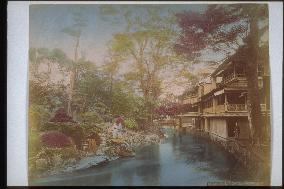
A woman looking at Otonashi River (Shakujii River) from a restaurant in Oji. The river was so clear during the Edo Period that tea made from river water was praised for its high quality. The hillside along the Otonashi River was also suited for tea growing, and the tea grown here was valued on a par with the famous tea from Uji. People were probably able to enjoy this tea here. Taken from a magic lantern made around 1897, this photograph shows that the river was still clean in the Meiji Period.==Date:unknown, Place:Tokyo, Photo:unknown, (Credit:Nagasaki University Library/Kyodo News Images) [Cabinet Number98‐50‐0]

  •  
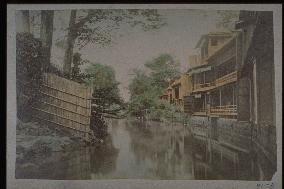
A teahouse at Oji

A teahouse at Oji

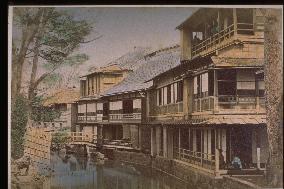
The building on the right is Ogiya Restaurant. A garden is on the left side of Otonashi River. According to the restaurant brochure, the history of the establishment goes back to 1648 when Yazaemon started a simple tea stand on the street. That was the time of the 3rd Shogun Tokugawa Iemitsu. Hayafune Takehiko is currently the 14th generation owner. The modern building is a five-story concrete structure, with Ogiya Restaurant on the second floor. The gates still remain at the first floor entrance. Taken in the middle of the Meiji Period.==Date:unknown, Place:Tokyo, Photo:unknown, (Credit:Nagasaki University Library/Kyodo News Images) [Cabinet Number91‐3‐0]

  •  
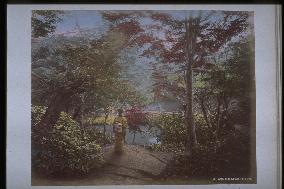
Autumn tints of Takinogawa, Oji

Autumn tints of Takinogawa, Oji

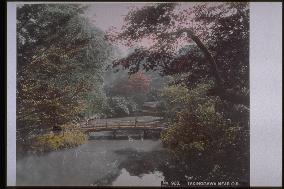
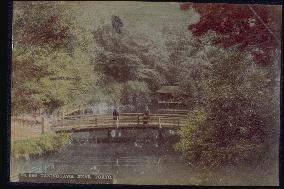
This seems to be Otonashi River (Shakujii River near Kongoji, the autumn colours temple. A bridge with a romantic atmosphere is said to have spanned a bend in the river. There was a bridge with a pleasant atmosphere. The deity Benzaiten was enshrined in a hollow in the rock near the bridge. A teahouse once stood on the hill. The river merges into Sumida River (formerly Arakawa), which flows northeast. Taken in the mid-Meiji Period.==Date:unknown, Place:Tokyo, Photo:unknown, (Credit:Nagasaki University Library/Kyodo News Images) [Cabinet Number88‐35‐0]

  •  
Autumn tints of Takinogawa, Oji

Autumn tints of Takinogawa, Oji

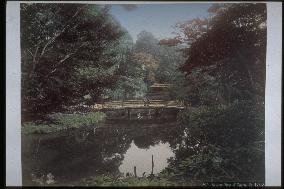
The 8th Shogun, Tokugawa Yoshimune, visited this area in 1720-21 and was pleased to find that the Oji Gongen Shrine and the name of the Otonashi River originated in his home province, Kishu. As a result he ordered the planting of Yoshino cherry trees at Mt. Asuka and maple trees along Takinogawa to provide autumn colours. Consequently, the Oji area became a popular tourist spot for people from Edo. Taken in the mid-Meiji Period.==Date:unknown, Place:Tokyo, Photo:unknown, (Credit:Nagasaki University Library/Kyodo News Images) [Cabinet Number80‐34‐0]

  •  
Autumn tints of Takinogawa, Oji

Autumn tints of Takinogawa, Oji

The photographs of Takinogawa taken during the Meiji Period capture the beauty of the autumn colours. However, after World War II, the development of the residential areas changed the area upstream. The river banks were covered with concrete and the river started to smell due to waste water from houses. The local people launched a movement to protect the river, and finally the government built the Otonashi River Shinsui (Water Friendly) Park in 1985. Spring water is mixed with the natural flow and filtered. Thus, clean water is circulated in certain areas. Depicting the area under present-day Otonashi Bridge, this photograph was taken by Kusakabe Kinbei between 1877 and 1887 (second decade of the Meiji Period).==Date:unknown, Place:Tokyo, Photo:Kusakabe Kinbei, (Credit:Nagasaki University Library/Kyodo News Images) [Cabinet Number53‐32‐0]

  •  
Autumn tints of Takinogawa, Oji

Autumn tints of Takinogawa, Oji

Oji Station is built over Shakujii River. In this area the river is called Otonashi River. The reason for this name is as follows. Toyoshima Gonnokami Kiyomitsu, a medieval feudal lord, hailed from Kishu (present-day Wakayama Prefecture) and thus established a shrine to Jakuichi Ouji Gongen (Kumano Gongen) that later became Oji Gongen. Consequently, this area was called Oji, and the river was named after the Otonashi River of Kishu. Upstream on the Otonashi River, Takinogawa Village gained fame for its autumn colours. Taken in the mid-Meiji Period.==Date:unknown, Place:Tokyo, Photo:Tamamura Kozaburo, (Credit:Nagasaki University Library/Kyodo News Images) [Cabinet Number48‐59‐0]

  •  
A teahouse at Oji

A teahouse at Oji

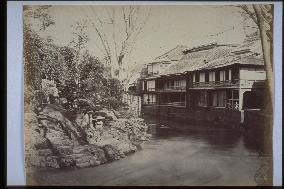
The restaurant Ogiya in Oji during the early Meiji era. Opened during the Kanei years of 1789-1801, it stands at the shore of the Otonashi River (Shaukujii River) and is the head of the Kanto Inari. It was a popular restaurant among people visiting Oji Inari, a famous spot during the Edo Era known in the Rakugo Fox of Oji story. The building to the fore does not have a third floor, so this picture must have been taken before the reconstruction.==Date:unknown, Place:Tokyo, Photo:F. Beato, (Credit:Nagasaki University Library/Kyodo News Images) [Cabinet Number28‐5‐0]

  •  
A teahouse at Oji

A teahouse at Oji

The restaurant Ogiya in Oji, in the early years of the Meiji era. It was opened during the Kansei era (1789-1801), and stands at the shore of Otonashi River (Shakujii River). It is the head of Kanto Inari. It is a famous restaurant for worshippers of the Inari in Oji, which was one of the famous spots in Edo. It is known for its appearance in the rakugo story Oji no Kitsune (Fox of Oji).==Date:unknown, Place:Tokyo, Photo:unknown, (Credit:Nagasaki University Library/Kyodo News Images) [Cabinet Number24‐47‐0]

  •  
A teahouse at Oji

A teahouse at Oji

The restaurant Ogiya in Oji in the early Meiji era. It was opened during the Kansei era (1789-1801) and stood along the Otonashi River (Shakujii River). It is a popular stop for people worshipping at Oji Inari, which is the head Inari Shrine in the Kanto area. It is also famous as a tourist spot and for the rakugo story entitled Fox of Oji .==Date:unknown, Place:Tokyo, Photo:unknown, (Credit:Nagasaki University Library/Kyodo News Images) [Cabinet Number14‐9‐0]

  • Main
  • Top
  • Editorial
  • Creative
  • About Us
  • About ILG
  • Terms of use
  • Company
  • BEHIND
  • Price List
  • Single Plan
  • Monthly Plan
  • Services
  • Shooting
  • Rights Clearance
  • Support
  • FAQ
  • How To Buy
  • Contact Us
  • Become a Partner

© KYODO NEWS IMAGES INC

All Rights Reserved.

  • Editorial
  • Olympics
  • News
  • Sports
  • Japan
  • Tech
  • Royal
  • Disaster
  • NorthKorea
  • Old Japan
  • SNS
  • Creative
  • Food
  • Japan
  • Landscape
  • Animal
  • Popular
  • #Ukraine
  • #China
  • #coronavirus
  • #N. Korea
  • #Thailand
  • #Russia
  • #Ukraine
  • #China
  • #coronavirus
  • #N. Korea
  • #Thailand
  • #Russia
  • Food
  • Japan
  • Landscape
  • Animal
  • Olympics
  • News
  • Sports
  • Japan
  • Tech
  • Royal
  • Disaster
  • NorthKorea
  • Old Japan
  • SNS