•  
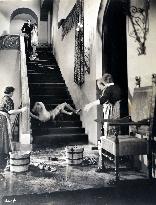
OUR DANCING DAUGHTERS

OUR DANCING DAUGHTERS

OUR DANCING DAUGHTERS NILS ASTHER, DOROTHY SEBASTIAN at top of the stairs OUR DANCING DAUGHTERS NILS ASTHER, DOROTHY SEBASTIAN at top of the stairs Date: 1928

  •  
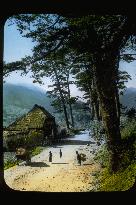
The Hakone Road

The Hakone Road

This is the view from the present-day Iriuda in Odawara City and Yamasaki in Hakone-machi when facing Yumoto. The road is Tokaido Highway (present-day National Route 1) and a cart, rickshaw, and pails are visible. Three children, possibly brothers and sister, are standing. The telegraph pole is on the right. Thus, this photo was taken after 1873 when the line was placed between Tokyo and Nagasaki.==Date:1904, Place:Hakone, Photo:unknown, (Credit:Nagasaki University Library/Kyodo News Images) [Cabinet Number98‐8‐0]

  •  
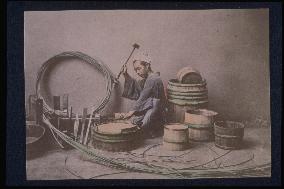
A cooper

A cooper

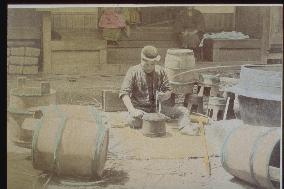
A young craftsman makes a tarai pail with a wooden hammer. He is wearing a head towel and a hanten coat. Bamboo materials twisted in circle, large and small pails, a saw, planes, hatchets and other tools are visible. This is a studio photograph.==Date:unknown, Place:unknown, Photo:unknown, (Credit:Nagasaki University Library/Kyodo News Images) [Cabinet Number96‐23‐0]

  •  
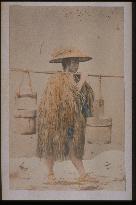
A farmer in a straw raincoat,with a straw cap on

A farmer in a straw raincoat,with a straw cap on

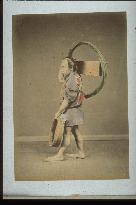
A man is carrying water pails with a balancing pole. He is wearing a bamboo hat and a straw raincoat. The unusually short ropes and short length of the pole suggest that it was being used for some special purpose, perhaps drawing seawater to make salt.==Date:unknown, Place:unknown, Photo:F. Beato, (Credit:Nagasaki University Library/Kyodo News Images) [Cabinet Number96‐11‐0]

  •  
A general shop

A general shop

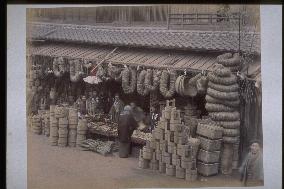
Pails and pitchers are piled in front of a shop. Small baskets are hanging from the eaves. Bamboo chests and crate baskets are also seen. A shop clerk in an short coat haggles with a customer wearing a hood, with apprentices watching.==Date:unknown, Place:unknown, Photo:unknown, (Credit:Nagasaki University Library/Kyodo News Images) [Cabinet Number85‐44‐0]

  •  
A general shop

A general shop

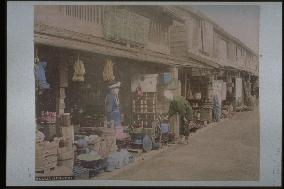
Vendors in a shop sell similar household goods. The photograph captures a man in a cap and headband, apparently the owner, and a customer. Large fish baskets are hanging under the eaves of the two shops. The merchandise includes pails, cooking pots, and jars.==Date:unknown, Place:unknown, Photo:unknown, (Credit:Nagasaki University Library/Kyodo News Images) [Cabinet Number83‐10‐0]

  •  
A greengrocery

A greengrocery

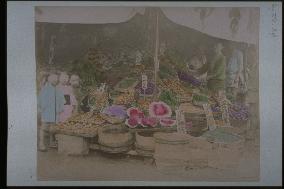
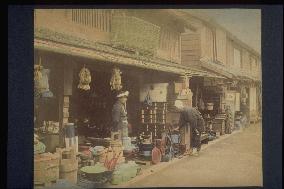
Pieces of ripe watermelon are displayed in front of a shop. Price tags are attached to vegetables such as cucumber, onions, turnips and ginger. The pails in front of the shop may contain pickled vegetables.==Date:unknown, Place:unknown, Photo:unknown, (Credit:Nagasaki University Library/Kyodo News Images) [Cabinet Number83‐4‐0]

  •  
A farmer carrying fertilizer tubs,wearing a straw raincoat and cap

A farmer carrying fertilizer tubs,wearing a straw raincoat and cap

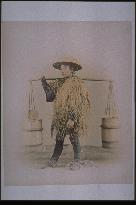
A man is carrying water pails with a balancing pole. He is wearing a bamboo hat and a straw raincoat. These pails may contain water, but since they are somewhat slender and deep they may contain fertilizer instead.==Date:unknown, Place:unknown, Photo:unknown, (Credit:Nagasaki University Library/Kyodo News Images) [Cabinet Number79‐49‐0]

  •  
A general shop

A general shop

Two sales clerks wearing hachimaki headbands sell tubs for cooked rice, small and large drawers, cooking pots, pails and other products. The box on the left was used to hold sets of rice bowls. A large drum is visible on the right.==Date:unknown, Place:unknown, Photo:R. Stillfried, (Credit:Nagasaki University Library/Kyodo News Images) [Cabinet Number78‐91‐0]

  •  
A dobbin carrying rice bags and the driver

A dobbin carrying rice bags and the driver

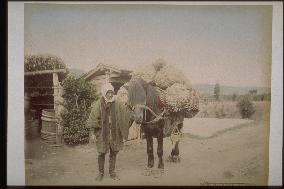
This is coloured photograph of a farming village taken in the early years of the Meiji Period. It shows four rice bags on the back of a draft horse. A small rice bag is seen on top of the other four. This draft horse is a small but powerful native species of Japan. The man in charge of the horse is a down-to-earth looking farmer. His attire suggests that it is late autumn or early winter. A few wooden barrels and pails are seen in the hut behind him. The pails may be used to carry manure.==Date:Middle Meiji (1883-1897), Place:unknown, Photo:unknown, (Credit:Nagasaki University Library/Kyodo News Images) [Cabinet Number51‐152‐0]

  •  
A secondhand shop

A secondhand shop

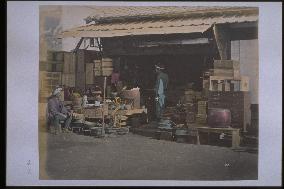
Secondhand dealers traded anything from daily necessities to curios and antiques. In this shop, utensils like iron kettles, portable wooden pails, bottles, drawers, large oblong chests are on display. A customer is assessing objects. The shop attendant is wearing a towel on his head.==Date:unknown, Place:unknown, Photo:unknown, (Credit:Nagasaki University Library/Kyodo News Images) [Cabinet Number51‐131‐0]

  •  
A pottery shop

A pottery shop

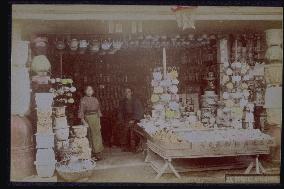
A pottery shop owner and his helper are seen in front of their shop, with many tea pots and clay jars on display. Plant pots and water pails are piled up on both sides. The shelves in the back are filled with tableware, and rice bowls are displayed in front.==Date:unknown, Place:unknown, Photo:Tamamura Kozaburo, (Credit:Nagasaki University Library/Kyodo News Images) [Cabinet Number48‐45‐0]

  •  
Great Nobi Earthquake (Ichinomiya Village)

Great Nobi Earthquake (Ichinomiya Village)

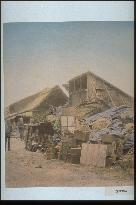
A father and child keep themselves from rain and wind in a simple hut built in front of their destroyed house in the Nobi earthquake. In front of them are cups, water pails and kettles. This may be a scene several days after the earthquake.==Date:unknown, Place:Aichi, Photo:Kusakabe Kinbei, (Credit:Nagasaki University Library/Kyodo News Images) [Cabinet Number39‐8‐0]

  •  
Sanmon of Seijokoji Temple in Fujisawa

Sanmon of Seijokoji Temple in Fujisawa

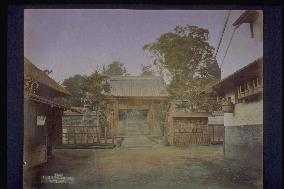
A gate is seen in the facade, and a stone pavement leads to the rear. Pails are lined up along the white walls of the building. (Same as that numbered 37-4 )==Date:unknown, Place:Fujisawa, Photo:unknown, (Credit:Nagasaki University Library/Kyodo News Images) [Cabinet Number37‐80‐0]

  •  
Sanmon of Seijokoji Temple in Fujisawa

Sanmon of Seijokoji Temple in Fujisawa

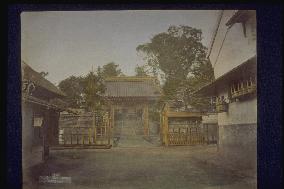
A gate is in the front, and stone pavement continues on. Pails are arranged in rows by the white building to the right of the road. (Identical to the photo numbered 37-80.)==Date:unknown, Place:Fujisawa, Photo:unknown, (Credit:Nagasaki University Library/Kyodo News Images) [Cabinet Number37‐4‐0]

  •  
A cooper

A cooper

A craftsman repairs a pail with a straw mat at the entrance. Many pails of various sizes line up. A person watches this scene at the entrance.==Date:unknown, Place:unknown, Photo:Ogawa Kazumasa, (Credit:Nagasaki University Library/Kyodo News Images) [Cabinet Number25‐80‐0]

  •  
Woman washing things in a tub

Woman washing things in a tub

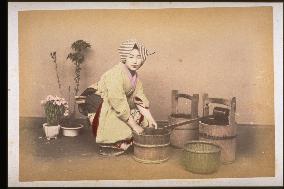
A young woman wearing furisode (long sleeved kimono) and a towel over her head washes dishes in a basin. This is probably a dramatized photo of Kichen chores. Two water pails, a wash basin and a big basket are placed to show the typical tools in a Japanese washing set. The flower is ornamental.==Date:unknown, Place:unknown, Photo:unknown, (Credit:Nagasaki University Library/Kyodo News Images) [Cabinet Number16‐4‐0]

  •  
Tub mender

Tub mender

Traditional pails with boards aligned in a circle and held together with hoops was invented in the Muromachi era. Pine was mainly used for the boards, and the okeya (pail shops) were usually operated by craftsmen who were also vendors. Some craftsmen specialized in putting on the hoops, like the man in this photo.==Date:unknown, Place:unknown, Photo:unknown, (Credit:Nagasaki University Library/Kyodo News Images) [Cabinet Number13‐6‐0]

  •  
A vegetable vendor

A vegetable vendor

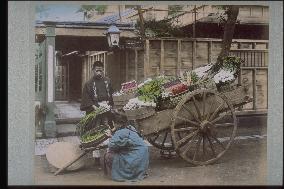
A man selling vegetables in front of a house and a woman customer. Various vegetables are sold with many baskets and pails on the daihachi guruma (big wheel cart). The grocery man holds vegetables in his hands, and the woman looks at the vegetables in the pail. The coat of the grocery man is printed with the letters Inoue .==Date:Late Meiji, Place:unknown, Photo:Ogawa Kazumasa, (Credit:Nagasaki University Library/Kyodo News Images) [Cabinet Number10‐41‐0]

  • Main
  • Top
  • Editorial
  • Creative
  • About Us
  • About ILG
  • Terms of use
  • Company
  • BEHIND
  • Price List
  • Single Plan
  • Monthly Plan
  • Services
  • Shooting
  • Rights Clearance
  • Support
  • FAQ
  • How To Buy
  • Contact Us
  • Become a Partner

© KYODO NEWS IMAGES INC

All Rights Reserved.

  • Editorial
  • Olympics
  • News
  • Sports
  • Japan
  • Tech
  • Royal
  • Disaster
  • NorthKorea
  • Old Japan
  • SNS
  • Creative
  • Food
  • Japan
  • Landscape
  • Animal
  • Popular
  • #Ukraine
  • #China
  • #coronavirus
  • #N. Korea
  • #Thailand
  • #Russia
  • #Ukraine
  • #China
  • #coronavirus
  • #N. Korea
  • #Thailand
  • #Russia
  • Food
  • Japan
  • Landscape
  • Animal
  • Olympics
  • News
  • Sports
  • Japan
  • Tech
  • Royal
  • Disaster
  • NorthKorea
  • Old Japan
  • SNS