•  

[Breaking News]Summer festival in Osaka

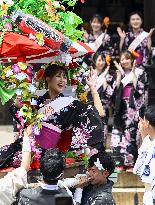
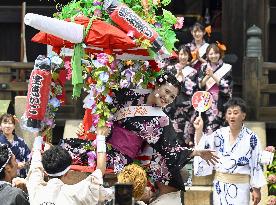
OSAKA, Japan, June 30 Kyodo - A woman wearing a Japanese summer kimono waves to the crowd in Osaka while sitting on a palanquin during a traditional parade as the three-day Aizen festival heralding the advent of summer begins in the western Japan city on June 30, 2024. (Kyodo)

  •  
Aoi Festival in Kyoto

Aoi Festival in Kyoto

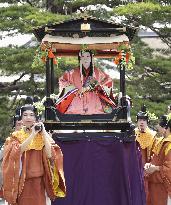
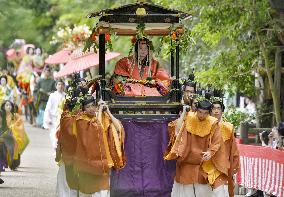
A palanquin carrying a woman playing the role of the Saio-dai priestess, clad in a 12-layer traditional Japanese kimono, parades at Kyoto's Shimogamo shrine during the annual Aoi Festival, one of the three main festivals of the ancient Japanese capital, on May 15, 2025.

  •  
Aoi festival in Kyoto

Aoi festival in Kyoto

A palanquin carrying a woman playing the role of the Saio-dai priestess, clad in a 12-layer traditional Japanese kimono, leaves Kyoto Imperial Palace for a parade during the annual Aoi Festival, one of the three main festivals of the ancient Japanese capital, on May 15, 2025.

  •  
Aoi festival in Kyoto

Aoi festival in Kyoto

A palanquin carrying a woman playing the role of the Saio-dai priestess, clad in a 12-layer traditional Japanese kimono, leaves Kyoto Imperial Palace for a parade during the annual Aoi Festival, one of the three main festivals of the ancient Japanese capital, on May 15, 2025.

  •  
Summer festival in Osaka

Summer festival in Osaka

A woman wearing a Japanese summer kimono waves to the crowd in Osaka while sitting on a palanquin during a traditional parade as the three-day Aizen festival heralding the advent of summer begins in the western Japan city on June 30, 2024.

  •  
Summer festival in Osaka

Summer festival in Osaka

A woman wearing a Japanese summer kimono waves to the crowd in Osaka while sitting on a palanquin during a traditional parade as the three-day Aizen festival heralding the advent of summer begins in the western Japan city on June 30, 2024.

  •  

Aoi festival in Kyoto

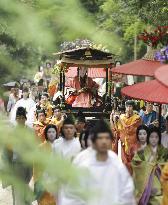
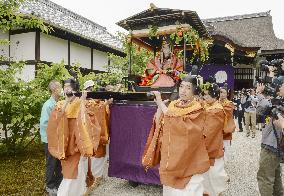
KYOTO, Japan, May 15 Kyodo - People dressed in traditional costumes of the ancient Heian period (794-1185) parade through Shimogamo Shrine in Kyoto on May 15, 2024, with a palanquin carrying a woman playing the role of the Saio-dai priestess during the annual Aoi Festival, one of the three main festivals of the ancient Japanese capital. (Kyodo)

  •  
Aoi festival in Kyoto

Aoi festival in Kyoto

People dressed in traditional costumes of the ancient Heian period (794-1185) parade through Shimogamo Shrine in Kyoto on May 15, 2024, with a palanquin carrying a woman playing the role of the Saio-dai priestess during the annual Aoi Festival, one of the three main festivals of the ancient Japanese capital.

  •  
Aoi festival in Kyoto

Aoi festival in Kyoto

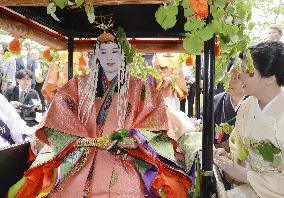
A woman playing the role of the Saio-dai priestess, clad in a 12-layer traditional Japanese kimono, is seated in a palanquin at Kyoto Imperial Palace for a parade during the annual Aoi Festival, one of the three main festivals of the ancient Japanese capital, on May 15, 2024.

  •  
Aoi festival in Kyoto

Aoi festival in Kyoto

A woman playing the role of the Saio-dai priestess, clad in a 12-layer traditional Japanese kimono, is carried in a palanquin at Kyoto Imperial Palace for a parade during the annual Aoi Festival, one of the three main festivals of the ancient Japanese capital, on May 15, 2024.

  •  
Celebrities, geisha parade at annual 'Ebisu' festival

Celebrities, geisha parade at annual 'Ebisu' festival

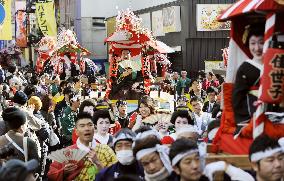
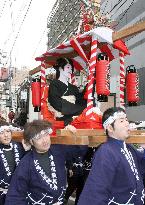
OSAKA, Japan - A dazzling good luck palanquin parade, featuring kabuki actor Nakamura Ganjiro (C) and other celebrities as well as geisha female entertainers, march through downtown Osaka in western Japan on Jan. 10, 2015, the main day of the annual "Toka Ebisu" festival, during which people pray to Ebisu, the patron deity of commerce, for business success.

  •  
Kids carry devil palanquin at spa resort festival

Kids carry devil palanquin at spa resort festival

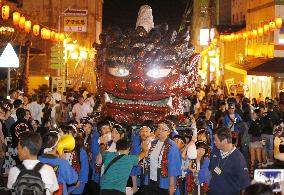
NOBORIBETSU, Japan - Children carry on their shoulders a devil palanquin during the annual "Jigoku Matsuri" (Hell Festival) at the Noboribetsu spa resort in Japan's northernmost prefecture of Hokkaido on Aug. 30, 2014.

  •  
Osaka commerce god festival

Osaka commerce god festival

OSAKA, Japan - Men carry a woman in a palanquin on a street as the Toka Ebisu festival featuring a commerce god begins in Osaka on Jan. 9, 2011.

  •  
Dressed Korean students parade in Tokyo

Dressed Korean students parade in Tokyo

TOKYO, Japan - About 150 students from South Korea, dressed as members of a Korean tributary mission sent to Japan during the Edo Period (1600-1868), parade along the Omotesando Avenue in Tokyo on Aug. 25. The envoy or the head of the delegation is seated in the palanquin carried by bearers. Korea sent a total of 12 delegations to Japan during the reign of the Tokugawa Shogunate. The last visit took place in 1811. The students organized the parade as part of events marking the FIFA 2002 World Cup finals co-hoted by Japan and South Korea.

  •  
Hiroshige - 53 Stations of the Tokaido - Print 53

Hiroshige - 53 Stations of the Tokaido - Print 53

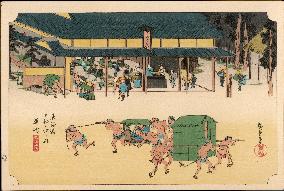
53 Kusatsu - View of a rest-house on for coolies, and horses on the road; coolies passing in foreground with a kago and a covered palanquin. The Nakasendo, another large highway which ran through the mountainous region between Edo and Kyoto joined the Tokaido at this station to form a single highway for the remainder of the highway to Kyoto. Utagawa Hiroshige (1797 - 1858). The Fifty-Three Stations of the Tokaido - Hoeido edition (1831-4) Date: 1831 - 1834

  •  
The Tamadare Falls,Hakone

The Tamadare Falls,Hakone

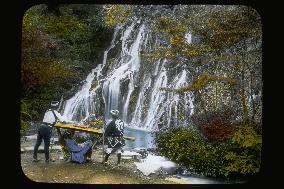
A woman and two palanquin men are watching Tamadare Falls at Hakone Yumoto. Judging from the appearance of the place, this photo was taken after 1891 when this place became Takinomae-Yuen Park by the entrepreneur Takashi Koyasu. Since it is written Ichinoyu on the hanten jacket worn by the palanquin man, it is assumed that a woman staying at the shinise (long-standing) inn Ichinoyu at Tonosawa Spa is visiting here.==Date:unknown, Place:Hakone, Photo:unknown, (Credit:Nagasaki University Library/Kyodo News Images) [Cabinet Number98‐34‐0]

  •  
The Hakone post town and a girl in a palanquin

The Hakone post town and a girl in a palanquin

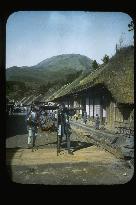
This is the view from Shin-machi of the post town of Hakone when facing Hakone checkpoint. The mountain behind is Komagadake. The street where the palanquin men are is Tokaido Highway (present-day National Route 1). The house on the right is facing toward southwest and a child and an old man are enjoying the sun. Judging from their clothes, it appears to be either late autumn or early spring. The girl on the palanquin is probably a tourist.==Date:unknown, Place:Hakone, Photo:unknown, (Credit:Nagasaki University Library/Kyodo News Images) [Cabinet Number98‐25‐0]

  •  
A yamakago (mountain palanquin) in the River Otani

A yamakago (mountain palanquin) in the River Otani

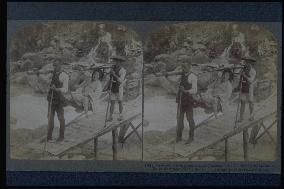
Two men carry a woman in a yama-kago (mountain palanquin) across Daiya River. The location is unclear, but the style and type of bridge over the narrow mountain river suggests that it is the gorge near Umagaeshi.==Date:1904, Place:Nikko, Photo:Underwood, (Credit:Nagasaki University Library/Kyodo News Images) [Cabinet Number97‐55‐0]

  •  
A woman in a basket palanquin

A woman in a basket palanquin

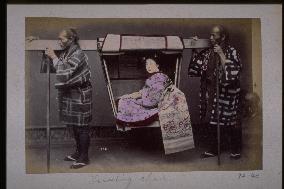
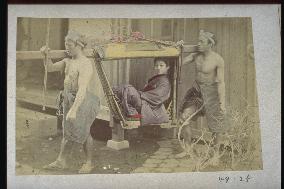
This may be a shitekago because the straw curtain seems to be rolled up. This kind of palanquin was made simply of four bamboo poles and braided bamboo sticks with straw curtain attached. The palanquin bearers had no set uniforms but carried ikizue (breath sticks) to regulate breathing. ==Date:unknown, Place:unknown, Photo:unknown, (Credit:Nagasaki University Library/Kyodo News Images) [Cabinet Number96‐10‐0]

  •  
A woman in a basket palanquin

A woman in a basket palanquin

The woman is riding a shitekago used by the general public in the Edo Period. This kind of palanquin was made simply of four bamboo poles and braided bamboo sticks with straw curtain attached. The palanquin bearers are wearing short coats and straw sandals and holding ikizue (breath sticks) to regulate breathing while walking.==Date:unknown, Place:unknown, Photo:unknown, (Credit:Nagasaki University Library/Kyodo News Images) [Cabinet Number92‐43‐0]

  •  
Mt. Fuji seen from the Otome Pass

Mt. Fuji seen from the Otome Pass

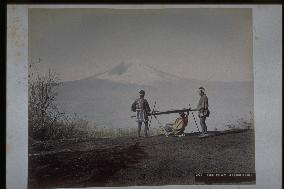
Mt. Fuji viewed from Otome Pass at the border of Shizuoka and Kanagawa Prefectures, facing west. Otome Pass is part of the road to Gotenba, Shizuoka Prefecture via Sengokubara (Kanagawa) and Hakone. It has been famous since ancient times for its spectacular view of Mt. Fuji. During the Edo Period, travel restrictions were enforced and people were not allowed to pass. This photograph taken at the top of the pass shows a woman in a palanquin, with the bearers on both sides.==Date:unknown, Place:Shizuoka, Photo:unknown, (Credit:Nagasaki University Library/Kyodo News Images) [Cabinet Number93‐1‐0]

  •  
A girl in a basket palanquin

A girl in a basket palanquin

This may be a shitekago because the straw curtain seems to be rolled up. This kind of palanquin was made simply of four bamboo poles and braided bamboo sticks with straw curtain attached. The palanquin bearers had no set uniforms but carried ikizue (breath sticks) to regulate breathing. ==Date:unknown, Place:unknown, Photo:unknown, (Credit:Nagasaki University Library/Kyodo News Images) [Cabinet Number91‐26‐0]

  •  
A girl in a basket palanquin

A girl in a basket palanquin

This may be a shitekago because the straw curtain seems to be rolled up. This kind of palanquin was made simply of four bamboo poles and braided bamboo sticks with straw curtain attached. The palanquin bearers had no set uniforms but carried ikizue (breath sticks) to regulate breathing. ==Date:unknown, Place:unknown, Photo:unknown, (Credit:Nagasaki University Library/Kyodo News Images) [Cabinet Number88‐47‐0]

  •  
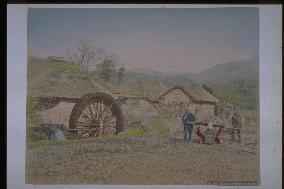
A water mill at Hakone

A water mill at Hakone

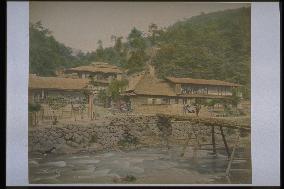
This is the northeastern view from the present-day parking lot of Miyagino Hojuin Temple. The water mill was taken place by a residential house, but the Setosawa Creek and the waterway on the left side of the water mill still exist today. The site where the palanquin men stand was the rice paddie until around 1975. The mountains far away are Myoujingadake and Hiuchidake.==Date:unknown, Place:Hakone, Photo:A. Farsari, (Credit:Nagasaki University Library/Kyodo News Images) [Cabinet Number81‐19‐0]

  •  
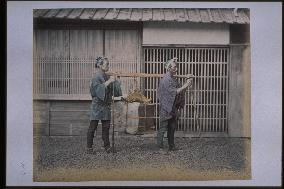
A cargo carrier

A cargo carrier

Two labourers are carrying luggage in the manner of palanquin bearers. They are holding a walking sticks and wearing momohiki (long johns), short coats and headbands.==Date:unknown, Place:unknown, Photo:R. Stillfried, (Credit:Nagasaki University Library/Kyodo News Images) [Cabinet Number78‐94‐0]

  •  
A palanquin bearer with a tattoo

A palanquin bearer with a tattoo

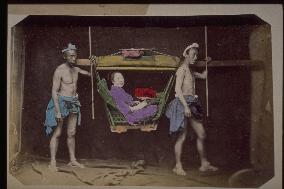
This is a Stillfried photograph depicting tattooed palanquin carriers. The tattoos were painted in later, and don't show the original design. The structure of the bamboo basket is clearly visible because the covering screen is rolled up.==Date:unknown, Place:unknown, Photo:R. Stillfried, (Credit:Nagasaki University Library/Kyodo News Images) [Cabinet Number77‐47‐0]

  •  
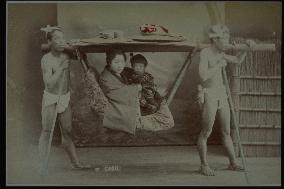
A mother and her daughter in a basket palanquin

A mother and her daughter in a basket palanquin

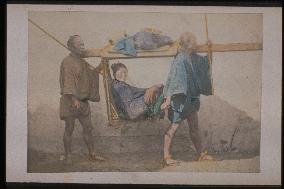
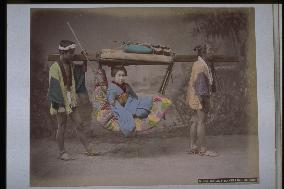
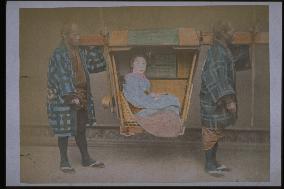
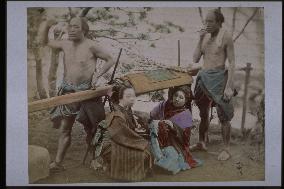
The kago (palanquin) was widely used in the Edo Period. Many types were developed for different social classes and purposes. This palanquin has no straw curtain and so is probably a yamakago used for mountain passages. A cushion was used to absorb shocks. The bearers are wearing loincloths, straw sandals and headbands, and they are holding ikizue (breath sticks) to regulate breathing while walking.==Date:unknown, Place:unknown, Photo:unknown, (Credit:Nagasaki University Library/Kyodo News Images) [Cabinet Number69‐56‐0]

  •  
A female palanquin bearer in male attire

A female palanquin bearer in male attire

A female palanquin bearer in male attire==Date:unknown, Place:unknown, Photo:Ogawa Kazumasa, (Credit:Nagasaki University Library/Kyodo News Images)

  •  
Tonosawa Spa

Tonosawa Spa

The earthen bridge where the palanquin is crossing is the Tamanoo Bridge. It crosses over Hayakawa River and at present the span is part of National Route 1. A rickshaw is also visible. This photo appears to have been taken after 1881 when a street for carts was open between Yumoto and Tonosawa. The building on the left is Motoyu (present day Kansui-ro), the one on the right is Ichinoyu (present day Ichinoyu), and the one in the centre back is Tamura (no longer extant). This area was the centre of Tonosawa.==Date:unknown, Place:Hakone, Photo:Usui Shuzaburo?, (Credit:Nagasaki University Library/Kyodo News Images) [Cabinet Number65‐5‐0]

  •  
palanquin bearers

palanquin bearers

The woman is riding a shitekago used by the general public in the Edo Period. This kind of palanquin was made simply of four bamboo poles and braided bamboo sticks with straw curtain attached. The palanquin bearers are wearing short coats and straw sandals and holding ikizue (breath sticks) to regulate breathing while walking.==Date:unknown, Place:unknown, Photo:unknown, (Credit:Nagasaki University Library/Kyodo News Images) [Cabinet Number64‐36‐0]

  •  
palanquin bearers

palanquin bearers

The kago (palanquin) was widely used in the Edo Period. Many types were developed for different social classes and purposes. This palanquin has no straw curtain and so is probably a yamakago used for mountain passages. A cushion was used to absorb shocks. The bearers are wearing loincloths, straw sandals and headbands, and they are holding ikizue (breath sticks) to regulate breathing while walking.==Date:unknown, Place:unknown, Photo:unknown, (Credit:Nagasaki University Library/Kyodo News Images) [Cabinet Number64‐37‐0]

  •  
palanquin bearers

palanquin bearers

A palanquin bearer is smoking tobacco with a long pipe, apparently during a break. The straw curtain seems to be rolled up, suggesting that this palanquin was a shitekago used by the general public in the Edo Period.==Date:Middle Meiji (1883-1897), Place:unknown, Photo:unknown, (Credit:Nagasaki University Library/Kyodo News Images) [Cabinet Number64‐8‐0]

  •  
Hakone Shrine

Hakone Shrine

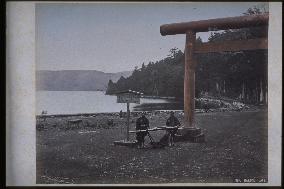
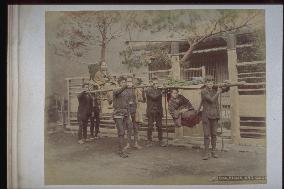
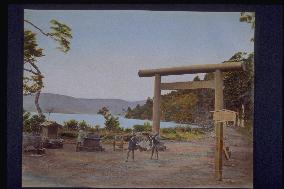
This is a photo with the Second Torii Gate of Hakone Shrine and the palanquin men. Although the sign board is on the right side of the gate in the picture painted by Kiyochika Kobayashi in 1880, it is moved to the left of the gate. Two iron pots made during the Kamakura Period to thank gods (Designated Important Cultural Asset) were moved to the main hall of the shrine and not visible on this photo. Lake Ashinoko can be seen behind.==Date:unknown, Place:Hakone, Photo:unknown, (Credit:Nagasaki University Library/Kyodo News Images) [Cabinet Number59‐53‐0]

  •  
Women in a pooled palanquin

Women in a pooled palanquin

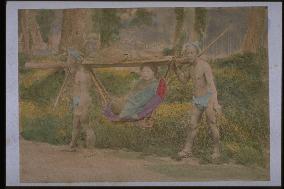
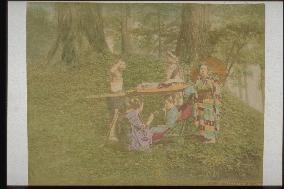
The overall impression and immobility of the people suggest that the photograph is staged. But the colouring applied to the kimono, meadow and trees is skillful.==Date:unknown, Place:unknown, Photo:unknown, (Credit:Nagasaki University Library/Kyodo News Images) [Cabinet Number51‐157‐2]

  •  
A woman in a basket palanquin

A woman in a basket palanquin

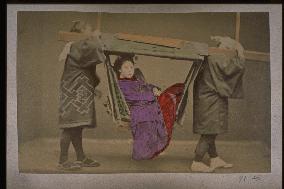
A woman is riding on a palanquin used for road and mountain passages. The bottom part of the seat is made of braided bamboo and shows no sagging. A cushion absorbed shocks. The palanquin bearer wore a headband and short coat and held an ikizue (breath stick) to regulate his breathing while carrying the palanquin.==Date:unknown, Place:unknown, Photo:unknown, (Credit:Nagasaki University Library/Kyodo News Images) [Cabinet Number51‐143‐0]

  •  
A girl in a basket palanquin

A girl in a basket palanquin

This may be a shitekago because the straw curtain seems to be rolled up. This kind of palanquin was made simply of four bamboo poles and braided bamboo sticks with straw curtain attached. The palanquin bearers had no set uniforms but carried ikizue (breath sticks) to regulate breathing. ==Date:unknown, Place:unknown, Photo:unknown, (Credit:Nagasaki University Library/Kyodo News Images) [Cabinet Number51‐20‐0]

  •  
A woman in a basket palanquin

A woman in a basket palanquin

This may be a shitekago because the straw curtain seems to be rolled up. This kind of palanquin was made simply of four bamboo poles and braided bamboo sticks with straw curtain attached. The palanquin bearers had no set uniforms but carried ikizue (breath sticks) to regulate breathing. ==Date:unknown, Place:unknown, Photo:unknown, (Credit:Nagasaki University Library/Kyodo News Images) [Cabinet Number49‐25‐0]

  •  
A woman in a basket palanquin

A woman in a basket palanquin

A woman is riding on a palanquin used for road and mountain passages. The bottom part of the seat is made of braided bamboo and shows no sagging. A cushion absorbed shocks. The palanquin bearer wore a headband and short coat and held an ikizue (breath stick) to regulate his breathing while carrying the palanquin.==Date:unknown, Place:unknown, Photo:Tamamura Kozaburo, (Credit:Nagasaki University Library/Kyodo News Images) [Cabinet Number48‐13‐0]

  •  
A palanquin going along a row of Japanese cedars

A palanquin going along a row of Japanese cedars

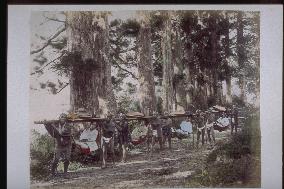
A palanquin going along a row of Japanese cedars==Date:Middle Meiji (1883-1897), Place:unknown, Photo:unknown, (Credit:Nagasaki University Library/Kyodo News Images)

  •  
Chair and palanquin

Chair and palanquin

A palanquin carrier holding a cane and a woman passenger. The roof of the palanquin seems to have vegetables. It is a mountain palanquin. In the back, a woman sits in a sedan chair carried by four men.==Date:unknown, Place:unknown, Photo:unknown, (Credit:Nagasaki University Library/Kyodo News Images) [Cabinet Number43‐18‐0]

  •  
A woman in a basket palanquin

A woman in a basket palanquin

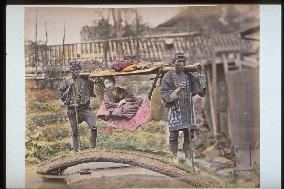
A mountain palanquin crosses the small bridge over the small river in the town. Two palanquin carriers may be the same as on the photo numbered 40-30.==Date:unknown, Place:unknown, Photo:Suzuki Shin-ichi, (Credit:Nagasaki University Library/Kyodo News Images) [Cabinet Number41‐28‐0]

  •  
A woman in a basket palanquin

A woman in a basket palanquin

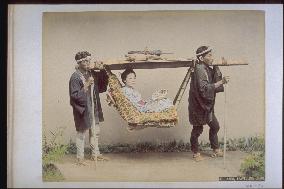
A woman rides a palanquin, two palanquin carriers with Ikizue (canes) and luggage of the passengers are placed on the roof. A dramatized photo seen very often.==Date:unknown, Place:unknown, Photo:Kusakabe Kinbei, (Credit:Nagasaki University Library/Kyodo News Images) [Cabinet Number40‐30‐0]

  •  
Torii gate at Hakone Gongen

Torii gate at Hakone Gongen

A picture of the former Ichino torii of Hakone Shrine, where the present Nino torii stands. A steel kettle used to stand here near the torii until 1880, which can be seen in the drawings by Kobayashi Kiyochika, so the picture was taken before that. The palanquin is place unnaturally, probably for the photo.==Date:unknown, Place:Hakone, Photo:unknown, (Credit:Nagasaki University Library/Kyodo News Images) [Cabinet Number37‐55‐0]

  •  
NIKKO IROHA slop

NIKKO IROHA slop

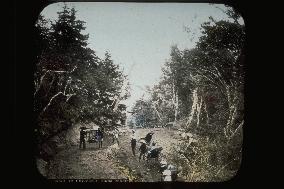
A palanquin and traveler stand on the zigzag slope of Chuzenjido. The new road was completed after 1887, and after that rickshaws could take this route. It was a difficult route for palanquins until then. Identical to the photo numbered 11-18.==Date:unknown, Place:Nikko, Photo:unknown, (Credit:Nagasaki University Library/Kyodo News Images) [Cabinet Number31‐79‐0]

  •  
NIKKO IROHA SLOPE

NIKKO IROHA SLOPE

A palanquin and rickshaw climb the zigzag slope of the Chuzenjido. The new road was completed after 1887, and after that rickshaws could take this route. It was a difficult route for palanquins until then.==Date:unknown, Place:Nikko, Photo:unknown, (Credit:Nagasaki University Library/Kyodo News Images) [Cabinet Number31‐37‐0]

  •  
Houses of hakone

Houses of hakone

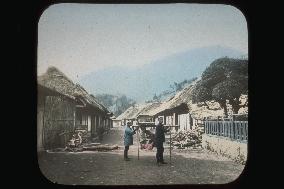
A photo taken in the direction of Mishimacho from Odawaracho, Hakone. The width of the road is rather narrow, taking into consideration the fact that it is the Tokaido, but the location can be judged from the shape of the mountains and houses in the background. The logs piled up could be a heap of products to be sold. The palanquin stands in an unnatural position.==Date:unknown, Place:Hakone, Photo:unknown, (Credit:Nagasaki University Library/Kyodo News Images) [Cabinet Number31‐7‐0]

  •  
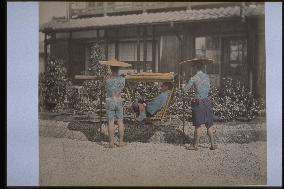
Teahouse at nikko umagaeshi

Teahouse at nikko umagaeshi

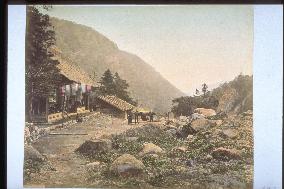
Umagaeshi is the starting point of Chuzenjido, leading to a rugged path in the mountains to Ohira. The picture shows a teahouse and a palanquin. The teahouse is probably Tsutaya.==Date:unknown, Place:Nikko, Photo:unknown, (Credit:Nagasaki University Library/Kyodo News Images) [Cabinet Number26‐2‐0]

  •  
Palanquin bearers

Palanquin bearers

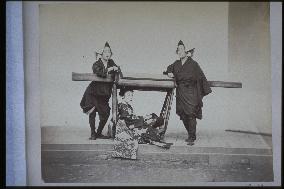
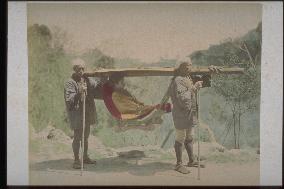
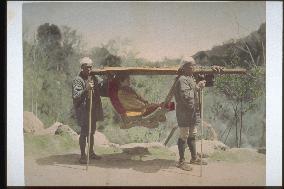
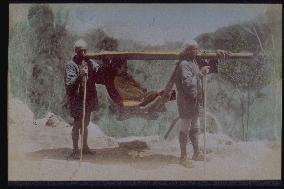
Two palanquin carriers hold a woman on their carriage in the mountains. Both have towels around their heads and bindings on their feet with sandals. They carry the carriage on their left shoulders, and hold canes in their right hands.==Date:unknown, Place:unknown, Photo:Ogawa Kazumasa, (Credit:Nagasaki University Library/Kyodo News Images) [Cabinet Number25‐68‐0]

  •  
CHUZENJI road

CHUZENJI road

Chuzenjido leads to Chuzenji from Umagaeshi to the winding slope and passes through the steep hills of Mt. Nantai. A palanquin and a traveler descend the slope by the river.==Date:unknown, Place:Nikko, Photo:Ogawa Kazumasa, (Credit:Nagasaki University Library/Kyodo News Images) [Cabinet Number25‐59‐0]

  •  
Crossing of sakawagawa river

Crossing of sakawagawa river

To Odawara over the Sakawa River. From this edition, the magazine started a series of sketches of a journey by three Englishmen, a Japanese official, 2 servants, three horses, and three extra men. The journey took 32 days in the summer of 1871, but they had to cross the Sakawa River by palanquin. When the cameraman was sent to take substitute photos, the river had gone dry, and there was a small bridge across it. From The Far East October 4, 1871. From the republished edition of The Far East.==Date:unknown, Place:Kanagawa, Photo:unknown, (Credit:Nagasaki University Library/Kyodo News Images) [Cabinet Number19‐51‐0]

  • Main
  • Top
  • Editorial
  • Creative
  • About Us
  • About ILG
  • Terms of use
  • Company
  • BEHIND
  • Price List
  • Single Plan
  • Monthly Plan
  • Services
  • Shooting
  • Rights Clearance
  • Support
  • FAQ
  • How To Buy
  • Contact Us
  • Become a Partner

© KYODO NEWS IMAGES INC

All Rights Reserved.

  • Editorial
  • Olympics
  • News
  • Sports
  • Japan
  • Tech
  • Royal
  • Disaster
  • NorthKorea
  • Old Japan
  • SNS
  • Creative
  • Food
  • Japan
  • Landscape
  • Animal
  • Popular
  • #Ukraine
  • #China
  • #coronavirus
  • #N. Korea
  • #Russia
  • #Thailand
  • #Ukraine
  • #China
  • #coronavirus
  • #N. Korea
  • #Russia
  • #Thailand
  • Food
  • Japan
  • Landscape
  • Animal
  • Olympics
  • News
  • Sports
  • Japan
  • Tech
  • Royal
  • Disaster
  • NorthKorea
  • Old Japan
  • SNS