•  
Commerce god festival in Osaka

Commerce god festival in Osaka

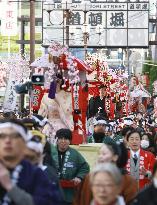
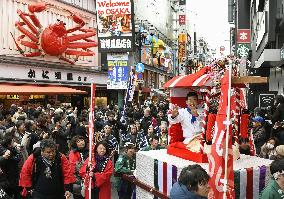
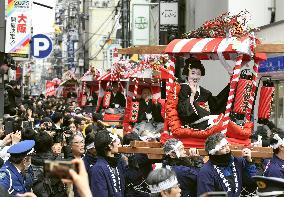
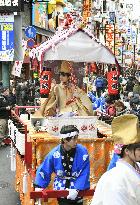
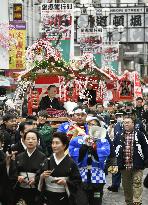
Colorful palanquins are paraded through the streets of downtown Osaka on Jan. 10, 2026, the main day of the annual Toka Ebisu Festival, during which people pray to Ebisu, the patron deity of commerce, for business prosperity.

  •  
Commerce god festival in Osaka

Commerce god festival in Osaka

Colorful palanquins are paraded through the streets of downtown Osaka on Jan. 10, 2026, the main day of the annual Toka Ebisu Festival, during which people pray to Ebisu, the patron deity of commerce, for business prosperity.

  •  
Commerce god festival in Osaka

Commerce god festival in Osaka

Colorful palanquins are paraded through the streets of downtown Osaka on Jan. 10, 2025, the main day of the annual Toka Ebisu Festival, during which people pray to Ebisu, the patron deity of commerce, for business prosperity.

  •  
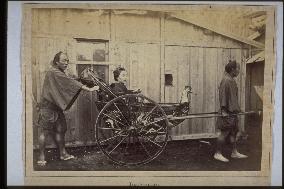
Jinrikisha,a man-pulled cart,decorated with chicken scuplture

Jinrikisha,a man-pulled cart,decorated with chicken scuplture

Carried on page 235 of the February 8, 1873 edition of The Far East. The article states that four years earlier there were no cars such as these but only palanquins for the nobility and commoners. Foreigners brought these types of vehicles into Japan, and entrepreneurs manufactured these boat-shaped baby car-type rickshaws.==Date:First year of Meiji, Place:unknown, Photo:unknown, (Credit:Nagasaki University Library/Kyodo News Images) [Cabinet Number17‐41‐0]

  •  
Oirans (courtesans) and palanquins

Oirans (courtesans) and palanquins

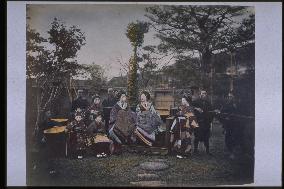
An oiran (courtesan) walking in formal style with attendants was called an oiran procession. The procession included a novice courtesan, child attendant and chaperone as well as male attendants carrying bed items, a shamisen lute and drums.==Date:unknown, Place:unknown, Photo:Usui Shuzaburo, (Credit:Nagasaki University Library/Kyodo News Images) [Cabinet Number94‐11‐0]

  •  
A jinrikisha

A jinrikisha

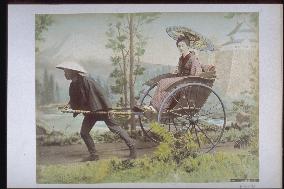
Rickshaws became popular instead of the palanquins after the Meiji era. A woman holds an umbrella and the rickshaw man bends forward. A photo with a popular structure.==Date:unknown, Place:unknown, Photo:Kusakabe Kinbei, (Credit:Nagasaki University Library/Kyodo News Images) [Cabinet Number40‐31‐0]

  •  
NIKKO IROHA slop

NIKKO IROHA slop

A palanquin and traveler stand on the zigzag slope of Chuzenjido. The new road was completed after 1887, and after that rickshaws could take this route. It was a difficult route for palanquins until then. Identical to the photo numbered 11-18.==Date:unknown, Place:Nikko, Photo:unknown, (Credit:Nagasaki University Library/Kyodo News Images) [Cabinet Number31‐79‐0]

  •  
Hafuya hotel

Hafuya hotel

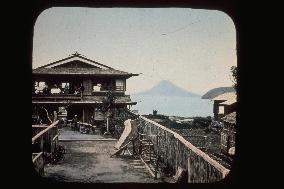
The Hafuya Shirozaemon of Odawara machi in Hakonejuku continued business in the Meiji Era as a Japanese-style hotel. The photo was taken at that time. Palanquins and guests of the hotel can be seen. The Fujiya Hotel bought it later and it became the present Hakone Hotel. Ashino Lake and Mt. Fuji can also be seen.==Date:unknown, Place:Hakone, Photo:unknown, (Credit:Nagasaki University Library/Kyodo News Images) [Cabinet Number31‐66‐0]

  •  
NIKKO IROHA SLOPE

NIKKO IROHA SLOPE

A palanquin and rickshaw climb the zigzag slope of the Chuzenjido. The new road was completed after 1887, and after that rickshaws could take this route. It was a difficult route for palanquins until then.==Date:unknown, Place:Nikko, Photo:unknown, (Credit:Nagasaki University Library/Kyodo News Images) [Cabinet Number31‐37‐0]

  •  
A distant view of Mt. Fuji

A distant view of Mt. Fuji

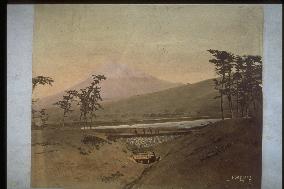
The location is unknown, but Mt. Fuji can be seen in the front. A river flows in the middle of the photo, and people on palanquins along the road by the river and men taking the lead holding umbrellas are clearly seen. What is grown in the depression in the fore cannot be seen.==Date:unknown, Place:unknown, Photo:unknown, (Credit:Nagasaki University Library/Kyodo News Images) [Cabinet Number26‐32‐0]

  •  
Miyanoshita Spa

Miyanoshita Spa

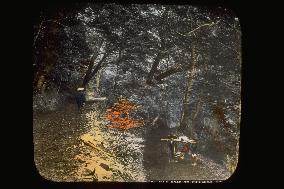
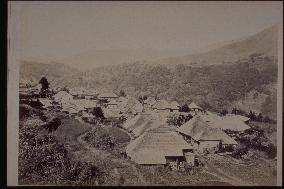
A view of Miyanoshita Hot Springs in the autumn of 1872. In the right background is the Japanese-style Naraya Hotel, where many foreigners stayed there from the early days. There were still no wide roads where rickshaws could pass, so travelers had to rely on palanquins. The mountain to the right is Myojodake.==Date:unknown, Place:Hakone, Photo:unknown, (Credit:Nagasaki University Library/Kyodo News Images) [Cabinet Number19‐37‐0]

  •  
Travellers in kago,a palanquin

Travellers in kago,a palanquin

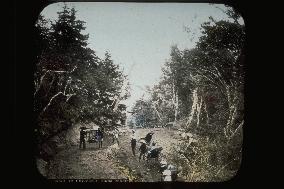
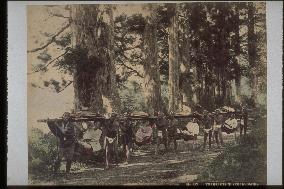
The palanquin seen in this photo is a simple one called yamakago . The cedar trees in the background are probably those of Nikko or Hakone. The procession of palanquins is not on the road, creating an unnatural atmosphere. This was probably a dramatization for the photo.==Date:unknown, Place:unknown, Photo:unknown, (Credit:Nagasaki University Library/Kyodo News Images) [Cabinet Number18‐16‐0]

  •  
Palanquin and woman

Palanquin and woman

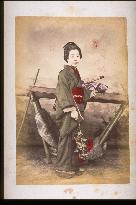
There were many types of palanquins, from the norimono with decorations on all four sides to the simple one for commoners without an enclosure. The Edo Shogunate designated the rank of people who could ride Norimono . The palanquin in the picture is the simplest form called Yamakago .==Date:unknown, Place:unknown, Photo:unknown, (Credit:Nagasaki University Library/Kyodo News Images) [Cabinet Number16‐20‐0]

  •  
A woman in a basket palanquin

A woman in a basket palanquin

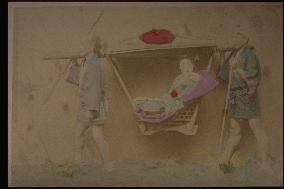
Bearers of carriages were called rokushaku and were distinguished from palanquin bearers. At lodging towns on main routes, kumosuke, or palanquin bearers, demanded money other than tips. The usual palanquin ran one Japanese mile in an hour, but the quick palanquins ran the distance between Edo and Kyoto in four days and a half.==Date:unknown, Place:unknown, Photo:unknown, (Credit:Nagasaki University Library/Kyodo News Images) [Cabinet Number15‐1‐0]

  •  
Byobu torii gate at the approach to hakone shrine

Byobu torii gate at the approach to hakone shrine

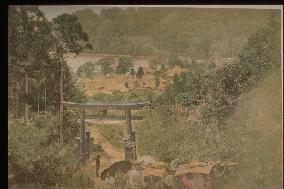
This torii does not stand at present, only a monument next to a petrol station. But it was probably famous during the Meiji era, and many photos remain of this scene. A procession of mountain palanquins and umbrellas is seen, some of the people looking like soldiers. It is scenic spot with a view of Ashino Lake.==Date:unknown, Place:Hakone, Photo:unknown, (Credit:Nagasaki University Library/Kyodo News Images) [Cabinet Number14‐7‐0]

  •  
CHUZENJI road

CHUZENJI road

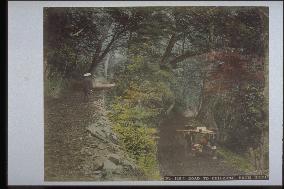
A palanquin and traveler standing on the winding Chuzenji Road. The new winding road was constructed after 1887, and not only palanquins but also rickshaws were able to climb the path. Until then, it was a difficult road for mountain palanquins.==Date:unknown, Place:Nikko, Photo:Tamamura Kozaburo, (Credit:Nagasaki University Library/Kyodo News Images) [Cabinet Number11‐18‐0]

  •  
Travelling in kago,palanquins along hakone highway

Travelling in kago,palanquins along hakone highway

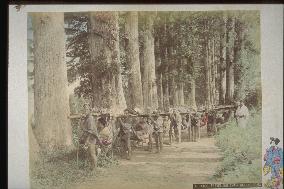
A procession of yamakago (mountain palanquins) and kumosuke (palanquin bearers) along the cedar path in Motohakone. This photo has been copied many times and is famous as the work of Kumosuke, but from the number of the negative in the first photo, this is believed to be by Kusakabe Kinbei. The pose suggests that the procession was arranged to make a souvenir photo.==Date:unknown, Place:Hakone, Photo:Ogawa Kazumasa, (Credit:Nagasaki University Library/Kyodo News Images) [Cabinet Number5‐35‐0]

  •  
Palanquins at owakudani valley

Palanquins at owakudani valley

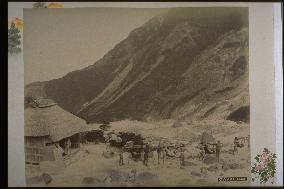
A tea house and procession of passengers in palanguins. Owakudani was toured on foot, or in palanguins or chairs (for foreigners). From the title on the negative, we can see that this photo was taken by Shima Shukichi who owned a photo studio in Miyanoshita. The mountain on the opposite side is Kanmuridake.==Date:unknown, Place:Hakone, Photo:Ogawa Kazumasa, (Credit:Nagasaki University Library/Kyodo News Images) [Cabinet Number5‐14‐0]

  •  
Osaka commerce god festival

Osaka commerce god festival

Colorful palanquins are paraded through the streets in downtown Osaka on Jan. 10, 2019, the main day of the annual "Toka Ebisu" festival, during which people pray to Ebisu, the patron deity of commerce, for business success. (Kyodo) ==Kyodo

  •  
Osaka commerce god festival

Osaka commerce god festival

Colorful palanquins are paraded through the streets in downtown Osaka on Jan. 10, 2019, the main day of the annual "Toka Ebisu" festival, during which people pray to Ebisu, the patron deity of commerce, for business success. (Kyodo) ==Kyodo

  •  
Osaka commerce god festival

Osaka commerce god festival

Colorful palanquins are paraded through the streets in downtown Osaka on Jan. 10, 2019, the main day of the annual "Toka Ebisu" festival, during which people pray to Ebisu, the patron deity of commerce, for business success. (Kyodo) ==Kyodo

  •  
Osaka commerce god festival

Osaka commerce god festival

Colorful palanquins are paraded through the streets in downtown Osaka on Jan. 10, 2019, the main day of the annual "Toka Ebisu" festival, during which people pray to Ebisu, the patron deity of commerce, for business success. (Kyodo) ==Kyodo

  • Main
  • Top
  • Editorial
  • Creative
  • About Us
  • About ILG
  • Terms of use
  • Company
  • BEHIND
  • Price List
  • Single Plan
  • Monthly Plan
  • Services
  • Shooting
  • Rights Clearance
  • Support
  • FAQ
  • How To Buy
  • Contact Us
  • Become a Partner

© KYODO NEWS IMAGES INC

All Rights Reserved.

  • Editorial
  • Olympics
  • News
  • Sports
  • Japan
  • Tech
  • Royal
  • Disaster
  • NorthKorea
  • Old Japan
  • SNS
  • Creative
  • Food
  • Japan
  • Landscape
  • Animal
  • Popular
  • #Ukraine
  • #China
  • #coronavirus
  • #N. Korea
  • #Thailand
  • #Russia
  • #Ukraine
  • #China
  • #coronavirus
  • #N. Korea
  • #Thailand
  • #Russia
  • Food
  • Japan
  • Landscape
  • Animal
  • Olympics
  • News
  • Sports
  • Japan
  • Tech
  • Royal
  • Disaster
  • NorthKorea
  • Old Japan
  • SNS