•  

China: Stunning Bioluminescent Glow Lights Up Eastern Weihai Beach

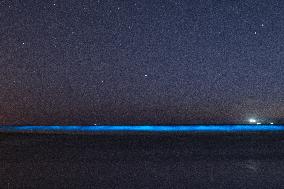
On June 4, 2025, at Jin Hai Beach in Weihai, Shandong, eastern China, glowing blue bioluminescent “blue tears” appeared as a net was dragged through the sea. The sapphire-like light, caused by marine plankton, captivated viewers, though netizens warned against touching it to protect the ecosystem.

  •  
Bioluminescent Plankton Light Up The Galicia Coast - Spain

Bioluminescent Plankton Light Up The Galicia Coast - Spain

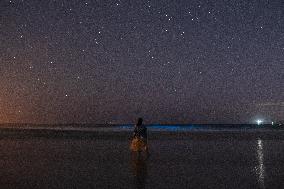
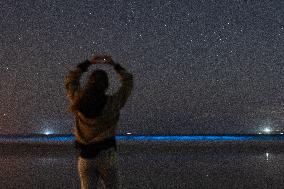
A person in the Sea of Ardora on the beach of Carnota, on August 7, 2024, in Carnota, A Coruña, Galicia, Spain. The Sea of Ardora is a natural phenomenon in which the sea water glows with a bluish hue in the darkness of the night. This spectacle is due to bioluminescent microorganisms, specifically the dinoflagellate Noctiluca Scintillans and other species of microalgae, where the organisms emit light as a result of internal chemical reactions, creating the characteristic luminous effect in the water. When there is a high density of microalgae and the water is agitated, this reaction that generates the blue glow occurs, a reaction similar to that which occurs in terrestrial fireflies. Photo by Elena Fernandez/Europa Press/ABACAPRESS.COM

  •  
Bioluminescent Plankton Light Up The Galicia Coast - Spain

Bioluminescent Plankton Light Up The Galicia Coast - Spain

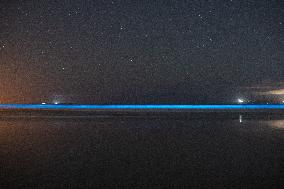
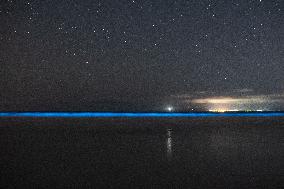
View of the Sea of Ardora on the beach of Carnota, on August 7, 2024, in Carnota, A Coruña, Galicia, Spain. The Sea of Ardora is a natural phenomenon in which the sea water glows with a bluish hue in the darkness of the night. This spectacle is due to bioluminescent microorganisms, specifically the dinoflagellate Noctiluca Scintillans and other species of microalgae, where the organisms emit light as a result of internal chemical reactions, creating the characteristic luminous effect in the water. When there is a high density of microalgae and the water is agitated, this reaction that generates the blue glow occurs, a reaction similar to that which occurs in terrestrial fireflies. Photo by Elena Fernandez/Europa Press/ABACAPRESS.COM

  •  
Bioluminescent Plankton Light Up The Galicia Coast - Spain

Bioluminescent Plankton Light Up The Galicia Coast - Spain

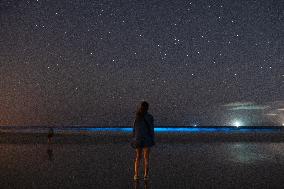
A person in the Sea of Ardora on the beach of Carnota, on August 7, 2024, in Carnota, A Coruña, Galicia, Spain. The Sea of Ardora is a natural phenomenon in which the sea water glows with a bluish hue in the darkness of the night. This spectacle is due to bioluminescent microorganisms, specifically the dinoflagellate Noctiluca Scintillans and other species of microalgae, where the organisms emit light as a result of internal chemical reactions, creating the characteristic luminous effect in the water. When there is a high density of microalgae and the water is agitated, this reaction that generates the blue glow occurs, a reaction similar to that which occurs in terrestrial fireflies. Photo by Elena Fernandez/Europa Press/ABACAPRESS.COM

  •  
Bioluminescent Plankton Light Up The Galicia Coast - Spain

Bioluminescent Plankton Light Up The Galicia Coast - Spain

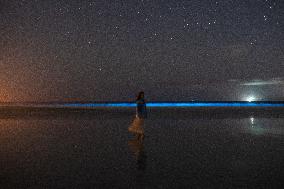
A person in the Sea of Ardora on the beach of Carnota, on August 7, 2024, in Carnota, A Coruña, Galicia, Spain. The Sea of Ardora is a natural phenomenon in which the sea water glows with a bluish hue in the darkness of the night. This spectacle is due to bioluminescent microorganisms, specifically the dinoflagellate Noctiluca Scintillans and other species of microalgae, where the organisms emit light as a result of internal chemical reactions, creating the characteristic luminous effect in the water. When there is a high density of microalgae and the water is agitated, this reaction that generates the blue glow occurs, a reaction similar to that which occurs in terrestrial fireflies. Photo by Elena Fernandez/Europa Press/ABACAPRESS.COM

  •  
Bioluminescent Plankton Light Up The Galicia Coast - Spain

Bioluminescent Plankton Light Up The Galicia Coast - Spain

View of the Sea of Ardora on the beach of Carnota, on August 7, 2024, in Carnota, A Coruña, Galicia, Spain. The Sea of Ardora is a natural phenomenon in which the sea water glows with a bluish hue in the darkness of the night. This spectacle is due to bioluminescent microorganisms, specifically the dinoflagellate Noctiluca Scintillans and other species of microalgae, where the organisms emit light as a result of internal chemical reactions, creating the characteristic luminous effect in the water. When there is a high density of microalgae and the water is agitated, this reaction that generates the blue glow occurs, a reaction similar to that which occurs in terrestrial fireflies. Photo by Elena Fernandez/Europa Press/ABACAPRESS.COM Photo by Elena Fernandez/Europa Press/ABACAPRESS.COM

  •  
Bioluminescent Plankton Light Up The Galicia Coast - Spain

Bioluminescent Plankton Light Up The Galicia Coast - Spain

View of the Sea of Ardora on the beach of Carnota, on August 7, 2024, in Carnota, A Coruña, Galicia, Spain. The Sea of Ardora is a natural phenomenon in which the sea water glows with a bluish hue in the darkness of the night. This spectacle is due to bioluminescent microorganisms, specifically the dinoflagellate Noctiluca Scintillans and other species of microalgae, where the organisms emit light as a result of internal chemical reactions, creating the characteristic luminous effect in the water. When there is a high density of microalgae and the water is agitated, this reaction that generates the blue glow occurs, a reaction similar to that which occurs in terrestrial fireflies. Photo by Elena Fernandez/Europa Press/ABACAPRESS.COM

  •  
Bioluminescent Plankton Light Up The Galicia Coast - Spain

Bioluminescent Plankton Light Up The Galicia Coast - Spain

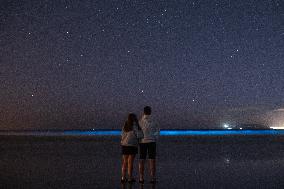
A couple in the Sea of Ardora on the beach of Carnota, on August 7, 2024, in Carnota, A Coruña, Galicia, Spain. The Sea of Ardora is a natural phenomenon in which the sea water glows with a bluish hue in the darkness of the night. This spectacle is due to bioluminescent microorganisms, specifically the dinoflagellate Noctiluca Scintillans and other species of microalgae, where the organisms emit light as a result of internal chemical reactions, creating the characteristic luminous effect in the water. When there is a high density of microalgae and the water is agitated, this reaction that generates the blue glow occurs, a reaction similar to that which occurs in terrestrial fireflies. Photo by Elena Fernandez/Europa Press/ABACAPRESS.COM

  •  
Bioluminescent Plankton Light Up The Galicia Coast - Spain

Bioluminescent Plankton Light Up The Galicia Coast - Spain

A person in the Sea of Ardora on the beach of Carnota, on August 7, 2024, in Carnota, A Coruña, Galicia, Spain. The Sea of Ardora is a natural phenomenon in which the sea water glows with a bluish hue in the darkness of the night. This spectacle is due to bioluminescent microorganisms, specifically the dinoflagellate Noctiluca Scintillans and other species of microalgae, where the organisms emit light as a result of internal chemical reactions, creating the characteristic luminous effect in the water. When there is a high density of microalgae and the water is agitated, this reaction that generates the blue glow occurs, a reaction similar to that which occurs in terrestrial fireflies. Photo by Elena Fernandez/Europa Press/ABACAPRESS.COM

  •  

Stunning "tears of the ocean" glowing at night

STORY: Stunning "tears of the ocean" glowing at night DATELINE: March 22, 2023 LENGTH: 00:00:15 LOCATION: PINGTAN, China CATEGORY: ENVIRONMENT SHOTLIST: 1. various of "blue tears" in Pingtan City, east China's Fujian Province STORYLINE: A surreal phosphorescent world of Avatar is seen in a sea in Dongmei Village in Pingtan, east China's Fujian Province. Dubbed as "tears of the ocean," the glowing wave is caused by bioluminescent plankton. Xinhua News Agency correspondents reporting from Pingtan, China. (XHTV)

  •  

Climate change indicated by carbon-reducing marine plankton: Spanish science study

STORY: Climate change indicated by carbon-reducing marine plankton: Spanish science study DATELINE: March 16, 2023 LENGTH: 00:01:39 LOCATION: Madrid CATEGORY: SCIENCE SHOTLIST: 1. various of Autonomous University of Barcelona's Institute of Environmental Science and Technology (ICTA-UAB) 2. various of ocean 3. various of studies on the carbon-reducing marine plankton in the sea and laboratory 4. various of the Port of Barcelona STORYLINE: A recent study at the Autonomous University of Barcelona's Institute of Environmental Science and Technology (ICTA-UAB) shows that climate change might be indicated by carbon-reducing marine plankton. The ICTA-UAB study published in the scientific journal, the Nature Communications, reveals that the exchange of carbon between the atmosphere and ocean is highly modulated by a unique group of photosynthesizing plankton called coccolithophores. Data from the study shows that coccolithophores, tiny algae less than a hundredth of a millimeter, account for 90% of the carbonat

  •  

Luminous "blue tears" light up waters on east China beach

STORY: Luminous "blue tears" light up waters on east China beach DATELINE: March 28, 2022 LENGTH: 00:00:34 LOCATION: FUZHOU, China CATEGORY: ENVIRONMENT SHOTLIST: 1. various of "blue tears" in Pingtan City, east China's Fujian Province STORYLINE: An ethereal blue glow lit up the beach near Dongmei Village in Pingtan, east China's Fujian province. The "blue tears" phenomenon is caused by luminous plankton called "Noctiluca scintillans," or sea sparkles. They are single-celled organisms found in coastal waters all over the world, especially on China's shores. They can create dazzling blue light at night when disturbed by swimmers, waves or passing boats. Xinhua News Agency correspondents reporting from Fuzhou, China. (XHTV)

  • Main
  • Top
  • Editorial
  • Creative
  • About Us
  • About ILG
  • Terms of use
  • Company
  • BEHIND
  • Price List
  • Single Plan
  • Monthly Plan
  • Services
  • Shooting
  • Rights Clearance
  • Support
  • FAQ
  • How To Buy
  • Contact Us
  • Become a Partner

© KYODO NEWS IMAGES INC

All Rights Reserved.

  • Editorial
  • Olympics
  • News
  • Sports
  • Japan
  • Tech
  • Royal
  • Disaster
  • NorthKorea
  • Old Japan
  • SNS
  • Creative
  • Food
  • Japan
  • Landscape
  • Animal
  • Popular
  • #Ukraine
  • #Russia
  • #coronavirus
  • #N. Korea
  • #China
  • #Thailand
  • #Ukraine
  • #Russia
  • #coronavirus
  • #N. Korea
  • #China
  • #Thailand
  • Food
  • Japan
  • Landscape
  • Animal
  • Olympics
  • News
  • Sports
  • Japan
  • Tech
  • Royal
  • Disaster
  • NorthKorea
  • Old Japan
  • SNS