•  
Tourist in Desert

Tourist in Desert

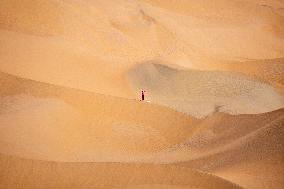
BAZHOU, CHINA - OCTOBER 5, 2025 - A tourist was cheering on the Qiemo section of the Weihe Desert Highway in Bazhou, Xinjiang Uygur Autonomous Region, China, on October 5, 2025

  •  
Tourist in Desert

Tourist in Desert

A tourist was cheering on the Qiemo section of the Weihe Desert Highway in Bazhou, Xinjiang Uygur Autonomous Region, China, on October 5, 2025

  •  
China Completes 750-kV Power Transmission Loop

China Completes 750-kV Power Transmission Loop

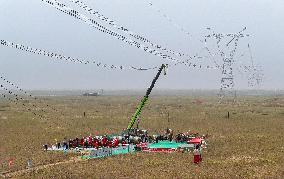
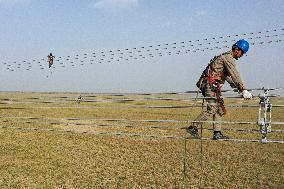
- Technicians install conductors for a 750-kilovolt (kV) power transmission line linking Minfeng and Qiemo in northwest China's Xinjiang Uygur Autonomous Region, July 11, 2025. China has finished construction of a 4,197-km extra-high voltage power transmission loop around the Tarim Basin, home to the country's largest desert, marking a major infrastructure milestone in southern Xinjiang Uygur Autonomous Region. The final section of the 750-kilovolt (kV) loop, now the country's largest of its kind, was connected on Sunday, capping a 15-year project involving nine substations and nearly 10,000 steel towers, according to a subsidiary of State Grid Xinjiang Electric Power Co., Ltd., which constructed the project. Photo by Zhang Limin/Xinhua/ABACAPRESS.COM

  •  
China Completes 750-kV Power Transmission Loop

China Completes 750-kV Power Transmission Loop

- Technicians work on a 750-kilovolt (kV) power transmission line linking Minfeng and Qiemo in northwest China's Xinjiang Uygur Autonomous Region, July 12, 2025. China has finished construction of a 4,197-km extra-high voltage power transmission loop around the Tarim Basin, home to the country's largest desert, marking a major infrastructure milestone in southern Xinjiang Uygur Autonomous Region. The final section of the 750-kilovolt (kV) loop, now the country's largest of its kind, was connected on Sunday, capping a 15-year project involving nine substations and nearly 10,000 steel towers, according to a subsidiary of State Grid Xinjiang Electric Power Co., Ltd., which constructed the project. Photo by Zhang Limin/Xinhua/ABACAPRESS.COM

  •  
China Completes 750-kV Power Transmission Loop

China Completes 750-kV Power Transmission Loop

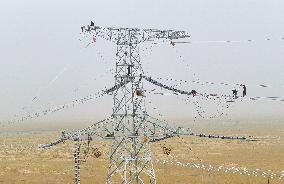
- A drone photo taken on April 28, 2025 shows a technician working on a 750-kilovolt (kV) power transmission line linking Qiemo and Ruoqiang in northwest China's Xinjiang Uygur Autonomous Region. China has finished construction of a 4,197-km extra-high voltage power transmission loop around the Tarim Basin, home to the country's largest desert, marking a major infrastructure milestone in southern Xinjiang Uygur Autonomous Region. The final section of the 750-kilovolt (kV) loop, now the country's largest of its kind, was connected on Sunday, capping a 15-year project involving nine substations and nearly 10,000 steel towers, according to a subsidiary of State Grid Xinjiang Electric Power Co., Ltd., which constructed the project. Photo by Ma Yuan/Xinhua/ABACAPRESS.COM

  •  
China Completes 750-kV Power Transmission Loop

China Completes 750-kV Power Transmission Loop

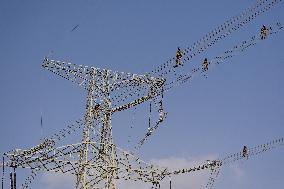
- Technicians work on a 750-kilovolt (kV) power transmission line linking Qiemo and Ruoqiang in northwest China's Xinjiang Uygur Autonomous Region, June 24, 2025. China has finished construction of a 4,197-km extra-high voltage power transmission loop around the Tarim Basin, home to the country's largest desert, marking a major infrastructure milestone in southern Xinjiang Uygur Autonomous Region. The final section of the 750-kilovolt (kV) loop, now the country's largest of its kind, was connected on Sunday, capping a 15-year project involving nine substations and nearly 10,000 steel towers, according to a subsidiary of State Grid Xinjiang Electric Power Co., Ltd., which constructed the project. Photo by Xinhua/Ding Lei/ABACAPRESS.COM

  •  
China Completes 750-kV Power Transmission Loop

China Completes 750-kV Power Transmission Loop

- A drone photo taken on June 24, 2025 shows technicians working on a 750-kilovolt (kV) power transmission line linking Qiemo and Ruoqiang in northwest China's Xinjiang Uygur Autonomous Region. China has finished construction of a 4,197-km extra-high voltage power transmission loop around the Tarim Basin, home to the country's largest desert, marking a major infrastructure milestone in southern Xinjiang Uygur Autonomous Region. The final section of the 750-kilovolt (kV) loop, now the country's largest of its kind, was connected on Sunday, capping a 15-year project involving nine substations and nearly 10,000 steel towers, according to a subsidiary of State Grid Xinjiang Electric Power Co., Ltd., which constructed the project. Photo by Xinhua/Ding Lei/ABACAPRESS.COM

  •  
China Completes 750-kV Power Transmission Loop

China Completes 750-kV Power Transmission Loop

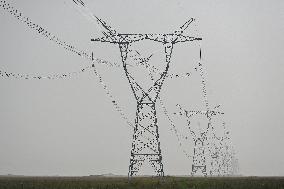
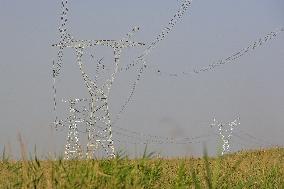
- This photo taken on June 24, 2025 shows a 750-kilovolt (kV) power transmission line linking Qiemo and Ruoqiang in northwest China's Xinjiang Uygur Autonomous Region. China has finished construction of a 4,197-km extra-high voltage power transmission loop around the Tarim Basin, home to the country's largest desert, marking a major infrastructure milestone in southern Xinjiang Uygur Autonomous Region. The final section of the 750-kilovolt (kV) loop, now the country's largest of its kind, was connected on Sunday, capping a 15-year project involving nine substations and nearly 10,000 steel towers, according to a subsidiary of State Grid Xinjiang Electric Power Co., Ltd., which constructed the project. Photo by Xinhua/Ding Lei/ABACAPRESS.COM

  •  
China Completes 750-kV Power Transmission Loop

China Completes 750-kV Power Transmission Loop

- Technicians work on a 750-kilovolt (kV) power transmission line linking Qiemo and Ruoqiang in northwest China's Xinjiang Uygur Autonomous Region, June 24, 2025. China has finished construction of a 4,197-km extra-high voltage power transmission loop around the Tarim Basin, home to the country's largest desert, marking a major infrastructure milestone in southern Xinjiang Uygur Autonomous Region. The final section of the 750-kilovolt (kV) loop, now the country's largest of its kind, was connected on Sunday, capping a 15-year project involving nine substations and nearly 10,000 steel towers, according to a subsidiary of State Grid Xinjiang Electric Power Co., Ltd., which constructed the project. Photo by Xinhua/Ding Lei/ABACAPRESS.COM

  •  
China Completes 750-kV Power Transmission Loop

China Completes 750-kV Power Transmission Loop

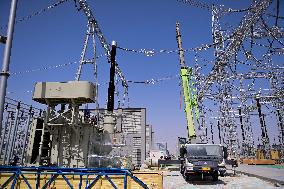
- This photo taken on June 25, 2025 shows the Qiemo 750-kilovolt substation of the 750-kilovolt transmission and transformation project around the Tarim Basin in northwest China's Xinjiang Uygur Autonomous Region. China has finished construction of a 4,197-km extra-high voltage power transmission loop around the Tarim Basin, home to the country's largest desert, marking a major infrastructure milestone in southern Xinjiang Uygur Autonomous Region. The final section of the 750-kilovolt (kV) loop, now the country's largest of its kind, was connected on Sunday, capping a 15-year project involving nine substations and nearly 10,000 steel towers, according to a subsidiary of State Grid Xinjiang Electric Power Co., Ltd., which constructed the project. Photo by Xinhua/Ding Lei/ABACAPRESS.COM

  •  
Taklimakan Desert Control Afforestation - China

Taklimakan Desert Control Afforestation - China

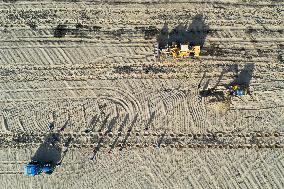
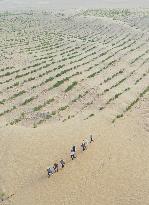
An aerial drone photo taken on April 9, 2025 shows staff members planting seedlings at a sand-control base in Qiemo County, the Mongolian Autonomous Prefecture of Bayingolin, northwest China's Xinjiang Uygur Autonomous Region. The Taklimakan Desert in northwest China's Xinjiang Uygur Autonomous Region covers 337,600 square kilometers and its circumference measures 3,046 kilometers, making it the largest desert in China and the second-largest drifting desert in the world. Thanks to decades-long sand prevention and control efforts, the Taklimakan Desert was completely encircled with a sand-blocking green belt on Nov. 28, 2024. In 2025, Xinjiang aims to afforest a land area of about 796,000 hectares, including 562,666 hectares for frontline control in the Taklimakan Desert. These afforestations form a part of the Three-North Shelterbelt Forest Program, the world's largest afforestation program, which tackles desertification in northwest, north and northeast China. Meanwhile, Xinjiang will further widen the sand-

  •  
Taklimakan Desert Control Afforestation - China

Taklimakan Desert Control Afforestation - China

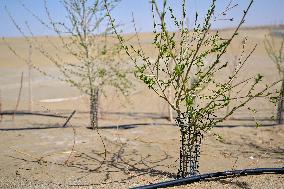
Protective nets are attached to seedlings to prevent animals from eating them at a sand-control base in Qiemo County, the Mongolian Autonomous Prefecture of Bayingolin, northwest China's Xinjiang Uygur Autonomous Region, April 9, 2025. The Taklimakan Desert in northwest China's Xinjiang Uygur Autonomous Region covers 337,600 square kilometers and its circumference measures 3,046 kilometers, making it the largest desert in China and the second-largest drifting desert in the world. Thanks to decades-long sand prevention and control efforts, the Taklimakan Desert was completely encircled with a sand-blocking green belt on Nov. 28, 2024. In 2025, Xinjiang aims to afforest a land area of about 796,000 hectares, including 562,666 hectares for frontline control in the Taklimakan Desert. These afforestations form a part of the Three-North Shelterbelt Forest Program, the world's largest afforestation program, which tackles desertification in northwest, north and northeast China. Meanwhile, Xinjiang will further widen

  •  
China Fortifies Green Great Wall To Contain Desert

China Fortifies Green Great Wall To Contain Desert

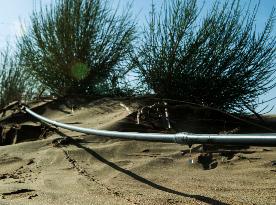
This photo shows sacsaoul tended by drip irrigation in Qiemo County, northwest China's Xinjiang Uygur Autonomous Region, Oct. 16, 2012. Photo by Jiang Wenyao/Xinhua/ABACAPRESS.COM

  •  
China Fortifies Green Great Wall To Contain Desert

China Fortifies Green Great Wall To Contain Desert

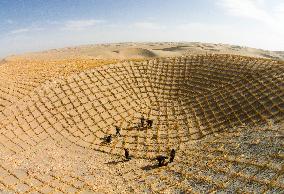
People fix straw checkerboards on sandy land in Qiemo County, northwest China's Xinjiang Uygur Autonomous Region, Oct. 6, 2014. Photo by Jiang Wenyao/Xinhua/ABACAPRESS.COM

  •  

Xinjiang, My home: Chasing dream with family love

STORY: Xinjiang, My home: Chasing dream with family love DATELINE: March 23, 2023 LENGTH: 0:02:02 LOCATION: URUMQI, China CATEGORY: SOCIETY SHOTLIST: 1 various of Hushnigar Hewer and her family STORYLINE: SOUNDBITE 1 (Chinese): HUSHNIGAR HEWER, Student in Xinjiang "Hello, I'm Hushnigar Hewer. I'm the team leader of the street dance group at Qiemo County No.2 Primary School in Xinjiang. I'm obsessed with dancing, hoping to dance on a big stage in the future. I think my families share the same personality, the endeavor to do what we like and try our best to do it well. This is my elder brother, who loves music since childhood. He's now a college student in Guangdong Province and has finally got the chance to attend a music group. What do you think about my video? I practiced the song for a long time. You look awesome! I'll show mum right now." SOUNDBITE 2 (Chinese): Hushnigar Hewer's mom "I have run the tailor shop for four years. I feel really happy as my clients love the clothes I made." SOUNDBITE 3 (Chi

  •  

Xinjiang, My home: Interior designer's passion for designing homes

STORY: Xinjiang, My home: Interior designer's passion for designing homes DATELINE: March 17, 2023 LENGTH: 00:02:10 LOCATION: URUMQI, China CATEGORY: SOCIETY SHOTLIST: 1. various of Kurban Rozi STORYLINE: Kurban Rozi, an interior designer, is passionate about designing homes for people in Qiemo County, China's Xinjiang. SOUNDBITE (Chinese): KURBAN ROZI, Interior designer from Xinjiang "Hi, I'm Kurban." "I'm from Tograk Township, Qiemo County, Bayingolin Mongolian Autonomous Prefecture." "This is my store selling interior decoration materials." "I sell and deliver materials while doing decoration design." "Now, I'm going to a client's home." "We're gonna make another cabinet and put it here." "Is it okay to make the sofa about 4 meters long?" "Okay." "Do you think this design is okay? Like this." "Ah, that's it?" "Yes." "Okay, let's do this." "This is the wardrobe in bedroom." "That's it. I want the white color." "Okay, this white color." "I have been doing interior decoration since 2013." "This is my clie

  •  
XINHUA-PICTURES OF THE YEAR 2022-CHINA NEWS

XINHUA-PICTURES OF THE YEAR 2022-CHINA NEWS

(230109) -- BEIJING, Jan. 9, 2023 (Xinhua) -- Veterans Zhang Xuanzhong (1st L), Tian Ye (2nd L) and others conduct a terran survey in the Taklimakan Desert in northwest China's Xinjiang Uygur Autonomous Region, July 3, 2022. Over four years, Tian Ye and seven fellow veterans have grown hundreds of hectares of wind-blocking and income-making plants in the Taklimakan Desert in northwest China's Xinjiang Uygur Autonomous Region. The veterans' efforts are part of a wider desert control campaign of Qiemo County. In nearly a decade, the county has recorded more than 150,000 people participating in its afforestation initiatives, resulting in a "green Great Wall" surrounding Qiemo. (Xinhua/Li Xiang)

  •  

6,000 common cranes spotted in China's Qiemo County for wintering

STORY: 6,000 common cranes spotted in China's Qiemo County for wintering DATELINE: Dec. 25, 2022 LENGTH: 00:00:42 LOCATION: URUMQI, China CATEGORY: SOCIETY SHOTLIST: 1. various of common cranes on Qarqan River STORYLINE: More than 6,000 common cranes have been spotted in Qiemo County in China's Xinjiang for wintering. Large flocks of the birds were first spotted in the region in early 2021. This winter, the number of common cranes in the county is three times that of last winter. SOUNDBITE (Chinese): CAI CIKE, Bureau of Natural Resources in Qiemo County in Xinjiang, China "Qiemo County has been pressing ahead with environmental protection, and water has been supplied to the downstream via the Dashimen water conservancy project. These have led to a notable improvement in the ecology in Qiemo, which provides a safe habitat for wild birds." The common crane is a second class nationally protected wildlife in China. Xinhua News Agency correspondents reporting from Urumqi, China. (XHTV)

  •  

600,000 more saxaul saplings planted in Xinjiang's desert county

STORY: 600,000 more saxaul saplings planted in Xinjiang's desert county DATELINE: Dec. 2, 2022 LENGTH: 00:01:21 LOCATION: QIEMO, China CATEGORY: ENVIRONMENT SHOTLIST: 1. various of desert in Qiemo County 2. various of people planting saxaul saplings 3. SOUNDBITE 1 (Chinese): PATIGUL YASIN, Staff at the desertification control station in Qiemo County, Xinjiang 4. various of desert in Qiemo County 5. SOUNDBITE 2 (Chinese):PATIGUL YASIN, Staff at the desertification control station in Qiemo County, Xinjiang STORYLINE: Qiemo County Xinjiang, China About 600,000 saxaul saplings have been planted in Qiemo County in the early winter. These wind-blocking plants are expected to become new "guardians" of the desert county. Qiemo is surrounded by the Taklimakan Desert on three sides. It carried out desertification prevention and control projects in 1998 and has been planting trees in the desert for 24 consecutive years. It takes longer to plant trees in autumn and winter than in spring. However, the newly plante

  •  
CHINA-XINJIANG-VETERANS-AFFORESTATION (CN)

CHINA-XINJIANG-VETERANS-AFFORESTATION (CN)

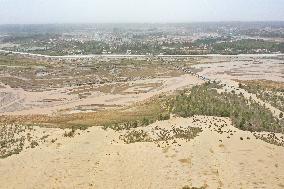
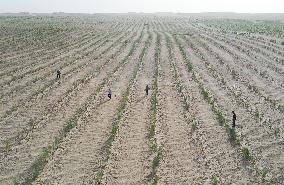
(221120) -- URUMQI, Nov. 20, 2022 (Xinhua) -- This aerial photo taken on June 26, 2022 shows a view of Qiemo, a desert county in northwest China's Xinjiang Uygur Autonomous Region. Over four years, Tian Ye and seven fellow veterans have grown hundreds of hectares of wind-blocking and income-making plants in the Taklimakan Desert in northwest China's Xinjiang Uygur Autonomous Region. Since 2018, Tian, together with his partners, has grown more than 10 varieties of desert plants in southern Xinjiang's Qiemo County, spanning more than 800 hectares. TO GO WITH "Wondrous Xinjiang: Veterans greening desert town in Xinjiang" (Xinhua/Li Xiang)

  •  
CHINA-XINJIANG-VETERANS-AFFORESTATION (CN)

CHINA-XINJIANG-VETERANS-AFFORESTATION (CN)

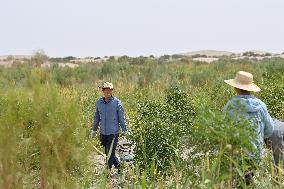
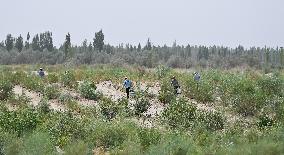
(221120) -- URUMQI, Nov. 20, 2022 (Xinhua) -- This aerial photo taken on July 5, 2022 shows veterans checking the condition of Haloxylon plants in Qiemo, a desert county in northwest China's Xinjiang Uygur Autonomous Region. Over four years, Tian Ye and seven fellow veterans have grown hundreds of hectares of wind-blocking and income-making plants in the Taklimakan Desert in northwest China's Xinjiang Uygur Autonomous Region. Since 2018, Tian, together with his partners, has grown more than 10 varieties of desert plants in southern Xinjiang's Qiemo County, spanning more than 800 hectares. TO GO WITH "Wondrous Xinjiang: Veterans greening desert town in Xinjiang" (Xinhua/Li Xiang)

  •  
CHINA-XINJIANG-VETERANS-AFFORESTATION (CN)

CHINA-XINJIANG-VETERANS-AFFORESTATION (CN)

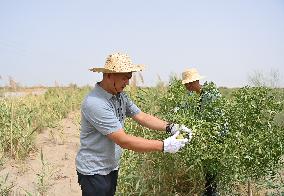
(221120) -- URUMQI, Nov. 20, 2022 (Xinhua) -- Veterans pick xanthoceras fruits in Qiemo, a desert county in northwest China's Xinjiang Uygur Autonomous Region, July 4, 2022. Over four years, Tian Ye and seven fellow veterans have grown hundreds of hectares of wind-blocking and income-making plants in the Taklimakan Desert in northwest China's Xinjiang Uygur Autonomous Region. Since 2018, Tian, together with his partners, has grown more than 10 varieties of desert plants in southern Xinjiang's Qiemo County, spanning more than 800 hectares. TO GO WITH "Wondrous Xinjiang: Veterans greening desert town in Xinjiang" (Xinhua/Li Xiang)

  •  
CHINA-XINJIANG-VETERANS-AFFORESTATION (CN)

CHINA-XINJIANG-VETERANS-AFFORESTATION (CN)

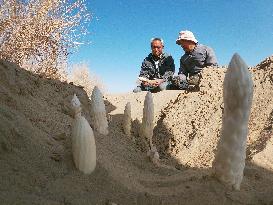
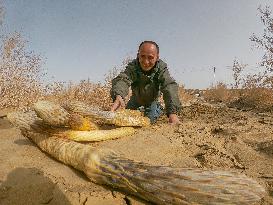
(221120) -- URUMQI, Nov. 20, 2022 (Xinhua) -- Veterans pick cistanche deserticola, a traditional Chinese herbal medicine, in Qiemo, a desert county in northwest China's Xinjiang Uygur Autonomous Region, Oct. 31, 2022. Over four years, Tian Ye and seven fellow veterans have grown hundreds of hectares of wind-blocking and income-making plants in the Taklimakan Desert in northwest China's Xinjiang Uygur Autonomous Region. Since 2018, Tian, together with his partners, has grown more than 10 varieties of desert plants in southern Xinjiang's Qiemo County, spanning more than 800 hectares. TO GO WITH "Wondrous Xinjiang: Veterans greening desert town in Xinjiang" (Photo by Su Xin/Xinhua)

  •  
CHINA-XINJIANG-VETERANS-AFFORESTATION (CN)

CHINA-XINJIANG-VETERANS-AFFORESTATION (CN)

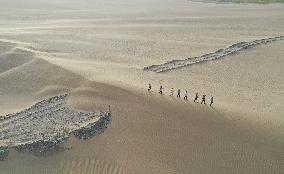
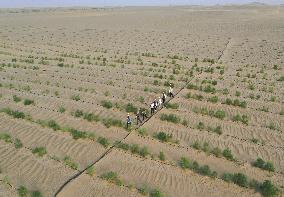
(221120) -- URUMQI, Nov. 20, 2022 (Xinhua) -- Veterans walk in the Taklimakan Desert in northwest China's Xinjiang Uygur Autonomous Region, July 3, 2022. Over four years, Tian Ye and seven fellow veterans have grown hundreds of hectares of wind-blocking and income-making plants in the Taklimakan Desert in northwest China's Xinjiang Uygur Autonomous Region. Since 2018, Tian, together with his partners, has grown more than 10 varieties of desert plants in southern Xinjiang's Qiemo County, spanning more than 800 hectares. TO GO WITH "Wondrous Xinjiang: Veterans greening desert town in Xinjiang" (Xinhua/Li Xiang)

  •  
CHINA-XINJIANG-VETERANS-AFFORESTATION (CN)

CHINA-XINJIANG-VETERANS-AFFORESTATION (CN)

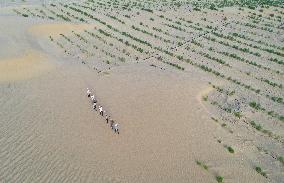
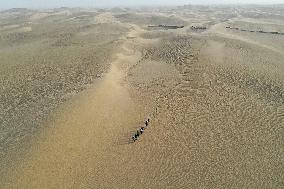
(221120) -- URUMQI, Nov. 20, 2022 (Xinhua) -- This aerial photo taken on July 5, 2022 shows veterans walking in the Taklimakan Desert in northwest China's Xinjiang Uygur Autonomous Region. Over four years, Tian Ye and seven fellow veterans have grown hundreds of hectares of wind-blocking and income-making plants in the Taklimakan Desert in northwest China's Xinjiang Uygur Autonomous Region. Since 2018, Tian, together with his partners, has grown more than 10 varieties of desert plants in southern Xinjiang's Qiemo County, spanning more than 800 hectares. TO GO WITH "Wondrous Xinjiang: Veterans greening desert town in Xinjiang" (Xinhua/Li Xiang)

  •  
CHINA-XINJIANG-VETERANS-AFFORESTATION (CN)

CHINA-XINJIANG-VETERANS-AFFORESTATION (CN)

(221120) -- URUMQI, Nov. 20, 2022 (Xinhua) -- Veterans pick xanthoceras fruits in Qiemo, a desert county in northwest China's Xinjiang Uygur Autonomous Region, July 4, 2022. Over four years, Tian Ye and seven fellow veterans have grown hundreds of hectares of wind-blocking and income-making plants in the Taklimakan Desert in northwest China's Xinjiang Uygur Autonomous Region. Since 2018, Tian, together with his partners, has grown more than 10 varieties of desert plants in southern Xinjiang's Qiemo County, spanning more than 800 hectares. TO GO WITH "Wondrous Xinjiang: Veterans greening desert town in Xinjiang" (Xinhua/Li Xiang)

  •  
CHINA-XINJIANG-VETERANS-AFFORESTATION (CN)

CHINA-XINJIANG-VETERANS-AFFORESTATION (CN)

(221120) -- URUMQI, Nov. 20, 2022 (Xinhua) -- Veteran Tian Ye picks cistanche deserticola, a traditional Chinese herbal medicine, in Qiemo, a desert county in northwest China's Xinjiang Uygur Autonomous Region, March 31, 2022. Over four years, Tian Ye and seven fellow veterans have grown hundreds of hectares of wind-blocking and income-making plants in the Taklimakan Desert in northwest China's Xinjiang Uygur Autonomous Region. Since 2018, Tian, together with his partners, has grown more than 10 varieties of desert plants in southern Xinjiang's Qiemo County, spanning more than 800 hectares. TO GO WITH "Wondrous Xinjiang: Veterans greening desert town in Xinjiang" (Photo by Su Xin/Xinhua)

  •  
CHINA-XINJIANG-VETERANS-AFFORESTATION (CN)

CHINA-XINJIANG-VETERANS-AFFORESTATION (CN)

(221120) -- URUMQI, Nov. 20, 2022 (Xinhua) -- This aerial photo taken on July 5, 2022 shows veterans checking the condition of Haloxylon plants in Qiemo, a desert county in northwest China's Xinjiang Uygur Autonomous Region. Over four years, Tian Ye and seven fellow veterans have grown hundreds of hectares of wind-blocking and income-making plants in the Taklimakan Desert in northwest China's Xinjiang Uygur Autonomous Region. Since 2018, Tian, together with his partners, has grown more than 10 varieties of desert plants in southern Xinjiang's Qiemo County, spanning more than 800 hectares. TO GO WITH "Wondrous Xinjiang: Veterans greening desert town in Xinjiang" (Xinhua/Li Xiang)

  •  
CHINA-XINJIANG-VETERANS-AFFORESTATION (CN)

CHINA-XINJIANG-VETERANS-AFFORESTATION (CN)

(221120) -- URUMQI, Nov. 20, 2022 (Xinhua) -- This aerial photo taken on July 4, 2022 shows veterans and local farmers checking the condition of Haloxylon plants in Qiemo, a desert county in northwest China's Xinjiang Uygur Autonomous Region. Over four years, Tian Ye and seven fellow veterans have grown hundreds of hectares of wind-blocking and income-making plants in the Taklimakan Desert in northwest China's Xinjiang Uygur Autonomous Region. Since 2018, Tian, together with his partners, has grown more than 10 varieties of desert plants in southern Xinjiang's Qiemo County, spanning more than 800 hectares. TO GO WITH "Wondrous Xinjiang: Veterans greening desert town in Xinjiang" (Xinhua/Li Xiang)

  •  
CHINA-XINJIANG-VETERANS-AFFORESTATION (CN)

CHINA-XINJIANG-VETERANS-AFFORESTATION (CN)

(221120) -- URUMQI, Nov. 20, 2022 (Xinhua) -- Veterans pick xanthoceras fruits in Qiemo, a desert county in northwest China's Xinjiang Uygur Autonomous Region, July 4, 2022. Over four years, Tian Ye and seven fellow veterans have grown hundreds of hectares of wind-blocking and income-making plants in the Taklimakan Desert in northwest China's Xinjiang Uygur Autonomous Region. Since 2018, Tian, together with his partners, has grown more than 10 varieties of desert plants in southern Xinjiang's Qiemo County, spanning more than 800 hectares. TO GO WITH "Wondrous Xinjiang: Veterans greening desert town in Xinjiang" (Xinhua/Li Xiang)

  •  
CHINA-XINJIANG-VETERANS-AFFORESTATION (CN)

CHINA-XINJIANG-VETERANS-AFFORESTATION (CN)

(221120) -- URUMQI, Nov. 20, 2022 (Xinhua) -- Veterans walk in the Taklimakan Desert in northwest China's Xinjiang Uygur Autonomous Region, July 3, 2022. Over four years, Tian Ye and seven fellow veterans have grown hundreds of hectares of wind-blocking and income-making plants in the Taklimakan Desert in northwest China's Xinjiang Uygur Autonomous Region. Since 2018, Tian, together with his partners, has grown more than 10 varieties of desert plants in southern Xinjiang's Qiemo County, spanning more than 800 hectares. TO GO WITH "Wondrous Xinjiang: Veterans greening desert town in Xinjiang" (Xinhua/Li Xiang)

  •  
CHINA-XINJIANG-VETERANS-AFFORESTATION (CN)

CHINA-XINJIANG-VETERANS-AFFORESTATION (CN)

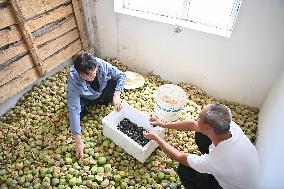
(221120) -- URUMQI, Nov. 20, 2022 (Xinhua) -- Veterans process xanthoceras fruits at a storage in Qiemo, a desert county in northwest China's Xinjiang Uygur Autonomous Region, July 4, 2022. Over four years, Tian Ye and seven fellow veterans have grown hundreds of hectares of wind-blocking and income-making plants in the Taklimakan Desert in northwest China's Xinjiang Uygur Autonomous Region. Since 2018, Tian, together with his partners, has grown more than 10 varieties of desert plants in southern Xinjiang's Qiemo County, spanning more than 800 hectares. TO GO WITH "Wondrous Xinjiang: Veterans greening desert town in Xinjiang" (Xinhua/Li Xiang)

  •  
CHINA-XINJIANG-VETERANS-AFFORESTATION (CN)

CHINA-XINJIANG-VETERANS-AFFORESTATION (CN)

(221120) -- URUMQI, Nov. 20, 2022 (Xinhua) -- This aerial photo taken on July 5, 2022 shows veterans walking in the Taklimakan Desert in northwest China's Xinjiang Uygur Autonomous Region. Over four years, Tian Ye and seven fellow veterans have grown hundreds of hectares of wind-blocking and income-making plants in the Taklimakan Desert in northwest China's Xinjiang Uygur Autonomous Region. Since 2018, Tian, together with his partners, has grown more than 10 varieties of desert plants in southern Xinjiang's Qiemo County, spanning more than 800 hectares. TO GO WITH "Wondrous Xinjiang: Veterans greening desert town in Xinjiang" (Xinhua/Li Xiang)

  •  
CHINA-XINJIANG-VETERANS-AFFORESTATION (CN)

CHINA-XINJIANG-VETERANS-AFFORESTATION (CN)

(221120) -- URUMQI, Nov. 20, 2022 (Xinhua) -- This aerial photo taken on July 5, 2022 shows veterans checking the irrigation pipes in Qiemo, a desert county in northwest China's Xinjiang Uygur Autonomous Region. Over four years, Tian Ye and seven fellow veterans have grown hundreds of hectares of wind-blocking and income-making plants in the Taklimakan Desert in northwest China's Xinjiang Uygur Autonomous Region. Since 2018, Tian, together with his partners, has grown more than 10 varieties of desert plants in southern Xinjiang's Qiemo County, spanning more than 800 hectares. TO GO WITH "Wondrous Xinjiang: Veterans greening desert town in Xinjiang" (Xinhua/Li Xiang)

  •  

GLOBALink | True Xinjiang through eyes of hardworking locals

STORY: True Xinjiang through eyes of hardworking locals DATELINE: July 14, 2022 LENGTH: 0:01:22 LOCATION: URUMQI, China CATEGORY: SOCIETY SHOTLIST: 1. SOUNDBITE 1 (Chinese): ARKEN TURSUN, Barbecue restaurant owner 2. SOUNDBITE 2 (Chinese): ARKEN TURSUN and his daughter 3. SOUNDBITE 3 (Chinese): RASHIDIN GHUPUR, Truck driver 4. SOUNDBITE 4 (Chinese): MAZIYA NIYAZ, Kindergarten teacher in Urumqi 5. SOUNDBITE 5 (Chinese): MAZIYA NIYAZ, Kindergarten teacher in Urumqi STORYLINE: What does the real Xinjiang look like? People of all ethnic groups living here are best positioned to answer this question. SOUNDBITE 1 (Chinese): ARKEN TURSUN, Barbecue restaurant owner "The mutton kebabs are ready. Hello, everyone. My name is Arken Tursun. I come from Yengiostang Township, Qiemo County. In 2014, I took over this barbecue restaurant from my dad." SOUNDBITE 2 (Chinese): ARKEN TURSUN and his daughter "The business at our barbecue restaurant is booming. Our daily lives are getting better and better. Babies, it's time fo

  •  
[GRAPHICS]CHINA-XINJIANG-DESERT-NEW HIGHWAY

[GRAPHICS]CHINA-XINJIANG-DESERT-NEW HIGHWAY

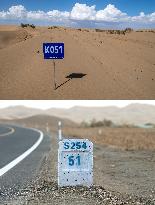
(220630) -- URUMQI, June 30, 2022 (Xinhua) -- A new highway traversing the Taklimakan Desert in China's northwestern Xinjiang Uygur Autonomous Region, was put into operation on Thursday. Located in south Xinjiang's Bayingolin Mongolian Autonomous Prefecture, the highway, connecting Yuli County and Qiemo County, is the third one across the Taklimakan Desert, the world's second-largest shifting-sand desert. With a designed speed of 60 or 80 km per hour for different sections, the highway has a total length of 334 km, with 307 km passing through the desert. So far, China has more than 1,200 km of highways across the Taklimakan Desert. (Xinhua/Ma Zegang)

  •  
[GRAPHICS]CHINA-XINJIANG-DESERT-NEW HIGHWAY

[GRAPHICS]CHINA-XINJIANG-DESERT-NEW HIGHWAY

(220630) -- URUMQI, June 30, 2022 (Xinhua) -- A new highway traversing the Taklimakan Desert in China's northwestern Xinjiang Uygur Autonomous Region, was put into operation on Thursday. Located in south Xinjiang's Bayingolin Mongolian Autonomous Prefecture, the highway, connecting Yuli County and Qiemo County, is the third one across the Taklimakan Desert, the world's second-largest shifting-sand desert. With a designed speed of 60 or 80 km per hour for different sections, the highway has a total length of 334 km, with 307 km passing through the desert. So far, China has more than 1,200 km of highways across the Taklimakan Desert. (Xinhua/Ma Zegang)

  •  
[GRAPHICS]CHINA-XINJIANG-DESERT-NEW HIGHWAY

[GRAPHICS]CHINA-XINJIANG-DESERT-NEW HIGHWAY

(220630) -- URUMQI, June 30, 2022 (Xinhua) -- A new highway traversing the Taklimakan Desert in China's northwestern Xinjiang Uygur Autonomous Region, was put into operation on Thursday. Located in south Xinjiang's Bayingolin Mongolian Autonomous Prefecture, the highway, connecting Yuli County and Qiemo County, is the third one across the Taklimakan Desert, the world's second-largest shifting-sand desert. With a designed speed of 60 or 80 km per hour for different sections, the highway has a total length of 334 km, with 307 km passing through the desert. So far, China has more than 1,200 km of highways across the Taklimakan Desert. (Xinhua/Ma Zegang)

  •  
[GRAPHICS]CHINA-XINJIANG-DESERT-NEW HIGHWAY

[GRAPHICS]CHINA-XINJIANG-DESERT-NEW HIGHWAY

(220630) -- URUMQI, June 30, 2022 (Xinhua) -- A new highway traversing the Taklimakan Desert in China's northwestern Xinjiang Uygur Autonomous Region, was put into operation on Thursday. Located in south Xinjiang's Bayingolin Mongolian Autonomous Prefecture, the highway, connecting Yuli County and Qiemo County, is the third one across the Taklimakan Desert, the world's second-largest shifting-sand desert. With a designed speed of 60 or 80 km per hour for different sections, the highway has a total length of 334 km, with 307 km passing through the desert. So far, China has more than 1,200 km of highways across the Taklimakan Desert. (Xinhua/Ma Zegang)

  •  
CHINA-XINJIANG-TAKLIMAKAN DESERT-NEW HIGHWAY (CN)

CHINA-XINJIANG-TAKLIMAKAN DESERT-NEW HIGHWAY (CN)

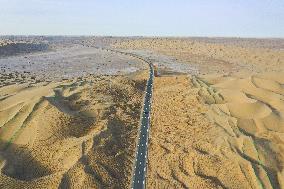
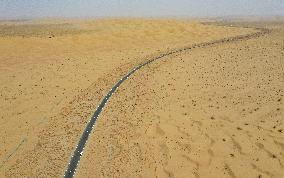
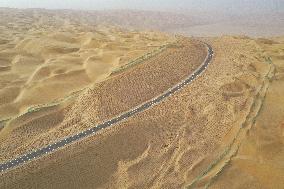
(220630) -- YULI, June 30, 2022 (Xinhua) -- Aerial photo shows a new highway traversing the Taklimakan Desert in northwest China's Xinjiang Uygur Autonomous Region, June 23, 2022. Located in south Xinjiang's Bayingolin Mongolian Autonomous Prefecture, the highway, connecting Yuli County and Qiemo County, was put into operation on Thursday. The highway is the third one across the Taklimakan Desert, the world's second-largest shifting-sand desert. With a designed speed of 60 or 80 km per hour for different sections, the highway has a total length of 334 km, with 307 km passing through the desert. So far, China has more than 1,200 km of highways across the Taklimakan Desert. The highway has been built with an estimated total investment of about 1.75 billion yuan (about 261.5 million U.S. dollars) and its construction started in October 2017. (Xinhua/Li Xiang)

  •  
CHINA-XINJIANG-TAKLIMAKAN DESERT-NEW HIGHWAY (CN)

CHINA-XINJIANG-TAKLIMAKAN DESERT-NEW HIGHWAY (CN)

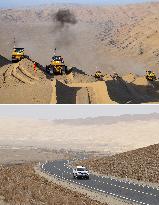
(220630) -- YULI, June 30, 2022 (Xinhua) -- Combo photo shows one section of a new highway traversing the Taklimakan Desert under construction on July 5, 2018 (top, photo taken by Hu Huhu) and the same section after construction on June 24, 2022 (photo taken by Li Xiang), in northwest China's Xinjiang Uygur Autonomous Region. Located in south Xinjiang's Bayingolin Mongolian Autonomous Prefecture, the highway, connecting Yuli County and Qiemo County, was put into operation on Thursday. The highway is the third one across the Taklimakan Desert, the world's second-largest shifting-sand desert. With a designed speed of 60 or 80 km per hour for different sections, the highway has a total length of 334 km, with 307 km passing through the desert. So far, China has more than 1,200 km of highways across the Taklimakan Desert. The highway has been built with an estimated total investment of about 1.75 billion yuan (about 261.5 million U.S. dollars) and its construction started in October 2017. (Xinhua/Li Xiang)

  •  
CHINA-XINJIANG-TAKLIMAKAN DESERT-NEW HIGHWAY (CN)

CHINA-XINJIANG-TAKLIMAKAN DESERT-NEW HIGHWAY (CN)

(220630) -- YULI, June 30, 2022 (Xinhua) -- Combo photo shows one section of a new highway traversing the Taklimakan Desert under construction on July 5, 2018 (top, photo taken by Hu Huhu) and the same section after construction on June 27, 2022 (photo taken by Gu Yu), in northwest China's Xinjiang Uygur Autonomous Region. Located in south Xinjiang's Bayingolin Mongolian Autonomous Prefecture, the highway, connecting Yuli County and Qiemo County, was put into operation on Thursday. The highway is the third one across the Taklimakan Desert, the world's second-largest shifting-sand desert. With a designed speed of 60 or 80 km per hour for different sections, the highway has a total length of 334 km, with 307 km passing through the desert. So far, China has more than 1,200 km of highways across the Taklimakan Desert. The highway has been built with an estimated total investment of about 1.75 billion yuan (about 261.5 million U.S. dollars) and its construction started in October 2017. (Xinhua)

  •  
CHINA-XINJIANG-TAKLIMAKAN DESERT-NEW HIGHWAY (CN)

CHINA-XINJIANG-TAKLIMAKAN DESERT-NEW HIGHWAY (CN)

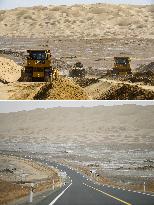
(220630) -- YULI, June 30, 2022 (Xinhua) -- Combo photo shows one section of a new highway traversing the Taklimakan Desert under construction on May 16, 2020 (top, photo taken by Hu Huhu) and the same section after construction on June 25, 2022 (photo taken by Li Xiang), in northwest China's Xinjiang Uygur Autonomous Region. Located in south Xinjiang's Bayingolin Mongolian Autonomous Prefecture, the highway, connecting Yuli County and Qiemo County, was put into operation on Thursday. The highway is the third one across the Taklimakan Desert, the world's second-largest shifting-sand desert. With a designed speed of 60 or 80 km per hour for different sections, the highway has a total length of 334 km, with 307 km passing through the desert. So far, China has more than 1,200 km of highways across the Taklimakan Desert. The highway has been built with an estimated total investment of about 1.75 billion yuan (about 261.5 million U.S. dollars) and its construction started in October 2017. (Xinhua)

  •  
CHINA-XINJIANG-TAKLIMAKAN DESERT-NEW HIGHWAY (CN)

CHINA-XINJIANG-TAKLIMAKAN DESERT-NEW HIGHWAY (CN)

(220630) -- YULI, June 30, 2022 (Xinhua) -- Aerial photo shows a new highway traversing the Taklimakan Desert in northwest China's Xinjiang Uygur Autonomous Region, June 25, 2022. Located in south Xinjiang's Bayingolin Mongolian Autonomous Prefecture, the highway, connecting Yuli County and Qiemo County, was put into operation on Thursday. The highway is the third one across the Taklimakan Desert, the world's second-largest shifting-sand desert. With a designed speed of 60 or 80 km per hour for different sections, the highway has a total length of 334 km, with 307 km passing through the desert. So far, China has more than 1,200 km of highways across the Taklimakan Desert. The highway has been built with an estimated total investment of about 1.75 billion yuan (about 261.5 million U.S. dollars) and its construction started in October 2017. (Xinhua/Li Xiang)

  •  
CHINA-XINJIANG-TAKLIMAKAN DESERT-NEW HIGHWAY (CN)

CHINA-XINJIANG-TAKLIMAKAN DESERT-NEW HIGHWAY (CN)

(220630) -- YULI, June 30, 2022 (Xinhua) -- The opening ceremony of a new highway traversing the Taklimakan Desert is held in northwest China's Xinjiang Uygur Autonomous Region, June 30, 2022. Located in south Xinjiang's Bayingolin Mongolian Autonomous Prefecture, the highway, connecting Yuli County and Qiemo County, was put into operation on Thursday. The highway is the third one across the Taklimakan Desert, the world's second-largest shifting-sand desert. With a designed speed of 60 or 80 km per hour for different sections, the highway has a total length of 334 km, with 307 km passing through the desert. So far, China has more than 1,200 km of highways across the Taklimakan Desert. The highway has been built with an estimated total investment of about 1.75 billion yuan (about 261.5 million U.S. dollars) and its construction started in October 2017. (Xinhua/Ma Zegang)

  •  
CHINA-XINJIANG-TAKLIMAKAN DESERT-NEW HIGHWAY (CN)

CHINA-XINJIANG-TAKLIMAKAN DESERT-NEW HIGHWAY (CN)

(220630) -- YULI, June 30, 2022 (Xinhua) -- Combo photo shows one section of a new highway traversing the Taklimakan Desert under construction on July 5, 2018 (top, photo taken by Hu Huhu) and the same section after construction on June 26, 2022 (photo taken by Li Xiang), in northwest China's Xinjiang Uygur Autonomous Region. Located in south Xinjiang's Bayingolin Mongolian Autonomous Prefecture, the highway, connecting Yuli County and Qiemo County, was put into operation on Thursday. The highway is the third one across the Taklimakan Desert, the world's second-largest shifting-sand desert. With a designed speed of 60 or 80 km per hour for different sections, the highway has a total length of 334 km, with 307 km passing through the desert. So far, China has more than 1,200 km of highways across the Taklimakan Desert. The highway has been built with an estimated total investment of about 1.75 billion yuan (about 261.5 million U.S. dollars) and its construction started in October 2017. (Xinhua)

  •  
CHINA-XINJIANG-TAKLIMAKAN DESERT-NEW HIGHWAY (CN)

CHINA-XINJIANG-TAKLIMAKAN DESERT-NEW HIGHWAY (CN)

(220630) -- YULI, June 30, 2022 (Xinhua) -- Aerial photo shows a new highway traversing the Taklimakan Desert in northwest China's Xinjiang Uygur Autonomous Region, June 26, 2022. Located in south Xinjiang's Bayingolin Mongolian Autonomous Prefecture, the highway, connecting Yuli County and Qiemo County, was put into operation on Thursday. The highway is the third one across the Taklimakan Desert, the world's second-largest shifting-sand desert. With a designed speed of 60 or 80 km per hour for different sections, the highway has a total length of 334 km, with 307 km passing through the desert. So far, China has more than 1,200 km of highways across the Taklimakan Desert. The highway has been built with an estimated total investment of about 1.75 billion yuan (about 261.5 million U.S. dollars) and its construction started in October 2017. (Xinhua/Li Xiang)

  •  
CHINA-XINJIANG-TAKLIMAKAN DESERT-NEW HIGHWAY (CN)

CHINA-XINJIANG-TAKLIMAKAN DESERT-NEW HIGHWAY (CN)

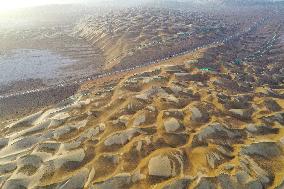
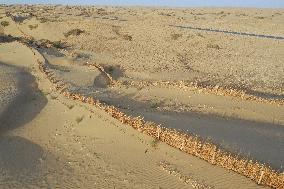
(220630) -- YULI, June 30, 2022 (Xinhua) -- Aerial photo shows sand barriers along a new highway traversing the Taklimakan Desert in northwest China's Xinjiang Uygur Autonomous Region, June 27, 2022. Located in south Xinjiang's Bayingolin Mongolian Autonomous Prefecture, the highway, connecting Yuli County and Qiemo County, was put into operation on Thursday. The highway is the third one across the Taklimakan Desert, the world's second-largest shifting-sand desert. With a designed speed of 60 or 80 km per hour for different sections, the highway has a total length of 334 km, with 307 km passing through the desert. So far, China has more than 1,200 km of highways across the Taklimakan Desert. The highway has been built with an estimated total investment of about 1.75 billion yuan (about 261.5 million U.S. dollars) and its construction started in October 2017. (Xinhua/Gu Yu)

  •  
CHINA-XINJIANG-TAKLIMAKAN DESERT-NEW HIGHWAY (CN)

CHINA-XINJIANG-TAKLIMAKAN DESERT-NEW HIGHWAY (CN)

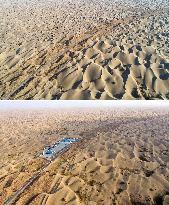
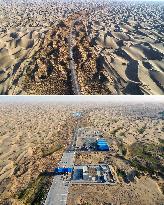
(220630) -- YULI, June 30, 2022 (Xinhua) -- Combo photo shows a construction site of a new highway traversing the Taklimakan Desert on July 5, 2018 (top, photo taken by Hu Huhu) and the same site where a toll station and service area have been set up on June 27, 2022 (photo taken by Su Chuanyi), in northwest China's Xinjiang Uygur Autonomous Region. Located in south Xinjiang's Bayingolin Mongolian Autonomous Prefecture, the highway, connecting Yuli County and Qiemo County, was put into operation on Thursday. The highway is the third one across the Taklimakan Desert, the world's second-largest shifting-sand desert. With a designed speed of 60 or 80 km per hour for different sections, the highway has a total length of 334 km, with 307 km passing through the desert. So far, China has more than 1,200 km of highways across the Taklimakan Desert. The highway has been built with an estimated total investment of about 1.75 billion yuan (about 261.5 million U.S. dollars) and its construction started in October 2

  •  
CHINA-XINJIANG-TAKLIMAKAN DESERT-NEW HIGHWAY (CN)

CHINA-XINJIANG-TAKLIMAKAN DESERT-NEW HIGHWAY (CN)

(220630) -- YULI, June 30, 2022 (Xinhua) -- Aerial photo shows a new highway traversing the Taklimakan Desert in northwest China's Xinjiang Uygur Autonomous Region, June 26, 2022. Located in south Xinjiang's Bayingolin Mongolian Autonomous Prefecture, the highway, connecting Yuli County and Qiemo County, was put into operation on Thursday. The highway is the third one across the Taklimakan Desert, the world's second-largest shifting-sand desert. With a designed speed of 60 or 80 km per hour for different sections, the highway has a total length of 334 km, with 307 km passing through the desert. So far, China has more than 1,200 km of highways across the Taklimakan Desert. The highway has been built with an estimated total investment of about 1.75 billion yuan (about 261.5 million U.S. dollars) and its construction started in October 2017. (Xinhua/Li Xiang)

  • Main
  • Top
  • Editorial
  • Creative
  • About Us
  • About ILG
  • Terms of use
  • Company
  • BEHIND
  • Price List
  • Single Plan
  • Monthly Plan
  • Services
  • Shooting
  • Rights Clearance
  • Support
  • FAQ
  • How To Buy
  • Contact Us
  • Become a Partner

© KYODO NEWS IMAGES INC

All Rights Reserved.

  • Editorial
  • Olympics
  • News
  • Sports
  • Japan
  • Tech
  • Royal
  • Disaster
  • NorthKorea
  • Old Japan
  • SNS
  • Creative
  • Food
  • Japan
  • Landscape
  • Animal
  • Popular
  • #Ukraine
  • #Thailand
  • #coronavirus
  • #N. Korea
  • #Russia
  • #China
  • #Ukraine
  • #Thailand
  • #coronavirus
  • #N. Korea
  • #Russia
  • #China
  • Food
  • Japan
  • Landscape
  • Animal
  • Olympics
  • News
  • Sports
  • Japan
  • Tech
  • Royal
  • Disaster
  • NorthKorea
  • Old Japan
  • SNS