•  
Plastic Pellets Polluting Spanish Beaches After Container Ship Spill

Plastic Pellets Polluting Spanish Beaches After Container Ship Spill

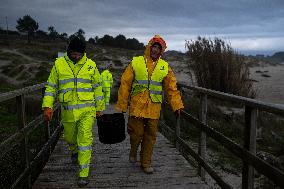
Two men carry a bucket full of pellets on the beach Do Dique, January 13, 2024, in Queiruga, A Coruña, Galicia (Spain). Already known as the "white tide", it is expected to come from the six containers from the ship Toconao that fell into the sea in Portuguese waters. At least one of the six containers, weighing around 20 tons, is believed to contain between 800 and 1,000 25-kilogram sacks of pellets. Pellets are small plastic balls of less than five millimeters that are used to manufacture plastic products. Because of their small size and light weight, it is "almost impossible to clean them up" once they are scattered on the beaches. Photo by Elena Fernández / Europa Press/ABACAPRESS.COM

  •  
Plastic Pellets Polluting Spanish Beaches After Container Ship Spill

Plastic Pellets Polluting Spanish Beaches After Container Ship Spill

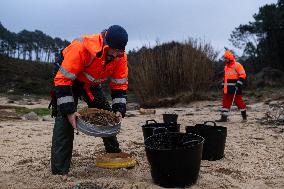
A man pours pellets into a bucket on the beach Do Dique, January 13, 2024, in Queiruga, A Coruña, Galicia, Spain. Already known as the "white tide", it is expected to come from the six containers from the ship Toconao that fell into the sea in Portuguese waters. At least one of the six containers, weighing around 20 tons, is believed to contain between 800 and 1,000 25-kilogram sacks of pellets. Pellets are small plastic balls of less than five millimeters that are used to manufacture plastic products. Because of their small size and light weight, it is "almost impossible to clean them up" once they are scattered on the beaches. Photo by Elena Fernández / Europa Press/ABACAPRESS.COM

  •  
Plastic Pellets Polluting Spanish Beaches After Container Ship Spill

Plastic Pellets Polluting Spanish Beaches After Container Ship Spill

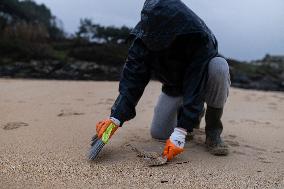
A person collects pellets at Do Dique beach, January 13, 2024, in Queiruga, A Coruña, Galicia, Spain. Already known as the "white tide", it is expected to come from the six containers from the ship Toconao that fell into the sea in Portuguese waters. At least one of the six containers, weighing around 20 tons, is believed to contain between 800 and 1,000 25-kilogram sacks of pellets. Pellets are small plastic balls of less than five millimeters that are used to manufacture plastic products. Because of their small size and light weight, it is "almost impossible to clean them up" once they are scattered on the beaches. Photo by Elena Fernández / Europa Press/ABACAPRESS.COM

  • Main
  • Top
  • Editorial
  • Creative
  • About Us
  • About ILG
  • Terms of use
  • Company
  • BEHIND
  • Price List
  • Single Plan
  • Monthly Plan
  • Services
  • Shooting
  • Rights Clearance
  • Support
  • FAQ
  • How To Buy
  • Contact Us
  • Become a Partner

© KYODO NEWS IMAGES INC

All Rights Reserved.

  • Editorial
  • Olympics
  • News
  • Sports
  • Japan
  • Tech
  • Royal
  • Disaster
  • NorthKorea
  • Old Japan
  • SNS
  • Creative
  • Food
  • Japan
  • Landscape
  • Animal
  • Popular
  • #Ukraine
  • #Thailand
  • #coronavirus
  • #N. Korea
  • #China
  • #Russia
  • #Ukraine
  • #Thailand
  • #coronavirus
  • #N. Korea
  • #China
  • #Russia
  • Food
  • Japan
  • Landscape
  • Animal
  • Olympics
  • News
  • Sports
  • Japan
  • Tech
  • Royal
  • Disaster
  • NorthKorea
  • Old Japan
  • SNS