•  
Star Explosion Reveals New Space Ingredients

Star Explosion Reveals New Space Ingredients

Handout - Scientists have spotted chlorine and potassium hiding inside the remains of a blown-up star for the first time. Using Japan’s XRISM space telescope, they found these elements inside the giant cloud of debris left behind by the supernova called Cassiopeia A. The explosion happened about 11,000 light-years from Earth, but it is still giving up new secrets today. The find shows how stars don’t just light up the sky, they also make many of the elements that help build planets and life. Even long after a star explodes, it can still teach us something new about the universe. This discovery was published in a scientific paper on December 4 this year, and the image was released on January 28, 2024, using data from NASA’s Chandra telescope along with Hubble, Webb and Spitzer. Photo by Image credit: X-ray: NASA/CXC/SAO; Optical: NASA/ESA/STScI; IR: NASA/ESA/CSA/STScI/Milisavljevic et al., NASA/JPL/CalTech; Image Processing: NASA/CXC/SAO/J. Schmidt and K. Arcand via ABACAPRESS.COM

  •  
Pillars of Creation Star in New Visualization from NASA's Hubble and Webb Telescopes

Pillars of Creation Star in New Visualization from NASA's Hubble and Webb Telescopes

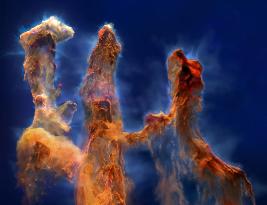
HANDOUT - The Pillars of Creation are one of the most iconic and beautiful sights in deep space - and now NASA has released a 3D visualisation allowing us to really see inside the most stunning part of the Eagle Nebula. Made famous in 1995 by NASA's Hubble Space Telescope, the Pillars of Creation are giant clouds where stars are born. Using data from NASA's Hubble and James Webb space telescopes, astronomers have created a comprehensive and detailed multiwavelength look at these towering celestial structures. By flying past and amongst the pillars, viewers experience their three-dimensional structure and see how they look different in the Hubble visible-light view versus the Webb infrared-light view," explained principal visualization scientist Frank Summers of the Space Telescope Science Institute (STScI) in Baltimore, who led the movie development team for NASA's Universe of Learning. The four Pillars of Creation, made primarily of cool molecular hydrogen and dust, are being eroded by the fierce winds and p

  •  
Pillars of Creation Star in New Visualization from NASA's Hubble and Webb Telescopes

Pillars of Creation Star in New Visualization from NASA's Hubble and Webb Telescopes

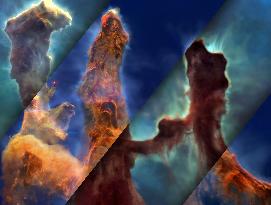
HANDOUT - The Pillars of Creation are one of the most iconic and beautiful sights in deep space - and now NASA has released a 3D visualisation allowing us to really see inside the most stunning part of the Eagle Nebula. Made famous in 1995 by NASA's Hubble Space Telescope, the Pillars of Creation are giant clouds where stars are born. Using data from NASA's Hubble and James Webb space telescopes, astronomers have created a comprehensive and detailed multiwavelength look at these towering celestial structures. By flying past and amongst the pillars, viewers experience their three-dimensional structure and see how they look different in the Hubble visible-light view versus the Webb infrared-light view," explained principal visualization scientist Frank Summers of the Space Telescope Science Institute (STScI) in Baltimore, who led the movie development team for NASA's Universe of Learning. The four Pillars of Creation, made primarily of cool molecular hydrogen and dust, are being eroded by the fierce winds and p

  •  
Pillars of Creation Star in New Visualization from NASA's Hubble and Webb Telescopes

Pillars of Creation Star in New Visualization from NASA's Hubble and Webb Telescopes

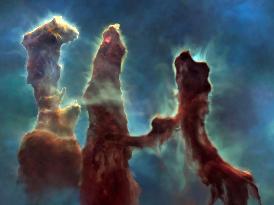
HANDOUT - The Pillars of Creation are one of the most iconic and beautiful sights in deep space - and now NASA has released a 3D visualisation allowing us to really see inside the most stunning part of the Eagle Nebula. Made famous in 1995 by NASA's Hubble Space Telescope, the Pillars of Creation are giant clouds where stars are born. Using data from NASA's Hubble and James Webb space telescopes, astronomers have created a comprehensive and detailed multiwavelength look at these towering celestial structures. By flying past and amongst the pillars, viewers experience their three-dimensional structure and see how they look different in the Hubble visible-light view versus the Webb infrared-light view," explained principal visualization scientist Frank Summers of the Space Telescope Science Institute (STScI) in Baltimore, who led the movie development team for NASA's Universe of Learning. The four Pillars of Creation, made primarily of cool molecular hydrogen and dust, are being eroded by the fierce winds and p

  •  
Pillars of Creation Star in New Visualization from NASA's Hubble and Webb Telescopes

Pillars of Creation Star in New Visualization from NASA's Hubble and Webb Telescopes

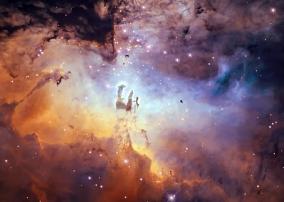
HANDOUT - The Pillars of Creation are one of the most iconic and beautiful sights in deep space - and now NASA has released a 3D visualisation allowing us to really see inside the most stunning part of the Eagle Nebula. Made famous in 1995 by NASA's Hubble Space Telescope, the Pillars of Creation are giant clouds where stars are born. Using data from NASA's Hubble and James Webb space telescopes, astronomers have created a comprehensive and detailed multiwavelength look at these towering celestial structures. By flying past and amongst the pillars, viewers experience their three-dimensional structure and see how they look different in the Hubble visible-light view versus the Webb infrared-light view," explained principal visualization scientist Frank Summers of the Space Telescope Science Institute (STScI) in Baltimore, who led the movie development team for NASA's Universe of Learning. The four Pillars of Creation, made primarily of cool molecular hydrogen and dust, are being eroded by the fierce winds and p

  •  
Hubble Spots the Little Dumbbell Nebula

Hubble Spots the Little Dumbbell Nebula

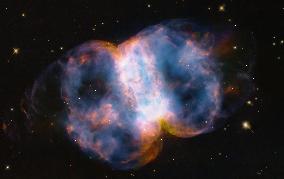
Handout - In celebration of the 34th anniversary of the launch of NASA’s Hubble Space Telescope, astronomers took a snapshot of the Little Dumbbell Nebula, also known as Messier 76, or M76, located 3,400 light-years away in the northern circumpolar constellation Perseus. The name ‘Little Dumbbell’ comes from its shape that is a two-lobed structure of colorful, mottled, glowing gases resembling a balloon that’s been pinched around a middle waist. Like an inflating balloon, the lobes are expanding into space from a dying star seen as a white dot in the center. Blistering ultraviolet radiation from the super-hot star is causing the gases to glow. The red color is from nitrogen, and blue is from oxygen. Photo by NASA, ESA, STScI via ABACAPRESS.COM

  •  
NASA’s Webb Finds Signs of Possible Aurorae on Isolated Brown Dwarf

NASA’s Webb Finds Signs of Possible Aurorae on Isolated Brown Dwarf

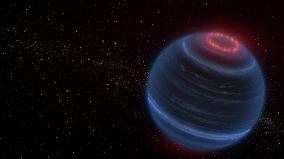
Handout photo - This artist concept portrays the brown dwarf W1935, which is located 47 light-years from Earth. Astronomers using NASA’s James Webb Space Telescope found infrared emission from methane coming from W1935. This is an unexpected discovery because the brown dwarf is cold and lacks a host star; therefore, there is no obvious source of energy to heat its upper atmosphere and make the methane glow. The team speculates that the methane emission may be due to processes generating aurorae, shown here in red. Infrared emission from methane suggests atmospheric heating by auroral processes. These findings are being presented at the 243rd meeting of the American Astronomical Society in New Orleans. To help explain the mystery of the infrared emission from methane, the team turned to our solar system. Methane in emission is a common feature in gas giants like Jupiter and Saturn. The upper-atmosphere heating that powers this emission is linked to aurorae. Photo by NASA, ESA, CSA, and L. Hustak (STScI) via AB

  •  
Webb Celebrates First Year of Science With Close-up on Birth of Sun-like Stars

Webb Celebrates First Year of Science With Close-up on Birth of Sun-like Stars

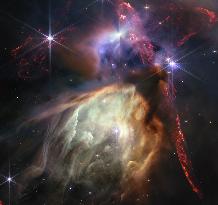
Handout - The first anniversary image from NASA’s James Webb Space Telescope displays star birth like it’s never been seen before, full of detailed, impressionistic texture. The subject is the Rho Ophiuchi cloud complex, the closest star-forming region to Earth. It is a relatively small, quiet stellar nursery, but you’d never know it from Webb’s chaotic close-up. Jets bursting from young stars crisscross the image, impacting the surrounding interstellar gas and lighting up molecular hydrogen, shown in red. Some stars display the telltale shadow of a circumstellar disk, the makings of future planetary systems. July 12, 2023. Photo by Klaus Pontoppidan/STScI, ASA, ESA, CSA /NASA via ABACAPRESS.COM

  •  
U.S.-GREENBELT-JAMES WEBB SPACE TELESCOPE-UNIVERSE-FIRST FULL-COLOR IMAGES

U.S.-GREENBELT-JAMES WEBB SPACE TELESCOPE-UNIVERSE-FIRST FULL-COLOR IMAGES

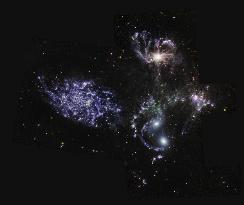
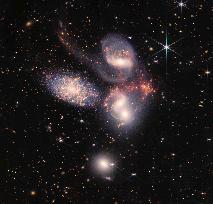
(220712) -- GREENBELT (U.S.), July 12, 2022 (Xinhua) -- Image released by NASA on July 12, 2022 shows Stephan's Quintet, a collection of five galaxies, as seen by MIRI from James Webb Space Telescope. NASA released James Webb Space Telescope's first full-color images of the universe and their spectroscopic data on Tuesday, revealing the unprecedented and detailed views of the universe. (NASA, ESA, CSA, STScI/Handout via Xinhua)

  •  
U.S.-GREENBELT-JAMES WEBB SPACE TELESCOPE-UNIVERSE-FIRST FULL-COLOR IMAGES

U.S.-GREENBELT-JAMES WEBB SPACE TELESCOPE-UNIVERSE-FIRST FULL-COLOR IMAGES

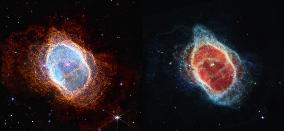
(220712) -- GREENBELT (U.S.), July 12, 2022 (Xinhua) -- Image released by NASA on July 12, 2022 shows a side-by-side comparison of the Southern Ring Nebula in near-infrared light (L) and mid-infrared light (R) from NASA's James Webb Space Telescope. NASA released James Webb Space Telescope's first full-color images of the universe and their spectroscopic data on Tuesday, revealing the unprecedented and detailed views of the universe. (NASA, ESA, CSA, STScI/Handout via Xinhua)

  •  
U.S.-GREENBELT-JAMES WEBB SPACE TELESCOPE-UNIVERSE-FIRST FULL-COLOR IMAGES

U.S.-GREENBELT-JAMES WEBB SPACE TELESCOPE-UNIVERSE-FIRST FULL-COLOR IMAGES

(220712) -- GREENBELT (U.S.), July 12, 2022 (Xinhua) -- Image released by NASA on July 12, 2022 shows Stephan's Quintet, a group of five galaxies that appear close to each other in the sky: two in the middle, one toward the top, one to the upper left, and one toward the bottom. NASA released James Webb Space Telescope's first full-color images of the universe and their spectroscopic data on Tuesday, revealing the unprecedented and detailed views of the universe. (NASA, ESA, CSA, STScI/Handout via Xinhua)

  •  
U.S.-GREENBELT-JAMES WEBB SPACE TELESCOPE-UNIVERSE-FIRST FULL-COLOR IMAGES

U.S.-GREENBELT-JAMES WEBB SPACE TELESCOPE-UNIVERSE-FIRST FULL-COLOR IMAGES

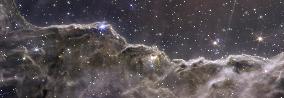
(220712) -- GREENBELT (U.S.), July 12, 2022 (Xinhua) -- Image released by NASA on July 12, 2022 shows a composite image of the Cosmic Cliffs in the Carina Nebula, created with James Webb Space Telescope's NIRCam and MIRI. NASA released James Webb Space Telescope's first full-color images of the universe and their spectroscopic data on Tuesday, revealing the unprecedented and detailed views of the universe. (NASA, ESA, CSA, STScI/Handout via Xinhua)

  •  
U.S.-GREENBELT-JAMES WEBB SPACE TELESCOPE-UNIVERSE-FIRST FULL-COLOR IMAGES

U.S.-GREENBELT-JAMES WEBB SPACE TELESCOPE-UNIVERSE-FIRST FULL-COLOR IMAGES

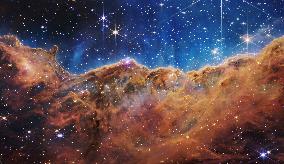
(220712) -- GREENBELT (U.S.), July 12, 2022 (Xinhua) -- Image released by NASA on July 12, 2022 shows the edge of a nearby, young, star-forming region called NGC 3324 in the Carina Nebula. Captured in infrared light by NASA's James Webb Space Telescope, the image reveals for the first time previously invisible areas of star birth. NASA released James Webb Space Telescope's first full-color images of the universe and their spectroscopic data on Tuesday, revealing the unprecedented and detailed views of the universe. (NASA, ESA, CSA, STScI/Handout via Xinhua)

  •  
U.S.-JAMES WEBB SPACE TELESCOPE-FIRST IMAGE

U.S.-JAMES WEBB SPACE TELESCOPE-FIRST IMAGE

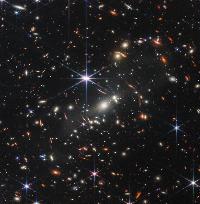
(220712) -- WASHINGTON, D.C., July 12, 2022 (Xinhua) -- Image released by NASA on July 11, 2022 shows galaxy cluster SMACS 0723, captured by the James Webb Space Telescope. U.S. President Joe Biden released one of the James Webb Space Telescope's first images in a preview event at the White House on Monday. This first image from Webb is the deepest and sharpest infrared image of the distant universe to date, NASA said. This image of galaxy cluster SMACS 0723 is filled with thousands of galaxies, including the faintest objects ever observed in the infrared, which have appeared in Webb's view for the first time, said NASA. (NASA/ESA/CSA/STScI/Handout via Xinhua)

  • Main
  • Top
  • Editorial
  • Creative
  • About Us
  • About ILG
  • Terms of use
  • Company
  • BEHIND
  • Price List
  • Single Plan
  • Monthly Plan
  • Services
  • Shooting
  • Rights Clearance
  • Support
  • FAQ
  • How To Buy
  • Contact Us
  • Become a Partner

© KYODO NEWS IMAGES INC

All Rights Reserved.

  • Editorial
  • Olympics
  • News
  • Sports
  • Japan
  • Tech
  • Royal
  • Disaster
  • NorthKorea
  • Old Japan
  • SNS
  • Creative
  • Food
  • Japan
  • Landscape
  • Animal
  • Popular
  • #Ukraine
  • #China
  • #coronavirus
  • #N. Korea
  • #Thailand
  • #Russia
  • #Ukraine
  • #China
  • #coronavirus
  • #N. Korea
  • #Thailand
  • #Russia
  • Food
  • Japan
  • Landscape
  • Animal
  • Olympics
  • News
  • Sports
  • Japan
  • Tech
  • Royal
  • Disaster
  • NorthKorea
  • Old Japan
  • SNS