•  
Salt Harvest Declines Sharply - Iraq

Salt Harvest Declines Sharply - Iraq

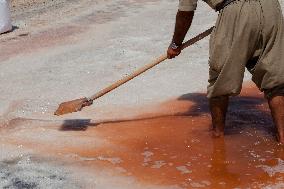
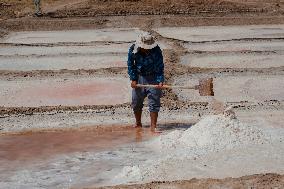
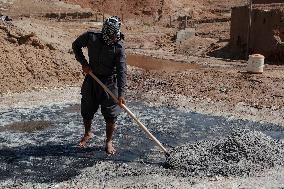
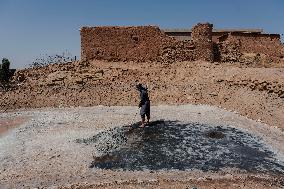
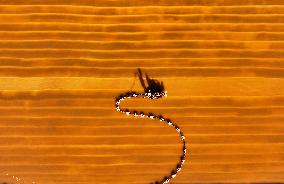
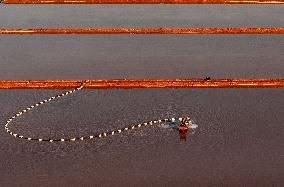
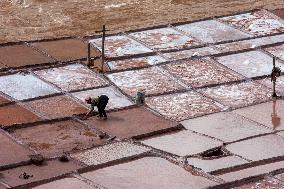
A worker uses a tool to scrape salt from a drying pond in Garmian, southwest of Sulaymaniyah, Iraq, on August 15, 2025. In the plains of Garmian, hundreds of residents continue an ancient salt-harvesting trade once known as "white gold." Production has sharply declined, with ponds now yielding less than a third of their former output, leaving villagers struggling against harsh natural conditions and poor infrastructure. Local harvester Peshkewt Saadoun explains that they collect two types of salt—coarse and fine—and notes that annual production has fallen from 800–900 tons in the past to about 250 tons today. Photo by Gailan Haji/Middle East Images/ABACAPRESS.COM

  •  
Salt Harvest Declines Sharply - Iraq

Salt Harvest Declines Sharply - Iraq

A worker uses a tool to scrape salt from a drying pond in Garmian, southwest of Sulaymaniyah, Iraq, on August 15, 2025. In the plains of Garmian, hundreds of residents continue an ancient salt-harvesting trade once known as "white gold." Production has sharply declined, with ponds now yielding less than a third of their former output, leaving villagers struggling against harsh natural conditions and poor infrastructure. Local harvester Peshkewt Saadoun explains that they collect two types of salt—coarse and fine—and notes that annual production has fallen from 800–900 tons in the past to about 250 tons today. Photo by Gailan Haji/Middle East Images/ABACAPRESS.COM

  •  
Salt Harvest Declines Sharply - Iraq

Salt Harvest Declines Sharply - Iraq

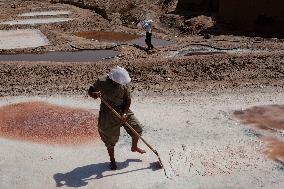
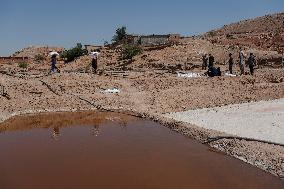
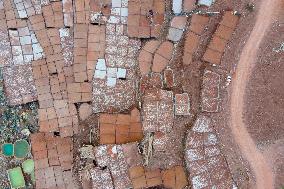
Men work around salt ponds in Garmian, southwest of Sulaymaniyah, Iraq, on August 15, 2025. In the plains of Garmian, hundreds of residents continue an ancient salt-harvesting trade once known as "white gold." Production has sharply declined, with ponds now yielding less than a third of their former output, leaving villagers struggling against harsh natural conditions and poor infrastructure. Local harvester Peshkewt Saadoun explains that they collect two types of salt—coarse and fine—and notes that annual production has fallen from 800–900 tons in the past to about 250 tons today. Photo by Gailan Haji/Middle East Images/ABACAPRESS.COM

  •  
Salt Harvest Declines Sharply - Iraq

Salt Harvest Declines Sharply - Iraq

A worker uses a tool to scrape salt from a drying pond in Garmian, southwest of Sulaymaniyah, Iraq, on August 15, 2025. In the plains of Garmian, hundreds of residents continue an ancient salt-harvesting trade once known as "white gold." Production has sharply declined, with ponds now yielding less than a third of their former output, leaving villagers struggling against harsh natural conditions and poor infrastructure. Local harvester Peshkewt Saadoun explains that they collect two types of salt—coarse and fine—and notes that annual production has fallen from 800–900 tons in the past to about 250 tons today. Photo by Gailan Haji/Middle East Images/ABACAPRESS.COM

  •  
Salt Harvest Declines Sharply - Iraq

Salt Harvest Declines Sharply - Iraq

A worker uses a tool to scrape salt from a drying pond in Garmian, southwest of Sulaymaniyah, Iraq, on August 15, 2025. In the plains of Garmian, hundreds of residents continue an ancient salt-harvesting trade once known as "white gold." Production has sharply declined, with ponds now yielding less than a third of their former output, leaving villagers struggling against harsh natural conditions and poor infrastructure. Local harvester Peshkewt Saadoun explains that they collect two types of salt—coarse and fine—and notes that annual production has fallen from 800–900 tons in the past to about 250 tons today. Photo by Gailan Haji/Middle East Images/ABACAPRESS.COM

  •  
Salt Harvest Declines Sharply - Iraq

Salt Harvest Declines Sharply - Iraq

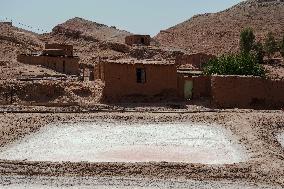
A salt pond lies in front of mud-brick homes in Garmian, southwest of Sulaymaniyah, Iraq, on August 15, 2025. In the plains of Garmian, hundreds of residents continue an ancient salt-harvesting trade once known as "white gold." Production has sharply declined, with ponds now yielding less than a third of their former output, leaving villagers struggling against harsh natural conditions and poor infrastructure. Local harvester Peshkewt Saadoun explains that they collect two types of salt—coarse and fine—and notes that annual production has fallen from 800–900 tons in the past to about 250 tons today. Photo by Gailan Haji/Middle East Images/ABACAPRESS.COM

  •  
Salt Harvest Declines Sharply - Iraq

Salt Harvest Declines Sharply - Iraq

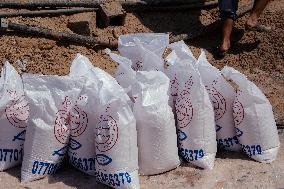
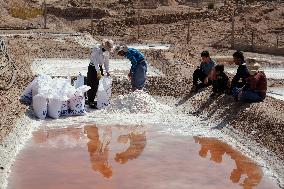
Bags of refined salt are stacked beside the ponds in Garmian, Iraqi Kurdistan, on August 15, 2025. In the plains of Garmian, hundreds of residents continue an ancient salt-harvesting trade once known as "white gold." Production has sharply declined, with ponds now yielding less than a third of their former output, leaving villagers struggling against harsh natural conditions and poor infrastructure. Local harvester Peshkewt Saadoun explains that they collect two types of salt—coarse and fine—and notes that annual production has fallen from 800–900 tons in the past to about 250 tons today. Photo by Gailan Haji/Middle East Images/ABACAPRESS.COM

  •  
Salt Harvest Declines Sharply - Iraq

Salt Harvest Declines Sharply - Iraq

A worker uses a tool to scrape salt from a drying pond in Garmian, southwest of Sulaymaniyah, Iraq, on August 15, 2025. In the plains of Garmian, hundreds of residents continue an ancient salt-harvesting trade once known as "white gold." Production has sharply declined, with ponds now yielding less than a third of their former output, leaving villagers struggling against harsh natural conditions and poor infrastructure. Local harvester Peshkewt Saadoun explains that they collect two types of salt—coarse and fine—and notes that annual production has fallen from 800–900 tons in the past to about 250 tons today. Photo by Gailan Haji/Middle East Images/ABACAPRESS.COM

  •  
Salt Harvest Declines Sharply - Iraq

Salt Harvest Declines Sharply - Iraq

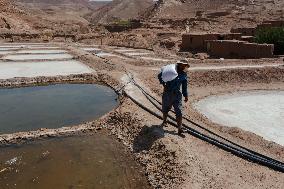
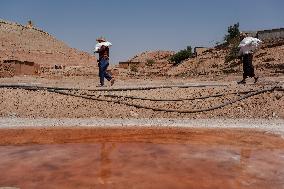
A worker carries a sack of salt across the ponds in Garmian, southwest of Sulaymaniyah, Iraq, on August 15, 2025. In the plains of Garmian, hundreds of residents continue an ancient salt-harvesting trade once known as "white gold." Production has sharply declined, with ponds now yielding less than a third of their former output, leaving villagers struggling against harsh natural conditions and poor infrastructure. Local harvester Peshkewt Saadoun explains that they collect two types of salt—coarse and fine—and notes that annual production has fallen from 800–900 tons in the past to about 250 tons today. Photo by Gailan Haji/Middle East Images/ABACAPRESS.COM

  •  
Salt Harvest Declines Sharply - Iraq

Salt Harvest Declines Sharply - Iraq

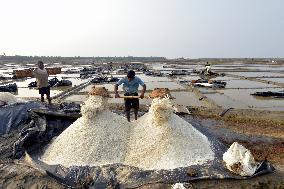
Men work around salt ponds in Garmian, southwest of Sulaymaniyah, Iraq, on August 15, 2025. In the plains of Garmian, hundreds of residents continue an ancient salt-harvesting trade once known as "white gold." Production has sharply declined, with ponds now yielding less than a third of their former output, leaving villagers struggling against harsh natural conditions and poor infrastructure. Local harvester Peshkewt Saadoun explains that they collect two types of salt—coarse and fine—and notes that annual production has fallen from 800–900 tons in the past to about 250 tons today. Photo by Gailan Haji/Middle East Images/ABACAPRESS.COM

  •  
Salt Harvest Declines Sharply - Iraq

Salt Harvest Declines Sharply - Iraq

Men work around salt ponds in Garmian, southwest of Sulaymaniyah, Iraq, on August 15, 2025. In the plains of Garmian, hundreds of residents continue an ancient salt-harvesting trade once known as "white gold." Production has sharply declined, with ponds now yielding less than a third of their former output, leaving villagers struggling against harsh natural conditions and poor infrastructure. Local harvester Peshkewt Saadoun explains that they collect two types of salt—coarse and fine—and notes that annual production has fallen from 800–900 tons in the past to about 250 tons today. Photo by Gailan Haji/Middle East Images/ABACAPRESS.COM

  •  
Salt Harvest Declines Sharply - Iraq

Salt Harvest Declines Sharply - Iraq

A worker uses a tool to scrape salt from a drying pond in Garmian, southwest of Sulaymaniyah, Iraq, on August 15, 2025. In the plains of Garmian, hundreds of residents continue an ancient salt-harvesting trade once known as "white gold." Production has sharply declined, with ponds now yielding less than a third of their former output, leaving villagers struggling against harsh natural conditions and poor infrastructure. Local harvester Peshkewt Saadoun explains that they collect two types of salt—coarse and fine—and notes that annual production has fallen from 800–900 tons in the past to about 250 tons today. Photo by Gailan Haji/Middle East Images/ABACAPRESS.COM

  •  
Salt Harvest Declines Sharply - Iraq

Salt Harvest Declines Sharply - Iraq

A worker uses a tool to scrape salt from a drying pond in Garmian, southwest of Sulaymaniyah, Iraq, on August 15, 2025. In the plains of Garmian, hundreds of residents continue an ancient salt-harvesting trade once known as "white gold." Production has sharply declined, with ponds now yielding less than a third of their former output, leaving villagers struggling against harsh natural conditions and poor infrastructure. Local harvester Peshkewt Saadoun explains that they collect two types of salt—coarse and fine—and notes that annual production has fallen from 800–900 tons in the past to about 250 tons today. Photo by Gailan Haji/Middle East Images/ABACAPRESS.COM

  •  
Salt Harvest Declines Sharply - Iraq

Salt Harvest Declines Sharply - Iraq

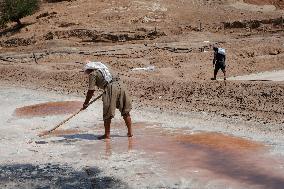
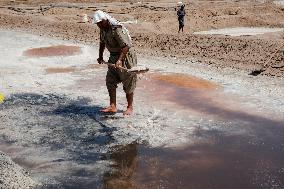
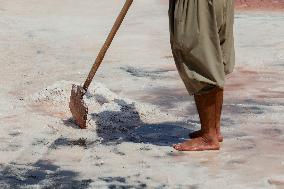
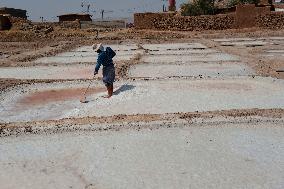
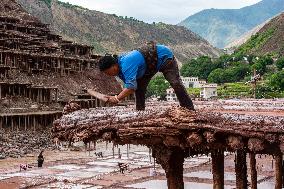
A worker uses a wooden tool to scrape salt from a drying pond in Garmian, southwest of Sulaymaniyah, Iraq, on August 15, 2025. In the plains of Garmian, hundreds of residents continue an ancient salt-harvesting trade once known as "white gold." Production has sharply declined, with ponds now yielding less than a third of their former output, leaving villagers struggling against harsh natural conditions and poor infrastructure. Local harvester Peshkewt Saadoun explains that they collect two types of salt—coarse and fine—and notes that annual production has fallen from 800–900 tons in the past to about 250 tons today. Photo by Gailan Haji/Middle East Images/ABACAPRESS.COM

  •  
Salt Harvest Declines Sharply - Iraq

Salt Harvest Declines Sharply - Iraq

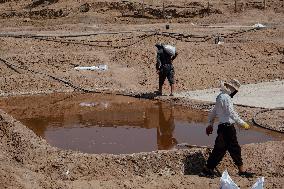
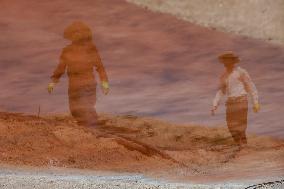
Reflections of workers appear on the surface of a salt pond in Garmian, Iraqi Kurdistan, on August 15, 2025. In the plains of Garmian, hundreds of residents continue an ancient salt-harvesting trade once known as "white gold." Production has sharply declined, with ponds now yielding less than a third of their former output, leaving villagers struggling against harsh natural conditions and poor infrastructure. Local harvester Peshkewt Saadoun explains that they collect two types of salt—coarse and fine—and notes that annual production has fallen from 800–900 tons in the past to about 250 tons today. Photo by Gailan Haji/Middle East Images/ABACAPRESS.COM

  •  
Salt Harvest Declines Sharply - Iraq

Salt Harvest Declines Sharply - Iraq

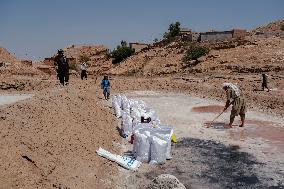
Workers carry salt bags past salt ponds in Khwelin village, southwest of Sulaymaniyah, Iraq, on August 15, 2025. In the plains of Garmian, hundreds of residents continue an ancient salt-harvesting trade once known as "white gold." Production has sharply declined, with ponds now yielding less than a third of their former output, leaving villagers struggling against harsh natural conditions and poor infrastructure. Local harvester Peshkewt Saadoun explains that they collect two types of salt—coarse and fine—and notes that annual production has fallen from 800–900 tons in the past to about 250 tons today. Photo by Gailan Haji/Middle East Images/ABACAPRESS.COM

  •  
Salt Harvest Declines Sharply - Iraq

Salt Harvest Declines Sharply - Iraq

A worker uses a wooden tool to scrape salt from a drying pond in Garmian, southwest of Sulaymaniyah, Iraq, on August 15, 2025. In the plains of Garmian, hundreds of residents continue an ancient salt-harvesting trade once known as "white gold." Production has sharply declined, with ponds now yielding less than a third of their former output, leaving villagers struggling against harsh natural conditions and poor infrastructure. Local harvester Peshkewt Saadoun explains that they collect two types of salt—coarse and fine—and notes that annual production has fallen from 800–900 tons in the past to about 250 tons today. Photo by Gailan Haji/Middle East Images/ABACAPRESS.COM

  •  
Salt Harvest Declines Sharply - Iraq

Salt Harvest Declines Sharply - Iraq

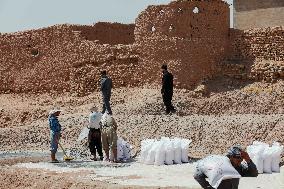
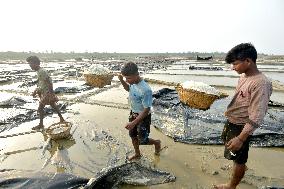
Villagers collect and bag salt in Garmian, Iraqi Kurdistan, on August 15, 2025. In the plains of Garmian, hundreds of residents continue an ancient salt-harvesting trade once known as "white gold." Production has sharply declined, with ponds now yielding less than a third of their former output, leaving villagers struggling against harsh natural conditions and poor infrastructure. Local harvester Peshkewt Saadoun explains that they collect two types of salt—coarse and fine—and notes that annual production has fallen from 800–900 tons in the past to about 250 tons today. Photo by Gailan Haji/Middle East Images/ABACAPRESS.COM

  •  
Salt Harvest Declines Sharply - Iraq

Salt Harvest Declines Sharply - Iraq

Workers carry salt bags past salt ponds in Khwelin village, southwest of Sulaymaniyah, Iraq, on August 15, 2025. In the plains of Garmian, hundreds of residents continue an ancient salt-harvesting trade once known as "white gold." Production has sharply declined, with ponds now yielding less than a third of their former output, leaving villagers struggling against harsh natural conditions and poor infrastructure. Local harvester Peshkewt Saadoun explains that they collect two types of salt—coarse and fine—and notes that annual production has fallen from 800–900 tons in the past to about 250 tons today. Photo by Gailan Haji/Middle East Images/ABACAPRESS.COM

  •  
Salt Harvesting And Processing - China

Salt Harvesting And Processing - China

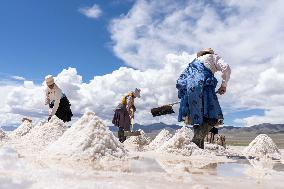
Herdsmen harvest the salt in Gegye County of Ngari Prefecture, southwest China's Xizang Autonomous Region, July 20, 2025. Rich in salt resources, Gegye County has established a crude salt processing plant, and formed gradually an industrial chain integrating salt harvesting, storage, processing, packaging and sales to increase the villagers' income. In 2018, Gegye's salt-carrying custom was included in the representative list of intangible cultural heritage of the Xizang Autonomous Region. Photo by Tenzing Nima Qadhup/Xinhua/ABACAPRESS.COM

  •  
Salt Harvesting And Processing - China

Salt Harvesting And Processing - China

A herdsman ties the salt to a sheep in Gegye County of Ngari Prefecture, southwest China's Xizang Autonomous Region, July 20, 2025. Rich in salt resources, Gegye County has established a crude salt processing plant, and formed gradually an industrial chain integrating salt harvesting, storage, processing, packaging and sales to increase the villagers' income. In 2018, Gegye's salt-carrying custom was included in the representative list of intangible cultural heritage of the Xizang Autonomous Region. Photo by Tenzing Nima Qadhup/Xinhua/ABACAPRESS.COM

  •  
Salt Harvesting And Processing - China

Salt Harvesting And Processing - China

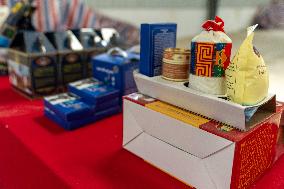
This photo taken on July 20, 2025 shows the products of a crude salt processing plant in Gegye County of Ngari Prefecture, southwest China's Xizang Autonomous Region. Rich in salt resources, Gegye County has established a crude salt processing plant, and formed gradually an industrial chain integrating salt harvesting, storage, processing, packaging and sales to increase the villagers' income. In 2018, Gegye's salt-carrying custom was included in the representative list of intangible cultural heritage of the Xizang Autonomous Region. Photo by Tenzing Nima Qadhup/Xinhua/ABACAPRESS.COM

  •  
Salt Harvesting And Processing - China

Salt Harvesting And Processing - China

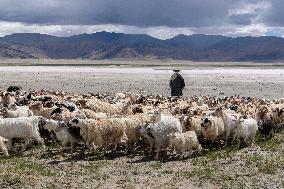
A herdsman walks to harvest salt is pictured with a sheep flock in Gegye County of Ngari Prefecture, southwest China's Xizang Autonomous Region, July 20, 2025. Rich in salt resources, Gegye County has established a crude salt processing plant, and formed gradually an industrial chain integrating salt harvesting, storage, processing, packaging and sales to increase the villagers' income. In 2018, Gegye's salt-carrying custom was included in the representative list of intangible cultural heritage of the Xizang Autonomous Region. Photo by Tenzing Nima Qadhup/Xinhua/ABACAPRESS.COM

  •  
Salt Harvesting And Processing - China

Salt Harvesting And Processing - China

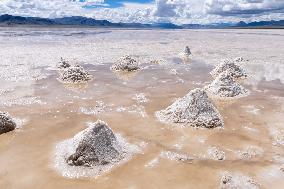
This photo taken on July 20, 2025 shows the piled salt in Gegye County of Ngari Prefecture, southwest China's Xizang Autonomous Region. Rich in salt resources, Gegye County has established a crude salt processing plant, and formed gradually an industrial chain integrating salt harvesting, storage, processing, packaging and sales to increase the villagers' income. In 2018, Gegye's salt-carrying custom was included in the representative list of intangible cultural heritage of the Xizang Autonomous Region. Photo by Tenzing Nima Qadhup/Xinhua/ABACAPRESS.COM

  •  
Salt Harvesting And Processing - China

Salt Harvesting And Processing - China

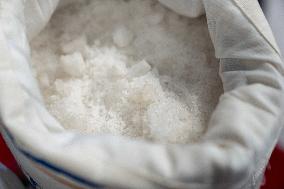
This photo taken on July 20, 2025 shows the harvested salt in Gegye County of Ngari Prefecture, southwest China's Xizang Autonomous Region. Rich in salt resources, Gegye County has established a crude salt processing plant, and formed gradually an industrial chain integrating salt harvesting, storage, processing, packaging and sales to increase the villagers' income. In 2018, Gegye's salt-carrying custom was included in the representative list of intangible cultural heritage of the Xizang Autonomous Region. Photo by Tenzing Nima Qadhup/Xinhua/ABACAPRESS.COM

  •  
Salt Harvesting And Processing - China

Salt Harvesting And Processing - China

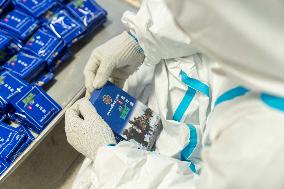
A staff member packages the salt at a crude salt processing plant in Gegye County of Ngari Prefecture, southwest China's Xizang Autonomous Region, July 20, 2025. Rich in salt resources, Gegye County has established a crude salt processing plant, and formed gradually an industrial chain integrating salt harvesting, storage, processing, packaging and sales to increase the villagers' income. In 2018, Gegye's salt-carrying custom was included in the representative list of intangible cultural heritage of the Xizang Autonomous Region. Photo by Tenzing Nima Qadhup/Xinhua/ABACAPRESS.COM

  •  
Salt Harvesting And Processing - China

Salt Harvesting And Processing - China

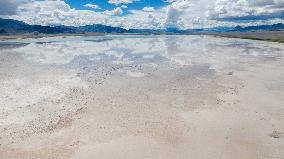
An aerial drone photo taken on July 20, 2025 shows a view of a salt lake in Gegye County of Ngari Prefecture, southwest China's Xizang Autonomous Region. Rich in salt resources, Gegye County has established a crude salt processing plant, and formed gradually an industrial chain integrating salt harvesting, storage, processing, packaging and sales to increase the villagers' income. In 2018, Gegye's salt-carrying custom was included in the representative list of intangible cultural heritage of the Xizang Autonomous Region. Photo by Tenzing Nima Qadhup/Xinhua/ABACAPRESS.COM

  •  
Salt Flats - China

Salt Flats - China

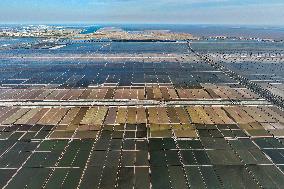
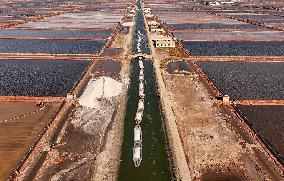
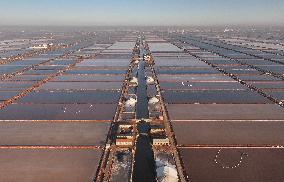
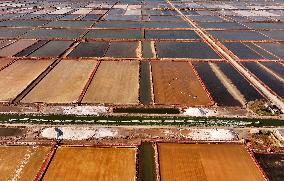
An aerial drone photo taken on April 27, 2025 shows salt flats of Tianjin Changlu Haijing Group Co., Ltd. in Tianjin, north China. In recent days, workers of Tianjin Changlu Haijing Group Co., Ltd. have been busy harvesting salt in its 250,000 mu (about 16,700 hectares) of salt flats. The spring harvest of salt usually starts from mid-to-late March to June, depending on the weather condition. Photo by Du Penghui/Xinhua/ABACAPRESS.COM

  •  
Salt Flats - China

Salt Flats - China

An aerial drone photo taken on April 27, 2025 shows a worker driving a machine in a salt flat of Tianjin Changlu Haijing Group Co., Ltd. in Tianjin, north China. In recent days, workers of Tianjin Changlu Haijing Group Co., Ltd. have been busy harvesting salt in its 250,000 mu (about 16,700 hectares) of salt flats. The spring harvest of salt usually starts from mid-to-late March to June, depending on the weather condition. Photo by Du Penghui/Xinhua/ABACAPRESS.COM

  •  
Salt Flats - China

Salt Flats - China

An aerial drone photo taken on April 27, 2025 shows salt flats of Tianjin Changlu Haijing Group Co., Ltd. in Tianjin, north China. In recent days, workers of Tianjin Changlu Haijing Group Co., Ltd. have been busy harvesting salt in its 250,000 mu (about 16,700 hectares) of salt flats. The spring harvest of salt usually starts from mid-to-late March to June, depending on the weather condition. Photo by Du Penghui/Xinhua/ABACAPRESS.COM

  •  
Salt Harvesting - China

Salt Harvesting - China

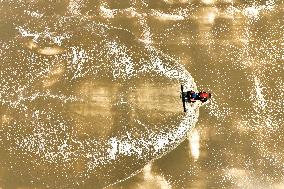
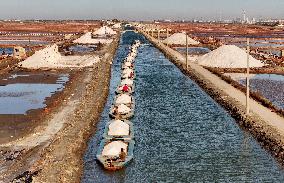
An aerial drone photo taken on Oct. 16, 2024 shows a worker operating a machinery harvesting salt at Nanpu salt field in Caofeidian District of Tangshan, north China's Hebei Province. Photo by Xinhua/Yang Shiyao/ABACAPRESS.COM

  •  
Salt Harvesting - China

Salt Harvesting - China

An aerial drone photo taken on Oct. 16, 2024 shows workers transporting harvested salt at Nanpu salt field in Caofeidian District of Tangshan, north China's Hebei Province. Photo by Xinhua/Yang Shiyao/ABACAPRESS.COM

  •  
Salt Harvesting - China

Salt Harvesting - China

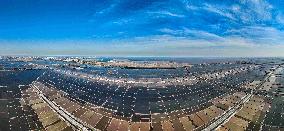
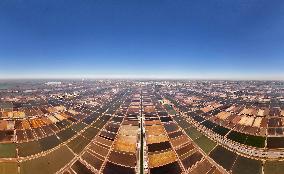
An aerial panoramic photo taken on Oct. 16, 2024 shows a view of the Nanpu salt field in Caofeidian District of Tangshan, north China's Hebei Province. Photo by Xinhua/Yang Shiyao/ABACAPRESS.COM

  •  
Salt Harvesting - China

Salt Harvesting - China

An aerial drone photo taken on Oct. 16, 2024 shows a worker operating a machinery harvesting salt at Nanpu salt field in Caofeidian District of Tangshan, north China's Hebei Province. Photo by Xinhua/Yang Shiyao/ABACAPRESS.COM

  •  
Salt Harvesting - China

Salt Harvesting - China

An aerial drone photo taken on Oct. 16, 2024 shows workers transporting harvested salt at Nanpu salt field in Caofeidian District of Tangshan, north China's Hebei Province. Photo by Xinhua/Yang Shiyao/ABACAPRESS.COM

  •  
Salt Harvesting - China

Salt Harvesting - China

An aerial drone photo taken on Oct. 16, 2024 shows a worker operating a machinery harvesting salt at Nanpu salt field in Caofeidian District of Tangshan, north China's Hebei Province. Photo by Xinhua/Yang Shiyao/ABACAPRESS.COM

  •  
Salt Harvesting - China

Salt Harvesting - China

An aerial drone photo taken on Oct. 16, 2024 shows a view of the Nanpu salt field in Caofeidian District of Tangshan, north China's Hebei Province. Photo by Xinhua/Yang Shiyao/ABACAPRESS.COM

  •  
Salt Harvesting - China

Salt Harvesting - China

An aerial drone photo taken on Oct. 16, 2024 shows a worker operating a machinery harvesting salt at Nanpu salt field in Caofeidian District of Tangshan, north China's Hebei Province. Photo by Xinhua/Yang Shiyao/ABACAPRESS.COM

  •  
Salt Harvesting - China

Salt Harvesting - China

An aerial drone photo taken on Oct. 16, 2024 shows workers transporting harvested salt at Nanpu salt field in Caofeidian District of Tangshan, north China's Hebei Province. Photo by Xinhua/Yang Shiyao/ABACAPRESS.COM

  •  
BANGLADESH-COX'S BAZAR-CYCLONE MOCHA-SALT-HARVESTING

BANGLADESH-COX'S BAZAR-CYCLONE MOCHA-SALT-HARVESTING

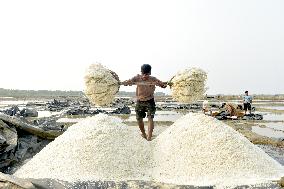
(230516) -- COX'S BAZAR, May 16, 2023 (Xinhua) -- People work at a salt farm in Cox's Bazar, Bangladesh on May 15, 2023. Farmers in Bangladesh's Cox's Bazar district, some 300 km southeast of capital Dhaka, are now busy harvesting salt after cyclone Mocha hit the lands. (Xinhua)

  •  
BANGLADESH-COX'S BAZAR-CYCLONE MOCHA-SALT-HARVESTING

BANGLADESH-COX'S BAZAR-CYCLONE MOCHA-SALT-HARVESTING

(230516) -- COX'S BAZAR, May 16, 2023 (Xinhua) -- People work at a salt farm in Cox's Bazar, Bangladesh on May 15, 2023. Farmers in Bangladesh's Cox's Bazar district, some 300 km southeast of capital Dhaka, are now busy harvesting salt after cyclone Mocha hit the lands. (Xinhua)

  •  
BANGLADESH-COX'S BAZAR-CYCLONE MOCHA-SALT-HARVESTING

BANGLADESH-COX'S BAZAR-CYCLONE MOCHA-SALT-HARVESTING

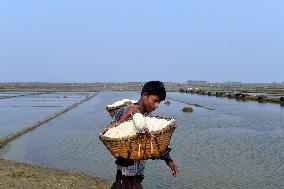
(230516) -- COX'S BAZAR, May 16, 2023 (Xinhua) -- A man carries loads of sea salt in Cox's Bazar, Bangladesh on May 15, 2023. Farmers in Bangladesh's Cox's Bazar district, some 300 km southeast of capital Dhaka, are now busy harvesting salt after cyclone Mocha hit the lands. (Xinhua)

  •  
BANGLADESH-COX'S BAZAR-CYCLONE MOCHA-SALT-HARVESTING

BANGLADESH-COX'S BAZAR-CYCLONE MOCHA-SALT-HARVESTING

(230516) -- COX'S BAZAR, May 16, 2023 (Xinhua) -- People work at a salt farm in Cox's Bazar, Bangladesh on May 15, 2023. Farmers in Bangladesh's Cox's Bazar district, some 300 km southeast of capital Dhaka, are now busy harvesting salt after cyclone Mocha hit the lands. (Xinhua)

  •  

Salt harvest in N China

STORY: Salt harvest in N China DATELINE: May 9, 2023 LENGTH: 00:00:47 LOCATION: SHIJIAZHUANG, China CATEGORY: ENTERTAINMENT SHOTLIST: 1. various of saltpans and people harvesting salt STORYLINE: Harvesting work has begun in more than 10,000 hectares of saltpans in Haixing County, north China's Hebei Province. Xinhua News Agency correspondents reporting from Shijiazhuang, China. (XHTV)

  •  
CHINA-TIBET-QAMDO-MANGKAM-SALT PAN (CN)

CHINA-TIBET-QAMDO-MANGKAM-SALT PAN (CN)

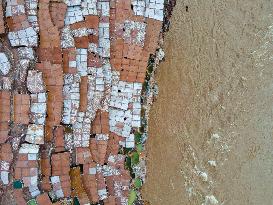
(220603) -- QAMDO, June 3, 2022 (Xinhua) -- A villager works in the salt pans in Naxi Township of Mangkam County, Qamdo, southwest China's Tibet Autonomous Region, May 26, 2022. Local people of Mangkam County follow a traditional salt harvesting method by collecting brines from salt mines and ponds and evaporating them in the sun until crystallization. (Xinhua/Chen Shangcai)

  •  
CHINA-TIBET-QAMDO-MANGKAM-SALT PAN (CN)

CHINA-TIBET-QAMDO-MANGKAM-SALT PAN (CN)

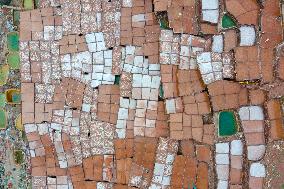
(220603) -- QAMDO, June 3, 2022 (Xinhua) -- Aerial photo taken on May 26, 2022 shows salt pans in Naxi Township of Mangkam County, Qamdo, southwest China's Tibet Autonomous Region. Local people of Mangkam County follow a traditional salt harvesting method by collecting brines from salt mines and ponds and evaporating them in the sun until crystallization. (Xinhua/Zhou Dixiao)

  •  
CHINA-TIBET-QAMDO-MANGKAM-SALT PAN (CN)

CHINA-TIBET-QAMDO-MANGKAM-SALT PAN (CN)

(220603) -- QAMDO, June 3, 2022 (Xinhua) -- Aerial photo taken on May 26, 2022 shows salt pans in Naxi Township of Mangkam County, Qamdo, southwest China's Tibet Autonomous Region. Local people of Mangkam County follow a traditional salt harvesting method by collecting brines from salt mines and ponds and evaporating them in the sun until crystallization. (Xinhua/Zhou Dixiao)

  •  
CHINA-TIBET-QAMDO-MANGKAM-SALT PAN (CN)

CHINA-TIBET-QAMDO-MANGKAM-SALT PAN (CN)

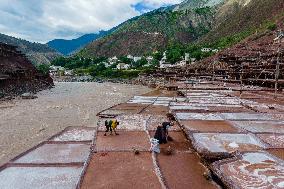
(220603) -- QAMDO, June 3, 2022 (Xinhua) -- Aerial photo taken on May 26, 2022 shows villagers working at the salt pans in Naxi Township of Mangkam County, Qamdo, southwest China's Tibet Autonomous Region. Local people of Mangkam County follow a traditional salt harvesting method by collecting brines from salt mines and ponds and evaporating them in the sun until crystallization. (Xinhua/Zhou Dixiao)

  •  
CHINA-TIBET-QAMDO-MANGKAM-SALT PAN (CN)

CHINA-TIBET-QAMDO-MANGKAM-SALT PAN (CN)

(220603) -- QAMDO, June 3, 2022 (Xinhua) -- Aerial photo taken on May 26, 2022 shows salt pans in Naxi Township of Mangkam County, Qamdo, southwest China's Tibet Autonomous Region. Local people of Mangkam County follow a traditional salt harvesting method by collecting brines from salt mines and ponds and evaporating them in the sun until crystallization. (Xinhua/Zhou Dixiao)

  •  
CHINA-TIBET-QAMDO-MANGKAM-SALT PAN (CN)

CHINA-TIBET-QAMDO-MANGKAM-SALT PAN (CN)

(220603) -- QAMDO, June 3, 2022 (Xinhua) -- A villager works in the salt pans in Naxi Township of Mangkam County, Qamdo, southwest China's Tibet Autonomous Region, May 26, 2022. Local people of Mangkam County follow a traditional salt harvesting method by collecting brines from salt mines and ponds and evaporating them in the sun until crystallization. (Xinhua/Chen Shangcai)

  • Main
  • Top
  • Editorial
  • Creative
  • About Us
  • About ILG
  • Terms of use
  • Company
  • BEHIND
  • Price List
  • Single Plan
  • Monthly Plan
  • Services
  • Shooting
  • Rights Clearance
  • Support
  • FAQ
  • How To Buy
  • Contact Us
  • Become a Partner

© KYODO NEWS IMAGES INC

All Rights Reserved.

  • Editorial
  • Olympics
  • News
  • Sports
  • Japan
  • Tech
  • Royal
  • Disaster
  • NorthKorea
  • Old Japan
  • SNS
  • Creative
  • Food
  • Japan
  • Landscape
  • Animal
  • Popular
  • #Ukraine
  • #Thailand
  • #coronavirus
  • #N. Korea
  • #Russia
  • #China
  • #Ukraine
  • #Thailand
  • #coronavirus
  • #N. Korea
  • #Russia
  • #China
  • Food
  • Japan
  • Landscape
  • Animal
  • Olympics
  • News
  • Sports
  • Japan
  • Tech
  • Royal
  • Disaster
  • NorthKorea
  • Old Japan
  • SNS