•  
Letters from Briton murdered in 1862

Letters from Briton murdered in 1862

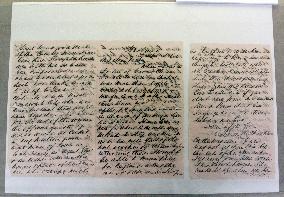
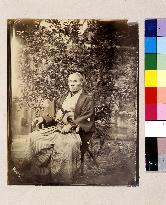
YOKOHAMA, Japan - Photo shows a letter written by Charles Richardson, a British man murdered by samurai in 1862 in the so-called Namamugi Incident. His letters were among items displayed in the Namamugi Incident exhibition that began at a museum in Yokohama, Kanagawa Prefecture, on July 19, 2012.

  •  
Letters from Briton murdered in 1862

Letters from Briton murdered in 1862

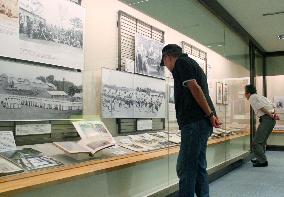
YOKOHAMA, Japan - People view items in the Namamugi Incident exhibition that began at a museum in Yokohama, Kanagawa Prefecture, on July 19, 2012. Among items on display are letters written by Charles Richardson, a British man murdered by samurai in 1862 in the so-called Namamugi Incident.

  •  
The Five Man Army - film (1969)

The Five Man Army - film (1969)

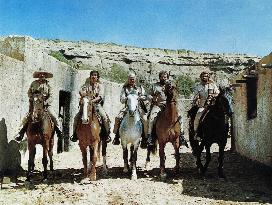
James Daly, Tetsuro Tanba, Peter Graves, Bud Spencer & Nino Castelnuovo Characters: Capt. Nicolas Augustus, Samurai, Dutchman, Mesito, Luis Dominguez Film: The Five Man Army (Un esercito di 5 uomini) It 1969, Director: Don Taylor, Italo Zingarelli 16 October 1969 Date: 16-Oct-69

  •  
NAGASAKI MAGISTRATE

NAGASAKI MAGISTRATE

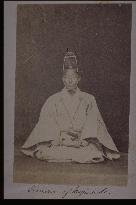
Taken by Beato. Written The Bugyo (magistrate) of Nagasaki . This official arrived in Nagasaki in May 1863 and became Nagasaki Bugyo from Metsuke and Konando Todori. He is Hattori Nagatonokami (Tsunesumi, Saemonsa) who left Nagasaki in January 1866.==Date:1864-6, Place:Nagasaki, Photo:F. Beato, (Credit:Nagasaki University Library/Kyodo News Images) [Cabinet Number17‐30‐0]

  •  
Seppuku,self-disembowelment

Seppuku,self-disembowelment

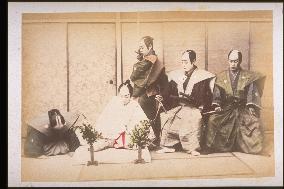
A dramatized photo of a samurai committing seppuku (ritual suicide) and wearing white garments, with the kaishaku (man to behead the samurai when too much pain occurs) and tachiai (witness) standing nearby.==Date:unknown, Place:unknown, Photo:unknown, (Credit:Nagasaki University Library/Kyodo News Images) [Cabinet Number16‐10‐0]

  •  
Costume of generals in the age of civil wars

Costume of generals in the age of civil wars

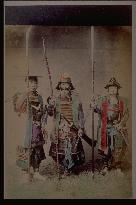
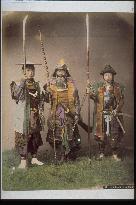
Three men dressed in full armour stand in a line and look toward the camera. The man on the left wears a hat and holds a halberd in his right hand. The man in the centre wears a helmet and holds a spear in his right hand and an arrow in his left. The man to the right wears a jingasa and holds a spear in his right hand.==Date:unknown, Place:unknown, Photo:unknown, (Credit:Nagasaki University Library/Kyodo News Images) [Cabinet Number15‐17‐0]

  •  
An actor in samurai attire

An actor in samurai attire

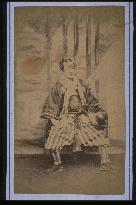
A sticker with the caption, Tokyo Asakusa Odaiji; Yokohama Bashamichi, photographer Uchida Kuichi is attached to the back of the photograph. This is one in a series of business-card-sized photographs depicting actors. An actor in samurai costume poses in front of a backdrop at the studio.==Date:unknown, Place:unknown, Photo:Uchida Kuichi, (Credit:Nagasaki University Library/Kyodo News Images) [Cabinet Number96‐27‐0]

  •  
A soldier in armour

A soldier in armour

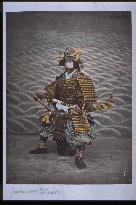
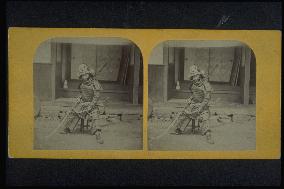
The domaru (torso guard) was used by samurai from the mid-Kamakura Period. The man strikes a stately pose in his kabuto war helmet, shoulder protectors, hitatare frontal armour and war shoes. By this time, however, armour was little more than an object for decoration.==Date:unknown, Place:unknown, Photo:Usui Shuzaburo, (Credit:Nagasaki University Library/Kyodo News Images) [Cabinet Number94‐28‐0]

  •  
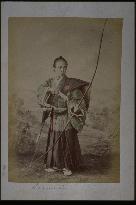
A samurai wearing hakama trousers and holding a bow

A samurai wearing hakama trousers and holding a bow

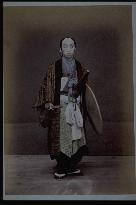
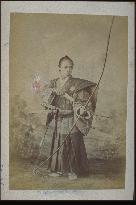
The man is wearing kamishimo ceremonial garb, an example of formal attire worn in the Edo Period. It consists of a stiff sleeveless robe and pleated loose-fitting trousers. It was worn over a crested robe or a short-sleeve kimono. The man has lowered the right shoulder portion of the kamishimo, apparently to draw a bow.==Date:unknown, Place:unknown, Photo:unknown, (Credit:Nagasaki University Library/Kyodo News Images) [Cabinet Number92‐31‐0]

  •  
A samurai warrior and his servant

A samurai warrior and his servant

This is one of the photographs in the album by Kashima Seibei. Although the English caption reads Samurai and Servant, this is a staged photograph of a samurai in official clothes. The child is pretending to be his servant. It looks very artificial.==Date:unknown, Place:unknown, Photo:unknown, (Credit:Nagasaki University Library/Kyodo News Images) [Cabinet Number84‐18‐0]

  •  
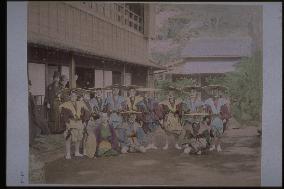
Samurai warriors in travelling attire

Samurai warriors in travelling attire

Twelve men in travel attire with swords at the waist pose for the camera. One man is holding a straw hat, and his head looks like that of a Buddhist priest. The men standing on the left wearing coats with family crests and derby hats are watching the travellers.==Date:unknown, Place:unknown, Photo:unknown, (Credit:Nagasaki University Library/Kyodo News Images) [Cabinet Number84‐14‐0]

  •  
A samurai warrior wearing hakama trousers

A samurai warrior wearing hakama trousers

This is a photograph from an album by Farsari & Co. Entitled SAMURAI, it was staged with a man wearing a kamishimo vest and hakama trousers. He carries a samurai's big and small swords and holds a fan in his hand. The scene is altogether artificial.==Date:unknown, Place:unknown, Photo:A. Farsari, (Credit:Nagasaki University Library/Kyodo News Images) [Cabinet Number82‐60‐0]

  •  
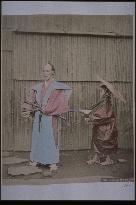
Samurai warriors

Samurai warriors

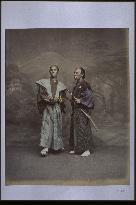
This photograph of two samurai comes from the album Views & Costumes by Stillfried & Andersen. The backdrop belongs to Stillfried's studio. Both samurai are wearing official hakama trousers and vests with family crests. The man on the left is wearing high geta clogs for rainy weather.==Date:unknown, Place:unknown, Photo:R. Stillfried, (Credit:Nagasaki University Library/Kyodo News Images) [Cabinet Number78‐70‐0]

  •  
Soldiers in armour

Soldiers in armour

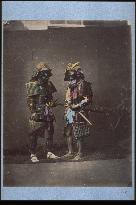
The men are wearing the armour of the time. It includes the torso protector, a throwback to older times. The armour consists of a helmet and protectors for the shoulders, upper arms, arms, thighs, mouth, jaw, and throat. However, the footwear of the man on the right is unnatural because he should be wearing socks made from deer skin or wood.==Date:unknown, Place:unknown, Photo:R. Stillfried, (Credit:Nagasaki University Library/Kyodo News Images) [Cabinet Number76‐28‐0]

  •  
A soldier in armour

A soldier in armour

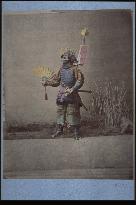
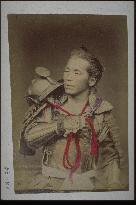
The man is wearing a set of armour that may be the military attire of the time. The flag on his back is held in a tube. From the medieval period, military commanders ordered soldiers to carry the flag in this fashion as an emblem. The man holds a fan in his right hand.==Date:unknown, Place:unknown, Photo:R. Stillfried, (Credit:Nagasaki University Library/Kyodo News Images) [Cabinet Number76‐27‐0]

  •  
A samurai warrior

A samurai warrior

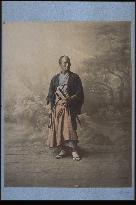
This is the same as photograph #3084 but comes from the 1876 album of Stillfried. A comparison of the two photographs reveals that the hakama trousers are green in 3084 and red in this photograph, while the kimono is red in 3084 but purple in this one. It is interesting to see the differences in colouring.==Date:unknown, Place:unknown, Photo:R. Stillfried, (Credit:Nagasaki University Library/Kyodo News Images) [Cabinet Number76‐21‐0]

  •  
A man wearing hakama (traditional trousers)

A man wearing hakama (traditional trousers)

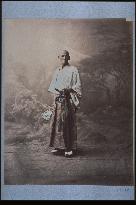
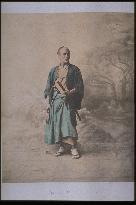
A man holds a fan in his right hand, a sword in his left hand, and a short sword at the waist. The short coat and pleated trousers were the typical casual attire of samurai.==Date:unknown, Place:unknown, Photo:R. Stillfried, (Credit:Nagasaki University Library/Kyodo News Images) [Cabinet Number76‐20‐0]

  •  
A mother and her son

A mother and her son

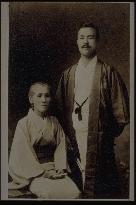
A man poses with a woman, probably with his mother. Both are well dressed. The woman wears the kimono with perfect grace, the collar area well closed. Her posture and clothing indicate that she is from a samurai family. The man appears to hold an important post with his company or in government.==Date:unknown, Place:Tokyo, Photo:unknown, (Credit:Nagasaki University Library/Kyodo News Images) [Cabinet Number72‐99‐2]

  •  
A mother and her son

A mother and her son

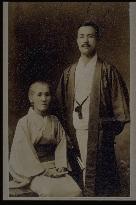
A man poses with a woman, probably with his mother. Both are well dressed. The woman wears the kimono with perfect grace, the collar area well closed. Her posture and clothing indicate that she is from a samurai family. The man appears to hold an important post with his company or in government.==Date:unknown, Place:Tokyo, Photo:unknown, (Credit:Nagasaki University Library/Kyodo News Images) [Cabinet Number72‐99‐0]

  •  
Battle between armed soldiers

Battle between armed soldiers

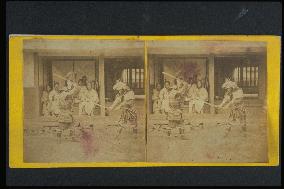
A battle scene is re-enacted by two men wearing the armour of the time. The spectators in the back suggest that this is a demonstration. The man on the left assumes the chudan stance and the man on the right the jodan stance.==Date:unknown, Place:unknown, Photo:Pierre Rossier, (Credit:Nagasaki University Library/Kyodo News Images) [Cabinet Number70‐14‐0]

  •  
A soldier in armour

A soldier in armour

This armour seems to be a domaru or torso protector. The man has two swords on the waist and seems to be holding a naginata (halberd). A nichirin orb is attached to the front of the helmet.==Date:unknown, Place:unknown, Photo:Pierre Rossier, (Credit:Nagasaki University Library/Kyodo News Images) [Cabinet Number70‐3‐0]

  •  
A samurai warrior in travelling gear

A samurai warrior in travelling gear

This is one of the loose photographs from a Yokohama album. It shows a samurai in travelling clothes but seems to have been staged with the help of a Kabuki actor. The man is wearing too many layers of kimono to be a traveller.==Date:unknown, Place:unknown, Photo:unknown, (Credit:Nagasaki University Library/Kyodo News Images) [Cabinet Number69‐41‐0]

  •  
Soldiers in armour

Soldiers in armour

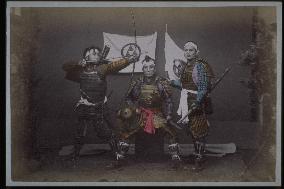
Each of the three men is wearing a set of armour of the time. The man on the left is carrying arrows on his back and pulling a bow. The family crest on the flag held by the man to the right is the famous kutsuwa or Greek cross of the Shimazu Clan. The flag in the centre with three imbricate patterns in a circle is the family crest of the Hojo Clan.==Date:unknown, Place:unknown, Photo:unknown, (Credit:Nagasaki University Library/Kyodo News Images) [Cabinet Number69‐33‐0]

  •  
A woman in male attire

A woman in male attire

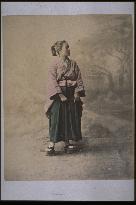
A woman is dressed in samurai costume. She has side locks and a sword at her waist and wears a pair of wooden clogs. This is a photograph of a woman dressed as a dignified man.==Date:unknown, Place:unknown, Photo:R. Stillfried, (Credit:Nagasaki University Library/Kyodo News Images) [Cabinet Number63‐9‐0]

  •  
A samurai warrior

A samurai warrior

This is a studio photograph of a samurai wearing a haori jacket (with a family crest) and hakama pants. Japan 1881 is penciled in. The backdrop suggests that it is from the Stillfried album. The samurai may be holding an imitation wooden sword. He also has a fan in his hand. On the back of the photograph is a photograph of Alexandria by Felix Bonfils.==Date:unknown, Place:unknown, Photo:R. Stillfried, (Credit:Nagasaki University Library/Kyodo News Images) [Cabinet Number63‐6‐0]

  •  
A soldier in armour

A soldier in armour

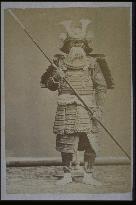
This armour seems to be a domaru or torso protector. It was a simple one originally used by foot soldiers in the medieval Japan. But when a long sleeve garment and helmet were added, military commanders started to wear them. In this photograph, the soldier wears a face protector under the helmet, hand protectors, shin protectors and holds a long spear.==Date:unknown, Place:unknown, Photo:unknown, (Credit:Nagasaki University Library/Kyodo News Images) [Cabinet Number55‐24‐5]

  •  
Samurai and women greeting each other

Samurai and women greeting each other

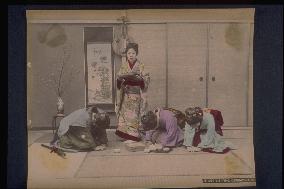
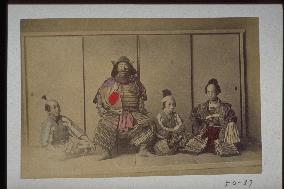
The man has placed his sword to the right and is exchanging greetings with two women in front of an alcove with a hanging scroll. They have one hand placed over the other. The English title reads VISITING CEREMONIALS. A gekkin (moon lute) is hanging on the alcove pillar.==Date:unknown, Place:unknown, Photo:unknown, (Credit:Nagasaki University Library/Kyodo News Images) [Cabinet Number51‐138‐0]

  •  
Soldiers in armour

Soldiers in armour

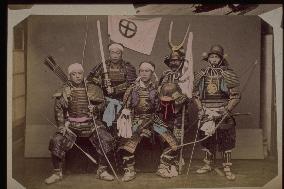
The men are wearing armour that seems to be the military attire of the time. The gold circle and design on the torso protector of the man on the right seems to be a family crest. The man second from right is wearing a helmet with a frontal ornament called a tentsuki. The man in the centre holds a baton of command, a tool used to give orders on the battlefield. The man second from left stands with a flag bearing his family crest and holds a bow and sword. This seems to a photograph from an exhibition of battle attire.==Date:unknown, Place:unknown, Photo:unknown, (Credit:Nagasaki University Library/Kyodo News Images) [Cabinet Number51‐14‐0]

  •  
A man in armour

A man in armour

A man wearing a set of armour. He has kote on his arm, and there is a large decorative object on the front of his helmet.==Date:unknown, Place:unknown, Photo:unknown, (Credit:Nagasaki University Library/Kyodo News Images) [Cabinet Number50‐43‐0]

  •  
A commander in armour and his men

A commander in armour and his men

The man on the right is wearing a jinbaori jacket over the armour of the time. The man next to him is wearing the kind of headgear worn under the helmet during battle. He is holding a fan with the rising sun design.==Date:unknown, Place:unknown, Photo:unknown, (Credit:Nagasaki University Library/Kyodo News Images) [Cabinet Number50‐37‐0]

  •  
A samurai wearing hakama trousers and holding a bow

A samurai wearing hakama trousers and holding a bow

The man is wearing kamishimo ceremonial garb, an example of formal attire worn in the Edo Period. It consists of a stiff sleeveless robe and pleated loose-fitting trousers. It was worn over a crested robe or a short-sleeve kimono. The man has lowered the right shoulder portion of the kamishimo, apparently to draw a bow.==Date:unknown, Place:unknown, Photo:unknown, (Credit:Nagasaki University Library/Kyodo News Images) [Cabinet Number50‐26‐0]

  •  
The dress of a warrior leaving for battle

The dress of a warrior leaving for battle

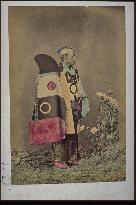
Despite the title, this attire was worn by samurai in the Edo Period for other purposes such as fire-fighting and security patrols. The object in the man's right hand is probably a paper hood made by the lacquered papier-m?ch? method. He is wearing a fire-fighting coat, a waist sash, outdoor culottes, and an apron. On his feet are a pair of leather socks.==Date:unknown, Place:unknown, Photo:unknown, (Credit:Nagasaki University Library/Kyodo News Images) [Cabinet Number50‐21‐0]

  •  
Duel of soldiers in wartime

Duel of soldiers in wartime

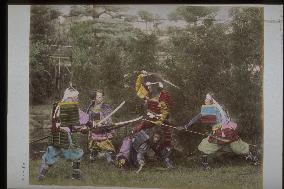
A photo reviving the warriors at war. The central warrior is attacked by those with spears and swords. The man to the fore had been beaten?==Date:unknown, Place:unknown, Photo:Ogawa Kazumasa, (Credit:Nagasaki University Library/Kyodo News Images) [Cabinet Number45‐12‐0]

  •  
Painting of a tycoon and his wife

Painting of a tycoon and his wife

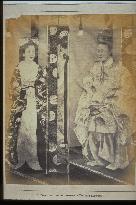
A portrait of the shogun in formal attire wearing eboshi (head gear worn by nobles in court dress) and kariginu (silk garment worn traditionally by nobles or court officials) and his wife wearing a long overgarment and hair done in Japanese style.==Date:unknown, Place:unknown, Photo:unknown, (Credit:Nagasaki University Library/Kyodo News Images) [Cabinet Number18‐44‐0]

  •  
Statue of buddha in the fields of nara

Statue of buddha in the fields of nara

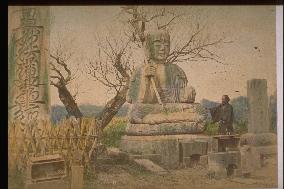
Details unknown. A man wearing kimono and a top-knot stands next to the stone Buddha whose height is approximately 5 meters.==Date:unknown, Place:Nara, Photo:unknown, (Credit:Nagasaki University Library/Kyodo News Images) [Cabinet Number14‐22‐0]

  •  
Dancing children

Dancing children

Two young women dance dressed as a woman and a man. The woman dressed as a man is a warrior with haori, hakama and a wooden sword. The other woman wears an courtesan costume and holds a stick to compete with the woman dressed as a man.==Date:unknown, Place:unknown, Photo:unknown, (Credit:Nagasaki University Library/Kyodo News Images) [Cabinet Number12‐48‐0]

  •  
The Chokugaku-mon Gate of Bunsho-in Reibyo, Zojoji Temple, Shiba

The Chokugaku-mon Gate of Bunsho-in Reibyo, Zojoji Temple, Shiba

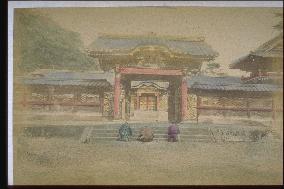
Bunshoin, the tomb of the sixth Shogun Tokugawa Ienobu. The man in the centre bowing down seems to be a samurai. The men on both sides are probably servants.==Date:unknown, Place:Tokyo, Photo:unknown, (Credit:Nagasaki University Library/Kyodo News Images) [Cabinet Number12‐5‐0]

  •  
Soldiers in armour

Soldiers in armour

Entitled Samurais in armor in English and German. Three men wear combat armor (body vest, hat, coat and sword). They each hold a spear, bow and a long sword. This is a dramatized photo of Japanese samurai dressed for war.==Date:unknown, Place:unknown, Photo:Kusakabe Kinbei, (Credit:Nagasaki University Library/Kyodo News Images) [Cabinet Number1‐14‐0]

  •  
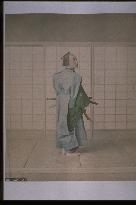
Samurai wearing nagabakama,long trousers

Samurai wearing nagabakama,long trousers

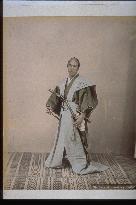
Samurai standing dressed in formal kamishimo and long trousers, holding a sword and fan. Hanagoza is spread on the floor. The handwritten caption reads Samurai mid hari-kiri and katana.==Date:unknown, Place:unknown, Photo:Kusakabe Kinbei, (Credit:Nagasaki University Library/Kyodo News Images) [Cabinet Number1‐13‐0]

  •  
Nakahara Naosuke, a Samurai from Satsuma

Nakahara Naosuke, a Samurai from Satsuma

This is a samurai from Satsuma, Nakahara Naosuke (1832-68). After assisting in the manufacturing of steam boats and kiriko glassware at Shuseikan in Satsuma Domain, he went to Tokyo and learned the canon gunnery from Egawa Tan'an. He eventually became the head of the Egawa School. After returning to Satsuma, he helped the navy to build canons. Unfortunately, he was killed in Nagaoka during the Boshin War. It is reported that he would have become a man of exceptional talent like Saigo or Okubo if he had lived. At the time this photo was taken, he seemed to have been visiting the Bauduins representing Satsuma.==Date:1866, Place:nagasaki, Photo:A.F. Bauduin, (Credit:Nagasaki University Library/Kyodo News Images) [Cabinet Number123‐46‐0]

  •  
Baseball: Otani to be removed from WBC roster

Baseball: Otani to be removed from WBC roster

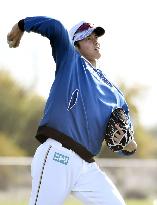
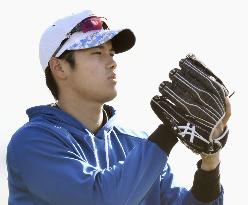
Nippon Ham Fighters pitcher-designated hitter Shohei Otani plays catch at the team's training camp in Peoria, Arizona, on Feb. 2, 2017. Otani will be taken off the 28-man roster for the upcoming World Baseball Classic, Samurai Japan skipper Hiroki Kokubo said Feb. 3. (Kyodo) ==Kyodo

  •  
Baseball: Otani to be removed from WBC roster

Baseball: Otani to be removed from WBC roster

Nippon Ham Fighters pitcher-designated hitter Shohei Otani plays catch at the team's training camp in Peoria, Arizona, on Feb. 2, 2017. Otani will be taken off the 28-man roster for the upcoming World Baseball Classic, Samurai Japan skipper Hiroki Kokubo said Feb. 3. (Kyodo) ==Kyodo

  •  
Baseball: Otani to be removed from WBC roster

Baseball: Otani to be removed from WBC roster

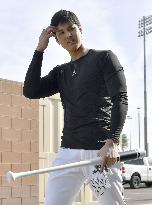
Nippon Ham Fighters pitcher-designated hitter Shohei Otani leaves after indoor hitting practice at the team's training camp in Peoria, Arizona, on Feb. 2, 2017. Otani will be taken off the 28-man roster for the upcoming World Baseball Classic, Samurai Japan skipper Hiroki Kokubo said Feb. 3. (Kyodo) ==Kyodo

  •  
Traditional ceremony in nuclear disaster-hit city

Traditional ceremony in nuclear disaster-hit city

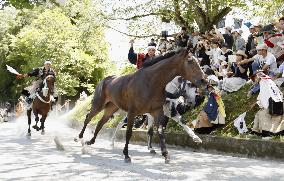
A man in the garb of a samurai warrior drives a horse into a shrine during a traditional ceremony on July 25, 2016, in the northeastern Japan city of Minamisoma, which has been affected by the 2011 nuclear disaster at the Fukushima Daiichi complex. Evacuation orders have been lifted in most areas of the city recently. (Kyodo) ==Kyodo

  • Main
  • Top
  • Editorial
  • Creative
  • About Us
  • About ILG
  • Terms of use
  • Company
  • BEHIND
  • Price List
  • Single Plan
  • Monthly Plan
  • Services
  • Shooting
  • Rights Clearance
  • Support
  • FAQ
  • How To Buy
  • Contact Us
  • Become a Partner

© KYODO NEWS IMAGES INC

All Rights Reserved.

  • Editorial
  • Olympics
  • News
  • Sports
  • Japan
  • Tech
  • Royal
  • Disaster
  • NorthKorea
  • Old Japan
  • SNS
  • Creative
  • Food
  • Japan
  • Landscape
  • Animal
  • Popular
  • #Ukraine
  • #Thailand
  • #coronavirus
  • #N. Korea
  • #Russia
  • #China
  • #Ukraine
  • #Thailand
  • #coronavirus
  • #N. Korea
  • #Russia
  • #China
  • Food
  • Japan
  • Landscape
  • Animal
  • Olympics
  • News
  • Sports
  • Japan
  • Tech
  • Royal
  • Disaster
  • NorthKorea
  • Old Japan
  • SNS