•  
S. Korean scholar says Japan's 1905 annexation of islets imperialism

S. Korean scholar says Japan's 1905 annexation of islets imperialism

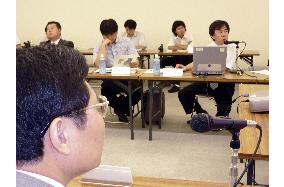
MATSUE, Japan - Choi Jang Geun (R), a full-time lecturer at South Korea's Daegu University, and Masao Shimojo, professor at Takushoku University in Tokyo, debate the territorial issue over a rocky islet chain in the Sea of Japan at a panel discussion organized by the the Shimane prefectural government in Matsue on July 25.

  •  
Ex-Japan army soldier recalls hide-out life on Philippine island

Ex-Japan army soldier recalls hide-out life on Philippine island

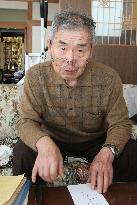
Tsukasa Shimojo, a former member of the Imperial Japanese Army, talks at his home in Rankoshi, Hokkaido Prefecture, northern Japan, on Feb. 18, 2015, about his life in a jungle hide-out on the Philippine island of Panay during World War II. (Kyodo) ==Kyodo

  •  
S. Korean scholar says Japan's 1905 annexation of islets imperia

S. Korean scholar says Japan's 1905 annexation of islets imperia

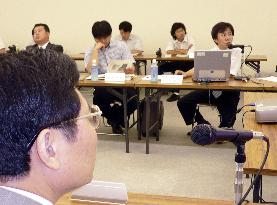
MATSUE, Japan - Choi Jang Geun (R), a full-time lecturer at South Korea's Daegu University, and Masao Shimojo, professor at Takushoku University in Tokyo, debate the territorial issue over a rocky islet chain in the Sea of Japan at a panel discussion organized by the the Shimane prefectural government in Matsue on July 25. (Kyodo)

  •  
Niju-bashi Bridge,the Imperial Palace

Niju-bashi Bridge,the Imperial Palace

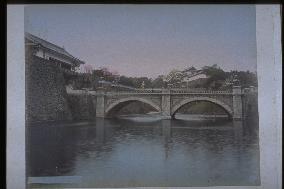
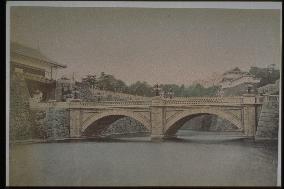
Kakumon Bridge spanning the inner moat (Nijubashi Moat) is said to have been built during the Kansei Period (1789-1801). During the Edo and Meiji Periods, the bridge in the foreground was called Nishinomaru Ote-bashi and the one behind it Nishinomaru Shimojo-bashi. The names currently used by the Imperial House Agency are Imperial Palace Main Gate Stone Bridge and Imperial Palace Main Gate Iron Bridge, respectively. Since 1948, commoners have been allowed to cross these bridges on January 2 and on the Emperor's birthday. Mid-Meiji Period.==Date:unknown, Place:Tokyo, Photo:unknown, (Credit:Nagasaki University Library/Kyodo News Images) [Cabinet Number88‐36‐0]

  •  
Niju-bashi Bridge,the Imperial Palace

Niju-bashi Bridge,the Imperial Palace

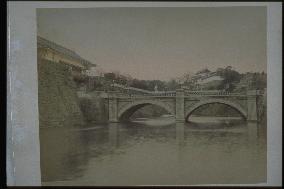
Kakumon Bridge spanning the inner moat (Nijubashi Moat) is said to have been built during the Kansei Period (1789-1801). During the Edo and Meiji Periods, the bridge in the foreground was called Nishinomaru Ote-bashi and the one behind it Nishinomaru Shimojo-bashi. The names currently used by the Imperial House Agency are Imperial Palace Main Gate Stone Bridge and Imperial Palace Main Gate Iron Bridge, respectively. Since 1948, commoners have been allowed to cross these bridges on January 2 and on the Emperor's birthday. Mid-Meiji Period.==Date:unknown, Place:Tokyo, Photo:unknown, (Credit:Nagasaki University Library/Kyodo News Images) [Cabinet Number87‐1‐0]

  •  
The Imperial Palace

The Imperial Palace

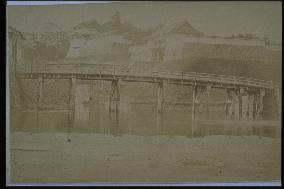
Nishinomaru Ote Bridge and Nishinomaru Shimojo Bridge seen from Nishinomaru Shita (present-day Imperial Palace Outer Garden). Nishinomaru Shimojo Bridge featured rare two-stage girders because of a deep moat. Thus, it was called Niju-bashi (double level bridge). The gate on the left is Nishinomaru Ote-mon. The gate on the right is Nishinomaru Shoinmae-mon. Next to it are Jurokken Tamon and Fushimi watchtower. Taken at the beginning of the Meiji Period.==Date:unknown, Place:Tokyo, Photo:unknown, (Credit:Nagasaki University Library/Kyodo News Images) [Cabinet Number69‐74‐2]

  •  
Niju-bashi Bridge,the Imperial Palace

Niju-bashi Bridge,the Imperial Palace

Ote Bridge of Nishinomaru (foreground) was replaced with an arched stone bridge in 1887. Although it is hidden behind the stone bridge, Nishinomaru Shimojo-bashi was replaced with an iron bridge in October 1888 at the time of the construction of new palace buildings. Ornamental lamps were installed for the first time here. (One of these is preserved at the Meiji Village theme park). The present-day Nishinomaru Shimojo-bashi Bridge was rebuilt in a similar design in 1964. The watchtower on the right was transferred from Fushimi Castle in Kyoto and re-named Fushimi Yagura. Mid-Meiji Period.==Date:unknown, Place:Tokyo, Photo:unknown, (Credit:Nagasaki University Library/Kyodo News Images) [Cabinet Number53‐41‐0]

  •  
Tennis: U.S. Open

Tennis: U.S. Open

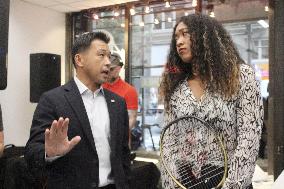
Naomi Osaka talks with Noriomi Shimojo, an official of sports equipment maker and her sponsor Yonex Co. in New York on Aug. 23, 2019, three days ahead of the U.S. Open. Shimojo, 46, is in charge of providing rackets and other tennis equipment to the Japanese tennis player. (Kyodo) ==Kyodo

  •  
Tennis: U.S. Open

Tennis: U.S. Open

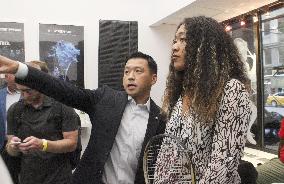
Naomi Osaka talks with Noriomi Shimojo, an official of sports equipment maker and her sponsor Yonex Co. in New York on Aug. 23, 2019, three days ahead of the U.S. Open. Shimojo, 46, is in charge of providing rackets and other tennis equipment to the Japanese tennis player. (Kyodo) ==Kyodo

  • Main
  • Top
  • Editorial
  • Creative
  • About Us
  • About ILG
  • Terms of use
  • Company
  • BEHIND
  • Price List
  • Single Plan
  • Monthly Plan
  • Services
  • Shooting
  • Rights Clearance
  • Support
  • FAQ
  • How To Buy
  • Contact Us
  • Become a Partner

© KYODO NEWS IMAGES INC

All Rights Reserved.

  • Editorial
  • Olympics
  • News
  • Sports
  • Japan
  • Tech
  • Royal
  • Disaster
  • NorthKorea
  • Old Japan
  • SNS
  • Creative
  • Food
  • Japan
  • Landscape
  • Animal
  • Popular
  • #Ukraine
  • #Thailand
  • #coronavirus
  • #N. Korea
  • #China
  • #Russia
  • #Ukraine
  • #Thailand
  • #coronavirus
  • #N. Korea
  • #China
  • #Russia
  • Food
  • Japan
  • Landscape
  • Animal
  • Olympics
  • News
  • Sports
  • Japan
  • Tech
  • Royal
  • Disaster
  • NorthKorea
  • Old Japan
  • SNS