•  
Nagasaki Habour seen from Mt. Hoshitori

Nagasaki Habour seen from Mt. Hoshitori

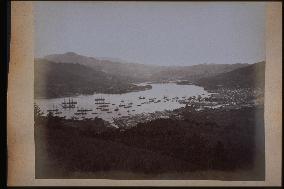
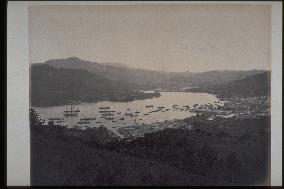
Nagasaki Port viewed from Mt. Hoshitori (Mt. Ohira at the time of the photo) overlooking the Oura foreign settlement. The promenade by Dejima built in 1867 and a corral for horses can be seen. Shinchi is to its right and the British Consulate is behind the foreign settlement. At the mouth of Urakami River in the back of the bay lies Urakami-Shinden (present-day Mori-machi). Since Dejima-Shinbashi Bridge built in 1869 is not visible, this photo must have been taken around 1868.==Date:about 1868, Place:Nagasaki, Photo: F. Beato, (Credit:Nagasaki University Library/Kyodo News Images)

  •  
Mt. Fuji seen from Kashiwabara

Mt. Fuji seen from Kashiwabara

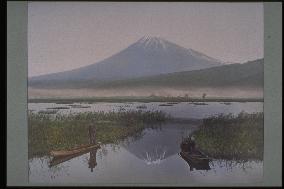
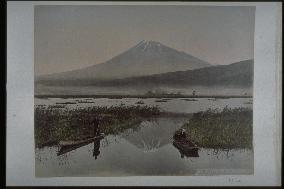
Northern view of a slightly snow-capped Mt. Fuji from Ukishimanuma (Floating Island Bog) near Kashiwabara-Shinden in Fuji City. The water from the bog becomes Numa River and flows into Tagonoura. Mt. Fuji is reflected on the surface of the bog. Two boats, one with a man standing and the other with a man sitting, are visible. Islands are visible in the background. Taken by Mizuno Hanbei.==Date:unknown, Place:Shizuoka, Photo:Mizuno Hanbei, (Credit:Nagasaki University Library/Kyodo News Images) [Cabinet Number96‐44‐0]

  •  
Nokendo

Nokendo

Nokendo was known as the best place to view the eight famous scenes of Kanagawa, but the scenery was gradually spoiled after the reclamation of Deiki Shinden from the sea, and the focus of popularity shifted to Kyurantei. The Nokendo temple buildings were lost in a fire in 1871, and presently only the stone monument remains.==Date:unknown, Place:Yokohama, Photo:Usui Shuzaburo, (Credit:Nagasaki University Library/Kyodo News Images) [Cabinet Number94‐30‐0]

  •  
Mt. Fuji seen from Kashiwabara

Mt. Fuji seen from Kashiwabara

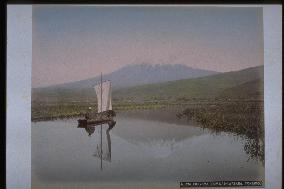
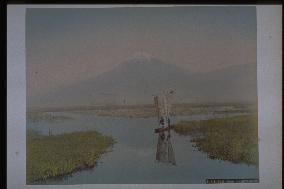
Northern view of the snow-capped peak of Mt. Fuji from Ukishimanuma (Floating Island Bog) near Kashiwabara-Shinden in Fuji City. The water from the pond becomes Numa River and flows into Tagonoura. The area surrounding Ukishimanuma Pond was a marsh called Ukishimagahara. People moved around by boat, creating a water traffic network. Two men are riding a river boat with sail, and Mt. Fuji is reflected upside down on the pond.==Date:unknown, Place:Shizuoka, Photo:unknown, (Credit:Nagasaki University Library/Kyodo News Images) [Cabinet Number88‐37‐0]

  •  
Viewing cherry blossoms at Koganei Banks

Viewing cherry blossoms at Koganei Banks

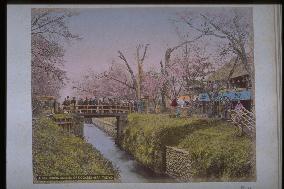
People are enjoying the cherry blossoms from Koganei Bridge. The most beautiful scenery stretched for two kilometers upstream and two kilometers downstream from the bridge. It is not clear when the cherry trees were planted at Tamagawa Waterway because different documents give different dates. However, the Koganei Cherry Tree Monument (still existing near Koganei Bridge) puts it at 1737. Records show that Kawasaki Heiemon Sadataka, the caretaker of Musashino Shinden, and others planted cherry trees on both sides of the waterway near Koganei Bridge. Taken around 1897.==Date:about 1897, Place:Tokyo, Photo:unknown, (Credit:Nagasaki University Library/Kyodo News Images) [Cabinet Number88‐33‐0]

  •  
Mt. Fuji seen from Kashiwabara

Mt. Fuji seen from Kashiwabara

Northern view of a slightly snow-capped Mt. Fuji from Ukishimanuma (Floating Island Bog) near Kashiwabara-Shinden in Fuji City. The water from the bog becomes Numa River and flows into Tagonoura. Mt. Fuji is reflected on the surface of the bog. Two boats, one with a man standing and the other with a man sitting, are visible. Islands are visible in the background. Taken by Mizuno Hanbei.==Date:unknown, Place:Shizuoka, Photo:Mizuno Hanbei, (Credit:Nagasaki University Library/Kyodo News Images) [Cabinet Number87‐32‐0]

  •  
Mt. Fuji seen from Kashiwabara

Mt. Fuji seen from Kashiwabara

Northern view of the snow-capped peak of Mt. Fuji from Ukishimanuma (Floating Island Bog) near Kashiwabara-Shinden in Fuji City. The water from the bog becomes Numa River and flows into Tagonoura harbour. The area surrounding Ukishimanuma was a marsh called Ukishimagahara. People moved around by boat, creating a water traffic network. Two men are riding a river boat with a sail.==Date:unknown, Place:Shizuoka, Photo:A. Farsari, (Credit:Nagasaki University Library/Kyodo News Images) [Cabinet Number81‐23‐0]

  •  
The Horiwari River,Yokohama

The Horiwari River,Yokohama

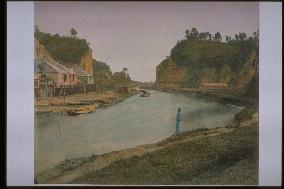
The Horiwari Waterway, connecting the Nakamura River with Takito, was completed in 1874. It made river boat traffic on the Nakamura River, O'oka River and Yoshida River possible in addition to providing mud to fill in Yoshida Shinden The building on the left could be an oil storeroom.==Date:unknown, Place:Yokohama, Photo:unknown, (Credit:Nagasaki University Library/Kyodo News Images) [Cabinet Number64‐68‐0]

  •  
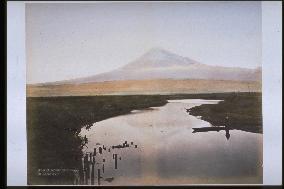
Mt. Fuji seen from Numakawa,Tagonoura

Mt. Fuji seen from Numakawa,Tagonoura

Northern view of Mt. Fuji from Ukishimanuma (Floating Island Bog) near Kashiwabara-Shinden in Fuji City. Ukishimagahara is the land surrounding Ukishimanuma Bog. The water from the bog becomes Numa River and flows into Tagonoura harbour. This photograph was taken near the origin of Numa River, with Mt. Fuji reflected upside down on the bog. The foot of Mt. Fuji is tinted roughly. There is a small boat on the right, and many wooden posts are visible on the left.==Date:unknown, Place:Shizuoka, Photo:unknown, (Credit:Nagasaki University Library/Kyodo News Images) [Cabinet Number64‐62‐0]

  •  
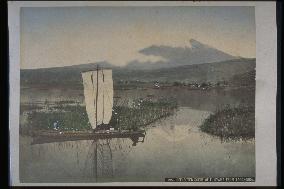
Mt. Fuji seen from Numakawa,Tagonoura

Mt. Fuji seen from Numakawa,Tagonoura

Northern view of Mt. Fuji from Ukishimanuma (Floating Island Bog) near Kashiwabara-Shinden in Fuji City. Ukishimanuma was formerly a stretch of low land between the southern foot of Mt. Fuji/Mt. Ashitaka and Suruga Bay. It flows into Numa River and Tagonoura harbour. Mt. Fuji and a sailboat are reflected on the pond. A man is on a small craft, with small islands scattered in the background.==Date:unknown, Place:Shizuoka, Photo:unknown, (Credit:Nagasaki University Library/Kyodo News Images) [Cabinet Number59‐48‐0]

  •  
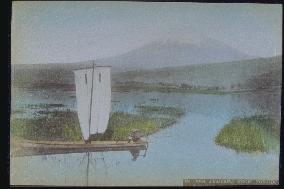
Mt. Fuji seen from Numakawa,Tagonoura

Mt. Fuji seen from Numakawa,Tagonoura

Northern view of Mt. Fuji from Ukishimanuma (Floating Island Bog) near Kashiwabara-Shinden in Fuji City. Ukishimanuma was formerly a stretch of low land between the southern foot of Mt. Fuji/Mt. Ashitaka and Suruga Bay. It flows into Numa River and Tagonoura harbour. Mt. Fuji and a sailboat are reflected on the pond. A man is on a small craft, with small islands scattered in the background.==Date:unknown, Place:Shizuoka, Photo:unknown, (Credit:Nagasaki University Library/Kyodo News Images) [Cabinet Number59‐8‐2]

  •  
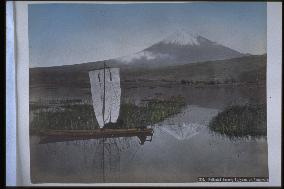
Mt. Fuji seen from Numakawa,Tokaido Road

Mt. Fuji seen from Numakawa,Tokaido Road

Northern view of snow-capped Mt. Fuji from Ukishimanuma (Floating Island Pond) around Kashiwabara-Shinden in Fuji City. The water from the pond becomes Numa River and flows into Tagonoura. The area surrounding Ukishimanuma Pond was marshland called Ukishimagahara. Water traffic increased there as people moved around by riverboats. A man sits on the sailboat.==Date:unknown, Place:Shizuoka, Photo:Tamamura Kozaburo, (Credit:Nagasaki University Library/Kyodo News Images) [Cabinet Number48‐98‐0]

  •  
Nagasaki Habour seen from Mt. Hoshitori

Nagasaki Habour seen from Mt. Hoshitori

Nagasaki Port viewed from Mt. Hoshitori (called Mt. Ohira at the time of the photo), overlooking the Oura foreign settlement. The promenade, built in 1867, around Dejima and the corral are visible. Shinchigura storehouse is to the right of that, the British Consulate behind the settlement. At the mouth of the Urakami River in the back of the bay lies Urakami-Shinden (present-day Mori-machi). Since the Dejima-Shinbashi Bridge, built in 1869, is not in the picture, this photo is presumed to have been taken around 1868.==Date:about 1868, Place:Nagasaki, Photo:F. Beato, (Credit:Nagasaki University Library/Kyodo News Images) [Cabinet Number28‐23‐0]

  •  
Canal and houses in YOKOHAMA

Canal and houses in YOKOHAMA

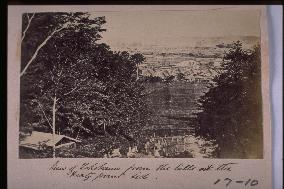
Taken by Beato. The caption is View of Yokohama from a sunny hill . This is a view of Yoshida Shinden from the Bluff. There is a cemetery with tombstones in the valley.==Date:unknown, Place:Yokohama, Photo:F. Beato, (Credit:Nagasaki University Library/Kyodo News Images) [Cabinet Number17‐10‐0]

  •  
Canal and houses at the back of YOKOHAMA

Canal and houses at the back of YOKOHAMA

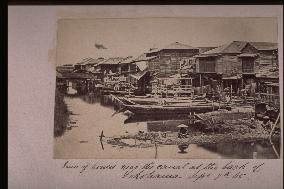
Written September 7, 1865 by Beato. In the distance to the left are the characters Within the Iwakame house . It is probably a brothel in Minatozaki-cho of Otaya Shinden Numachi at the back of the foreign settlement in Yokohama. It was destroyed in the fire of 1866 and moved to the Yoshida Shinden (presently the Shinyoshiwara Nakano-cho) the following year.==Date:1866, Place:Yokohama, Photo:F. Beato, (Credit:Nagasaki University Library/Kyodo News Images) [Cabinet Number17‐8‐0]

  •  
Canal from YOKOHAMA hillside

Canal from YOKOHAMA hillside

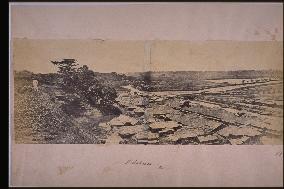
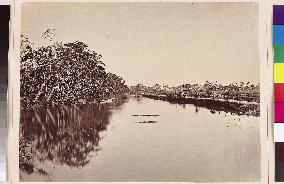
Written October 1865 by Beato. A view of Yoshida Shinden at the back of the settlement from the Bluff of Yokohama. In the hills to the left, a foreigner and a half-naked Japanese wearing a hat can be seen. The bridge is Kuruma Bridge, and the houses in the centre are Ishikawa Nakamura.==Date:1865, Place:Yokohama, Photo:F. Beato, (Credit:Nagasaki University Library/Kyodo News Images) [Cabinet Number17‐6‐0]

  •  
Kinkakuji Temple

Kinkakuji Temple

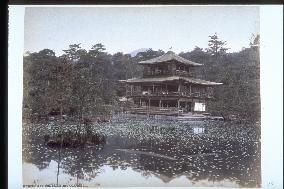
Kinkakuji in the Kita district of Kyoto city. A view of Kinkakuji Temple with the three-story building reflected on the surface of the Kyoko Pond. The first floor is done in shinden zukuri (Fujiwara palace style), the second is in Shoin zukuri (drawing-room style) and the third floor where the Buddha is enshrined is in Chinese style. The second and third floors are covered in gold, and thus the name of Kinkaku (Golden Pavilion). To the left is Ashibara island and Nakajima.==Date:unknown, Place:Kyoto, Photo:Ogawa Kazumasa, (Credit:Nagasaki University Library/Kyodo News Images) [Cabinet Number9‐30‐0]

  •  
Kinkakuji Temple

Kinkakuji Temple

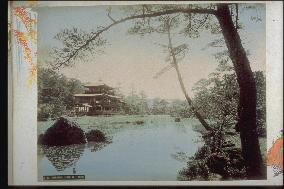
Kinkakuji in the Kita district of Kyoto city. The temple was a mountain cottage of the Saionji family from the Kamakura to the Nanboku period. It was bought by Ashikaga Yoshimitsu as his retirement spot . A garden with Kyoko Pond in the center. The shariden (the receptacle of Buddha's ashes) built by the pond can be seen to the left. The first floor of the shariden was made in shinden tsukuri (palace of the Fujiwara style of architecture), the second floor is of shoin tsukuri (drawing room style), and the third floor is done in Chinese style enshrining the Buddha. The second and third floors are covered with gold, thus the name of Kinkaku(Golden Pavilion). To the left are the garden stones and the pine of the bank to the right.==Date:unknown, Place:Kyoto, Photo:Ogawa Kazumasa, (Credit:Nagasaki University Library/Kyodo News Images) [Cabinet Number5‐44‐0]

  •  
The north part of the city of Nagasaki and Nagasaki Harbour

The north part of the city of Nagasaki and Nagasaki Harbour

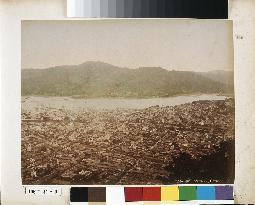
This photograph taken from Mt. Kazagashira captures the central part of Nagasaki and the elevated area where the Nagasaki Prefecture Office, Nagasaki City Hall and Daikoku-machi are situated, with Urakami Shinden on the right. The date is around 1887. Nakashima River is visible in the centre. This provides a view of the densely populated downtown area of Nagasaki city in the mid-Meiji Period.==Date:unknown, Place:Nagasaki, Photo:Tamamura Kozaburo, (Credit:Nagasaki University Library/Kyodo News Images) [Cabinet Number106‐41‐0]

  •  
A view of Yokohama from Mt. Noge

A view of Yokohama from Mt. Noge

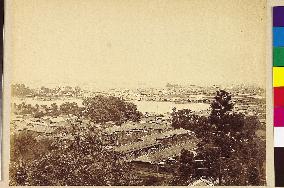
The town in the foreground is Noge-machi. The houses in rows are official residences of the Kanagawa magistrate's office. The town on the other side of the water is Irifune-machi, built on the embankment of Otaya Shinden. There are official residences in Benten-no-mori as well. The town of Yokohama stretches to the right.==Date:unknown, Place:Yokohama, Photo:F. Beato, (Credit:Nagasaki University Library/Kyodo News Images) [Cabinet Number104‐13‐0]

  •  
Yanagawa

Yanagawa

Taken in the early Meiji Period, this photograph shows the Urakami River just downstream from present-day Nagasaki. Urakami-Yamazato Village lay at the mouth of the river, and the downstream area was called Yanagawa at the time. The camera is looking upstream. Urakami Shinden (new fields) is on the right, and the Takenokubo area on the left. The scenery of the Urakami River area is captured before its reclamation from the harbour in 1897.==Date:unknown, Place:Nagasaki, Photo:Ueno Hikoma, (Credit:Nagasaki University Library/Kyodo News Images) [Cabinet Number102‐30‐0]

  • Main
  • Top
  • Editorial
  • Creative
  • About Us
  • About ILG
  • Terms of use
  • Company
  • BEHIND
  • Price List
  • Single Plan
  • Monthly Plan
  • Services
  • Shooting
  • Rights Clearance
  • Support
  • FAQ
  • How To Buy
  • Contact Us
  • Become a Partner

© KYODO NEWS IMAGES INC

All Rights Reserved.

  • Editorial
  • Olympics
  • News
  • Sports
  • Japan
  • Tech
  • Royal
  • Disaster
  • NorthKorea
  • Old Japan
  • SNS
  • Creative
  • Food
  • Japan
  • Landscape
  • Animal
  • Popular
  • #Ukraine
  • #Russia
  • #coronavirus
  • #N. Korea
  • #Thailand
  • #China
  • #Ukraine
  • #Russia
  • #coronavirus
  • #N. Korea
  • #Thailand
  • #China
  • Food
  • Japan
  • Landscape
  • Animal
  • Olympics
  • News
  • Sports
  • Japan
  • Tech
  • Royal
  • Disaster
  • NorthKorea
  • Old Japan
  • SNS