•  
NASA's MAVEN Spacecraft Acquired Stunning Views Of Mars

NASA's MAVEN Spacecraft Acquired Stunning Views Of Mars

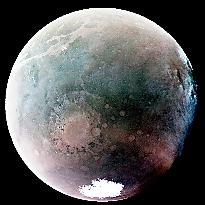
Handout photo - The first image was taken in July 2022 during the southern hemisphere’s summer season, which occurs when Mars passes closet to the Sun. The summer season is caused by the tilt of the planet’s rotational axis, similar to seasons on Earth. Argyre Basin, one of Mars’ deepest craters, appears at bottom left filled with atmospheric haze (depicted here as pale pink). Scientists have shown off the Red Planet in a new light with the unveiling of two incredible images of Mars. NASA’s MAVEN (Mars Atmosphere and Volatile EvolutioN) mission acquired "stunning views" of Mars in two ultraviolet images taken at different points along our neighbouring planet’s orbit around the Sun. By viewing the planet in ultraviolet wavelengths, scientists say they can gain insight into the Martian atmosphere and view surface features in remarkable ways. MAVEN’s Imaging Ultraviolet Spectrograph (IUVS) instrument obtained these global views of Mars in 2022 and 2023 when the planet was near opposite ends of its elliptical orb

  •  
NASA's MAVEN Spacecraft Acquired Stunning Views Of Mars

NASA's MAVEN Spacecraft Acquired Stunning Views Of Mars

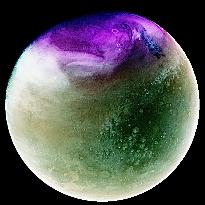
Handout photo - The second image is of Mars’ northern hemisphere and was taken in January 2023 after Mars had passed the farthest point in its orbit from the Sun. The rapidly changing seasons in the north polar region cause an abundance of white clouds. The deep canyons of Valles Marineris can be seen in tan at lower left, along with many craters. Scientists have shown off the Red Planet in a new light with the unveiling of two incredible images of Mars. NASA’s MAVEN (Mars Atmosphere and Volatile EvolutioN) mission acquired "stunning views" of Mars in two ultraviolet images taken at different points along our neighbouring planet’s orbit around the Sun. By viewing the planet in ultraviolet wavelengths, scientists say they can gain insight into the Martian atmosphere and view surface features in remarkable ways. MAVEN’s Imaging Ultraviolet Spectrograph (IUVS) instrument obtained these global views of Mars in 2022 and 2023 when the planet was near opposite ends of its elliptical orbit. Photo by NASA/LASP/CU Boul

  •  
View Of Comet Helps Solve Mystery Of Earth's Abundant Water

View Of Comet Helps Solve Mystery Of Earth's Abundant Water

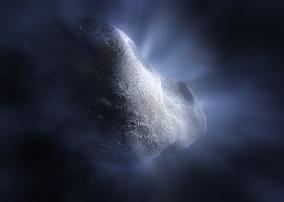
Handout - This artist’s concept of Comet 238P/Read shows the main belt comet sublimating—its water ice vaporising as its orbit approaches the Sun. This is significant, as the sublimation is what distinguishes comets from asteroids, creating their distinctive tail and hazy halo, or coma. The James Webb Space Telescope’s detection of water vapor at Comet Read is a major benchmark in the study of main belt comets, and in the broader investigation of the origin of Earth’s abundant water. NASA's James Webb Space Telescope has enabled another long-sought scientific breakthrough, this time for solar system scientists studying the origins of Earth's abundant water. Using Webb's NIRSpec (Near-Infrared Spectrograph) instrument, astronomers have confirmed gas – specifically water vapor – around a comet in the main asteroid belt for the first time, indicating that water ice from the primordial solar system can be preserved in that region. Comet Read is a main belt comet – an object that resides in the main asteroid belt

  •  
View Of Comet Helps Solve Mystery Of Earth's Abundant Water

View Of Comet Helps Solve Mystery Of Earth's Abundant Water

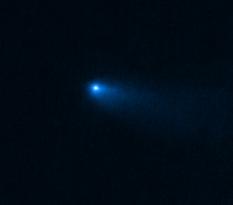
Handout - This image of Comet 238P/Read was captured by the NIRCam (Near-Infrared Camera) instrument on NASA’s James Webb Space Telescope on September 8, 2022. It displays the hazy halo, called the coma, and tail that are characteristic of comets, as opposed to asteroids. The dusty coma and tail result from the vaporization of ices as the Sun warms the main body of the comet. NASA's James Webb Space Telescope has enabled another long-sought scientific breakthrough, this time for solar system scientists studying the origins of Earth's abundant water. Using Webb's NIRSpec (Near-Infrared Spectrograph) instrument, astronomers have confirmed gas – specifically water vapor – around a comet in the main asteroid belt for the first time, indicating that water ice from the primordial solar system can be preserved in that region. Comet Read is a main belt comet – an object that resides in the main asteroid belt but which periodically displays a halo, or coma, and tail like a comet. Main belt comets themselves are a fair

  •  
NASA Delays The James Webb Space Telescope Launch Again

NASA Delays The James Webb Space Telescope Launch Again

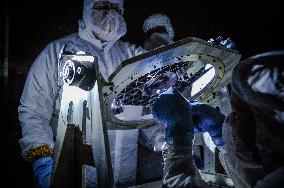
★Handout photo dated September 4, 2014 of NASA engineers inspect a new piece of technology developed for the James Webb Space Telescope, the micro shutter array, with a low light test at NASA's Goddard Space Flight Center in Greenbelt, Maryland. Developed at Goddard to allow Webb's Near Infrared Spectrograph to obtain spectra of more than 100 objects in the universe simultaneously, the micro shutter array uses thousands of tiny shutters to capture spectra from selected objects of interest in space and block out light from all other sources. Last summer, NASA and the European Space Agency (ESA) set an October 31, 2021, launch date for the $ 10 billion James Webb Space Telescope, but it's having to delay the science observatory's trip into space once again. Thankfully, the launch might take place just a few weeks later, in November or early December. A rescheduled date is unlikely to be con

  • Main
  • Top
  • Editorial
  • Creative
  • About Us
  • About ILG
  • Terms of use
  • Company
  • BEHIND
  • Price List
  • Single Plan
  • Monthly Plan
  • Services
  • Shooting
  • Rights Clearance
  • Support
  • FAQ
  • How To Buy
  • Contact Us
  • Become a Partner

© KYODO NEWS IMAGES INC

All Rights Reserved.

  • Editorial
  • Olympics
  • News
  • Sports
  • Japan
  • Tech
  • Royal
  • Disaster
  • NorthKorea
  • Old Japan
  • SNS
  • Creative
  • Food
  • Japan
  • Landscape
  • Animal
  • Popular
  • #Ukraine
  • #Thailand
  • #coronavirus
  • #N. Korea
  • #China
  • #Russia
  • #Ukraine
  • #Thailand
  • #coronavirus
  • #N. Korea
  • #China
  • #Russia
  • Food
  • Japan
  • Landscape
  • Animal
  • Olympics
  • News
  • Sports
  • Japan
  • Tech
  • Royal
  • Disaster
  • NorthKorea
  • Old Japan
  • SNS