•  
Yokozuna Kisenosato to take part in Nagoya tournament

Yokozuna Kisenosato to take part in Nagoya tournament

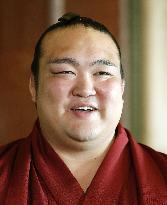
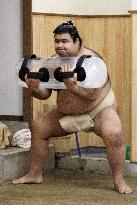
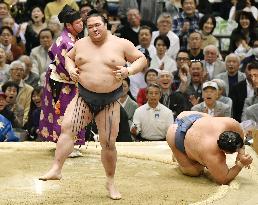
NAGAKUTE, Japan, July 6 Kyodo - During a meeting with reporters on July 6, 2017, sumo stablemaster Tagonoura says yokozuna Kisenosato, who missed the last five days of the summer tournament in May due to chest and arm muscle injuries, will compete in the upcoming Nagoya Grand Sumo Tournament.

  •  
Sumo stablemaster Tagonoura dies at 46

Sumo stablemaster Tagonoura dies at 46

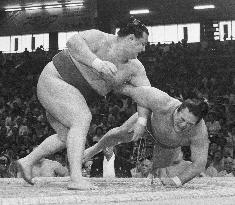
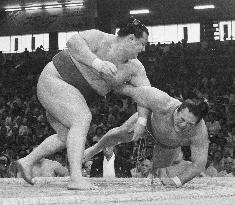
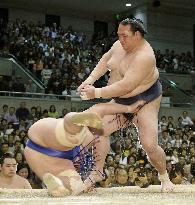
TOKYO, Japan - File photo shows makuuchi-division wrestler Kushimaumi (L) throwing Kotonishiki during the Nagoya Grand Sumo Tournament in 1989. Kushimaumi, who became the sumo stablemaster Keihito Tagonoura, died of unknown causes at a Tokyo hospital on Feb. 13, police said. He was 46.

  •  
Sumo stablemaster Tagonoura dies at 46

Sumo stablemaster Tagonoura dies at 46

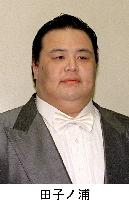
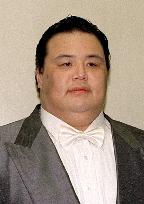
TOKYO, Japan - File photo taken in May 1999 shows sumo stablemaster Keihito Tagonoura, former makuuchi-division wrestler Kushimaumi. He died of unknown causes at a Tokyo hospital on Feb. 13, 2012, police said. He was 46.

  •  
Typhoon lands in Japan

Typhoon lands in Japan

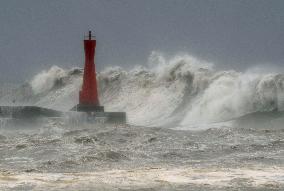
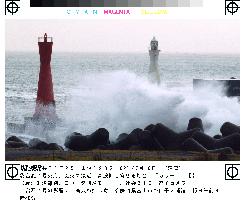
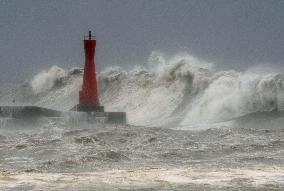
TOKYO, Japan - High waves hit Tagonoura Port in Fuji, Shizuoka Prefecture, on Oct. 8, 2009, due to Typhoon Melor.

  •  
Typhoon expected to hit Honshu, traffic disrupted

Typhoon expected to hit Honshu, traffic disrupted

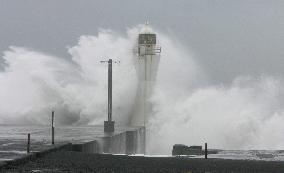
FUJI, Japan - High waves wash a lighthouse near Tagonoura port in Shizuoka Prefecture as a powerful typhoon approaches Japan's largest main island of Honshu on Aug. 25. Typhoon Mawar is expected to make landfall somewhere between the Tokai and Kanto regions late Aug. 25 or early Aug. 26, the Japan Meteorological Agency said.

  •  
(2)Typhoon Halong hits Japan

(2)Typhoon Halong hits Japan

NUMAZU, Japan - High waves whipped up by Typhoon Halong hit Tagonoura port in Shizuoka Prefecture on July 16.

  •  
Sumo: Kisenosato bidding to become 1st Japanese yokozuna in 18 years

Sumo: Kisenosato bidding to become 1st Japanese yokozuna in 18 years

Kisenosato speaks to reporters in his Tagonoura stable's lodge in Nagakute, Aichi Prefecture, on June 27, 2016, as the rankings for the Nagoya Grand Sumo Tournament in July were released the same day. The 29-year-old ozeki will be looking to earn promotion to become the first Japanese-born yokozuna in 18 years but will likely need to win an elusive first title to be considered for a move up to sumo's top rank. (Kyodo) ==Kyodo

  •  
Sumo: Kisenosato resumes training for yokozuna bid

Sumo: Kisenosato resumes training for yokozuna bid

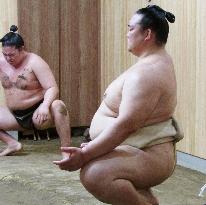
Japanese ozeki Kisenosato (R) resumes training at his Tagonoura stable in Tokyo on May 30, 2016, after falling short of winning his first career Emperor's Cup at the Summer Grand Sumo Tournament earlier in the month. Kisenosato will try to put in a strong performance at the Nagoya meet in July to earn promotion to yokozuna. (Kyodo) ==Kyodo

  •  
Warhorse Wakanosato announces retirement

Warhorse Wakanosato announces retirement

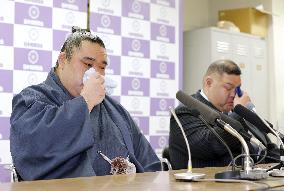
Former sekiwake Wakanosato (L) and his stable master Tagonoura wipe away tears after the 39-year-old wrestler, whose real name is Shinobu Kogawa, announced he would end his wrestling career at a press conference in Tokyo on Sept. 3, 2015. (Kyodo) ==Kyodo

  •  
Sumo: All eyes on new ozeki Takayasu at Nagoya tourney

Sumo: All eyes on new ozeki Takayasu at Nagoya tourney

Newly promoted ozeki Takayasu trains at his Tagonoura stable in Tokyo on June 5, 2017. The Japan Sumo Association has released the "banzuke" rankings list for the July 9-23 Nagoya Grand Sumo Tournament, with the spotlight set to be cast on Takayasu. (Kyodo) ==Kyodo

  •  
Typhoon expected to hit Honshu, traffic disrupted

Typhoon expected to hit Honshu, traffic disrupted

FUJI, Japan - High waves wash a lighthouse near Tagonoura port in Shizuoka Prefecture as a powerful typhoon approaches Japan's largest main island of Honshu on Aug. 25. Typhoon Mawar is expected to make landfall somewhere between the Tokai and Kanto regions late Aug. 25 or early Aug. 26, the Japan Meteorological Agency said. (Kyodo)

  •  
Typhoon lands in Japan

Typhoon lands in Japan

TOKYO, Japan - High waves hit Tagonoura Port in Fuji, Shizuoka Prefecture, on Oct. 8, 2009, due to Typhoon Melor. (Kyodo)

  •  
Mt. Fuji seen from Numakawa,Tagonoura

Mt. Fuji seen from Numakawa,Tagonoura

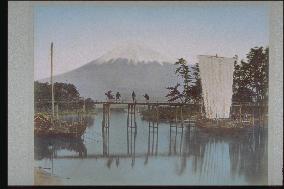
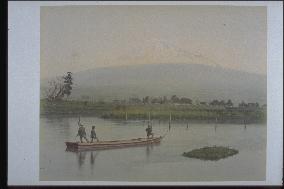
With Mt. Fuji topped with white snow in the background, a rickshaw, people and aged person appear on the wooden bridge over Numa River. The boat has one mast, and a square sail is placed in the middle. This is probably a cargo boat of the time called Bezai boat. The bay with Mt. Fuji in the background is a very popular scene in Japan.==Date:unknown, Place:Shizuoka, Photo:Ogawa Kazumasa, (Credit:Nagasaki University Library/Kyodo News Images) [Cabinet Number10‐15‐0]

  •  
Mt. Fuji seen from Kashiwabara

Mt. Fuji seen from Kashiwabara

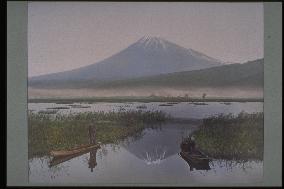
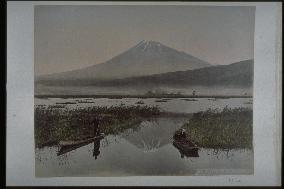
Northern view of a slightly snow-capped Mt. Fuji from Ukishimanuma (Floating Island Bog) near Kashiwabara-Shinden in Fuji City. The water from the bog becomes Numa River and flows into Tagonoura. Mt. Fuji is reflected on the surface of the bog. Two boats, one with a man standing and the other with a man sitting, are visible. Islands are visible in the background. Taken by Mizuno Hanbei.==Date:unknown, Place:Shizuoka, Photo:Mizuno Hanbei, (Credit:Nagasaki University Library/Kyodo News Images) [Cabinet Number96‐44‐0]

  •  
Mt. Fuji seen from Numakawa,Tagonoura

Mt. Fuji seen from Numakawa,Tagonoura

Northern view of Mt. Fuji from Tagonoura (formerly Yoshiwara Minato) harbour in Fuji City. Since the stone dam is visible in the distance, this photograph must have been taken after 1886. The X-shaped reinforcements and the low parapet indicate that Tagonoura Bridge had been rebuilt by this time. There is a rickshaw on the bridge, and four boats of various sizes are visible.==Date:unknown, Place:Shizuoka, Photo:unknown, (Credit:Nagasaki University Library/Kyodo News Images) [Cabinet Number92‐18‐0]

  •  
Mt. Fuji seen from Kashiwabara

Mt. Fuji seen from Kashiwabara

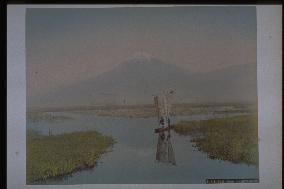
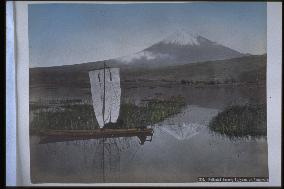
Northern view of the snow-capped peak of Mt. Fuji from Ukishimanuma (Floating Island Bog) near Kashiwabara-Shinden in Fuji City. The water from the pond becomes Numa River and flows into Tagonoura. The area surrounding Ukishimanuma Pond was a marsh called Ukishimagahara. People moved around by boat, creating a water traffic network. Two men are riding a river boat with sail, and Mt. Fuji is reflected upside down on the pond.==Date:unknown, Place:Shizuoka, Photo:unknown, (Credit:Nagasaki University Library/Kyodo News Images) [Cabinet Number88‐37‐0]

  •  
Mt. Fuji seen from Kashiwabara

Mt. Fuji seen from Kashiwabara

Northern view of a slightly snow-capped Mt. Fuji from Ukishimanuma (Floating Island Bog) near Kashiwabara-Shinden in Fuji City. The water from the bog becomes Numa River and flows into Tagonoura. Mt. Fuji is reflected on the surface of the bog. Two boats, one with a man standing and the other with a man sitting, are visible. Islands are visible in the background. Taken by Mizuno Hanbei.==Date:unknown, Place:Shizuoka, Photo:Mizuno Hanbei, (Credit:Nagasaki University Library/Kyodo News Images) [Cabinet Number87‐32‐0]

  •  
Mt. Fuji seen from Kashiwabara

Mt. Fuji seen from Kashiwabara

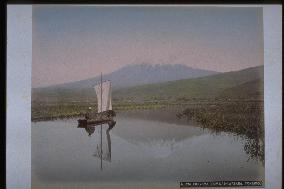
Northern view of the snow-capped peak of Mt. Fuji from Ukishimanuma (Floating Island Bog) near Kashiwabara-Shinden in Fuji City. The water from the bog becomes Numa River and flows into Tagonoura harbour. The area surrounding Ukishimanuma was a marsh called Ukishimagahara. People moved around by boat, creating a water traffic network. Two men are riding a river boat with a sail.==Date:unknown, Place:Shizuoka, Photo:A. Farsari, (Credit:Nagasaki University Library/Kyodo News Images) [Cabinet Number81‐23‐0]

  •  
Tagonoura Bridge and Mt. Fuji

Tagonoura Bridge and Mt. Fuji

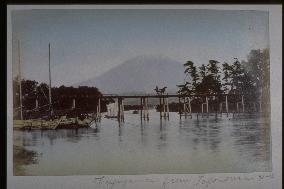
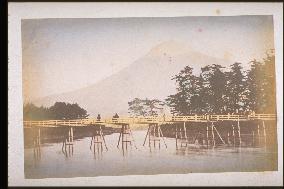
Northern view of Mt. Fuji from the mouth of Tagonoura (formerly Yoshiwara Minato) harbour in Fuji City. The reinforcements to the girders of Tagonoura Bridge (built in 1873) indicate that this photograph was taken after photograph #3146. Also, because the stone gate to block the back flow is missing in the inner part of the harbour, this photograph must have been taken before 1886. Four or five people can be seen standing on the bridge.==Date:unknown, Place:Shizuoka, Photo:unknown, (Credit:Nagasaki University Library/Kyodo News Images) [Cabinet Number69‐48‐0]

  •  
Mt. Fuji seen from Numakawa,Tagonoura

Mt. Fuji seen from Numakawa,Tagonoura

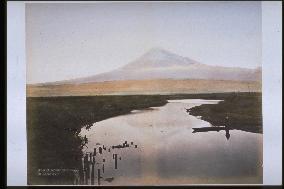
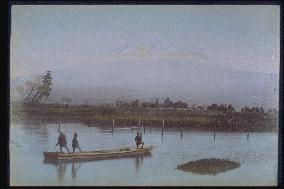
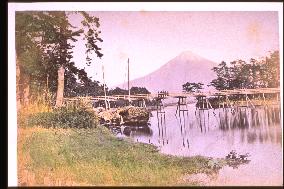
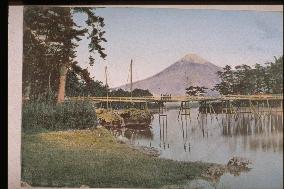
Northern view of Mt. Fuji from Ukishimanuma (Floating Island Bog) near Kashiwabara-Shinden in Fuji City. Ukishimagahara is the land surrounding Ukishimanuma Bog. The water from the bog becomes Numa River and flows into Tagonoura harbour. This photograph was taken near the origin of Numa River, with Mt. Fuji reflected upside down on the bog. The foot of Mt. Fuji is tinted roughly. There is a small boat on the right, and many wooden posts are visible on the left.==Date:unknown, Place:Shizuoka, Photo:unknown, (Credit:Nagasaki University Library/Kyodo News Images) [Cabinet Number64‐62‐0]

  •  
Tagonoura Bridge and Mt. Fuji

Tagonoura Bridge and Mt. Fuji

Northern view of Mt. Fuji from the mouth of Tagonoura (formerly Yoshiwara Minato) harbour in Fuji City. A rickshaw driver is carrying a passenger with an umbrella over the Tagonoura Bridge built in 1873. Since the stone gate to block the back flow is missing in the inner part of the harbour, this photograph must have been taken before 1886. Two boats are docked on the left.==Date:unknown, Place:Shizuoka, Photo:unknown, (Credit:Nagasaki University Library/Kyodo News Images) [Cabinet Number64‐44‐0]

  •  
Mt. Fuji seen from Numakawa,Tagonoura

Mt. Fuji seen from Numakawa,Tagonoura

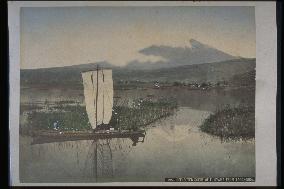
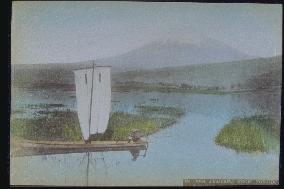
Northern view of Mt. Fuji from Ukishimanuma (Floating Island Bog) near Kashiwabara-Shinden in Fuji City. Ukishimanuma was formerly a stretch of low land between the southern foot of Mt. Fuji/Mt. Ashitaka and Suruga Bay. It flows into Numa River and Tagonoura harbour. Mt. Fuji and a sailboat are reflected on the pond. A man is on a small craft, with small islands scattered in the background.==Date:unknown, Place:Shizuoka, Photo:unknown, (Credit:Nagasaki University Library/Kyodo News Images) [Cabinet Number59‐48‐0]

  •  
Mt. Fuji seen from Numakawa,Tagonoura

Mt. Fuji seen from Numakawa,Tagonoura

Northern view of Mt. Fuji from Ukishimanuma (Floating Island Bog) near Kashiwabara-Shinden in Fuji City. Ukishimanuma was formerly a stretch of low land between the southern foot of Mt. Fuji/Mt. Ashitaka and Suruga Bay. It flows into Numa River and Tagonoura harbour. Mt. Fuji and a sailboat are reflected on the pond. A man is on a small craft, with small islands scattered in the background.==Date:unknown, Place:Shizuoka, Photo:unknown, (Credit:Nagasaki University Library/Kyodo News Images) [Cabinet Number59‐8‐2]

  •  
Mt. Fuji seen from Numakawa,Tagonoura

Mt. Fuji seen from Numakawa,Tagonoura

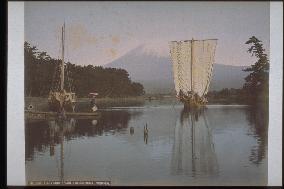
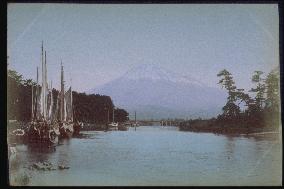
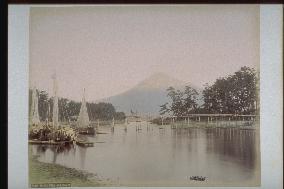
Northern view of Mt. Fuji from Tagonoura (formerly Yoshiwara Minato) harbour in Fuji City. Since the stone dam has already been built, this photograph was taken after 1886. Only part of the foundation of the former bridge remains. Two cargo ships are docked, one with sails hoisted.==Date:unknown, Place:Shizuoka, Photo:unknown, (Credit:Nagasaki University Library/Kyodo News Images) [Cabinet Number51‐166‐0]

  •  
Mt. Fuji seen from Numakawa,Tagonoura

Mt. Fuji seen from Numakawa,Tagonoura

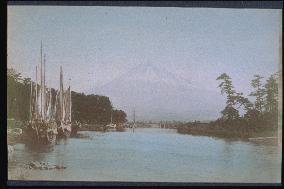
Northern view of Mt. Fuji from Tagonoura (formerly Yoshiwara Minato) harbour in Fuji City. Since the stone dam has already been built, this photograph was taken after 1886. Only part of the foundation of former bridge remains. Many boats are docked in the harbour. Taken by Hanbei Mizuno, the photograph may have been sold by Tamamura.==Date:unknown, Place:Shizuoka, Photo:Mizuno Hanbei, (Credit:Nagasaki University Library/Kyodo News Images) [Cabinet Number48‐131‐0]

  •  
Mt. Fuji seen from Numakawa,Tokaido Road

Mt. Fuji seen from Numakawa,Tokaido Road

View of the snow-capped peak of Mt. Fuji from the mouth of Numa River at Tagonoura, Fuji City. This photograph was probably taken from the Suruga Bay side, because Mt. Hoei is visible on the right side of Mt. Fuji. Three men are riding a river boat, and a few wooden posts are visible. Pine trees line the Tokaido Highway in the centre.==Date:unknown, Place:Shizuoka, Photo:Tamamura Kozaburo, (Credit:Nagasaki University Library/Kyodo News Images) [Cabinet Number48‐99‐0]

  •  
Mt. Fuji seen from Numakawa,Tokaido Road

Mt. Fuji seen from Numakawa,Tokaido Road

Northern view of snow-capped Mt. Fuji from Ukishimanuma (Floating Island Pond) around Kashiwabara-Shinden in Fuji City. The water from the pond becomes Numa River and flows into Tagonoura. The area surrounding Ukishimanuma Pond was marshland called Ukishimagahara. Water traffic increased there as people moved around by riverboats. A man sits on the sailboat.==Date:unknown, Place:Shizuoka, Photo:Tamamura Kozaburo, (Credit:Nagasaki University Library/Kyodo News Images) [Cabinet Number48‐98‐0]

  •  
Mt. Fuji seen from Numakawa,Tokaido Road

Mt. Fuji seen from Numakawa,Tokaido Road

Northern view of Mt. Fuji from Tagonoura (formerly Yoshiwara Minato) harbour in Fuji City. Since the stone dam has already been built, this photograph was taken after 1886. Only part of the foundation of former bridge remains. Many boats are docked in the harbour. Taken by Mizuno Hanbei Mizuno, the photograph may have been sold by Tamamura.==Date:unknown, Place:Shizuoka, Photo:Mizuno Hanbei, (Credit:Nagasaki University Library/Kyodo News Images) [Cabinet Number48‐100‐0]

  •  
Mt. Fuji seen from Numakawa,Tagonoura

Mt. Fuji seen from Numakawa,Tagonoura

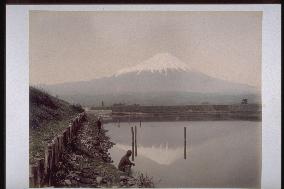
Northern view of snow-capped Mt. Fuji from the mouth of Numa River, which flows into Tagonoura Harbour in Fuji City. The location of Mt. Hoei indicates that this was developed from the wrong side of the negative. The piled stones on the left could be part of a stone gate. A retaining wall constructed of wooden posts and pebbles protect the riverbank. Two men are visible.==Date:unknown, Place:Shizuoka, Photo:unknown, (Credit:Nagasaki University Library/Kyodo News Images) [Cabinet Number47‐21‐0]

  •  
Mt. Fuji seen from Numakawa,Tagonoura

Mt. Fuji seen from Numakawa,Tagonoura

The clarity differs, but probably the same photo as that numbered 26-39. Tagonura Bridge and Mt. Fuji are photographed. Tagonura was famous for the reflection of Mt. Fuji on the Suruga Bay, and many poets wrote about the scene from the old days.==Date:unknown, Place:Shizuoka, Photo:Suzuki Shin-ichi, (Credit:Nagasaki University Library/Kyodo News Images) [Cabinet Number41‐7‐0]

  •  
Mt. Fuji seen from Numakawa,Tagonoura

Mt. Fuji seen from Numakawa,Tagonoura

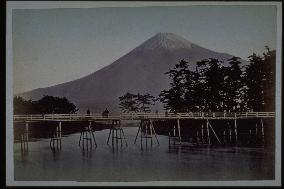
Tagonoura Bridge and Mount Fuji located beyond Suruga Bay in the eastern part of Shizuoka Prefecture. Three cargo ships can be seen in the left corner. It is famous for Yamabeno Akahito, the poet of the Manyoshu who wrote about this place in his poems.==Date:unknown, Place:Shizuoka, Photo:unknown, (Credit:Nagasaki University Library/Kyodo News Images) [Cabinet Number26‐39‐0]

  •  
Mt. Fuji seen from Numakawa,Tagonoura

Mt. Fuji seen from Numakawa,Tagonoura

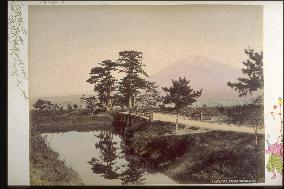
A pine grove and Mt.Fuji is used for the background of a wooden bridge built over the Numa River. There was beautiful white sand and green pine trees on the beach at Tagonoura, a scenic spot where Mt.Fuji casts a reflection over Suruga Bay.==Date:unknown, Place:Shizuoka, Photo:unknown, (Credit:Nagasaki University Library/Kyodo News Images) [Cabinet Number16‐29‐0]

  •  
Mt. Fuji seen from Numakawa,Tagonoura

Mt. Fuji seen from Numakawa,Tagonoura

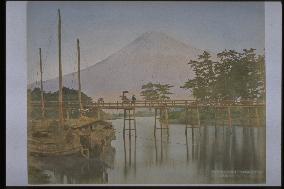
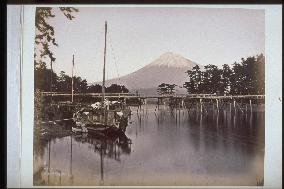
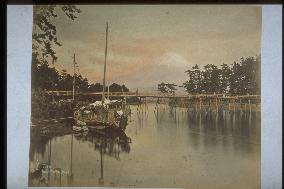
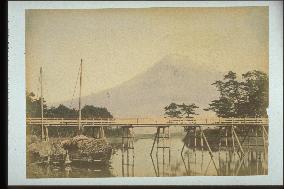
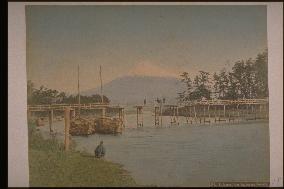
The boat is probably the cargo boat of the time, the Bezai boat. The sail has been folded, and the boat is anchored and covered with a straw mat. Tagonoura was a port of the Edo era where sengokubune (junks with a capacity for a thousand koku of rice) came in and out from Kashima, a territory of the Shogunate. The shadow of the wooden bridge is beautiful. * A photo from the same angle is in the book edited by Ozawa Kenji The End of the Bakufu and Meiji in Pictures , entitled Mt.Fuji from Tagonoura 1880s Kinpei Album, p.67. The only difference with (7) is the angle.==Date:unknown, Place:Shizuoka, Photo:unknown, (Credit:Nagasaki University Library/Kyodo News Images) [Cabinet Number15‐45‐0]

  •  
Mt. Fuji seen from Numakawa,Tagonoura

Mt. Fuji seen from Numakawa,Tagonoura

The boat is probably the cargo vessel of the time, the Bezai boat. The sail has been folded, and the boat is anchored with a straw matting. Tagonoura was a port of the Edo era for Sengokubune (junk boats with capacity for one thousand koku of rice) of the Shogunate that came in and out from Kashima, a territory of the Shogunate. The shadow of the wooden bridge is beautiful. * A photo taken from the same angle is included in the book edited by Ozawa Kenji The End of the Bakufu and Meiji in Pictures , entitled Mt.Fuji from Tagonoura 1880s Kinpei album ( p.67).==Date:unknown, Place:Shizuoka, Photo:unknown, (Credit:Nagasaki University Library/Kyodo News Images) [Cabinet Number14‐1‐0]

  •  
Mt. Fuji seen from Numakawa,Tagonoura

Mt. Fuji seen from Numakawa,Tagonoura

This is a old-fashioned cargo boat, or Bezai boat. The sail has been folded, and the boat is anchored. Tagonoura was a port where boats used to come and go during the Edo period with rice from the Bakufu territory of Kashima. The wooden bridge casts a beautiful shadow on the surface of the water. * A photo taken from the same angle entitled Fuji from Tagonoura 1880s Kinpei Album is included in the End of the Bakufu Era and Meiji in Photos edited by Ozawa Kenji (p.67).==Date:unknown, Place:Shizuoka, Photo:unknown, (Credit:Nagasaki University Library/Kyodo News Images) [Cabinet Number13‐17‐0]

  •  
Mt. Fuji seen from Numakawa,Tagonoura

Mt. Fuji seen from Numakawa,Tagonoura

A sand delta developed on the north bank of Suruga Bay with the sand carried by the Fuji River and Kano River. A lagoon was formed, and further sand accumulation created the peculiar Ukishimagahara. The boat in the photo is a flat bottom river boat. The river boats had a simple structure with boards stuck together in the shape of boxes.==Date:unknown, Place:Shizuoka, Photo:unknown, (Credit:Nagasaki University Library/Kyodo News Images) [Cabinet Number11‐28‐0]

  •  
Tagonoura Bridge and Mt. Fuji

Tagonoura Bridge and Mt. Fuji

A rickshaw stands at the center of Tagonoura Bridge over the Numa River. It may have been taken by the same person as No. 10-15 (both from the Kazuma Ogawa album). A cargo boat is seen to the left of the photo, but what cargo it contains is unknown.==Date:unknown, Place:Shizuoka, Photo:Ogawa Kazumasa, (Credit:Nagasaki University Library/Kyodo News Images) [Cabinet Number6‐7‐0]

  •  
Mt. FUJI from kawai bridge of suzukawa river

Mt. FUJI from kawai bridge of suzukawa river

Suzu River was formerly called Moto Yoshiwara. Yoshiwara station was moved to avoid floods in 1639, and Suzukawa station was later built on the spot. The railroad station is the nearest station to Mt. Fuji, and the coast opens on Tagonoura Bay.==Date:unknown, Place:Shizuoka, Photo:Ogawa Kazumasa, (Credit:Nagasaki University Library/Kyodo News Images) [Cabinet Number5‐30‐0]

  •  
Mt. Fuji seen from Numakawa,Tagonoura

Mt. Fuji seen from Numakawa,Tagonoura

Mt.Fuji seen from Tagonoura. The bridge near the present Numa and Suzu Rivers. The person watching the rickshaw and travelers may be a boatsman. The boat is a comparatively large Japanese-style boat and was probably used for cargo.==Date:unknown, Place:Shizuoka, Photo:Kusakabe Kinbei, (Credit:Nagasaki University Library/Kyodo News Images) [Cabinet Number4‐19‐0]

  •  
Mt. Fuji seen from Numakawa,Tagonoura

Mt. Fuji seen from Numakawa,Tagonoura

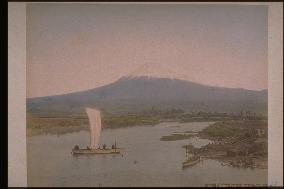
Mt.Fuji viewed from the mouth of the Numa River in the port of Tagonoura. Numa River starts flowing from Miyauchi (presently Fujinomiya city) and flows into the sea at Tagonoura. The white sail of a boat is seen. The boat may be a ferry, since passengers can be seen.==Date:unknown, Place:Shizuoka, Photo:Kusakabe Kinbei, (Credit:Nagasaki University Library/Kyodo News Images) [Cabinet Number4‐21‐0]

  •  
Mt. Fuji seen from Numakawa,Tagonoura

Mt. Fuji seen from Numakawa,Tagonoura

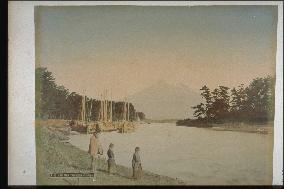
The Numa River belongs to the Fuji River system which runs along the west of Ukishimagahara to the north banks of Suruga Bay. The anchored boats may be Japanese-style boats or Bezai boats of the time. Fuji River, with its abundant water, was an important means of maritime transport, connecting the Kofu Basin and Tokai area.==Date:unknown, Place:Shizuoka, Photo:Kusakabe Kinbei, (Credit:Nagasaki University Library/Kyodo News Images) [Cabinet Number1‐40‐0]

  •  
Sumo stablemaster Tagonoura dies at 46

Sumo stablemaster Tagonoura dies at 46

TOKYO, Japan - File photo taken in May 1999 shows sumo stablemaster Keihito Tagonoura, former makuuchi-division wrestler Kushimaumi. He died of unknown causes at a Tokyo hospital on Feb. 13, 2012, police said. He was 46. (Kyodo)

  •  
Sumo stablemaster Tagonoura dies at 46

Sumo stablemaster Tagonoura dies at 46

TOKYO, Japan - File photo shows makuuchi-division wrestler Kushimaumi (L) throwing Kotonishiki during the Nagoya Grand Sumo Tournament in 1989. Kushimaumi, who became the sumo stablemaster Keihito Tagonoura, died of unknown causes at a Tokyo hospital on Feb. 13, police said. He was 46. (Kyodo)

  •  
Sumo: Kisenosato's retirement

Sumo: Kisenosato's retirement

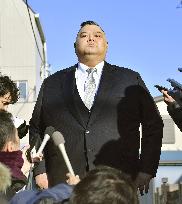
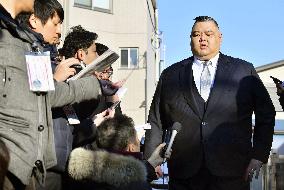
Sumo stablemaster Tagonoura tells reporters in Tokyo on Jan. 16, 2019 that injury-plagued grand champion Kisenosato has decided to retire. (Kyodo) ==Kyodo

  •  
Sumo: Kisenosato's retirement

Sumo: Kisenosato's retirement

Sumo stablemaster Tagonoura tells reporters in Tokyo on Jan. 16, 2019 that injury-plagued grand champion Kisenosato has decided to retire. (Kyodo) ==Kyodo

  •  
Sumo: Kisenosato, Takayasu remain in lead at Spring tourney

Sumo: Kisenosato, Takayasu remain in lead at Spring tourney

New grand champion Kisenosato (R) defeats sekiwake Kotoshogiku on the ninth day of the Spring Grand Sumo Tournament at Edion Arena Osaka on March 20, 2017. Kisenosato and sekiwake Takayasu, both wrestlers of the Tagonoura stable, remained in a share of the lead with 9-0 records. (Kyodo) ==Kyodo

  •  
Sumo: Kisenosato, Takayasu remain in lead at Spring tourney

Sumo: Kisenosato, Takayasu remain in lead at Spring tourney

New grand champion Kisenosato (R) defeats sekiwake Kotoshogiku on the ninth day of the Spring Grand Sumo Tournament at Edion Arena Osaka on March 20, 2017. Kisenosato and sekiwake Takayasu, both wrestlers of the Tagonoura stable, remained in a share of the lead with 9-0 records. (Kyodo) ==Kyodo

  •  
Tagonoura Bridge and Mt. Fuji

Tagonoura Bridge and Mt. Fuji

Tagonoura Bridge and Mt. Fuji ==Date:unknown, Place:Shizuoka, Photo:unknown, (Credit:Nagasaki University Library/Kyodo News Images)

  •  
Mt. Fuji seen from Numakawa, Tagonoura

Mt. Fuji seen from Numakawa, Tagonoura

Mt. Fuji seen from Numakawa, Tagonoura ==Date:unknown, Place:Shizuoka, Photo:unknown, (Credit:Nagasaki University Library/Kyodo News Images)

  •  
Viewing Iso from Tagonoura

Viewing Iso from Tagonoura

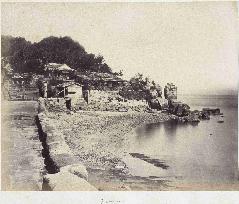
Viewing Iso from Tagonoura==Date:about 1874, Place:Kagoshima, Photo:unknown, (Credit:Nagasaki University Library/Kyodo News Images)

  • Main
  • Top
  • Editorial
  • Creative
  • About Us
  • About ILG
  • Terms of use
  • Company
  • BEHIND
  • Price List
  • Single Plan
  • Monthly Plan
  • Services
  • Shooting
  • Rights Clearance
  • Support
  • FAQ
  • How To Buy
  • Contact Us
  • Become a Partner

© KYODO NEWS IMAGES INC

All Rights Reserved.

  • Editorial
  • Olympics
  • News
  • Sports
  • Japan
  • Tech
  • Royal
  • Disaster
  • NorthKorea
  • Old Japan
  • SNS
  • Creative
  • Food
  • Japan
  • Landscape
  • Animal
  • Popular
  • #Ukraine
  • #Russia
  • #coronavirus
  • #N. Korea
  • #China
  • #Thailand
  • #Ukraine
  • #Russia
  • #coronavirus
  • #N. Korea
  • #China
  • #Thailand
  • Food
  • Japan
  • Landscape
  • Animal
  • Olympics
  • News
  • Sports
  • Japan
  • Tech
  • Royal
  • Disaster
  • NorthKorea
  • Old Japan
  • SNS