•  

Japan launches new unmanned cargo spacecraft bound for ISS

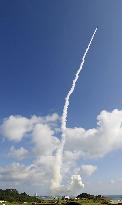
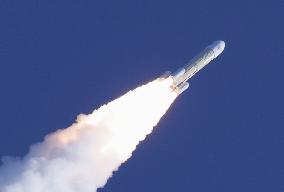
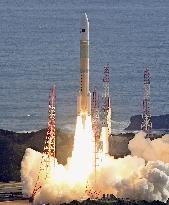
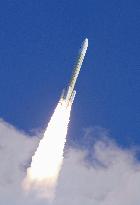
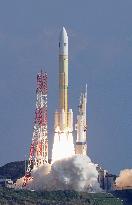
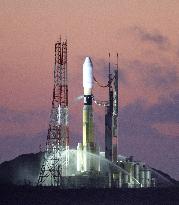
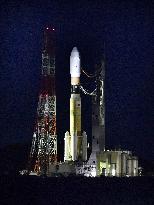
MINAMITANE, Japan, Oct. 27 Kyodo - An H3 rocket carrying the first HTV-X unmanned cargo spacecraft bound for the International Space Station soars through the sky after lifting off from the Tanegashima Space Center in Minamitane in the southwestern Japan prefecture of Kagoshima on Oct. 26, 2025. (Kyodo)

  •  
Japan launches new unmanned cargo spacecraft bound for ISS

Japan launches new unmanned cargo spacecraft bound for ISS

An H3 rocket carrying the first HTV-X unmanned cargo spacecraft bound for the International Space Station soars through the sky after lifting off from the Tanegashima Space Center in Minamitane in the southwestern Japan prefecture of Kagoshima on Oct. 26, 2025.

  •  
Japan launches new unmanned cargo spacecraft bound for ISS

Japan launches new unmanned cargo spacecraft bound for ISS

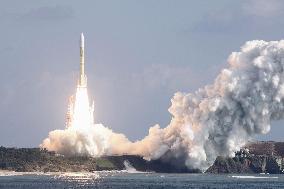
An H3 rocket carrying the first HTV-X unmanned cargo spacecraft bound for the International Space Station soars through the sky after lifting off from the Tanegashima Space Center in Minamitane in the southwestern Japan prefecture of Kagoshima on Oct. 26, 2025.

  •  
Japan launches new unmanned cargo spacecraft bound for ISS

Japan launches new unmanned cargo spacecraft bound for ISS

Photo taken from a Kyodo News helicopter shows an H3 rocket carrying the first HTV-X unmanned cargo spacecraft bound for the International Space Station lifting off from the Tanegashima Space Center in Minamitane in the southwestern Japan prefecture of Kagoshima on Oct. 26, 2025.

  •  
Japan launches new unmanned cargo spacecraft bound for ISS

Japan launches new unmanned cargo spacecraft bound for ISS

An H3 rocket carrying the first HTV-X unmanned cargo spacecraft bound for the International Space Station soars through the sky after lifting off from the Tanegashima Space Center in Minamitane in the southwestern Japan prefecture of Kagoshima on Oct. 26, 2025.

  •  
Japan launches new unmanned cargo spacecraft bound for ISS

Japan launches new unmanned cargo spacecraft bound for ISS

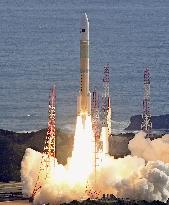
An H3 rocket carrying the first HTV-X unmanned cargo spacecraft bound for the International Space Station lifts off from the Tanegashima Space Center in Minamitane in the southwestern Japan prefecture of Kagoshima on Oct. 26, 2025.

  •  
Japan launches new unmanned cargo spacecraft bound for ISS

Japan launches new unmanned cargo spacecraft bound for ISS

An H3 rocket carrying the first HTV-X unmanned cargo spacecraft bound for the International Space Station lifts off from the Tanegashima Space Center in Minamitane in the southwestern Japan prefecture of Kagoshima on Oct. 26, 2025.

  •  
Japan launches new unmanned cargo spacecraft bound for ISS

Japan launches new unmanned cargo spacecraft bound for ISS

Photo taken from a Kyodo News helicopter shows an H3 rocket carrying the first HTV-X unmanned cargo spacecraft bound for the International Space Station lifting off from the Tanegashima Space Center in Minamitane in the southwestern Japan prefecture of Kagoshima on Oct. 26, 2025.

  •  

Russia to evacuate astronauts from ISS amid emergency

STORY: Russia to evacuate astronauts from ISS amid emergency DATELINE: Jan. 16, 2023 LENGTH: 00:00:45 LOCATION: Moscow CATEGORY: SCIENCE SHOTLIST: 1. shot of International Space Station 2. shot of preparation of the plan 3. various of footage released by Roscosmos about the evacuation plan 4. various of footage from the ISS STORYLINE: Russia will launch the unmanned Soyuz MS-23 spacecraft to bring home three astronauts from the International Space Station (ISS) as their Soyuz MS-22 spaceship has an emergency situation, Russian space authorities said Saturday. Russian cosmonauts Sergei Prokopyev and Dmitry Petelin together with NASA astronaut Francisco Rubio will return to Earth aboard the Soyuz MS-23 in the next weeks, which is supposed to dock to the ISS on Feb. 22, Russia's space agency Roscosmos said in a statement. Last month, astronauts found damage to the outer skin of the instrument-assembly compartment of the Soyuz MS-22 docked to the ISS, which caused a pressure drop in the cooling system. The

  •  
NASA successfully conducts 1st unmanned test flight of Orion

NASA successfully conducts 1st unmanned test flight of Orion

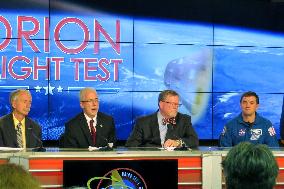
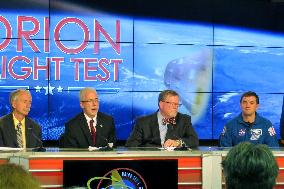
CAPE CANAVERAL, United States - Officials of the National Aeronautics and Space Administration hold a press conference at Kennedy Space Center in Florida on Dec. 5, 2014, after NASA successfully conducted the first unmanned test flight of its next-generation spacecraft Orion, developed to carry astronauts to an asteroid in the 2020s and to Mars in the 2030s.

  •  
NASA successfully conducts 1st unmanned test flight of Orion

NASA successfully conducts 1st unmanned test flight of Orion

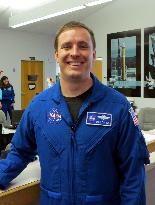
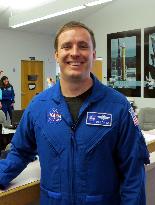
CAPE CANAVERAL, United States - Jack Fischer, an astronaut of the National Aeronautics and Space Administration, is interviewed at Kennedy Space Center in Florida on Dec. 5, 2014, after NASA successfully conducted the first unmanned test flight of its next-generation spacecraft Orion, developed to carry astronauts to an asteroid in the 2020s and to Mars in the 2030s.

  •  
NASA successfully conducts 1st unmanned test flight of Orion

NASA successfully conducts 1st unmanned test flight of Orion

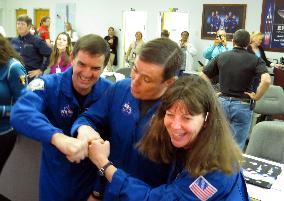
CAPE CANAVERAL, United States - Jack Fischer (C) and other astronauts of the National Aeronautics and Space Administration celebrate at Kennedy Space Center in Florida on Dec. 5, 2014, after NASA successfully conducted the first unmanned test flight of its next-generation spacecraft Orion, developed to carry astronauts to an asteroid in the 2020s and to Mars in the 2030s.

  •  
Spacecraft Orion developed for Mars trip lifts off on 1st test flight

Spacecraft Orion developed for Mars trip lifts off on 1st test flight

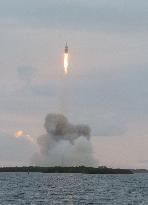
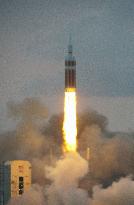
CAPE CANAVERAL, United States - A Delta 4 Heavy rocket, carrying NASA's next-generation spacecraft Orion, lifts off from Cape Canaveral Air Force Station in Florida on Dec. 5, 2014 in its first unmanned test flight. Orion was developed to carry astronauts to an asteroid in the 2020s and to Mars in the 2030s.

  •  
Spacecraft Orion developed for Mars trip lifts off on 1st test flight

Spacecraft Orion developed for Mars trip lifts off on 1st test flight

CAPE CANAVERAL, United States - A Delta 4 Heavy rocket, carrying NASA's next-generation spacecraft Orion, lifts off from Cape Canaveral Air Force Station in Florida on Dec. 5, 2014 in its first unmanned test flight. Orion was developed to carry astronauts to an asteroid in the 2020s and to Mars in the 2030s.

  •  
U.S. rocket explodes after failed launch

U.S. rocket explodes after failed launch

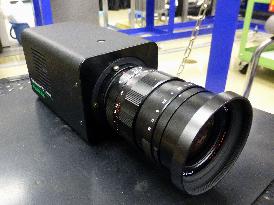
CHIBA, Japan - Photo taken at the Chiba Institute of Technology in Narashino, Chiba Prefecture on Oct. 29, 2014, shows a meteor observation camera partly developed by the Japanese university. The same type of camera was among two tons of cargo including food and experimental equipment bound for the International Space Station, carried by the Cygnus unmanned spacecraft which exploded shortly after launch in Virginia on Oct. 28.

  •  
NASA's Orion spacecraft shown to press

NASA's Orion spacecraft shown to press

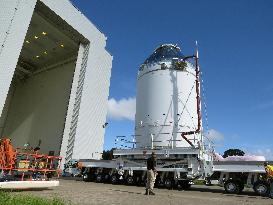
CAPE CANAVERAL, United States - NASA's Orion spacecraft on a carriage is shown to the press at the Kennedy Space Center in Florida on Sept. 11, 2014. The crew module is stacked atop a cylindrical service module which will provide electricity and propulsion. Its unmanned first flight to space is scheduled in December.

  •  
Antares rocket

Antares rocket

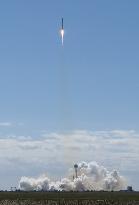
WALLOPS, United States - Orbital Sciences Corp.'s Antares rocket is launched at the Wallops Flight Facility of the National Aeronautics and Space Administration in Virginia on Sept. 18, 2013. The rocket later released an unmanned Cygnus spacecraft to deliver cargo to the International Space Station.

  •  
Antares rocket

Antares rocket

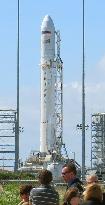
WALLOPS, United States - Orbital Sciences Corp.'s Antares rocket is unveiled at the Wallops Flight Facility of the National Aeronautics and Space Administration in Virginia on Sept. 17, 2013. The rocket carrying the first unmanned Cygnus spacecraft is scheduled to be launched the following day to deliver cargo to the International Space Station.

  •  
Japan's 1st lunar orbiter spacecraft on display

Japan's 1st lunar orbiter spacecraft on display

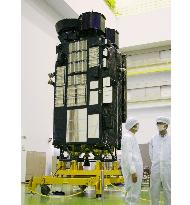
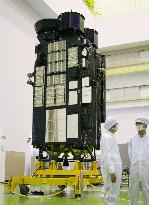
TANEGASHIMA, Japan - Japan's first lunar orbiter Kaguya, scheduled to be launched Aug. 16 aboard an H-2A rocket, is on display at the Tanegashima Space Center in Kagoshima Prefecture on June 18. According to the Japan Aerospace Exploration Agency, the 3-ton, 5.5-meter-tall unmanned spacecraft will be used to collect scientific data to help scientists better understand about the origin of the moon and its transformational history. Among the scientific data to be observed during the orbiter's one-year mission include the moon's gravity, distribution of its magnetic field and the structure of the moon surface.

  •  

We're ready for launch of Shenzhou-15 spaceflight mission: scientist

STORY: We're ready for launch of Shenzhou-15 spaceflight mission: scientist DATELINE: Nov. 28, 2022 LENGTH: 00:01:46 LOCATION: JIUQUAN, China CATEGORY: SCIENCE SHOTLIST: 1. various of the launch site in Jiuquan 2. SOUNDBITE (Chinese): SHEN TINGZHENG, Scientist at Jiuquan Satellite Launch Center STORYLINE: The China Manned Space Agency announced Monday that the Shenzhou-15 crewed spaceship will be launched at 11:08 p.m. Tuesday (Beijing Time) from the Jiuquan Satellite Launch Center in northwest China. A scientist with the spaceflight mission has explained their preparation work, saying that they are ready for the task. SOUNDBITE (Chinese): SHEN TINGZHENG, Scientist at Jiuquan Satellite Launch Center "This is our first manned space mission to be completed in extremely low temperatures. Within two days before the launch, the temperature at the launch site has dropped below minus 20 degrees Celsius. We also encountered extremely cold weather when launching the Shenzhou-4, an unmanned spacecraft. The tempera

  •  
Japan's 1st lunar orbiter spacecraft on display

Japan's 1st lunar orbiter spacecraft on display

TANEGASHIMA, Japan - Japan's first lunar orbiter Kaguya, scheduled to be launched Aug. 16 aboard an H-2A rocket, is on display at the Tanegashima Space Center in Kagoshima Prefecture on June 18. According to the Japan Aerospace Exploration Agency, the 3-ton, 5.5-meter-tall unmanned spacecraft will be used to collect scientific data to help scientists better understand about the origin of the moon and its transformational history. Among the scientific data to be observed during the orbiter's one-year mission include the moon's gravity, distribution of its magnetic field and the structure of the moon surface. (Kyodo)

  •  
JAXA's flight director happy at Japan cargo mission's success

JAXA's flight director happy at Japan cargo mission's success

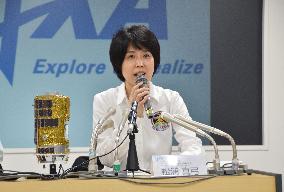
Japan Aerospace Exploration Agency flight director Mayumi Matsuura meets the press at the Tsukuba Space Center in Ibaraki Prefecture, northeast of Tokyo, on Aug. 25, 2015. She expressed relief as Japanese astronaut Kimiya Yui aboard the International Space Station successfully captured the Kounotori5 unmanned supply spacecraft by maneuvering a robotic arm. (Kyodo) ==Kyodo

  •  
NASA successfully conducts 1st unmanned test flight of Orion

NASA successfully conducts 1st unmanned test flight of Orion

CAPE CANAVERAL, United States - Officials of the National Aeronautics and Space Administration hold a press conference at Kennedy Space Center in Florida on Dec. 5, 2014, after NASA successfully conducted the first unmanned test flight of its next-generation spacecraft Orion, developed to carry astronauts to an asteroid in the 2020s and to Mars in the 2030s. (Kyodo)

  •  
NASA successfully conducts 1st unmanned test flight of Orion

NASA successfully conducts 1st unmanned test flight of Orion

CAPE CANAVERAL, United States - Jack Fischer, an astronaut of the National Aeronautics and Space Administration, is interviewed at Kennedy Space Center in Florida on Dec. 5, 2014, after NASA successfully conducted the first unmanned test flight of its next-generation spacecraft Orion, developed to carry astronauts to an asteroid in the 2020s and to Mars in the 2030s. (Kyodo)

  •  
NASA's Orion spacecraft shown to press

NASA's Orion spacecraft shown to press

CAPE CANAVERAL, United States - NASA's Orion spacecraft on a carriage is shown to the press at the Kennedy Space Center in Florida on Sept. 11, 2014. The crew module is stacked atop a cylindrical service module which will provide electricity and propulsion. Its unmanned first flight to space is scheduled in December. (Kyodo)

  •  
Fire foils Japanese rocket launch

Fire foils Japanese rocket launch

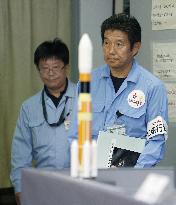
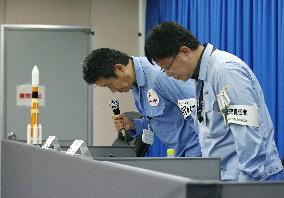
Atsutoshi Tamura (R), vice chief of Mitsubishi Heavy Industries Ltd.'s space operations, prepares to attend a press conference at Tanegashima Space Center in Kagoshima Prefecture, southwestern Japan, on Sept. 11, 2019, after a fire prompted the cancellation of the launch of an H-2B rocket carrying the unmanned Kounotori8 spacecraft, due to fly to the International Space Station. (Kyodo) ==Kyodo

  •  
Fire cancels Japanese rocket launch to ISS

Fire cancels Japanese rocket launch to ISS

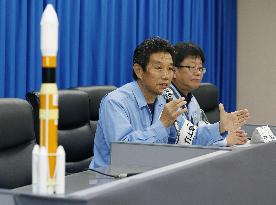
Atsutoshi Tamura (L), vice chief of Mitsubishi Heavy Industries Ltd.'s space operations, speaks at a press conference at Tanegashima Space Center in Kagoshima Prefecture, southwestern Japan, on Sept. 11, 2019, after a fire prompted the cancellation of the launch of an H-2B rocket carrying the unmanned Kounotori8 spacecraft, which had been scheduled to fly to the International Space Station. (Kyodo) ==Kyodo

  •  
Fire foils Japanese rocket launch

Fire foils Japanese rocket launch

Atsutoshi Tamura (L), vice chief of Mitsubishi Heavy Industries Ltd.'s space operations division, bows at a press conference at Tanegashima Space Center in Kagoshima Prefecture, southwestern Japan, on Sept. 11, 2019, after a fire prompted the cancellation of the launch of an H-2B rocket carrying the unmanned Kounotori8 spacecraft, bound for the International Space Station. (Kyodo) ==Kyodo

  •  
Fire foils Japanese rocket launch

Fire foils Japanese rocket launch

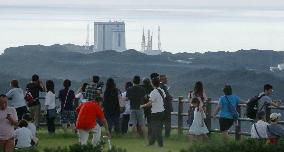
Onlookers view an H-2B rocket at Tanegashima Space Center in Kagoshima Prefecture, southwestern Japan, on the morning of Sept. 11, 2019, after a fire prompted the cancellation of its launch. It had been due to carry the International Space Station-bound, unmanned, Kounotori8 spacecraft. (Kyodo) ==Kyodo

  •  
Fire foils Japanese rocket launch

Fire foils Japanese rocket launch

Photo taken in the early hours of Sept. 11, 2019, shows a fire at the rocket launch pad of Tanegashima Space Center in Kagoshima Prefecture, southwestern Japan. The fire prompted the cancellation of the launch of an H-2B rocket carrying the unmanned Kounotori8 spacecraft, scheduled to fly to the International Space Station. (Kyodo) ==Kyodo

  •  
Fire foils Japanese rocket launch

Fire foils Japanese rocket launch

Firefighters tackle a blaze at the rocket launch pad of Tanegashima Space Center in Kagoshima Prefecture, southwestern Japan, in the early hours of Sept. 11, 2019. The fire prompted the cancellation of the launch of an H-2B rocket carrying the unmanned Kounotori8 spacecraft, scheduled to fly to the International Space Station. (Kyodo) ==Kyodo

  •  
Fire foils Japanese rocket launch

Fire foils Japanese rocket launch

Firefighters tackle a blaze at the rocket launch pad of Tanegashima Space Center in Kagoshima Prefecture, southwestern Japan, in the early hours of Sept. 11, 2019. The fire prompted the cancellation of the launch of an H-2B rocket carrying the unmanned Kounotori8 spacecraft, scheduled to fly to the International Space Station. (Kyodo) ==Kyodo

  •  
Japan to launch supply rocket to ISS

Japan to launch supply rocket to ISS

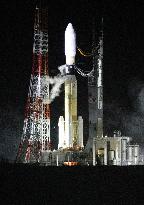
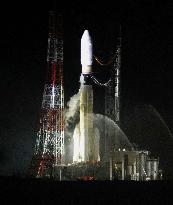
An H-2B rocket carrying the Konotori 6 unmanned cargo spacecraft is seen at Tanegashima Space Center in the southwestern Japan prefecture of Kagoshima on Dec. 9, 2016, hours ahead of its planned launch the same day. The cargo ship will deliver supplies to the International Space Station. (Kyodo) ==Kyodo

  •  
Japan to launch Konotori 6 to carry supplies to ISS

Japan to launch Konotori 6 to carry supplies to ISS

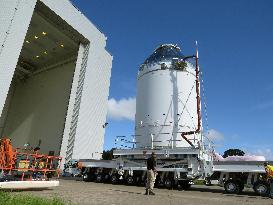
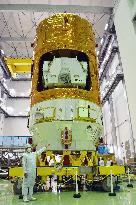
The Japan Aerospace Exploration Agency unveils the Konotori 6 unmanned cargo spacecraft at the Tanegashima Space Center in the southwestern Japan prefecture of Kagoshima on Oct. 19, 2016. The cargo ship, which will deliver supplies to the International Space Station, is scheduled to take off on Dec. 9, carried by an H-2B rocket. (Kyodo) ==Kyodo

  • Main
  • Top
  • Editorial
  • Creative
  • About Us
  • About ILG
  • Terms of use
  • Company
  • BEHIND
  • Price List
  • Single Plan
  • Monthly Plan
  • Services
  • Shooting
  • Rights Clearance
  • Support
  • FAQ
  • How To Buy
  • Contact Us
  • Become a Partner

© KYODO NEWS IMAGES INC

All Rights Reserved.

  • Editorial
  • Olympics
  • News
  • Sports
  • Japan
  • Tech
  • Royal
  • Disaster
  • NorthKorea
  • Old Japan
  • SNS
  • Creative
  • Food
  • Japan
  • Landscape
  • Animal
  • Popular
  • #Ukraine
  • #Russia
  • #coronavirus
  • #N. Korea
  • #Thailand
  • #China
  • #Ukraine
  • #Russia
  • #coronavirus
  • #N. Korea
  • #Thailand
  • #China
  • Food
  • Japan
  • Landscape
  • Animal
  • Olympics
  • News
  • Sports
  • Japan
  • Tech
  • Royal
  • Disaster
  • NorthKorea
  • Old Japan
  • SNS