•  
Gov't begins netting nonnative fish from imperial moat

Gov't begins netting nonnative fish from imperial moat

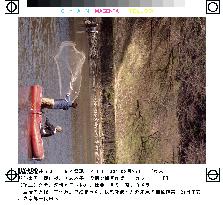
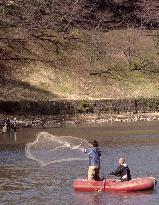
TOKYO, Japan - A worker begins netting nonnative fish from the Ushigafuchi section of the Imperial Palace moat Feb. 27 to protect the moat's usual inhabitants, under a project promoted by the Environment Ministry.

  •  
(2)Gov't removes garbage, nonnative fish from imperial moat

(2)Gov't removes garbage, nonnative fish from imperial moat

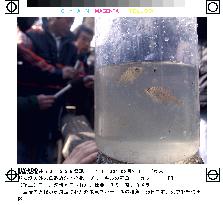
TOKYO, Japan - Fray bluegill sunfish are seen in a container. The fish were captured Feb. 25 at the Ushigafuchi section of the Imperial Palace moat as the government began cleaning the section to remove garbage and nonnative species of fish.

  •  
(1)Gov't removes garbage, nonnative fish from imperial moat

(1)Gov't removes garbage, nonnative fish from imperial moat

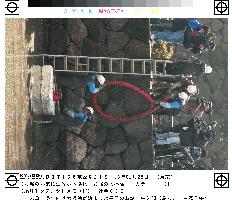
TOKYO, Japan - Workers begin cleaning up the Ushigafuchi section of the Imperial Palace moat Feb. 25 to remove garbage and nonnative species of fish as part of a government project.

  •  
Gov't to drain moat, remove garbage, non-indigenous fish

Gov't to drain moat, remove garbage, non-indigenous fish

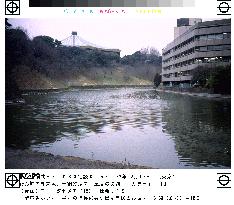
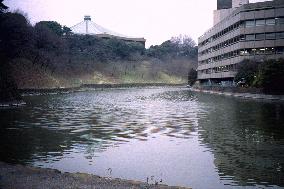
TOKYO, Japan - The Ushigafuchi section of the moat surrounding the Imperial Palace in Tokyo, which the Environment Ministry said Feb. 19 it intends to drain and clean up. The Usigafuchi section will be a pilot project for a five-year scheme to eliminate foreign fish from the entire 13 sections of the palace moat to preserve indigenous species. The ministry said non-indigenous fish, notably bluegill sunfish and black bass, have come to dominate the moat.

  •  
(1)Gov't removes garbage, nonnative fish from imperial moat

(1)Gov't removes garbage, nonnative fish from imperial moat

TOKYO, Japan - Workers begin cleaning up the Ushigafuchi section of the Imperial Palace moat Feb. 25 to remove garbage and nonnative species of fish as part of a government project. (Kyodo)

  •  
Gov't begins netting nonnative fish from imperial moat

Gov't begins netting nonnative fish from imperial moat

TOKYO, Japan - A worker begins netting nonnative fish from the Ushigafuchi section of the Imperial Palace moat Feb. 27 to protect the moat's usual inhabitants, under a project promoted by the Environment Ministry. (Kyodo)

  •  
The city of Tokyo seen from moatside

The city of Tokyo seen from moatside

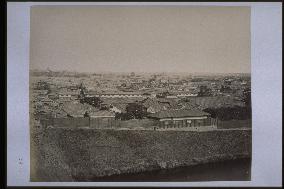
View from the middle of Kudan Slope (just outside Tayasu Gate), looking west at the Kanda area. The other side of the Ushigafuchi area is Iida-machi 1-chome, acquired by Yasukuni Shinto Shrine (still called Shokonsha) for emergency use in June 1878. The Kokkokan Panorama would be built here in 1902 and later rented as a military hall (present-day Kudan Kaikan) to provide income for the shrine. Connected to the right of photograph #4004, this photograph creates a panoramic view of the area.==Date:unknown, Place:Tokyo, Photo:R. Stillfried, (Credit:Nagasaki University Library/Kyodo News Images) [Cabinet Number78‐21‐0]

  •  
A view of the Goji-in plain outside Ichihashi-mon Gate

A view of the Goji-in plain outside Ichihashi-mon Gate

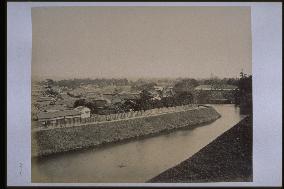
View of Shimizu-mon (gate) located half-way up Kudan-zaka (in front of Tayasu Gate). The gate visible in the centre back is Shimizu-mon. Since the gate was destroyed in 1873, this photograph must have been taken before that date. The building on its right is the guardsmen's artillery station at Takebashi. The moat in the foreground was called Ushigafuchi (Bull Ravine). The Shinsen Tokyo Meishozue (Newly Selected Famous Places of Tokyo) states that, A bull and cart carrying coins went down into the moat and never came up, and this is the origin of the name. When attached to photograph #4003, this becomes a continuous panoramic scene.==Date:unknown, Place:Tokyo, Photo:R. Stillfried, (Credit:Nagasaki University Library/Kyodo News Images) [Cabinet Number78‐22‐0]

  •  
(2)Gov't removes garbage, nonnative fish from imperial moat

(2)Gov't removes garbage, nonnative fish from imperial moat

TOKYO, Japan - Fray bluegill sunfish are seen in a container. The fish were captured Feb. 25 at the Ushigafuchi section of the Imperial Palace moat as the government began cleaning the section to remove garbage and nonnative species of fish. (Kyodo)

  •  
Gov't to drain moat, remove garbage, non-indigenous fish

Gov't to drain moat, remove garbage, non-indigenous fish

TOKYO, Japan - The Ushigafuchi section of the moat surrounding the Imperial Palace in Tokyo, which the Environment Ministry said Feb. 19 it intends to drain and clean up. The Usigafuchi section will be a pilot project for a five-year scheme to eliminate foreign fish from the entire 13 sections of the palace moat to preserve indigenous species. The ministry said non-indigenous fish, notably bluegill sunfish and black bass, have come to dominate the moat. (Kyodo)

  • Main
  • Top
  • Editorial
  • Creative
  • About Us
  • About ILG
  • Terms of use
  • Company
  • BEHIND
  • Price List
  • Single Plan
  • Monthly Plan
  • Services
  • Shooting
  • Rights Clearance
  • Support
  • FAQ
  • How To Buy
  • Contact Us
  • Become a Partner

© KYODO NEWS IMAGES INC

All Rights Reserved.

  • Editorial
  • Olympics
  • News
  • Sports
  • Japan
  • Tech
  • Royal
  • Disaster
  • NorthKorea
  • Old Japan
  • SNS
  • Creative
  • Food
  • Japan
  • Landscape
  • Animal
  • Popular
  • #Ukraine
  • #Thailand
  • #coronavirus
  • #N. Korea
  • #Russia
  • #China
  • #Ukraine
  • #Thailand
  • #coronavirus
  • #N. Korea
  • #Russia
  • #China
  • Food
  • Japan
  • Landscape
  • Animal
  • Olympics
  • News
  • Sports
  • Japan
  • Tech
  • Royal
  • Disaster
  • NorthKorea
  • Old Japan
  • SNS