•  
Kuahuqiao Site Museum

Kuahuqiao Site Museum

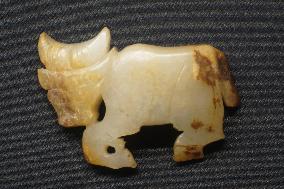
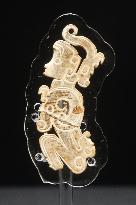
HANGZHOU, CHINA - JUNE 15, 2025 - Visitors are viewing the exhibition of fine jade wares from the State of Guo of the Western Zhou Dynasty at the Kuahuqiao Site Museum in Hangzhou, Zhejiang Province, China on June 15, 2025.

  •  
Kuahuqiao Site Museum

Kuahuqiao Site Museum

HANGZHOU, CHINA - JUNE 15, 2025 - Visitors are viewing the exhibition of fine jade wares from the State of Guo of the Western Zhou Dynasty at the Kuahuqiao Site Museum in Hangzhou, Zhejiang Province, China on June 15, 2025.

  •  
Kuahuqiao Site Museum

Kuahuqiao Site Museum

HANGZHOU, CHINA - JUNE 15, 2025 - Visitors are viewing the exhibition of fine jade wares from the State of Guo of the Western Zhou Dynasty at the Kuahuqiao Site Museum in Hangzhou, Zhejiang Province, China on June 15, 2025.

  •  
Kuahuqiao Site Museum

Kuahuqiao Site Museum

HANGZHOU, CHINA - JUNE 15, 2025 - Visitors are viewing the exhibition of fine jade wares from the State of Guo of the Western Zhou Dynasty at the Kuahuqiao Site Museum in Hangzhou, Zhejiang Province, China on June 15, 2025.

  •  
Kuahuqiao Site Museum

Kuahuqiao Site Museum

HANGZHOU, CHINA - JUNE 15, 2025 - Visitors are viewing the exhibition of fine jade wares from the State of Guo of the Western Zhou Dynasty at the Kuahuqiao Site Museum in Hangzhou, Zhejiang Province, China on June 15, 2025.

  •  
Kuahuqiao Site Museum

Kuahuqiao Site Museum

HANGZHOU, CHINA - JUNE 15, 2025 - Visitors are viewing the exhibition of fine jade wares from the State of Guo of the Western Zhou Dynasty at the Kuahuqiao Site Museum in Hangzhou, Zhejiang Province, China on June 15, 2025.

  •  
Kuahuqiao Site Museum

Kuahuqiao Site Museum

HANGZHOU, CHINA - JUNE 15, 2025 - Visitors are viewing the exhibition of fine jade wares from the State of Guo of the Western Zhou Dynasty at the Kuahuqiao Site Museum in Hangzhou, Zhejiang Province, China on June 15, 2025.

  •  
Kuahuqiao Site Museum

Kuahuqiao Site Museum

HANGZHOU, CHINA - JUNE 15, 2025 - Visitors are viewing the exhibition of fine jade wares from the State of Guo of the Western Zhou Dynasty at the Kuahuqiao Site Museum in Hangzhou, Zhejiang Province, China on June 15, 2025.

  •  
Kuahuqiao Site Museum

Kuahuqiao Site Museum

HANGZHOU, CHINA - JUNE 15, 2025 - Visitors are viewing the exhibition of fine jade wares from the State of Guo of the Western Zhou Dynasty at the Kuahuqiao Site Museum in Hangzhou, Zhejiang Province, China on June 15, 2025.

  •  
Kuahuqiao Site Museum

Kuahuqiao Site Museum

HANGZHOU, CHINA - JUNE 15, 2025 - Visitors are viewing the exhibition of fine jade wares from the State of Guo of the Western Zhou Dynasty at the Kuahuqiao Site Museum in Hangzhou, Zhejiang Province, China on June 15, 2025.

  •  
Kuahuqiao Site Museum

Kuahuqiao Site Museum

HANGZHOU, CHINA - JUNE 15, 2025 - Visitors are viewing the exhibition of fine jade wares from the State of Guo of the Western Zhou Dynasty at the Kuahuqiao Site Museum in Hangzhou, Zhejiang Province, China on June 15, 2025.

  •  
Kuahuqiao Site Museum

Kuahuqiao Site Museum

HANGZHOU, CHINA - JUNE 15, 2025 - Visitors are viewing the exhibition of fine jade wares from the State of Guo of the Western Zhou Dynasty at the Kuahuqiao Site Museum in Hangzhou, Zhejiang Province, China on June 15, 2025.

  •  
Kuahuqiao Site Museum

Kuahuqiao Site Museum

HANGZHOU, CHINA - JUNE 15, 2025 - Visitors are viewing the exhibition of fine jade wares from the State of Guo of the Western Zhou Dynasty at the Kuahuqiao Site Museum in Hangzhou, Zhejiang Province, China on June 15, 2025.

  •  
Kuahuqiao Site Museum

Kuahuqiao Site Museum

HANGZHOU, CHINA - JUNE 15, 2025 - Visitors are viewing the exhibition of fine jade wares from the State of Guo of the Western Zhou Dynasty at the Kuahuqiao Site Museum in Hangzhou, Zhejiang Province, China on June 15, 2025.

  •  
Kuahuqiao Site Museum

Kuahuqiao Site Museum

HANGZHOU, CHINA - JUNE 15, 2025 - Visitors are viewing the exhibition of fine jade wares from the State of Guo of the Western Zhou Dynasty at the Kuahuqiao Site Museum in Hangzhou, Zhejiang Province, China on June 15, 2025.

  •  
Kuahuqiao Site Museum

Kuahuqiao Site Museum

HANGZHOU, CHINA - JUNE 15, 2025 - Visitors are viewing the exhibition of fine jade wares from the State of Guo of the Western Zhou Dynasty at the Kuahuqiao Site Museum in Hangzhou, Zhejiang Province, China on June 15, 2025.

  •  
Kuahuqiao Site Museum

Kuahuqiao Site Museum

HANGZHOU, CHINA - JUNE 15, 2025 - Visitors are viewing the exhibition of fine jade wares from the State of Guo of the Western Zhou Dynasty at the Kuahuqiao Site Museum in Hangzhou, Zhejiang Province, China on June 15, 2025.

  •  
Kuahuqiao Site Museum

Kuahuqiao Site Museum

HANGZHOU, CHINA - JUNE 15, 2025 - Visitors are viewing the exhibition of fine jade wares from the State of Guo of the Western Zhou Dynasty at the Kuahuqiao Site Museum in Hangzhou, Zhejiang Province, China on June 15, 2025.

  •  
Kuahuqiao Site Museum

Kuahuqiao Site Museum

HANGZHOU, CHINA - JUNE 15, 2025 - Visitors are viewing the exhibition of fine jade wares from the State of Guo of the Western Zhou Dynasty at the Kuahuqiao Site Museum in Hangzhou, Zhejiang Province, China on June 15, 2025.

  •  
Kuahuqiao Site Museum

Kuahuqiao Site Museum

HANGZHOU, CHINA - JUNE 15, 2025 - Visitors are viewing the exhibition of fine jade wares from the State of Guo of the Western Zhou Dynasty at the Kuahuqiao Site Museum in Hangzhou, Zhejiang Province, China on June 15, 2025.

  •  
Kuahuqiao Site Museum

Kuahuqiao Site Museum

HANGZHOU, CHINA - JUNE 15, 2025 - Visitors are viewing the exhibition of fine jade wares from the State of Guo of the Western Zhou Dynasty at the Kuahuqiao Site Museum in Hangzhou, Zhejiang Province, China on June 15, 2025.

  •  
Kuahuqiao Site Museum

Kuahuqiao Site Museum

HANGZHOU, CHINA - JUNE 15, 2025 - Visitors are viewing the exhibition of fine jade wares from the State of Guo of the Western Zhou Dynasty at the Kuahuqiao Site Museum in Hangzhou, Zhejiang Province, China on June 15, 2025.

  •  
Kuahuqiao Site Museum

Kuahuqiao Site Museum

HANGZHOU, CHINA - JUNE 15, 2025 - Visitors are viewing the exhibition of fine jade wares from the State of Guo of the Western Zhou Dynasty at the Kuahuqiao Site Museum in Hangzhou, Zhejiang Province, China on June 15, 2025.

  •  
Kuahuqiao Site Museum

Kuahuqiao Site Museum

HANGZHOU, CHINA - JUNE 15, 2025 - Visitors are viewing the exhibition of fine jade wares from the State of Guo of the Western Zhou Dynasty at the Kuahuqiao Site Museum in Hangzhou, Zhejiang Province, China on June 15, 2025.

  •  
Kuahuqiao Site Museum

Kuahuqiao Site Museum

HANGZHOU, CHINA - JUNE 15, 2025 - Visitors are viewing the exhibition of fine jade wares from the State of Guo of the Western Zhou Dynasty at the Kuahuqiao Site Museum in Hangzhou, Zhejiang Province, China on June 15, 2025.

  •  
Kuahuqiao Site Museum

Kuahuqiao Site Museum

HANGZHOU, CHINA - JUNE 15, 2025 - Visitors are viewing the exhibition of fine jade wares from the State of Guo of the Western Zhou Dynasty at the Kuahuqiao Site Museum in Hangzhou, Zhejiang Province, China on June 15, 2025.

  •  
Kuahuqiao Site Museum

Kuahuqiao Site Museum

HANGZHOU, CHINA - JUNE 15, 2025 - Visitors are viewing the exhibition of fine jade wares from the State of Guo of the Western Zhou Dynasty at the Kuahuqiao Site Museum in Hangzhou, Zhejiang Province, China on June 15, 2025.

  •  
Illustration - Provence Food

Illustration - Provence Food

FRANCE. VAUCLUSE (84) L'ISLE-SUR-LA-SORGUE. THE FLOATING MARKET. FLOATING MARKET ON THE FIRST SUNDAY IN AUGUST: TRADERS SELL THEIR WARES ABOARD BOATS ON THE SORGUE. Photo by Gerard Sioen/Only France/ABACAPRESS.COM

  •  
Illustration - Provence Food

Illustration - Provence Food

FRANCE. VAUCLUSE (84) L'ISLE-SUR-LA-SORGUE. THE FLOATING MARKET. FLOATING MARKET ON THE FIRST SUNDAY IN AUGUST: TRADERS SELL THEIR WARES ABOARD BOATS ON THE SORGUE. Photo by Gerard Sioen/Only France/ABACAPRESS.COM

  •  
XINHUA PHOTOS OF THE DAY

XINHUA PHOTOS OF THE DAY

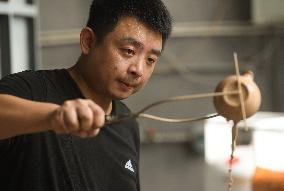
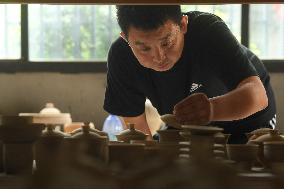
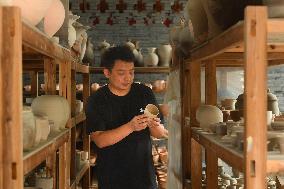
(240712) -- BEIJING, July 12, 2024 Photo by Xinhua/ABACAPRESS.COM) -- Xie Zhenwei applies glaze to a porcelain ware at a kiln in Shabu Township, Huangyan of Taizhou, east China's Zhejiang Province, July 11, 2024. Originated in the Tang Dynasty (618-907) and flourished in the Northern Song Dynasty (960-1127), the Shabu Kilns are considered as transitional kilns during the development of southern celadon industry from Yue Kilns to Longquan Kilns. Xie Zhenwei, a young porcelain artisan and a native of Shabu Township, has been making efforts to reproduce the celadon wares in the style of Shabu Kilns, which is characterized by exquisite carved patterns. To achieve his goal, Xie learned techniques from Yue Kilns and Longquan Kilns and kept using local materials. At present, Xie has successfully made celadon wares like censer, jug and powder boxes, in the style of Shabu Kilns. He also set up a workshop to display the culture of this art. Photo by Xinhua/ABACAPRESS.COM/Weng Xinyang)

  •  
(ZhejiangPictorial)CHINA-ZHEJIANG-SHABU KILNS-CELADON PORCELAIN-ARTISAN (CN)

(ZhejiangPictorial)CHINA-ZHEJIANG-SHABU KILNS-CELADON PORCELAIN-ARTISAN (CN)

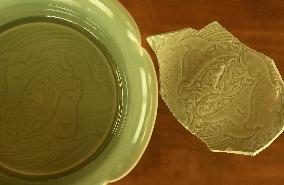
(240711) -- TAIZHOU, July 11, 2024 Photo by Xinhua/ABACAPRESS.COM) -- A piece of ancient Shabu-Kiln celadon ware (R) and a celadon ware made by Xie Zhenwei are pictured in Shabu Township, Huangyan of Taizhou, east China's Zhejiang Province, July 11, 2024. Originated in the Tang Dynasty (618-907) and flourished in the Northern Song Dynasty (960-1127), the Shabu Kilns are considered as transitional kilns during the development of southern celadon industry from Yue Kilns to Longquan Kilns. Xie Zhenwei, a young porcelain artisan and a native of Shabu Township, has been making efforts to reproduce the celadon wares in the style of Shabu Kilns, which is characterized by exquisite carved patterns. To achieve his goal, Xie learned techniques from Yue Kilns and Longquan Kilns and kept using local materials. At present, Xie has successfully made celadon wares like censer, jug and powder boxes, in the style of Shabu Kilns. He also set up a workshop to display the culture of this art. Photo by Xinhua/ABACAPRESS.COM/Weng

  •  
(ZhejiangPictorial)CHINA-ZHEJIANG-SHABU KILNS-CELADON PORCELAIN-ARTISAN (CN)

(ZhejiangPictorial)CHINA-ZHEJIANG-SHABU KILNS-CELADON PORCELAIN-ARTISAN (CN)

(240711) -- TAIZHOU, July 11, 2024 Photo by Xinhua/ABACAPRESS.COM) -- Xie Zhenwei arranges porcelain wares at a kiln in Shabu Township, Huangyan of Taizhou, east China's Zhejiang Province, July 11, 2024. Originated in the Tang Dynasty (618-907) and flourished in the Northern Song Dynasty (960-1127), the Shabu Kilns are considered as transitional kilns during the development of southern celadon industry from Yue Kilns to Longquan Kilns. Xie Zhenwei, a young porcelain artisan and a native of Shabu Township, has been making efforts to reproduce the celadon wares in the style of Shabu Kilns, which is characterized by exquisite carved patterns. To achieve his goal, Xie learned techniques from Yue Kilns and Longquan Kilns and kept using local materials. At present, Xie has successfully made celadon wares like censer, jug and powder boxes, in the style of Shabu Kilns. He also set up a workshop to display the culture of this art. Photo by Xinhua/ABACAPRESS.COM/Weng Xinyang)

  •  
(ZhejiangPictorial)CHINA-ZHEJIANG-SHABU KILNS-CELADON PORCELAIN-ARTISAN (CN)

(ZhejiangPictorial)CHINA-ZHEJIANG-SHABU KILNS-CELADON PORCELAIN-ARTISAN (CN)

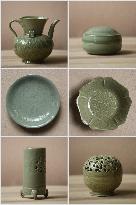
(240711) -- TAIZHOU, July 11, 2024 Photo by Xinhua/ABACAPRESS.COM) -- This combo photo taken on July 11, 2024 shows celadon wares made by Xie Zhenwei in Shabu Township, Huangyan of Taizhou, east China's Zhejiang Province. Originated in the Tang Dynasty (618-907) and flourished in the Northern Song Dynasty (960-1127), the Shabu Kilns are considered as transitional kilns during the development of southern celadon industry from Yue Kilns to Longquan Kilns. Xie Zhenwei, a young porcelain artisan and a native of Shabu Township, has been making efforts to reproduce the celadon wares in the style of Shabu Kilns, which is characterized by exquisite carved patterns. To achieve his goal, Xie learned techniques from Yue Kilns and Longquan Kilns and kept using local materials. At present, Xie has successfully made celadon wares like censer, jug and powder boxes, in the style of Shabu Kilns. He also set up a workshop to display the culture of this art. Photo by Xinhua/ABACAPRESS.COM/Weng Xinyang)

  •  
(ZhejiangPictorial)CHINA-ZHEJIANG-SHABU KILNS-CELADON PORCELAIN-ARTISAN (CN)

(ZhejiangPictorial)CHINA-ZHEJIANG-SHABU KILNS-CELADON PORCELAIN-ARTISAN (CN)

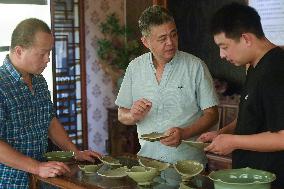
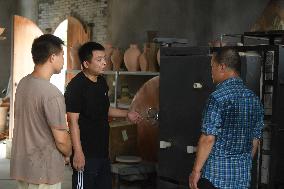
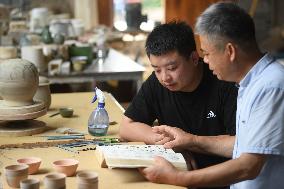
(240711) -- TAIZHOU, July 11, 2024 Photo by Xinhua/ABACAPRESS.COM) -- Luo Yonghua (C), an expert on Shabu Kilns, explains the features of the carved patterns on ancient Shabu-Kiln celadon pieces as Xie Zhenwei (R) listens in Shabu Township, Huangyan of Taizhou, east China's Zhejiang Province, July 11, 2024. Originated in the Tang Dynasty (618-907) and flourished in the Northern Song Dynasty (960-1127), the Shabu Kilns are considered as transitional kilns during the development of southern celadon industry from Yue Kilns to Longquan Kilns. Xie Zhenwei, a young porcelain artisan and a native of Shabu Township, has been making efforts to reproduce the celadon wares in the style of Shabu Kilns, which is characterized by exquisite carved patterns. To achieve his goal, Xie learned techniques from Yue Kilns and Longquan Kilns and kept using local materials. At present, Xie has successfully made celadon wares like censer, jug and powder boxes, in the style of Shabu Kilns. He also set up a workshop to display the cult

  •  
(ZhejiangPictorial)CHINA-ZHEJIANG-SHABU KILNS-CELADON PORCELAIN-ARTISAN (CN)

(ZhejiangPictorial)CHINA-ZHEJIANG-SHABU KILNS-CELADON PORCELAIN-ARTISAN (CN)

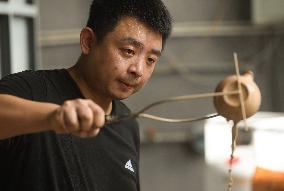
(240711) -- TAIZHOU, July 11, 2024 Photo by Xinhua/ABACAPRESS.COM) -- Xie Zhenwei works at a kiln in Shabu Township, Huangyan of Taizhou, east China's Zhejiang Province, July 11, 2024. Originated in the Tang Dynasty (618-907) and flourished in the Northern Song Dynasty (960-1127), the Shabu Kilns are considered as transitional kilns during the development of southern celadon industry from Yue Kilns to Longquan Kilns. Xie Zhenwei, a young porcelain artisan and a native of Shabu Township, has been making efforts to reproduce the celadon wares in the style of Shabu Kilns, which is characterized by exquisite carved patterns. To achieve his goal, Xie learned techniques from Yue Kilns and Longquan Kilns and kept using local materials. At present, Xie has successfully made celadon wares like censer, jug and powder boxes, in the style of Shabu Kilns. He also set up a workshop to display the culture of this art. Photo by Xinhua/ABACAPRESS.COM/Weng Xinyang)

  •  
(ZhejiangPictorial)CHINA-ZHEJIANG-SHABU KILNS-CELADON PORCELAIN-ARTISAN (CN)

(ZhejiangPictorial)CHINA-ZHEJIANG-SHABU KILNS-CELADON PORCELAIN-ARTISAN (CN)

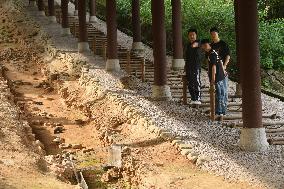
(240711) -- TAIZHOU, July 11, 2024 Photo by Xinhua/ABACAPRESS.COM) -- Xie Zhenwei (L) makes a point as students graduated from a technician college look on during a visit in a relic site of an ancient kiln in Shabu Township, Huangyan of Taizhou, east China's Zhejiang Province, July 11, 2024. Originated in the Tang Dynasty (618-907) and flourished in the Northern Song Dynasty (960-1127), the Shabu Kilns are considered as transitional kilns during the development of southern celadon industry from Yue Kilns to Longquan Kilns. Xie Zhenwei, a young porcelain artisan and a native of Shabu Township, has been making efforts to reproduce the celadon wares in the style of Shabu Kilns, which is characterized by exquisite carved patterns. To achieve his goal, Xie learned techniques from Yue Kilns and Longquan Kilns and kept using local materials. At present, Xie has successfully made celadon wares like censer, jug and powder boxes, in the style of Shabu Kilns. He also set up a workshop to display the culture of this art.

  •  
(ZhejiangPictorial)CHINA-ZHEJIANG-SHABU KILNS-CELADON PORCELAIN-ARTISAN (CN)

(ZhejiangPictorial)CHINA-ZHEJIANG-SHABU KILNS-CELADON PORCELAIN-ARTISAN (CN)

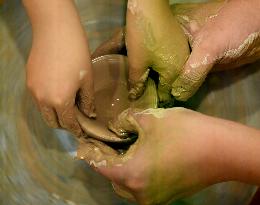
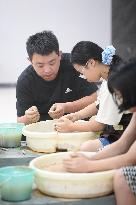
(240711) -- TAIZHOU, July 11, 2024 Photo by Xinhua/ABACAPRESS.COM) -- Xie Zhenwei helps a primary school student make a piece of porcelain in Shabu Township, Huangyan of Taizhou, east China's Zhejiang Province, July 11, 2024. Originated in the Tang Dynasty (618-907) and flourished in the Northern Song Dynasty (960-1127), the Shabu Kilns are considered as transitional kilns during the development of southern celadon industry from Yue Kilns to Longquan Kilns. Xie Zhenwei, a young porcelain artisan and a native of Shabu Township, has been making efforts to reproduce the celadon wares in the style of Shabu Kilns, which is characterized by exquisite carved patterns. To achieve his goal, Xie learned techniques from Yue Kilns and Longquan Kilns and kept using local materials. At present, Xie has successfully made celadon wares like censer, jug and powder boxes, in the style of Shabu Kilns. He also set up a workshop to display the culture of this art. Photo by Xinhua/ABACAPRESS.COM/Weng Xinyang)

  •  
(ZhejiangPictorial)CHINA-ZHEJIANG-SHABU KILNS-CELADON PORCELAIN-ARTISAN (CN)

(ZhejiangPictorial)CHINA-ZHEJIANG-SHABU KILNS-CELADON PORCELAIN-ARTISAN (CN)

(240711) -- TAIZHOU, July 11, 2024 Photo by Xinhua/ABACAPRESS.COM) -- Xie Zhenwei (C) discusses with his fellows on porcelain-making in Shabu Township, Huangyan of Taizhou, east China's Zhejiang Province, July 11, 2024. Originated in the Tang Dynasty (618-907) and flourished in the Northern Song Dynasty (960-1127), the Shabu Kilns are considered as transitional kilns during the development of southern celadon industry from Yue Kilns to Longquan Kilns. Xie Zhenwei, a young porcelain artisan and a native of Shabu Township, has been making efforts to reproduce the celadon wares in the style of Shabu Kilns, which is characterized by exquisite carved patterns. To achieve his goal, Xie learned techniques from Yue Kilns and Longquan Kilns and kept using local materials. At present, Xie has successfully made celadon wares like censer, jug and powder boxes, in the style of Shabu Kilns. He also set up a workshop to display the culture of this art. Photo by Xinhua/ABACAPRESS.COM/Weng Xinyang)

  •  
(ZhejiangPictorial)CHINA-ZHEJIANG-SHABU KILNS-CELADON PORCELAIN-ARTISAN (CN)

(ZhejiangPictorial)CHINA-ZHEJIANG-SHABU KILNS-CELADON PORCELAIN-ARTISAN (CN)

(240711) -- TAIZHOU, July 11, 2024 Photo by Xinhua/ABACAPRESS.COM) -- Luo Yonghua (R), an expert on Shabu Kilns, shows the traditional carved patterns to Xie Zhenwei in Shabu Township, Huangyan of Taizhou, east China's Zhejiang Province, July 11, 2024. Originated in the Tang Dynasty (618-907) and flourished in the Northern Song Dynasty (960-1127), the Shabu Kilns are considered as transitional kilns during the development of southern celadon industry from Yue Kilns to Longquan Kilns. Xie Zhenwei, a young porcelain artisan and a native of Shabu Township, has been making efforts to reproduce the celadon wares in the style of Shabu Kilns, which is characterized by exquisite carved patterns. To achieve his goal, Xie learned techniques from Yue Kilns and Longquan Kilns and kept using local materials. At present, Xie has successfully made celadon wares like censer, jug and powder boxes, in the style of Shabu Kilns. He also set up a workshop to display the culture of this art. Photo by Xinhua/ABACAPRESS.COM/Weng Xin

  •  
(ZhejiangPictorial)CHINA-ZHEJIANG-SHABU KILNS-CELADON PORCELAIN-ARTISAN (CN)

(ZhejiangPictorial)CHINA-ZHEJIANG-SHABU KILNS-CELADON PORCELAIN-ARTISAN (CN)

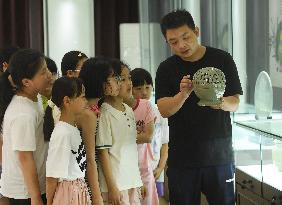
(240711) -- TAIZHOU, July 11, 2024 Photo by Xinhua/ABACAPRESS.COM) -- Xie Zhenwei explains the features of a Shabu-Kiln celadon censer as primary school students listen in Shabu Township, Huangyan of Taizhou, east China's Zhejiang Province, July 11, 2024. Originated in the Tang Dynasty (618-907) and flourished in the Northern Song Dynasty (960-1127), the Shabu Kilns are considered as transitional kilns during the development of southern celadon industry from Yue Kilns to Longquan Kilns. Xie Zhenwei, a young porcelain artisan and a native of Shabu Township, has been making efforts to reproduce the celadon wares in the style of Shabu Kilns, which is characterized by exquisite carved patterns. To achieve his goal, Xie learned techniques from Yue Kilns and Longquan Kilns and kept using local materials. At present, Xie has successfully made celadon wares like censer, jug and powder boxes, in the style of Shabu Kilns. He also set up a workshop to display the culture of this art. Photo by Xinhua/ABACAPRESS.COM/Weng

  •  
(ZhejiangPictorial)CHINA-ZHEJIANG-SHABU KILNS-CELADON PORCELAIN-ARTISAN (CN)

(ZhejiangPictorial)CHINA-ZHEJIANG-SHABU KILNS-CELADON PORCELAIN-ARTISAN (CN)

(240711) -- TAIZHOU, July 11, 2024 Photo by Xinhua/ABACAPRESS.COM) -- Xie Zhenwei gives instruction in a pottery class for primary school students at his studio in Shabu Township, Huangyan of Taizhou, east China's Zhejiang Province, July 11, 2024. Originated in the Tang Dynasty (618-907) and flourished in the Northern Song Dynasty (960-1127), the Shabu Kilns are considered as transitional kilns during the development of southern celadon industry from Yue Kilns to Longquan Kilns. Xie Zhenwei, a young porcelain artisan and a native of Shabu Township, has been making efforts to reproduce the celadon wares in the style of Shabu Kilns, which is characterized by exquisite carved patterns. To achieve his goal, Xie learned techniques from Yue Kilns and Longquan Kilns and kept using local materials. At present, Xie has successfully made celadon wares like censer, jug and powder boxes, in the style of Shabu Kilns. He also set up a workshop to display the culture of this art. Photo by Xinhua/ABACAPRESS.COM/Weng Xinyang)

  •  
(ZhejiangPictorial)CHINA-ZHEJIANG-SHABU KILNS-CELADON PORCELAIN-ARTISAN (CN)

(ZhejiangPictorial)CHINA-ZHEJIANG-SHABU KILNS-CELADON PORCELAIN-ARTISAN (CN)

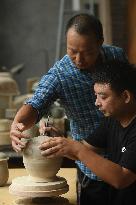
(240711) -- TAIZHOU, July 11, 2024 Photo by Xinhua/ABACAPRESS.COM) -- Longquan celadon artisan Chen Junlin (top) instructs as Xie Zhenwei makes a censer in the style of Shabu Kilns in Shabu Township, Huangyan of Taizhou, east China's Zhejiang Province, July 11, 2024. Originated in the Tang Dynasty (618-907) and flourished in the Northern Song Dynasty (960-1127), the Shabu Kilns are considered as transitional kilns during the development of southern celadon industry from Yue Kilns to Longquan Kilns. Xie Zhenwei, a young porcelain artisan and a native of Shabu Township, has been making efforts to reproduce the celadon wares in the style of Shabu Kilns, which is characterized by exquisite carved patterns. To achieve his goal, Xie learned techniques from Yue Kilns and Longquan Kilns and kept using local materials. At present, Xie has successfully made celadon wares like censer, jug and powder boxes, in the style of Shabu Kilns. He also set up a workshop to display the culture of this art. Photo by Xinhua/ABACAPRE

  •  
(ZhejiangPictorial)CHINA-ZHEJIANG-SHABU KILNS-CELADON PORCELAIN-ARTISAN (CN)

(ZhejiangPictorial)CHINA-ZHEJIANG-SHABU KILNS-CELADON PORCELAIN-ARTISAN (CN)

(240711) -- TAIZHOU, July 11, 2024 Photo by Xinhua/ABACAPRESS.COM) -- Xie Zhenwei applies glaze to a porcelain ware at a kiln in Shabu Township, Huangyan of Taizhou, east China's Zhejiang Province, July 11, 2024. Originated in the Tang Dynasty (618-907) and flourished in the Northern Song Dynasty (960-1127), the Shabu Kilns are considered as transitional kilns during the development of southern celadon industry from Yue Kilns to Longquan Kilns. Xie Zhenwei, a young porcelain artisan and a native of Shabu Township, has been making efforts to reproduce the celadon wares in the style of Shabu Kilns, which is characterized by exquisite carved patterns. To achieve his goal, Xie learned techniques from Yue Kilns and Longquan Kilns and kept using local materials. At present, Xie has successfully made celadon wares like censer, jug and powder boxes, in the style of Shabu Kilns. He also set up a workshop to display the culture of this art. Photo by Xinhua/ABACAPRESS.COM/Weng Xinyang)

  •  
(ZhejiangPictorial)CHINA-ZHEJIANG-SHABU KILNS-CELADON PORCELAIN-ARTISAN (CN)

(ZhejiangPictorial)CHINA-ZHEJIANG-SHABU KILNS-CELADON PORCELAIN-ARTISAN (CN)

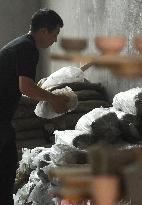
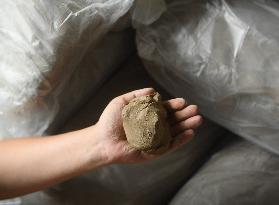
(240711) -- TAIZHOU, July 11, 2024 Photo by Xinhua/ABACAPRESS.COM) -- Xie Zhenwei shows the clay made from local materials for porcelain-making in Shabu Township, Huangyan of Taizhou, east China's Zhejiang Province, July 11, 2024. Originated in the Tang Dynasty (618-907) and flourished in the Northern Song Dynasty (960-1127), the Shabu Kilns are considered as transitional kilns during the development of southern celadon industry from Yue Kilns to Longquan Kilns. Xie Zhenwei, a young porcelain artisan and a native of Shabu Township, has been making efforts to reproduce the celadon wares in the style of Shabu Kilns, which is characterized by exquisite carved patterns. To achieve his goal, Xie learned techniques from Yue Kilns and Longquan Kilns and kept using local materials. At present, Xie has successfully made celadon wares like censer, jug and powder boxes, in the style of Shabu Kilns. He also set up a workshop to display the culture of this art. Photo by Xinhua/ABACAPRESS.COM/Weng Xinyang)

  •  
(ZhejiangPictorial)CHINA-ZHEJIANG-SHABU KILNS-CELADON PORCELAIN-ARTISAN (CN)

(ZhejiangPictorial)CHINA-ZHEJIANG-SHABU KILNS-CELADON PORCELAIN-ARTISAN (CN)

(240711) -- TAIZHOU, July 11, 2024 Photo by Xinhua/ABACAPRESS.COM) -- Xie Zhenwei arranges porcelain wares at a kiln in Shabu Township, Huangyan of Taizhou, east China's Zhejiang Province, July 11, 2024. Originated in the Tang Dynasty (618-907) and flourished in the Northern Song Dynasty (960-1127), the Shabu Kilns are considered as transitional kilns during the development of southern celadon industry from Yue Kilns to Longquan Kilns. Xie Zhenwei, a young porcelain artisan and a native of Shabu Township, has been making efforts to reproduce the celadon wares in the style of Shabu Kilns, which is characterized by exquisite carved patterns. To achieve his goal, Xie learned techniques from Yue Kilns and Longquan Kilns and kept using local materials. At present, Xie has successfully made celadon wares like censer, jug and powder boxes, in the style of Shabu Kilns. He also set up a workshop to display the culture of this art. Photo by Xinhua/ABACAPRESS.COM/Weng Xinyang)

  •  
(MASTER OF CRAFTS)CHINA-CARVED LACQUER-INHERITOR-STUDIO (CN)

(MASTER OF CRAFTS)CHINA-CARVED LACQUER-INHERITOR-STUDIO (CN)

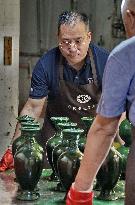
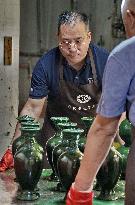
(240607) -- BEIJING, June 7, 2024 Photo by Xinhua/ABACAPRESS.COM) -- Zhu Jiang (L) and his father carry semi-finished carved lacquer wares for drying at his studio in Gu'an, north China's Hebei Province, May 30, 2024. Carved lacquer, dating back to the Tang Dynasty (618-907), greeted its peak time in Ming and Qing dynasties (1368-1911). Since the founding of the People's Republic of China in 1949, Beijing and Yangzhou have become the two centers for the craft of carved lacquer, which was listed as a national-level intangible cultural heritage in 2006. Carved lacquer differs in its colors, namely red, black or multiple colors. Its making procedures include designing, body shaping, lacquer making, coating, drawing, carving and grinding. The craftsman needs to smoothly use various kinds of knives to carve patterns on the ware, and even a little miss can destroy the whole artwork. The craft can only be grasped through three to five years of practice. Therefore, it is also called "the art of time." Born in 1976, Z

  •  
(MASTER OF CRAFTS)CHINA-CARVED LACQUER-INHERITOR-STUDIO (CN)

(MASTER OF CRAFTS)CHINA-CARVED LACQUER-INHERITOR-STUDIO (CN)

(240607) -- BEIJING, June 7, 2024 Photo by Xinhua/ABACAPRESS.COM) -- Zhu Jiang checks semi-finished carved lacquer wares at his studio in Gu'an, north China's Hebei Province, May 30, 2024. Carved lacquer, dating back to the Tang Dynasty (618-907), greeted its peak time in Ming and Qing dynasties (1368-1911). Since the founding of the People's Republic of China in 1949, Beijing and Yangzhou have become the two centers for the craft of carved lacquer, which was listed as a national-level intangible cultural heritage in 2006. Carved lacquer differs in its colors, namely red, black or multiple colors. Its making procedures include designing, body shaping, lacquer making, coating, drawing, carving and grinding. The craftsman needs to smoothly use various kinds of knives to carve patterns on the ware, and even a little miss can destroy the whole artwork. The craft can only be grasped through three to five years of practice. Therefore, it is also called "the art of time." Born in 1976, Zhu Jiang, an inheritor of the

  •  
(MASTER OF CRAFTS)CHINA-CARVED LACQUER-INHERITOR-STUDIO (CN)

(MASTER OF CRAFTS)CHINA-CARVED LACQUER-INHERITOR-STUDIO (CN)

(240607) -- BEIJING, June 7, 2024 (Xinhua) -- Zhu Jiang checks semi-finished carved lacquer wares at his studio in Gu'an, north China's Hebei Province, May 30, 2024. Carved lacquer, dating back to the Tang Dynasty (618-907), greeted its peak time in Ming and Qing dynasties (1368-1911). Since the founding of the People's Republic of China in 1949, Beijing and Yangzhou have become the two centers for the craft of carved lacquer, which was listed as a national-level intangible cultural heritage in 2006. Carved lacquer differs in its colors, namely red, black or multiple colors. Its making procedures include designing, body shaping, lacquer making, coating, drawing, carving and grinding. The craftsman needs to smoothly use various kinds of knives to carve patterns on the ware, and even a little miss can destroy the whole artwork. The craft can only be grasped through three to five years of practice. Therefore, it is also called "the art of time." Born in 1976, Zhu Jiang, an inheritor of the craft of carved

  •  
(MASTER OF CRAFTS)CHINA-CARVED LACQUER-INHERITOR-STUDIO (CN)

(MASTER OF CRAFTS)CHINA-CARVED LACQUER-INHERITOR-STUDIO (CN)

(240607) -- BEIJING, June 7, 2024 (Xinhua) -- Zhu Jiang (L) and his father carry semi-finished carved lacquer wares for drying at his studio in Gu'an, north China's Hebei Province, May 30, 2024. Carved lacquer, dating back to the Tang Dynasty (618-907), greeted its peak time in Ming and Qing dynasties (1368-1911). Since the founding of the People's Republic of China in 1949, Beijing and Yangzhou have become the two centers for the craft of carved lacquer, which was listed as a national-level intangible cultural heritage in 2006. Carved lacquer differs in its colors, namely red, black or multiple colors. Its making procedures include designing, body shaping, lacquer making, coating, drawing, carving and grinding. The craftsman needs to smoothly use various kinds of knives to carve patterns on the ware, and even a little miss can destroy the whole artwork. The craft can only be grasped through three to five years of practice. Therefore, it is also called "the art of time." Born in 1976, Zhu Jiang, an inhe

  •  
MasterOfCrafts | Porcelain mending inheritor in east China's Shandong Province

MasterOfCrafts | Porcelain mending inheritor in east China's Shandong Province

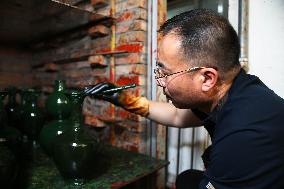
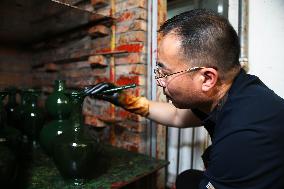
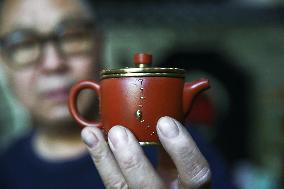
(240601) -- ZIBO, June 1, 2024 Photo by Xinhua/ABACAPRESS.COM) -- Yang Tao shows a mended porcelain tea pot at his studio in Zichuan District of Zibo City, east China's Shandong Province, May 8, 2024. Porcelain mending, an ancient Chinese traditional craft which uses special drills and nails to make patches on broken porcelain wares, gives a new life to the porcelain and allows it to be back into use. Yang Tao, a fifth generation inheritor of Yang's porcelain mending skills in Zibo City of east China's Shandong Province, has been dedicated in the craft for over 30 years." In ancient times, we mended the porcelain wares just for reusing it, but now the craft can recreate it to a piece of artwork," said Yang Tao. Influenced by his father and grandfather, Yang has been interested in the craft since his childhood. The first toy he got was a load filled with various tools for porcelain mending. He became a professional porcelain mender when he was 25 years old and started to visit masters in the art across the cou

  • Main
  • Top
  • Editorial
  • Creative
  • About Us
  • About ILG
  • Terms of use
  • Company
  • BEHIND
  • Price List
  • Single Plan
  • Monthly Plan
  • Services
  • Shooting
  • Rights Clearance
  • Support
  • FAQ
  • How To Buy
  • Contact Us
  • Become a Partner

© KYODO NEWS IMAGES INC

All Rights Reserved.

  • Editorial
  • Olympics
  • News
  • Sports
  • Japan
  • Tech
  • Royal
  • Disaster
  • NorthKorea
  • Old Japan
  • SNS
  • Creative
  • Food
  • Japan
  • Landscape
  • Animal
  • Popular
  • #Ukraine
  • #China
  • #coronavirus
  • #N. Korea
  • #Russia
  • #Thailand
  • #Ukraine
  • #China
  • #coronavirus
  • #N. Korea
  • #Russia
  • #Thailand
  • Food
  • Japan
  • Landscape
  • Animal
  • Olympics
  • News
  • Sports
  • Japan
  • Tech
  • Royal
  • Disaster
  • NorthKorea
  • Old Japan
  • SNS