•  
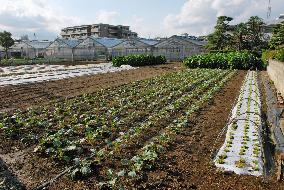
Tokyo snapshot: Vegetable fields dotting Tokyo's Edogawa area

Tokyo snapshot: Vegetable fields dotting Tokyo's Edogawa area

Photo taken on Sept. 11, 2015, shows a vegetable field in a residential area of Tokyo's Edogawa district. The Komatsugawa area produces a leafy vegetable variety known as "komatsuna," a name given by feudal ruler Tokugawa Yoshimune during the Edo shogunate period. (Kyodo) ==Kyodo

  •  
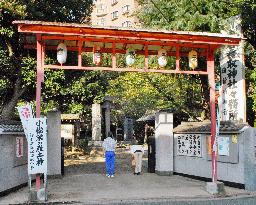
Tokyo snapshot: Shrine dedicated to god of leafy vegetable

Tokyo snapshot: Shrine dedicated to god of leafy vegetable

Photo taken on Sept. 11, 2015, shows Shinkoiwa Yakuyoke Katori Shrine in Tokyo's Edogawa district. The signboard in the left foreground states the shrine is dedicated to the god who created the "komatsuna" leafy vegetable variety. The chief priest is said to have served soup with the vegetable to feudal ruler Tokugawa Yoshimune in 1719 and Yoshimune named it komatsuna after the area's name, Komatsugawa. (Kyodo) ==Kyodo

  •  
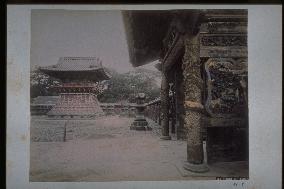
The bell tower at Yushoin,Zojoji Temple,Shiba

The bell tower at Yushoin,Zojoji Temple,Shiba

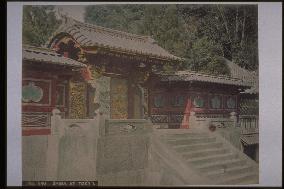
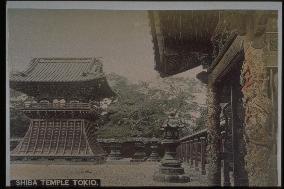
Chokugaku Gate, the main entrance to the mausoleum of the 7th Shogun Tokugawa Ietsugu, and the bell tower are viewed from the south. There are carvings of dragons on the gateposts. The most opulent of the Tokugawa mausoleums at Zojoji Temple, it was the last built exclusively as a mausoleum. Subsequent shoguns were enshrined in existing mausoleums in accordance with the wishes of the 8th Shogun Yoshimune.==Date:unknown, Place:Tokyo, Photo:unknown, (Credit:Nagasaki University Library/Kyodo News Images) [Cabinet Number93‐5‐0]

  •  
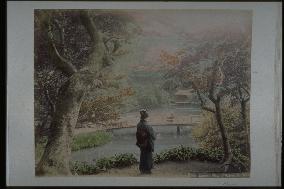
Autumn tints of Takinogawa, Oji

Autumn tints of Takinogawa, Oji

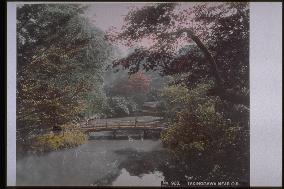
The slow-flowing Shakujii River originates from Sanpoji Pond, Shakujii Pond, and Fujimi Pond, then becomes a rapid stream in the Oji area. It is said that the river roared like a waterfall. Hence, the name of the river became Takinogawa ( Waterfall River). Takinogawa became famous for its autumn colours after the 8th Shogun, Tokugawa Yoshimune, had them planted in this area in 1721. A woman stands in the foreground, enjoying the scenery.==Date:unknown, Place:Tokyo, Photo:Kajima Seibei, (Credit:Nagasaki University Library/Kyodo News Images) [Cabinet Number87‐12‐0]

  •  
Autumn tints of Takinogawa, Oji

Autumn tints of Takinogawa, Oji

The 8th Shogun, Tokugawa Yoshimune, visited this area in 1720-21 and was pleased to find that the Oji Gongen Shrine and the name of the Otonashi River originated in his home province, Kishu. As a result he ordered the planting of Yoshino cherry trees at Mt. Asuka and maple trees along Takinogawa to provide autumn colours. Consequently, the Oji area became a popular tourist spot for people from Edo. Taken in the mid-Meiji Period.==Date:unknown, Place:Tokyo, Photo:unknown, (Credit:Nagasaki University Library/Kyodo News Images) [Cabinet Number80‐34‐0]

  •  
The General's tomb,Zojoji Temple,Shiba

The General's tomb,Zojoji Temple,Shiba

This is the gate in front of the pagoda of the 9th Shogun Tokugawa Ieshige (Shunshinin). No new mausoleums were constructed after the 8th Shogun Yoshimune, so the okuin (inner shrine) of Shunshinin was attached to that of Yushouin. This is the northernmost mausoleum at Zojoji Temple built for the Tokugawa shoguns.==Date:unknown, Place:Tokyo, Photo:Tamamura Kozaburo, (Credit:Nagasaki University Library/Kyodo News Images) [Cabinet Number80‐33‐0]

  •  
Fukiage Park,the Imperial Palace

Fukiage Park,the Imperial Palace

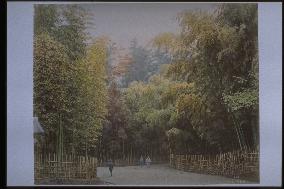
The 8th Shogun Tokugawa Yoshimune is said to have planted bamboo trees in Fukiage Garden located north of Hanzo-mon around 1725, a time when the shogunate was in dire financial straits. Bamboo was chosen because it is practical and abundant. The bamboo trees can still be seen today inside Hanzo-mon. Emperor Showa (1926-1989) used to enjoy digging up bamboo shoots here. Taken between 1877 and 1887 (second decade of the Meiji Period).==Date:unknown, Place:Tokyo, Photo:R. Stillfried, (Credit:Nagasaki University Library/Kyodo News Images) [Cabinet Number77‐6‐0]

  •  
Shiba Zojoji Temple

Shiba Zojoji Temple

Chokugaku Gate, the main entrance to the mausoleum of the 7th Shogun Tokugawa Ietsugu, and the bell tower are viewed from the south. There are carvings of dragons on the gateposts. The most opulent of the Tokugawa mausoleums at Zojoji Temple, it was the last built exclusively as a mausoleum. Subsequent shoguns were enshrined in existing mausoleums in accordance with the wishes of the 8th Shogun Yoshimune.==Date:unknown, Place:Tokyo, Photo:Usui Shuzaburo?, (Credit:Nagasaki University Library/Kyodo News Images) [Cabinet Number65‐38‐0]

  •  
Cherry trees at Mukojima

Cherry trees at Mukojima

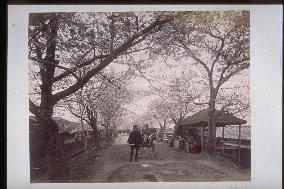
The area across Sumida River from Asakusa is Mukojima. There is no official boundary, but area from Mokuboji Temple to Makura Bridge is referred to as Mukojima. The banks of Sumida River at Mukojima are called Sumida-tei or Boku-tei. Cherry trees were planted here during the Kyoho Period (1716-36) by the 8th Shogun Tokugawa Yoshimune, and saplings were planted from time to time thereafter. This area thus became the most popular place to enjoy cherry blossoms in Edo. Taken around 1898.==Date:unknown, Place:Tokyo, Photo:unknown, (Credit:Nagasaki University Library/Kyodo News Images) [Cabinet Number53‐40‐0]

  •  
The bell tower at Yushoin,Zojoji Temple,Shiba

The bell tower at Yushoin,Zojoji Temple,Shiba

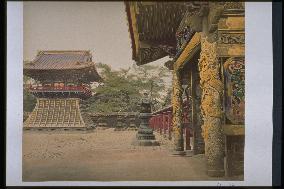
Chokugaku Gate, the main entrance to the mausoleum of the 7th Shogun Tokugawa Ietsugu, and the bell tower are viewed from the south. There are carvings of dragons on the gateposts. The most opulent of the Tokugawa mausoleums at Zojoji Temple, it was the last built exclusively as a mausoleum. Subsequent shoguns were enshrined in existing mausoleums in accordance with the wishes of the 8th Shogun Yoshimune.==Date:unknown, Place:Tokyo, Photo:unknown, (Credit:Nagasaki University Library/Kyodo News Images) [Cabinet Number53‐42‐0]

  •  
Ueno Park

Ueno Park

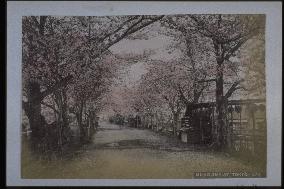
In 1717, the 8th Shogun Tokugawa Yoshimune planted 100 cherry trees along the Mukojima riverbank, and the spot became popular for cherry blossom viewing. In 1883, when Okura Kihachiro planted an additional 1,000 trees here, the riverbank became full of cherry blossoms. Many simple teahouses were built along the riverbank for the use of visitors.==Date:unknown, Place:Tokyo, Photo:unknown, (Credit:Nagasaki University Library/Kyodo News Images) [Cabinet Number47‐8‐0]

  •  
The five-story pagoda of Kaneiji Temple

The five-story pagoda of Kaneiji Temple

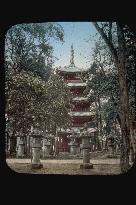
Kaneiji Temple in Ueno enshrined the tombs of five Shoguns: Ietsuna, Tsunayoshi, Yoshimune, Ieharu and Iesada. The five-story tower was rebuilt and is now located within the Ueno Zoo.==Date:unknown, Place:Tokyo, Photo:unknown, (Credit:Nagasaki University Library/Kyodo News Images) [Cabinet Number31‐3‐0]

  •  
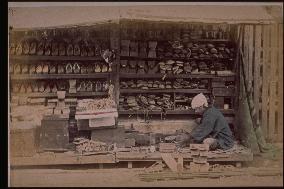
A geta clog craftsman

A geta clog craftsman

The geta (Japanese clogs) have a long history, going back to the Yayoi era. But they became widely popular only in the Edo era. During the reign of the Shogun Yoshimune, the sanmaiba geta became the footwear for prostitutes. Red high-heeled pokkuri (sandals) became a trend among young girls, and geta became an important fashion item. When Japanese women dressed mainly in kimono, geta craftsmen had a variety of geta in their shops.==Date:unknown, Place:unknown, Photo:unknown, (Credit:Nagasaki University Library/Kyodo News Images) [Cabinet Number15‐5‐0]

  • Main
  • Top
  • Editorial
  • Creative
  • About Us
  • About ILG
  • Terms of use
  • Company
  • BEHIND
  • Price List
  • Single Plan
  • Monthly Plan
  • Services
  • Shooting
  • Rights Clearance
  • Support
  • FAQ
  • How To Buy
  • Contact Us
  • Become a Partner

© KYODO NEWS IMAGES INC

All Rights Reserved.

  • Editorial
  • Olympics
  • News
  • Sports
  • Japan
  • Tech
  • Royal
  • Disaster
  • NorthKorea
  • Old Japan
  • SNS
  • Creative
  • Food
  • Japan
  • Landscape
  • Animal
  • Popular
  • #Ukraine
  • #China
  • #coronavirus
  • #N. Korea
  • #Thailand
  • #Russia
  • #Ukraine
  • #China
  • #coronavirus
  • #N. Korea
  • #Thailand
  • #Russia
  • Food
  • Japan
  • Landscape
  • Animal
  • Olympics
  • News
  • Sports
  • Japan
  • Tech
  • Royal
  • Disaster
  • NorthKorea
  • Old Japan
  • SNS