•  
XINHUA PHOTOS OF THE DAY

XINHUA PHOTOS OF THE DAY

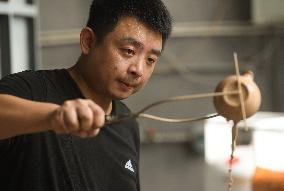
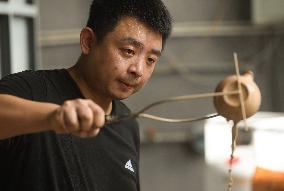
(240712) -- BEIJING, July 12, 2024 Photo by Xinhua/ABACAPRESS.COM) -- Xie Zhenwei applies glaze to a porcelain ware at a kiln in Shabu Township, Huangyan of Taizhou, east China's Zhejiang Province, July 11, 2024. Originated in the Tang Dynasty (618-907) and flourished in the Northern Song Dynasty (960-1127), the Shabu Kilns are considered as transitional kilns during the development of southern celadon industry from Yue Kilns to Longquan Kilns. Xie Zhenwei, a young porcelain artisan and a native of Shabu Township, has been making efforts to reproduce the celadon wares in the style of Shabu Kilns, which is characterized by exquisite carved patterns. To achieve his goal, Xie learned techniques from Yue Kilns and Longquan Kilns and kept using local materials. At present, Xie has successfully made celadon wares like censer, jug and powder boxes, in the style of Shabu Kilns. He also set up a workshop to display the culture of this art. Photo by Xinhua/ABACAPRESS.COM/Weng Xinyang)

  •  
(ZhejiangPictorial)CHINA-ZHEJIANG-SHABU KILNS-CELADON PORCELAIN-ARTISAN (CN)

(ZhejiangPictorial)CHINA-ZHEJIANG-SHABU KILNS-CELADON PORCELAIN-ARTISAN (CN)

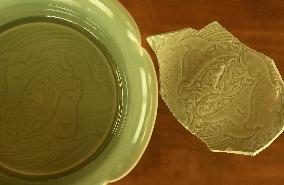
(240711) -- TAIZHOU, July 11, 2024 Photo by Xinhua/ABACAPRESS.COM) -- A piece of ancient Shabu-Kiln celadon ware (R) and a celadon ware made by Xie Zhenwei are pictured in Shabu Township, Huangyan of Taizhou, east China's Zhejiang Province, July 11, 2024. Originated in the Tang Dynasty (618-907) and flourished in the Northern Song Dynasty (960-1127), the Shabu Kilns are considered as transitional kilns during the development of southern celadon industry from Yue Kilns to Longquan Kilns. Xie Zhenwei, a young porcelain artisan and a native of Shabu Township, has been making efforts to reproduce the celadon wares in the style of Shabu Kilns, which is characterized by exquisite carved patterns. To achieve his goal, Xie learned techniques from Yue Kilns and Longquan Kilns and kept using local materials. At present, Xie has successfully made celadon wares like censer, jug and powder boxes, in the style of Shabu Kilns. He also set up a workshop to display the culture of this art. Photo by Xinhua/ABACAPRESS.COM/Weng

  •  
(ZhejiangPictorial)CHINA-ZHEJIANG-SHABU KILNS-CELADON PORCELAIN-ARTISAN (CN)

(ZhejiangPictorial)CHINA-ZHEJIANG-SHABU KILNS-CELADON PORCELAIN-ARTISAN (CN)

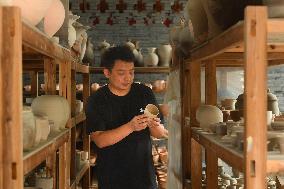
(240711) -- TAIZHOU, July 11, 2024 Photo by Xinhua/ABACAPRESS.COM) -- Xie Zhenwei arranges porcelain wares at a kiln in Shabu Township, Huangyan of Taizhou, east China's Zhejiang Province, July 11, 2024. Originated in the Tang Dynasty (618-907) and flourished in the Northern Song Dynasty (960-1127), the Shabu Kilns are considered as transitional kilns during the development of southern celadon industry from Yue Kilns to Longquan Kilns. Xie Zhenwei, a young porcelain artisan and a native of Shabu Township, has been making efforts to reproduce the celadon wares in the style of Shabu Kilns, which is characterized by exquisite carved patterns. To achieve his goal, Xie learned techniques from Yue Kilns and Longquan Kilns and kept using local materials. At present, Xie has successfully made celadon wares like censer, jug and powder boxes, in the style of Shabu Kilns. He also set up a workshop to display the culture of this art. Photo by Xinhua/ABACAPRESS.COM/Weng Xinyang)

  •  
(ZhejiangPictorial)CHINA-ZHEJIANG-SHABU KILNS-CELADON PORCELAIN-ARTISAN (CN)

(ZhejiangPictorial)CHINA-ZHEJIANG-SHABU KILNS-CELADON PORCELAIN-ARTISAN (CN)

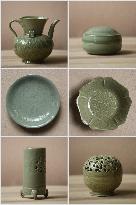
(240711) -- TAIZHOU, July 11, 2024 Photo by Xinhua/ABACAPRESS.COM) -- This combo photo taken on July 11, 2024 shows celadon wares made by Xie Zhenwei in Shabu Township, Huangyan of Taizhou, east China's Zhejiang Province. Originated in the Tang Dynasty (618-907) and flourished in the Northern Song Dynasty (960-1127), the Shabu Kilns are considered as transitional kilns during the development of southern celadon industry from Yue Kilns to Longquan Kilns. Xie Zhenwei, a young porcelain artisan and a native of Shabu Township, has been making efforts to reproduce the celadon wares in the style of Shabu Kilns, which is characterized by exquisite carved patterns. To achieve his goal, Xie learned techniques from Yue Kilns and Longquan Kilns and kept using local materials. At present, Xie has successfully made celadon wares like censer, jug and powder boxes, in the style of Shabu Kilns. He also set up a workshop to display the culture of this art. Photo by Xinhua/ABACAPRESS.COM/Weng Xinyang)

  •  
(ZhejiangPictorial)CHINA-ZHEJIANG-SHABU KILNS-CELADON PORCELAIN-ARTISAN (CN)

(ZhejiangPictorial)CHINA-ZHEJIANG-SHABU KILNS-CELADON PORCELAIN-ARTISAN (CN)

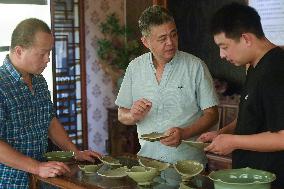
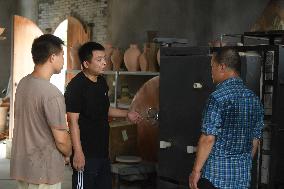
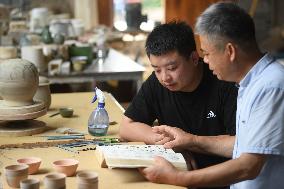
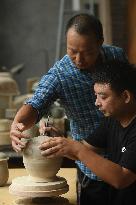
(240711) -- TAIZHOU, July 11, 2024 Photo by Xinhua/ABACAPRESS.COM) -- Luo Yonghua (C), an expert on Shabu Kilns, explains the features of the carved patterns on ancient Shabu-Kiln celadon pieces as Xie Zhenwei (R) listens in Shabu Township, Huangyan of Taizhou, east China's Zhejiang Province, July 11, 2024. Originated in the Tang Dynasty (618-907) and flourished in the Northern Song Dynasty (960-1127), the Shabu Kilns are considered as transitional kilns during the development of southern celadon industry from Yue Kilns to Longquan Kilns. Xie Zhenwei, a young porcelain artisan and a native of Shabu Township, has been making efforts to reproduce the celadon wares in the style of Shabu Kilns, which is characterized by exquisite carved patterns. To achieve his goal, Xie learned techniques from Yue Kilns and Longquan Kilns and kept using local materials. At present, Xie has successfully made celadon wares like censer, jug and powder boxes, in the style of Shabu Kilns. He also set up a workshop to display the cult

  •  
(ZhejiangPictorial)CHINA-ZHEJIANG-SHABU KILNS-CELADON PORCELAIN-ARTISAN (CN)

(ZhejiangPictorial)CHINA-ZHEJIANG-SHABU KILNS-CELADON PORCELAIN-ARTISAN (CN)

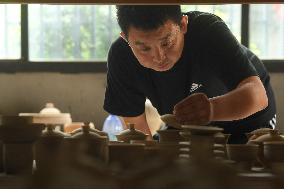
(240711) -- TAIZHOU, July 11, 2024 Photo by Xinhua/ABACAPRESS.COM) -- Xie Zhenwei works at a kiln in Shabu Township, Huangyan of Taizhou, east China's Zhejiang Province, July 11, 2024. Originated in the Tang Dynasty (618-907) and flourished in the Northern Song Dynasty (960-1127), the Shabu Kilns are considered as transitional kilns during the development of southern celadon industry from Yue Kilns to Longquan Kilns. Xie Zhenwei, a young porcelain artisan and a native of Shabu Township, has been making efforts to reproduce the celadon wares in the style of Shabu Kilns, which is characterized by exquisite carved patterns. To achieve his goal, Xie learned techniques from Yue Kilns and Longquan Kilns and kept using local materials. At present, Xie has successfully made celadon wares like censer, jug and powder boxes, in the style of Shabu Kilns. He also set up a workshop to display the culture of this art. Photo by Xinhua/ABACAPRESS.COM/Weng Xinyang)

  •  
(ZhejiangPictorial)CHINA-ZHEJIANG-SHABU KILNS-CELADON PORCELAIN-ARTISAN (CN)

(ZhejiangPictorial)CHINA-ZHEJIANG-SHABU KILNS-CELADON PORCELAIN-ARTISAN (CN)

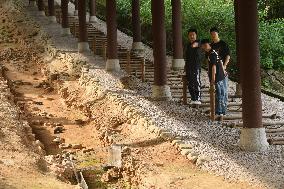
(240711) -- TAIZHOU, July 11, 2024 Photo by Xinhua/ABACAPRESS.COM) -- Xie Zhenwei (L) makes a point as students graduated from a technician college look on during a visit in a relic site of an ancient kiln in Shabu Township, Huangyan of Taizhou, east China's Zhejiang Province, July 11, 2024. Originated in the Tang Dynasty (618-907) and flourished in the Northern Song Dynasty (960-1127), the Shabu Kilns are considered as transitional kilns during the development of southern celadon industry from Yue Kilns to Longquan Kilns. Xie Zhenwei, a young porcelain artisan and a native of Shabu Township, has been making efforts to reproduce the celadon wares in the style of Shabu Kilns, which is characterized by exquisite carved patterns. To achieve his goal, Xie learned techniques from Yue Kilns and Longquan Kilns and kept using local materials. At present, Xie has successfully made celadon wares like censer, jug and powder boxes, in the style of Shabu Kilns. He also set up a workshop to display the culture of this art.

  •  
(ZhejiangPictorial)CHINA-ZHEJIANG-SHABU KILNS-CELADON PORCELAIN-ARTISAN (CN)

(ZhejiangPictorial)CHINA-ZHEJIANG-SHABU KILNS-CELADON PORCELAIN-ARTISAN (CN)

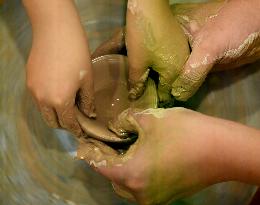
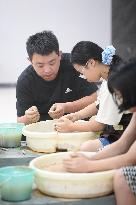
(240711) -- TAIZHOU, July 11, 2024 Photo by Xinhua/ABACAPRESS.COM) -- Xie Zhenwei helps a primary school student make a piece of porcelain in Shabu Township, Huangyan of Taizhou, east China's Zhejiang Province, July 11, 2024. Originated in the Tang Dynasty (618-907) and flourished in the Northern Song Dynasty (960-1127), the Shabu Kilns are considered as transitional kilns during the development of southern celadon industry from Yue Kilns to Longquan Kilns. Xie Zhenwei, a young porcelain artisan and a native of Shabu Township, has been making efforts to reproduce the celadon wares in the style of Shabu Kilns, which is characterized by exquisite carved patterns. To achieve his goal, Xie learned techniques from Yue Kilns and Longquan Kilns and kept using local materials. At present, Xie has successfully made celadon wares like censer, jug and powder boxes, in the style of Shabu Kilns. He also set up a workshop to display the culture of this art. Photo by Xinhua/ABACAPRESS.COM/Weng Xinyang)

  •  
(ZhejiangPictorial)CHINA-ZHEJIANG-SHABU KILNS-CELADON PORCELAIN-ARTISAN (CN)

(ZhejiangPictorial)CHINA-ZHEJIANG-SHABU KILNS-CELADON PORCELAIN-ARTISAN (CN)

(240711) -- TAIZHOU, July 11, 2024 Photo by Xinhua/ABACAPRESS.COM) -- Xie Zhenwei (C) discusses with his fellows on porcelain-making in Shabu Township, Huangyan of Taizhou, east China's Zhejiang Province, July 11, 2024. Originated in the Tang Dynasty (618-907) and flourished in the Northern Song Dynasty (960-1127), the Shabu Kilns are considered as transitional kilns during the development of southern celadon industry from Yue Kilns to Longquan Kilns. Xie Zhenwei, a young porcelain artisan and a native of Shabu Township, has been making efforts to reproduce the celadon wares in the style of Shabu Kilns, which is characterized by exquisite carved patterns. To achieve his goal, Xie learned techniques from Yue Kilns and Longquan Kilns and kept using local materials. At present, Xie has successfully made celadon wares like censer, jug and powder boxes, in the style of Shabu Kilns. He also set up a workshop to display the culture of this art. Photo by Xinhua/ABACAPRESS.COM/Weng Xinyang)

  •  
(ZhejiangPictorial)CHINA-ZHEJIANG-SHABU KILNS-CELADON PORCELAIN-ARTISAN (CN)

(ZhejiangPictorial)CHINA-ZHEJIANG-SHABU KILNS-CELADON PORCELAIN-ARTISAN (CN)

(240711) -- TAIZHOU, July 11, 2024 Photo by Xinhua/ABACAPRESS.COM) -- Luo Yonghua (R), an expert on Shabu Kilns, shows the traditional carved patterns to Xie Zhenwei in Shabu Township, Huangyan of Taizhou, east China's Zhejiang Province, July 11, 2024. Originated in the Tang Dynasty (618-907) and flourished in the Northern Song Dynasty (960-1127), the Shabu Kilns are considered as transitional kilns during the development of southern celadon industry from Yue Kilns to Longquan Kilns. Xie Zhenwei, a young porcelain artisan and a native of Shabu Township, has been making efforts to reproduce the celadon wares in the style of Shabu Kilns, which is characterized by exquisite carved patterns. To achieve his goal, Xie learned techniques from Yue Kilns and Longquan Kilns and kept using local materials. At present, Xie has successfully made celadon wares like censer, jug and powder boxes, in the style of Shabu Kilns. He also set up a workshop to display the culture of this art. Photo by Xinhua/ABACAPRESS.COM/Weng Xin

  •  
(ZhejiangPictorial)CHINA-ZHEJIANG-SHABU KILNS-CELADON PORCELAIN-ARTISAN (CN)

(ZhejiangPictorial)CHINA-ZHEJIANG-SHABU KILNS-CELADON PORCELAIN-ARTISAN (CN)

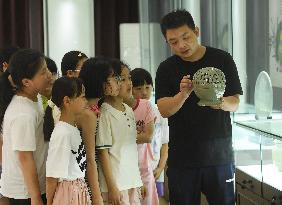
(240711) -- TAIZHOU, July 11, 2024 Photo by Xinhua/ABACAPRESS.COM) -- Xie Zhenwei explains the features of a Shabu-Kiln celadon censer as primary school students listen in Shabu Township, Huangyan of Taizhou, east China's Zhejiang Province, July 11, 2024. Originated in the Tang Dynasty (618-907) and flourished in the Northern Song Dynasty (960-1127), the Shabu Kilns are considered as transitional kilns during the development of southern celadon industry from Yue Kilns to Longquan Kilns. Xie Zhenwei, a young porcelain artisan and a native of Shabu Township, has been making efforts to reproduce the celadon wares in the style of Shabu Kilns, which is characterized by exquisite carved patterns. To achieve his goal, Xie learned techniques from Yue Kilns and Longquan Kilns and kept using local materials. At present, Xie has successfully made celadon wares like censer, jug and powder boxes, in the style of Shabu Kilns. He also set up a workshop to display the culture of this art. Photo by Xinhua/ABACAPRESS.COM/Weng

  •  
(ZhejiangPictorial)CHINA-ZHEJIANG-SHABU KILNS-CELADON PORCELAIN-ARTISAN (CN)

(ZhejiangPictorial)CHINA-ZHEJIANG-SHABU KILNS-CELADON PORCELAIN-ARTISAN (CN)

(240711) -- TAIZHOU, July 11, 2024 Photo by Xinhua/ABACAPRESS.COM) -- Xie Zhenwei gives instruction in a pottery class for primary school students at his studio in Shabu Township, Huangyan of Taizhou, east China's Zhejiang Province, July 11, 2024. Originated in the Tang Dynasty (618-907) and flourished in the Northern Song Dynasty (960-1127), the Shabu Kilns are considered as transitional kilns during the development of southern celadon industry from Yue Kilns to Longquan Kilns. Xie Zhenwei, a young porcelain artisan and a native of Shabu Township, has been making efforts to reproduce the celadon wares in the style of Shabu Kilns, which is characterized by exquisite carved patterns. To achieve his goal, Xie learned techniques from Yue Kilns and Longquan Kilns and kept using local materials. At present, Xie has successfully made celadon wares like censer, jug and powder boxes, in the style of Shabu Kilns. He also set up a workshop to display the culture of this art. Photo by Xinhua/ABACAPRESS.COM/Weng Xinyang)

  •  
(ZhejiangPictorial)CHINA-ZHEJIANG-SHABU KILNS-CELADON PORCELAIN-ARTISAN (CN)

(ZhejiangPictorial)CHINA-ZHEJIANG-SHABU KILNS-CELADON PORCELAIN-ARTISAN (CN)

(240711) -- TAIZHOU, July 11, 2024 Photo by Xinhua/ABACAPRESS.COM) -- Longquan celadon artisan Chen Junlin (top) instructs as Xie Zhenwei makes a censer in the style of Shabu Kilns in Shabu Township, Huangyan of Taizhou, east China's Zhejiang Province, July 11, 2024. Originated in the Tang Dynasty (618-907) and flourished in the Northern Song Dynasty (960-1127), the Shabu Kilns are considered as transitional kilns during the development of southern celadon industry from Yue Kilns to Longquan Kilns. Xie Zhenwei, a young porcelain artisan and a native of Shabu Township, has been making efforts to reproduce the celadon wares in the style of Shabu Kilns, which is characterized by exquisite carved patterns. To achieve his goal, Xie learned techniques from Yue Kilns and Longquan Kilns and kept using local materials. At present, Xie has successfully made celadon wares like censer, jug and powder boxes, in the style of Shabu Kilns. He also set up a workshop to display the culture of this art. Photo by Xinhua/ABACAPRE

  •  
(ZhejiangPictorial)CHINA-ZHEJIANG-SHABU KILNS-CELADON PORCELAIN-ARTISAN (CN)

(ZhejiangPictorial)CHINA-ZHEJIANG-SHABU KILNS-CELADON PORCELAIN-ARTISAN (CN)

(240711) -- TAIZHOU, July 11, 2024 Photo by Xinhua/ABACAPRESS.COM) -- Xie Zhenwei applies glaze to a porcelain ware at a kiln in Shabu Township, Huangyan of Taizhou, east China's Zhejiang Province, July 11, 2024. Originated in the Tang Dynasty (618-907) and flourished in the Northern Song Dynasty (960-1127), the Shabu Kilns are considered as transitional kilns during the development of southern celadon industry from Yue Kilns to Longquan Kilns. Xie Zhenwei, a young porcelain artisan and a native of Shabu Township, has been making efforts to reproduce the celadon wares in the style of Shabu Kilns, which is characterized by exquisite carved patterns. To achieve his goal, Xie learned techniques from Yue Kilns and Longquan Kilns and kept using local materials. At present, Xie has successfully made celadon wares like censer, jug and powder boxes, in the style of Shabu Kilns. He also set up a workshop to display the culture of this art. Photo by Xinhua/ABACAPRESS.COM/Weng Xinyang)

  •  
(ZhejiangPictorial)CHINA-ZHEJIANG-SHABU KILNS-CELADON PORCELAIN-ARTISAN (CN)

(ZhejiangPictorial)CHINA-ZHEJIANG-SHABU KILNS-CELADON PORCELAIN-ARTISAN (CN)

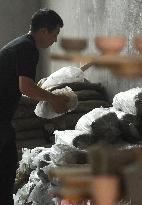
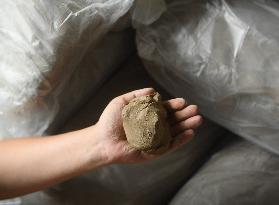
(240711) -- TAIZHOU, July 11, 2024 Photo by Xinhua/ABACAPRESS.COM) -- Xie Zhenwei shows the clay made from local materials for porcelain-making in Shabu Township, Huangyan of Taizhou, east China's Zhejiang Province, July 11, 2024. Originated in the Tang Dynasty (618-907) and flourished in the Northern Song Dynasty (960-1127), the Shabu Kilns are considered as transitional kilns during the development of southern celadon industry from Yue Kilns to Longquan Kilns. Xie Zhenwei, a young porcelain artisan and a native of Shabu Township, has been making efforts to reproduce the celadon wares in the style of Shabu Kilns, which is characterized by exquisite carved patterns. To achieve his goal, Xie learned techniques from Yue Kilns and Longquan Kilns and kept using local materials. At present, Xie has successfully made celadon wares like censer, jug and powder boxes, in the style of Shabu Kilns. He also set up a workshop to display the culture of this art. Photo by Xinhua/ABACAPRESS.COM/Weng Xinyang)

  •  
(ZhejiangPictorial)CHINA-ZHEJIANG-SHABU KILNS-CELADON PORCELAIN-ARTISAN (CN)

(ZhejiangPictorial)CHINA-ZHEJIANG-SHABU KILNS-CELADON PORCELAIN-ARTISAN (CN)

(240711) -- TAIZHOU, July 11, 2024 Photo by Xinhua/ABACAPRESS.COM) -- Xie Zhenwei arranges porcelain wares at a kiln in Shabu Township, Huangyan of Taizhou, east China's Zhejiang Province, July 11, 2024. Originated in the Tang Dynasty (618-907) and flourished in the Northern Song Dynasty (960-1127), the Shabu Kilns are considered as transitional kilns during the development of southern celadon industry from Yue Kilns to Longquan Kilns. Xie Zhenwei, a young porcelain artisan and a native of Shabu Township, has been making efforts to reproduce the celadon wares in the style of Shabu Kilns, which is characterized by exquisite carved patterns. To achieve his goal, Xie learned techniques from Yue Kilns and Longquan Kilns and kept using local materials. At present, Xie has successfully made celadon wares like censer, jug and powder boxes, in the style of Shabu Kilns. He also set up a workshop to display the culture of this art. Photo by Xinhua/ABACAPRESS.COM/Weng Xinyang)

  •  
(SP)CHINA-XINJIANG-AKSU-TAKLIMAKAN RALLY-9TH STAGE (CN)

(SP)CHINA-XINJIANG-AKSU-TAKLIMAKAN RALLY-9TH STAGE (CN)

(240531) -- AKSU, May 31, 2024 Photo by Xinhua/ABACAPRESS.COM) -- Driver Lu Binglong and co-driver Gao Zhenwei compete during the 9th stage of the 2024 Taklimakan Rally in northwest China's Xinjiang Uygur Autonomous Region, May 31, 2024. Photo by Xinhua/ABACAPRESS.COM/Chen Shuo)

  •  
(SP)CHINA-XINJIANG-AKSU-TAKLIMAKAN RALLY-9TH STAGE (CN)

(SP)CHINA-XINJIANG-AKSU-TAKLIMAKAN RALLY-9TH STAGE (CN)

(240531) -- AKSU, May 31, 2024 (Xinhua) -- Driver Lu Binglong and co-driver Gao Zhenwei compete during the 9th stage of the 2024 Taklimakan Rally in northwest China's Xinjiang Uygur Autonomous Region, May 31, 2024. (Xinhua/Chen Shuo)

  •  
(SP)CHINA-HOTAN-TAKLIMAKAN RALLY-FOURTH STAGE (CN)

(SP)CHINA-HOTAN-TAKLIMAKAN RALLY-FOURTH STAGE (CN)

(240525) -- HOTAN, May 25, 2024 (Xinhua) -- Driver Lu Binglong of China and his pilot Gao Zhenwei of China compete during the fourth stage at the 2024 Taklimakan Rally, China's northwestern Xinjiang Uygur Autonomous Region, May 25, 2024. (Xinhua/Chen Shuo)

  •  
(SP)CHINA-HOTAN-TAKLIMAKAN RALLY-FOURTH STAGE (CN)

(SP)CHINA-HOTAN-TAKLIMAKAN RALLY-FOURTH STAGE (CN)

(240525) -- HOTAN, May 25, 2024 (Xinhua) -- Driver Lu Binglong of China and his pilot Gao Zhenwei of China compete during the fourth stage at the 2024 Taklimakan Rally, China's northwestern Xinjiang Uygur Autonomous Region, May 25, 2024. (Xinhua/Chen Shuo)

  • Main
  • Top
  • Editorial
  • Creative
  • About Us
  • About ILG
  • Terms of use
  • Company
  • BEHIND
  • Price List
  • Single Plan
  • Monthly Plan
  • Services
  • Shooting
  • Rights Clearance
  • Support
  • FAQ
  • How To Buy
  • Contact Us
  • Become a Partner

© KYODO NEWS IMAGES INC

All Rights Reserved.

  • Editorial
  • Olympics
  • News
  • Sports
  • Japan
  • Tech
  • Royal
  • Disaster
  • NorthKorea
  • Old Japan
  • SNS
  • Creative
  • Food
  • Japan
  • Landscape
  • Animal
  • Popular
  • #Ukraine
  • #Russia
  • #coronavirus
  • #N. Korea
  • #China
  • #Thailand
  • #Ukraine
  • #Russia
  • #coronavirus
  • #N. Korea
  • #China
  • #Thailand
  • Food
  • Japan
  • Landscape
  • Animal
  • Olympics
  • News
  • Sports
  • Japan
  • Tech
  • Royal
  • Disaster
  • NorthKorea
  • Old Japan
  • SNS