•  
Low-Energy High-Intensity Heavy-Ion Accelerator Facility - China

Low-Energy High-Intensity Heavy-Ion Accelerator Facility - China

Sun Liangting, a researcher with the Institute of Modern Physics of the Chinese Academy of Sciences, checks equipment on December 10, 2024. The world's first stand-alone low-energy high-intensity heavy-ion accelerator facility (LEAF), developed by the Institute of Modern Physics of the Chinese Academy of Sciences, recently passed the expert panel acceptance inspection organized by the National Natural Science Foundation of China. The LEAF can provide intense heavy-ion beams and mixed ion beams of various charge states from light to heavy elements, offering advantages such as high beam intensity, high charge state, diverse ion species, and a wide range of energy variations. With the upgrading of ion accelerators and the evolution of accelerator technologies, frontier research in ion beam physics has continuously deepened human understanding of the world, and related application technologies have been widely adopted in various fields. Photo by Jin Liwang/Xinhua/ABACAPRESS.COM

  •  
Low-Energy High-Intensity Heavy-Ion Accelerator Facility - China

Low-Energy High-Intensity Heavy-Ion Accelerator Facility - China

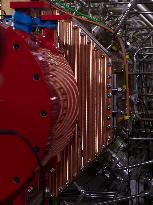
This photo taken on December 10, 2024 shows part of the low-energy high-intensity heavy-ion accelerator facility (LEAF). The world's first stand-alone low-energy high-intensity heavy-ion accelerator facility (LEAF), developed by the Institute of Modern Physics of the Chinese Academy of Sciences, recently passed the expert panel acceptance inspection organized by the National Natural Science Foundation of China. The LEAF can provide intense heavy-ion beams and mixed ion beams of various charge states from light to heavy elements, offering advantages such as high beam intensity, high charge state, diverse ion species, and a wide range of energy variations. With the upgrading of ion accelerators and the evolution of accelerator technologies, frontier research in ion beam physics has continuously deepened human understanding of the world, and related application technologies have been widely adopted in various fields. Photo by Jin Liwang/Xinhua/ABACAPRESS.COM

  •  
Low-Energy High-Intensity Heavy-Ion Accelerator Facility - China

Low-Energy High-Intensity Heavy-Ion Accelerator Facility - China

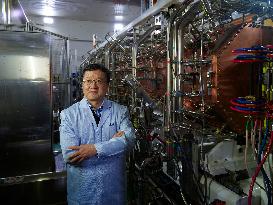
Zhao Hongwei, an academician of the Chinese Academy of Sciences (CAS), poses for a photo in front of the low-energy high-intensity heavy-ion accelerator facility (LEAF) on December 10, 2024. The world's first stand-alone low-energy high-intensity heavy-ion accelerator facility (LEAF), developed by the Institute of Modern Physics of the Chinese Academy of Sciences, recently passed the expert panel acceptance inspection organized by the National Natural Science Foundation of China. The LEAF can provide intense heavy-ion beams and mixed ion beams of various charge states from light to heavy elements, offering advantages such as high beam intensity, high charge state, diverse ion species, and a wide range of energy variations. With the upgrading of ion accelerators and the evolution of accelerator technologies, frontier research in ion beam physics has continuously deepened human understanding of the world, and related application technologies have been widely adopted in various fields. Photo by Jin Liwang/Xinhua

  •  
Low-Energy High-Intensity Heavy-Ion Accelerator Facility - China

Low-Energy High-Intensity Heavy-Ion Accelerator Facility - China

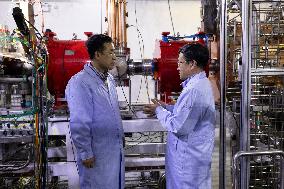
Zhao Hongwei (R), an academician of the Chinese Academy of Sciences (CAS), and Sun Liangting, a researcher with the Institute of Modern Physics of the CAS, discuss on experiment progress in front of the low-energy high-intensity heavy-ion accelerator facility (LEAF) on December 10, 2024. The world's first stand-alone low-energy high-intensity heavy-ion accelerator facility (LEAF), developed by the Institute of Modern Physics of the Chinese Academy of Sciences, recently passed the expert panel acceptance inspection organized by the National Natural Science Foundation of China. The LEAF can provide intense heavy-ion beams and mixed ion beams of various charge states from light to heavy elements, offering advantages such as high beam intensity, high charge state, diverse ion species, and a wide range of energy variations. With the upgrading of ion accelerators and the evolution of accelerator technologies, frontier research in ion beam physics has continuously deepened human understanding of the world, and relat

  •  
Low-Energy High-Intensity Heavy-Ion Accelerator Facility - China

Low-Energy High-Intensity Heavy-Ion Accelerator Facility - China

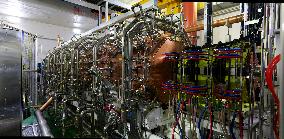
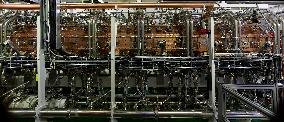
This stitched photo taken on December 10, 2024 shows part of the low-energy high-intensity heavy-ion accelerator facility (LEAF). The world's first stand-alone low-energy high-intensity heavy-ion accelerator facility (LEAF), developed by the Institute of Modern Physics of the Chinese Academy of Sciences, recently passed the expert panel acceptance inspection organized by the National Natural Science Foundation of China. The LEAF can provide intense heavy-ion beams and mixed ion beams of various charge states from light to heavy elements, offering advantages such as high beam intensity, high charge state, diverse ion species, and a wide range of energy variations. With the upgrading of ion accelerators and the evolution of accelerator technologies, frontier research in ion beam physics has continuously deepened human understanding of the world, and related application technologies have been widely adopted in various fields. Photo by Jin Liwang/Xinhua/ABACAPRESS.COM

  •  
Low-Energy High-Intensity Heavy-Ion Accelerator Facility - China

Low-Energy High-Intensity Heavy-Ion Accelerator Facility - China

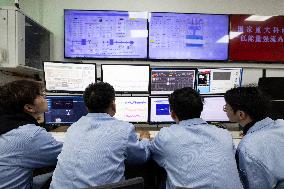
Researchers observe experiment progress at the control room of the low-energy high-intensity heavy-ion accelerator facility (LEAF) on December 10, 2024. The world's first stand-alone low-energy high-intensity heavy-ion accelerator facility (LEAF), developed by the Institute of Modern Physics of the Chinese Academy of Sciences, recently passed the expert panel acceptance inspection organized by the National Natural Science Foundation of China. The LEAF can provide intense heavy-ion beams and mixed ion beams of various charge states from light to heavy elements, offering advantages such as high beam intensity, high charge state, diverse ion species, and a wide range of energy variations. With the upgrading of ion accelerators and the evolution of accelerator technologies, frontier research in ion beam physics has continuously deepened human understanding of the world, and related application technologies have been widely adopted in various fields. Photo by Jin Liwang/Xinhua/ABACAPRESS.COM

  •  
Low-Energy High-Intensity Heavy-Ion Accelerator Facility - China

Low-Energy High-Intensity Heavy-Ion Accelerator Facility - China

Researchers analyze experimental data at the control room of the low-energy high-intensity heavy-ion accelerator facility (LEAF) on December 10, 2024. The world's first stand-alone low-energy high-intensity heavy-ion accelerator facility (LEAF), developed by the Institute of Modern Physics of the Chinese Academy of Sciences, recently passed the expert panel acceptance inspection organized by the National Natural Science Foundation of China. The LEAF can provide intense heavy-ion beams and mixed ion beams of various charge states from light to heavy elements, offering advantages such as high beam intensity, high charge state, diverse ion species, and a wide range of energy variations. With the upgrading of ion accelerators and the evolution of accelerator technologies, frontier research in ion beam physics has continuously deepened human understanding of the world, and related application technologies have been widely adopted in various fields. Photo by Jin Liwang/Xinhua/ABACAPRESS.COM

  •  
Low-Energy High-Intensity Heavy-Ion Accelerator Facility - China

Low-Energy High-Intensity Heavy-Ion Accelerator Facility - China

This stitched photo taken on December 10, 2024 shows part of the low-energy high-intensity heavy-ion accelerator facility (LEAF). The world's first stand-alone low-energy high-intensity heavy-ion accelerator facility (LEAF), developed by the Institute of Modern Physics of the Chinese Academy of Sciences, recently passed the expert panel acceptance inspection organized by the National Natural Science Foundation of China. The LEAF can provide intense heavy-ion beams and mixed ion beams of various charge states from light to heavy elements, offering advantages such as high beam intensity, high charge state, diverse ion species, and a wide range of energy variations. With the upgrading of ion accelerators and the evolution of accelerator technologies, frontier research in ion beam physics has continuously deepened human understanding of the world, and related application technologies have been widely adopted in various fields. Photo by Jin Liwang/Xinhua/ABACAPRESS.COM

  •  
Team develops particle accelerator boosting technique

Team develops particle accelerator boosting technique

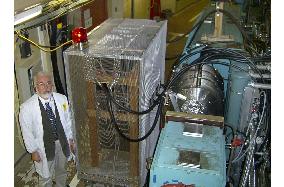
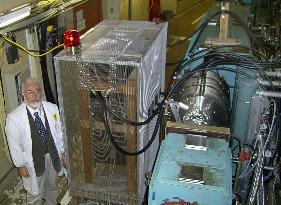
TSUKUBA, Japan - Ken Takayama, a professor at the High Energy Accelerator Research Organization, stands by equipment he and his team members have developed to dramatically boost the performance of synchrotrons, circular particle accelerators used in experiments to find out more about subatomic particles.

  •  
Team develops particle accelerator boosting technique

Team develops particle accelerator boosting technique

TSUKUBA, Japan - Ken Takayama, a professor at the High Energy Accelerator Research Organization, stands by equipment he and his team members have developed to dramatically boost the performance of synchrotrons, circular particle accelerators used in experiments to find out more about subatomic particles. (Kyodo)

  • Main
  • Top
  • Editorial
  • Creative
  • About Us
  • About ILG
  • Terms of use
  • Company
  • BEHIND
  • Price List
  • Single Plan
  • Monthly Plan
  • Services
  • Shooting
  • Rights Clearance
  • Support
  • FAQ
  • How To Buy
  • Contact Us
  • Become a Partner

© KYODO NEWS IMAGES INC

All Rights Reserved.

  • Editorial
  • Olympics
  • News
  • Sports
  • Japan
  • Tech
  • Royal
  • Disaster
  • NorthKorea
  • Old Japan
  • SNS
  • Creative
  • Food
  • Japan
  • Landscape
  • Animal
  • Popular
  • #Ukraine
  • #Thailand
  • #coronavirus
  • #N. Korea
  • #Russia
  • #China
  • #Ukraine
  • #Thailand
  • #coronavirus
  • #N. Korea
  • #Russia
  • #China
  • Food
  • Japan
  • Landscape
  • Animal
  • Olympics
  • News
  • Sports
  • Japan
  • Tech
  • Royal
  • Disaster
  • NorthKorea
  • Old Japan
  • SNS