•  
Thanksgiving Beyond Earth

Thanksgiving Beyond Earth

Handout photo dated November 27, 2018 shows Getting all ten members of an aggregation consisting of seven Endeavour astronauts and three Expedition 18 crewmembers into a single photo wasn't easy as the two crews shared a Thanksgiving meal on the middeck of the orbiter. Astronaut Sandra Magnus, Expedition 18 flight engineer, appears at top center. Clockwise from her position are astronauts Shane Kimbrough and Eric Boe, along with cosmonaut Yury Lonchakov, and astronauts Steve Bowen (partially visible behind Lonchakov), Donald Pettit, Michael Fincke, Gregory Chamitoff, Heidemarie Stefanyshyn-Piper and Chris Ferguson (partially visible at top right). Ferguson is STS-126 commander, and Fincke is commander for the station crew. Since 1973, astronauts have celebrated Thanksgiving in space, bringing a cherished tradition far beyond Earth. The first Thanksgiving in orbit took place aboard Skylab during the Skylab 4 mission, where astronauts Gerald Carr, Edward Gibson, and William Pogue marked the day with an improvis

  •  
(EyesOnSci) CHINA-SHANGHAI-OPTICAL DISK-RESEARCHERS (CN)

(EyesOnSci) CHINA-SHANGHAI-OPTICAL DISK-RESEARCHERS (CN)

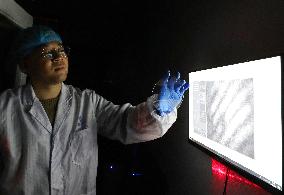
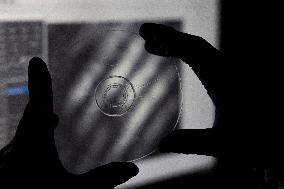
(240303) -- SHANGHAI, March 3, 2024 (Xinhua) -- Researcher Zhao Miao shows a three-dimensional nanoscale optical disk memory with petabit capacity at a laboratory in the Shanghai Institute of Optics and Fine Mechanics, Chinese Academy of Sciences in east China's Shanghai, Feb. 29, 2024. A three-dimensional nanoscale optical disk memory with petabit capacity has been developed at the Shanghai Institute of Optics and Fine Mechanics, Chinese Academy of Sciences, according to an article published on Feb. 22 in Nature. The research team managed to increase the capacity of optical data storage to the petabit level by extending the planar recording architecture to three dimensions with hundreds of layers, while also breaking the optical diffraction limit barrier of the recorded spots. The minimum spot size and lateral track pitch are 54 nm and 70 nm, respectively. The team developed an optical recording medium based on a photoresist film doped with aggregation-induced emission dye, which can be optically stimu

  •  
(EyesOnSci) CHINA-SHANGHAI-OPTICAL DISK-RESEARCHERS (CN)

(EyesOnSci) CHINA-SHANGHAI-OPTICAL DISK-RESEARCHERS (CN)

(240303) -- SHANGHAI, March 3, 2024 (Xinhua) -- Researcher Zhao Miao observes experiment materials at a laboratory in the Shanghai Institute of Optics and Fine Mechanics, Chinese Academy of Sciences in east China's Shanghai, Feb. 29, 2024. A three-dimensional nanoscale optical disk memory with petabit capacity has been developed at the Shanghai Institute of Optics and Fine Mechanics, Chinese Academy of Sciences, according to an article published on Feb. 22 in Nature. The research team managed to increase the capacity of optical data storage to the petabit level by extending the planar recording architecture to three dimensions with hundreds of layers, while also breaking the optical diffraction limit barrier of the recorded spots. The minimum spot size and lateral track pitch are 54 nm and 70 nm, respectively. The team developed an optical recording medium based on a photoresist film doped with aggregation-induced emission dye, which can be optically stimulated by femtosecond laser beams. The new tech

  •  
(EyesOnSci) CHINA-SHANGHAI-OPTICAL DISK-RESEARCHERS (CN)

(EyesOnSci) CHINA-SHANGHAI-OPTICAL DISK-RESEARCHERS (CN)

(240303) -- SHANGHAI, March 3, 2024 (Xinhua) -- Researcher Ruan Hao works at a laboratory in the Shanghai Institute of Optics and Fine Mechanics, Chinese Academy of Sciences in east China's Shanghai, Feb. 29, 2024. A three-dimensional nanoscale optical disk memory with petabit capacity has been developed at the Shanghai Institute of Optics and Fine Mechanics, Chinese Academy of Sciences, according to an article published on Feb. 22 in Nature. The research team managed to increase the capacity of optical data storage to the petabit level by extending the planar recording architecture to three dimensions with hundreds of layers, while also breaking the optical diffraction limit barrier of the recorded spots. The minimum spot size and lateral track pitch are 54 nm and 70 nm, respectively. The team developed an optical recording medium based on a photoresist film doped with aggregation-induced emission dye, which can be optically stimulated by femtosecond laser beams. The new technology marks the world's

  •  
(EyesOnSci) CHINA-SHANGHAI-OPTICAL DISK-RESEARCHERS (CN)

(EyesOnSci) CHINA-SHANGHAI-OPTICAL DISK-RESEARCHERS (CN)

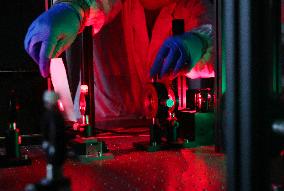
(240303) -- SHANGHAI, March 3, 2024 (Xinhua) -- Researcher Zhao Miao debugs experiment equipment at a laboratory in the Shanghai Institute of Optics and Fine Mechanics, Chinese Academy of Sciences in east China's Shanghai, Feb. 29, 2024. A three-dimensional nanoscale optical disk memory with petabit capacity has been developed at the Shanghai Institute of Optics and Fine Mechanics, Chinese Academy of Sciences, according to an article published on Feb. 22 in Nature. The research team managed to increase the capacity of optical data storage to the petabit level by extending the planar recording architecture to three dimensions with hundreds of layers, while also breaking the optical diffraction limit barrier of the recorded spots. The minimum spot size and lateral track pitch are 54 nm and 70 nm, respectively. The team developed an optical recording medium based on a photoresist film doped with aggregation-induced emission dye, which can be optically stimulated by femtosecond laser beams. The new techno

  •  
(EyesOnSci) CHINA-SHANGHAI-OPTICAL DISK-RESEARCHERS (CN)

(EyesOnSci) CHINA-SHANGHAI-OPTICAL DISK-RESEARCHERS (CN)

(240303) -- SHANGHAI, March 3, 2024 (Xinhua) -- Researcher Zhao Miao debugs experiment equipment at a laboratory in the Shanghai Institute of Optics and Fine Mechanics, Chinese Academy of Sciences in east China's Shanghai, Feb. 29, 2024. A three-dimensional nanoscale optical disk memory with petabit capacity has been developed at the Shanghai Institute of Optics and Fine Mechanics, Chinese Academy of Sciences, according to an article published on Feb. 22 in Nature. The research team managed to increase the capacity of optical data storage to the petabit level by extending the planar recording architecture to three dimensions with hundreds of layers, while also breaking the optical diffraction limit barrier of the recorded spots. The minimum spot size and lateral track pitch are 54 nm and 70 nm, respectively. The team developed an optical recording medium based on a photoresist film doped with aggregation-induced emission dye, which can be optically stimulated by femtosecond laser beams. The new techno

  •  
(EyesOnSci) CHINA-SHANGHAI-OPTICAL DISK-RESEARCHERS (CN)

(EyesOnSci) CHINA-SHANGHAI-OPTICAL DISK-RESEARCHERS (CN)

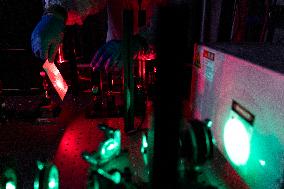
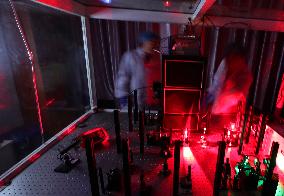
(240303) -- SHANGHAI, March 3, 2024 (Xinhua) -- Researchers perform an experiment at a laboratory in the Shanghai Institute of Optics and Fine Mechanics, Chinese Academy of Sciences in east China's Shanghai, Feb. 29, 2024. A three-dimensional nanoscale optical disk memory with petabit capacity has been developed at the Shanghai Institute of Optics and Fine Mechanics, Chinese Academy of Sciences, according to an article published on Feb. 22 in Nature. The research team managed to increase the capacity of optical data storage to the petabit level by extending the planar recording architecture to three dimensions with hundreds of layers, while also breaking the optical diffraction limit barrier of the recorded spots. The minimum spot size and lateral track pitch are 54 nm and 70 nm, respectively. The team developed an optical recording medium based on a photoresist film doped with aggregation-induced emission dye, which can be optically stimulated by femtosecond laser beams. The new technology marks the

  •  
(EyesOnSci) CHINA-SHANGHAI-OPTICAL DISK-RESEARCHERS (CN)

(EyesOnSci) CHINA-SHANGHAI-OPTICAL DISK-RESEARCHERS (CN)

(240303) -- SHANGHAI, March 3, 2024 (Xinhua) -- Researcher Zhao Miao shows a three-dimensional nanoscale optical disk memory with petabit capacity in the Shanghai Institute of Optics and Fine Mechanics, Chinese Academy of Sciences in east China's Shanghai, Feb. 29, 2024. A three-dimensional nanoscale optical disk memory with petabit capacity has been developed at the Shanghai Institute of Optics and Fine Mechanics, Chinese Academy of Sciences, according to an article published on Feb. 22 in Nature. The research team managed to increase the capacity of optical data storage to the petabit level by extending the planar recording architecture to three dimensions with hundreds of layers, while also breaking the optical diffraction limit barrier of the recorded spots. The minimum spot size and lateral track pitch are 54 nm and 70 nm, respectively. The team developed an optical recording medium based on a photoresist film doped with aggregation-induced emission dye, which can be optically stimulated by femtose

  •  
(EyesOnSci) CHINA-SHANGHAI-OPTICAL DISK-RESEARCHERS (CN)

(EyesOnSci) CHINA-SHANGHAI-OPTICAL DISK-RESEARCHERS (CN)

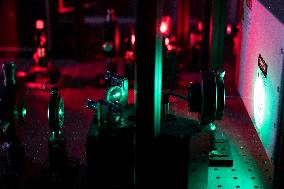
(240303) -- SHANGHAI, March 3, 2024 (Xinhua) -- This photo taken on Feb. 29, 2024 shows experiment materials in the Shanghai Institute of Optics and Fine Mechanics, Chinese Academy of Sciences in east China's Shanghai. A three-dimensional nanoscale optical disk memory with petabit capacity has been developed at the Shanghai Institute of Optics and Fine Mechanics, Chinese Academy of Sciences, according to an article published on Feb. 22 in Nature. The research team managed to increase the capacity of optical data storage to the petabit level by extending the planar recording architecture to three dimensions with hundreds of layers, while also breaking the optical diffraction limit barrier of the recorded spots. The minimum spot size and lateral track pitch are 54 nm and 70 nm, respectively. The team developed an optical recording medium based on a photoresist film doped with aggregation-induced emission dye, which can be optically stimulated by femtosecond laser beams. The new technology marks the worl

  •  
(EyesOnSci) CHINA-SHANGHAI-OPTICAL DISK-RESEARCHERS (CN)

(EyesOnSci) CHINA-SHANGHAI-OPTICAL DISK-RESEARCHERS (CN)

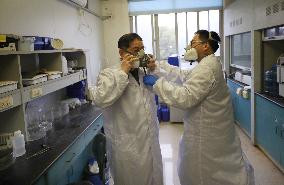
(240303) -- SHANGHAI, March 3, 2024 (Xinhua) -- Reseachers wear masks at a laboratory in the Shanghai Institute of Optics and Fine Mechanics, Chinese Academy of Sciences in east China's Shanghai, Feb. 29, 2024. A three-dimensional nanoscale optical disk memory with petabit capacity has been developed at the Shanghai Institute of Optics and Fine Mechanics, Chinese Academy of Sciences, according to an article published on Feb. 22 in Nature. The research team managed to increase the capacity of optical data storage to the petabit level by extending the planar recording architecture to three dimensions with hundreds of layers, while also breaking the optical diffraction limit barrier of the recorded spots. The minimum spot size and lateral track pitch are 54 nm and 70 nm, respectively. The team developed an optical recording medium based on a photoresist film doped with aggregation-induced emission dye, which can be optically stimulated by femtosecond laser beams. The new technology marks the world's firs

  •  
(EyesOnSci) CHINA-SHANGHAI-OPTICAL DISK-RESEARCHERS (CN)

(EyesOnSci) CHINA-SHANGHAI-OPTICAL DISK-RESEARCHERS (CN)

(240303) -- SHANGHAI, March 3, 2024 (Xinhua) -- Researchers perform an experiment at a laboratory in the Shanghai Institute of Optics and Fine Mechanics, Chinese Academy of Sciences in east China's Shanghai, Feb. 29, 2024. A three-dimensional nanoscale optical disk memory with petabit capacity has been developed at the Shanghai Institute of Optics and Fine Mechanics, Chinese Academy of Sciences, according to an article published on Feb. 22 in Nature. The research team managed to increase the capacity of optical data storage to the petabit level by extending the planar recording architecture to three dimensions with hundreds of layers, while also breaking the optical diffraction limit barrier of the recorded spots. The minimum spot size and lateral track pitch are 54 nm and 70 nm, respectively. The team developed an optical recording medium based on a photoresist film doped with aggregation-induced emission dye, which can be optically stimulated by femtosecond laser beams. The new technology marks the

  •  
(EyesOnSci) CHINA-SHANGHAI-OPTICAL DISK-RESEARCHERS (CN)

(EyesOnSci) CHINA-SHANGHAI-OPTICAL DISK-RESEARCHERS (CN)

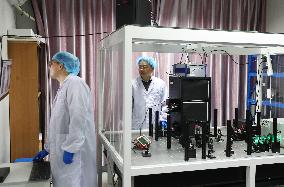
(240303) -- SHANGHAI, March 3, 2024 (Xinhua) -- Researchers perform an experiment at a laboratory in the Shanghai Institute of Optics and Fine Mechanics, Chinese Academy of Sciences in east China's Shanghai, Feb. 29, 2024. A three-dimensional nanoscale optical disk memory with petabit capacity has been developed at the Shanghai Institute of Optics and Fine Mechanics, Chinese Academy of Sciences, according to an article published on Feb. 22 in Nature. The research team managed to increase the capacity of optical data storage to the petabit level by extending the planar recording architecture to three dimensions with hundreds of layers, while also breaking the optical diffraction limit barrier of the recorded spots. The minimum spot size and lateral track pitch are 54 nm and 70 nm, respectively. The team developed an optical recording medium based on a photoresist film doped with aggregation-induced emission dye, which can be optically stimulated by femtosecond laser beams. The new technology marks the

  •  
(EyesOnSci) CHINA-SHANGHAI-OPTICAL DISK-RESEARCHERS (CN)

(EyesOnSci) CHINA-SHANGHAI-OPTICAL DISK-RESEARCHERS (CN)

(240303) -- SHANGHAI, March 3, 2024 (Xinhua) -- Researchers perform an experiment at a laboratory in the Shanghai Institute of Optics and Fine Mechanics, Chinese Academy of Sciences in east China's Shanghai, Feb. 29, 2024. A three-dimensional nanoscale optical disk memory with petabit capacity has been developed at the Shanghai Institute of Optics and Fine Mechanics, Chinese Academy of Sciences, according to an article published on Feb. 22 in Nature. The research team managed to increase the capacity of optical data storage to the petabit level by extending the planar recording architecture to three dimensions with hundreds of layers, while also breaking the optical diffraction limit barrier of the recorded spots. The minimum spot size and lateral track pitch are 54 nm and 70 nm, respectively. The team developed an optical recording medium based on a photoresist film doped with aggregation-induced emission dye, which can be optically stimulated by femtosecond laser beams. The new technology marks the

  •  
(EyesOnSci) CHINA-SHANGHAI-OPTICAL DISK-RESEARCHERS (CN)

(EyesOnSci) CHINA-SHANGHAI-OPTICAL DISK-RESEARCHERS (CN)

(240303) -- SHANGHAI, March 3, 2024 (Xinhua) -- Researcher Zhao Miao observes experiment materials via a microscope at a laboratory in the Shanghai Institute of Optics and Fine Mechanics, Chinese Academy of Sciences in east China's Shanghai, Feb. 29, 2024. A three-dimensional nanoscale optical disk memory with petabit capacity has been developed at the Shanghai Institute of Optics and Fine Mechanics, Chinese Academy of Sciences, according to an article published on Feb. 22 in Nature. The research team managed to increase the capacity of optical data storage to the petabit level by extending the planar recording architecture to three dimensions with hundreds of layers, while also breaking the optical diffraction limit barrier of the recorded spots. The minimum spot size and lateral track pitch are 54 nm and 70 nm, respectively. The team developed an optical recording medium based on a photoresist film doped with aggregation-induced emission dye, which can be optically stimulated by femtosecond laser beam

  •  
Firebugs

Firebugs

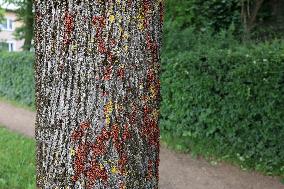
10.07.2023, Tartu. Aggregation of firebugs on a tree trunk, Pyrrhocoris apterus, insects. Photo Sille Annuk, Tartu Postimees

  •  
Firebugs

Firebugs

10.07.2023, Tartu. Aggregation of firebugs, Pyrrhocoris apterus, insects. Photo Sille Annuk, Tartu Postimees

  •  
Firebugs

Firebugs

10.07.2023, Tartu. Aggregation of firebugs, Pyrrhocoris apterus, insects. Photo Sille Annuk, Tartu Postimees

  •  
Illustration: Zhihu

Illustration: Zhihu

SUQIAN, CHINA - MAY 27, 2023 - Illustration: Zhihu, May 27, 2023, Suqian City, Jiangsu Province, China. Zhihu has released the latest large model application "Search aggregation", which is now in private beta.

  •  
Illustration: Zhihu

Illustration: Zhihu

SUQIAN, CHINA - MAY 27, 2023 - Illustration: Zhihu, May 27, 2023, Suqian City, Jiangsu Province, China. Zhihu has released the latest large model application "Search aggregation", which is now in private beta.

  •  
Illustration: Zhihu

Illustration: Zhihu

SUQIAN, CHINA - MAY 27, 2023 - Illustration: Zhihu, May 27, 2023, Suqian City, Jiangsu Province, China. Zhihu has released the latest large model application "Search aggregation", which is now in private beta.

  •  
Undersea debris

Undersea debris

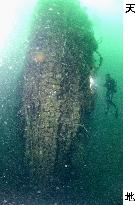
SENDAI, Japan - Photo taken with a fisheye lens on July 12, 2013 at about 25 meters deep in the Pacific Ocean off Onagawa, Miyagi Prefecture, shows a tower-like aggregation of debris from the March 2011 tsunami, including ropes from fish farming facilities and crushed fishing gears.

  •  
Undersea debris

Undersea debris

SENDAI, Japan - Photo taken with a fisheye lens on July 12, 2013 at about 25 meters deep in the Pacific Ocean off Onagawa, Miyagi Prefecture, shows a tower-like aggregation of debris from the March 2011 tsunami, including ropes from fish farming facilities and crushed fishing gears.

  • Main
  • Top
  • Editorial
  • Creative
  • About Us
  • About ILG
  • Terms of use
  • Company
  • BEHIND
  • Price List
  • Single Plan
  • Monthly Plan
  • Services
  • Shooting
  • Rights Clearance
  • Support
  • FAQ
  • How To Buy
  • Contact Us
  • Become a Partner

© KYODO NEWS IMAGES INC

All Rights Reserved.

  • Editorial
  • Olympics
  • News
  • Sports
  • Japan
  • Tech
  • Royal
  • Disaster
  • NorthKorea
  • Old Japan
  • SNS
  • Creative
  • Food
  • Japan
  • Landscape
  • Animal
  • Popular
  • #Ukraine
  • #Thailand
  • #coronavirus
  • #N. Korea
  • #Russia
  • #China
  • #Ukraine
  • #Thailand
  • #coronavirus
  • #N. Korea
  • #Russia
  • #China
  • Food
  • Japan
  • Landscape
  • Animal
  • Olympics
  • News
  • Sports
  • Japan
  • Tech
  • Royal
  • Disaster
  • NorthKorea
  • Old Japan
  • SNS