•  
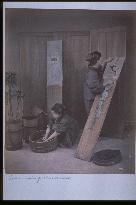
Women washing clothes

Women washing clothes

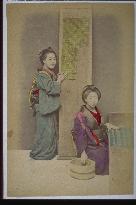
The women are pulling apart soiled kimono, hand-washing the pieces, and then stretching them over a plank (a process called araihari ). Once these are dry, they are made into kimono again. This kind of drying process was applied not only to kimono but also to bedding and other sleeping items.==Date:unknown, Place:unknown, Photo:Usui Shuzaburo, (Credit:Nagasaki University Library/Kyodo News Images) [Cabinet Number94‐25‐0]

  •  
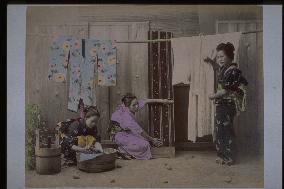
Women washing clothes

Women washing clothes

Kimono are being dried on bamboo poles. People aired clothes and books in the sun, in places where a breeze blows on a sunny non-humid day to prevent moisture, dust, and insects from damaging the items. The girl in the centre is doing araihari (explained in #2353). The girls all have their sleeves pulled up with cords.==Date:unknown, Place:unknown, Photo:A. Farsari, (Credit:Nagasaki University Library/Kyodo News Images) [Cabinet Number81‐40‐0]

  •  
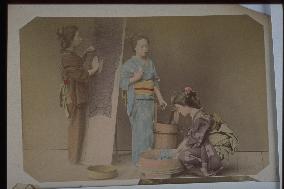
Women washing clothes

Women washing clothes

The women are pulling apart soiled kimono, hand-washing the pieces, and then stretching them over a plank (a process called araihari ). Once these are dry, they are made into kimono again. This kind of drying process was applied not only to kimono but also to bedding and other sleeping items.==Date:unknown, Place:unknown, Photo:unknown, (Credit:Nagasaki University Library/Kyodo News Images) [Cabinet Number51‐1‐0]

  •  
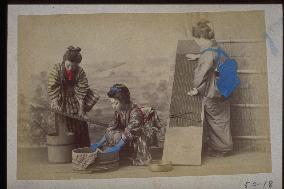
Women washing clothes

Women washing clothes

The women are pulling apart soiled kimono, hand-washing the pieces, and then stretching them over a plank (a process called araihari ). Once these are dry, they are made into kimono again. This kind of drying process was applied not only to kimono but also to bedding and other sleeping items.==Date:unknown, Place:unknown, Photo:unknown, (Credit:Nagasaki University Library/Kyodo News Images) [Cabinet Number50‐18‐0]

  •  
Women washing and stretching cloth

Women washing and stretching cloth

A kimono was not washed in one piece, but the threads were pulled out and the kimono made into plain material to wash. After washing, the material was starched and dried by pasting it on a board, a process called araihari . The pail probably contains starch. The material to be starched is placed inside. Starch was made of liquid from stewed seaweed, and the drying board was a single cedar board, both sides of which could be used.==Date:unknown, Place:unknown, Photo:unknown, (Credit:Nagasaki University Library/Kyodo News Images) [Cabinet Number12‐35‐0]

  • Main
  • Top
  • Editorial
  • Creative
  • About Us
  • About ILG
  • Terms of use
  • Company
  • BEHIND
  • Price List
  • Single Plan
  • Monthly Plan
  • Services
  • Shooting
  • Rights Clearance
  • Support
  • FAQ
  • How To Buy
  • Contact Us
  • Become a Partner

© KYODO NEWS IMAGES INC

All Rights Reserved.

  • Editorial
  • Olympics
  • News
  • Sports
  • Japan
  • Tech
  • Royal
  • Disaster
  • NorthKorea
  • Old Japan
  • SNS
  • Creative
  • Food
  • Japan
  • Landscape
  • Animal
  • Popular
  • #Ukraine
  • #Russia
  • #coronavirus
  • #N. Korea
  • #China
  • #Thailand
  • #Ukraine
  • #Russia
  • #coronavirus
  • #N. Korea
  • #China
  • #Thailand
  • Food
  • Japan
  • Landscape
  • Animal
  • Olympics
  • News
  • Sports
  • Japan
  • Tech
  • Royal
  • Disaster
  • NorthKorea
  • Old Japan
  • SNS