•  
Cartoonist paints monk Shinran on folding screen

Cartoonist paints monk Shinran on folding screen

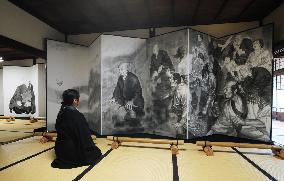
KYOTO, Japan - A painting by cartoonist Takehiko Inoue of Shinran, a famous 13th-century Buddhist monk, drawn on a "byobu" folding screen is shown to the press at a temple in Kyoto, western Japan, on Oct. 28, 2014. It will go on display at Kyoto's Higashi Honganji temple from Nov. 1 along with the famed late woodblock print artist Shiko Munakata's paintings on "fusuma" sliding doors.

  •  
Star Wars-themed traditional Japanese screens

Star Wars-themed traditional Japanese screens

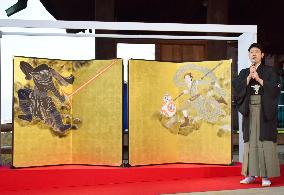
Screens drawn by artist Taro Yamamoto are shown to the press at Kiyomizu Temple in Kyoto on Nov. 30, 2015, to celebrate the Dec. 18 release of "Star Wars: The Force Awakens" and the 400th anniversary of the birth of Rimpa school of Japanese painting. The Star Wars version of the famous "Fujin Raijin-zu byobu" (Wind God and Thunder God Screens) by the 17th-century artist Tawaraya Sotatsu will be exhibited at the temple from Dec. 8-15. (Kyodo) ==Kyodo

  •  
Star Wars-themed traditional Japanese screens

Star Wars-themed traditional Japanese screens

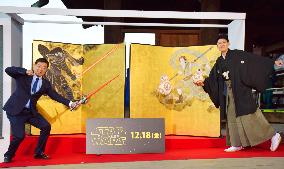
Screens drawn by artist Taro Yamamoto (R) are shown to the press at Kiyomizu Temple in Kyoto on Nov. 30, 2015, to celebrate the Dec. 18 release of "Star Wars: The Force Awakens" and the 400th anniversary of the birth of Rimpa school of Japanese painting, with Kyoto Gov. Keiji Yamada (L) adopting a pose. The Star Wars version of the famous "Fujin Raijin-zu byobu" (Wind God and Thunder God Screens) by the 17th-century artist Tawaraya Sotatsu will be exhibited at the temple from Dec. 8-15. (Kyodo) ==Kyodo

  •  
Star Wars-themed traditional Japanese screens

Star Wars-themed traditional Japanese screens

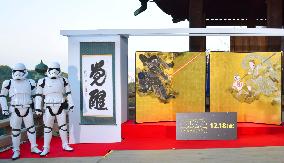
Screens drawn by artist Taro Yamamoto are shown to the press at Kiyomizu Temple in Kyoto on Nov. 30, 2015, to celebrate the Dec. 18 release of "Star Wars: The Force Awakens" and the 400th anniversary of the birth of Rimpa school of Japanese painting. The Star Wars version of the famous "Fujin Raijin-zu byobu" (Wind God and Thunder God Screens) by the 17th-century artist Tawaraya Sotatsu will be exhibited at the temple from Dec. 8-15. (Kyodo) ==Kyodo

  •  
Byobu torii gate at the approach to hakone shrine

Byobu torii gate at the approach to hakone shrine

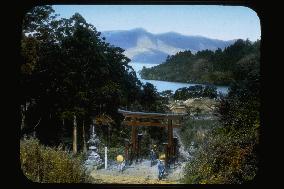
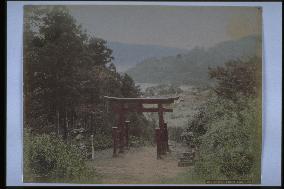
The Byobu Torii on the way to Hakone Shinto Shrine with a view of Ashino Lake. The seats to the right were there until the early Meiji era. A very similar photo appears in The Far East Vol. 2-20, with people in a different position.==Date:unknown, Place:Hakone, Photo:unknown, (Credit:Nagasaki University Library/Kyodo News Images) [Cabinet Number19‐41‐0]

  •  
The torii gate on the approach to Hakone Shrine

The torii gate on the approach to Hakone Shrine

This is the Byobu Torii Gate located at the intersection of present-day National Route 1 after going down Gongen Slope after walking up the old Hakone Highway from the post town of Hata area. This site was very popular because Lake Ashinoko and the village of Moto-Hakone could be seen as well as the traffic hub. Many photos taken here remain.==Date:unknown, Place:Hakone, Photo:unknown, (Credit:Nagasaki University Library/Kyodo News Images) [Cabinet Number98‐16‐0]

  •  
Girls dancing to the shamisen

Girls dancing to the shamisen

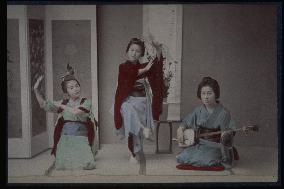
A full moon over a eulalia field is painted on a three panel byobu screen. The season is autumn. When a dancer pulls up the sleeves with a cord or doffs the upper half of the kimono, the music is probably a lively melody such as haiya or kappore. The dancers are posing.==Date:unknown, Place:unknown, Photo:F. Beato, (Credit:Nagasaki University Library/Kyodo News Images) [Cabinet Number96‐12‐0]

  •  
Women having tea

Women having tea

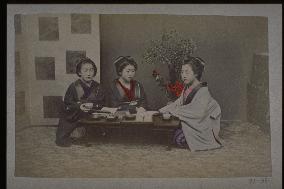
Three women drink tea at a tea table. A byobu screen and arranged flowers are placed in the background. Each woman is formally dressed in a haori coat with a family crest. The period is uncertain. Their hair is arranged in the marumage style for married women.==Date:unknown, Place:unknown, Photo:unknown, (Credit:Nagasaki University Library/Kyodo News Images) [Cabinet Number91‐33‐0]

  •  
A woman through the glass window

A woman through the glass window

It was fashionable at the time to have shoji-do (sliding doors) with glass windowpanes at the entrance to rooms with byobu screens. This is a scene of a young woman in kimono looking out through the glass window.==Date:unknown, Place:unknown, Photo:unknown, (Credit:Nagasaki University Library/Kyodo News Images) [Cabinet Number91‐38‐0]

  •  
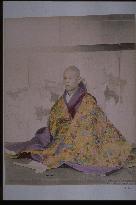
A priest

A priest

This photograph by Kashima Seibei bears the English title, Buddhist Priest. The priest is wearing the kesa robe of high-ranking clergy over a purple kimono. Behind him is a byobu screen with illustrations.==Date:unknown, Place:unknown, Photo:unknown, (Credit:Nagasaki University Library/Kyodo News Images) [Cabinet Number84‐15‐0]

  •  
Shamisen practice

Shamisen practice

A woman is receiving a lesson on shamisen lute from a master. She wears a red floral hairpin and is trying her best to play. Tea and sweets are waiting. A byobu screen is visible behind them. A flower is arranged in a porcelain vase on the table.==Date:unknown, Place:unknown, Photo:unknown, (Credit:Nagasaki University Library/Kyodo News Images) [Cabinet Number79‐41‐0]

  •  
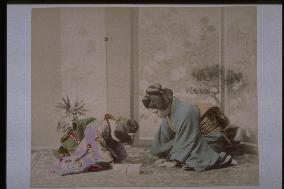
Women greeting each other

Women greeting each other

A young woman in a furisode kimono offers a greeting to her host in front of a tokonoma (alcove) with a byobu screen placed to the right. A gift box tied with a mizuhiki (red and white string) is presented. The young woman is expressing thanks for something with this greeting.==Date:unknown, Place:unknown, Photo:unknown, (Credit:Nagasaki University Library/Kyodo News Images) [Cabinet Number79‐31‐0]

  •  
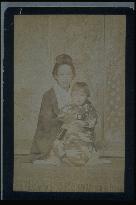
A mother and her daughter

A mother and her daughter

A mother and child pose for a memorial photograph in front of a byobu screen. The mother wears a haori coat, and the child is also in formal dress. The child is holding a toy-like object. The peacock indicates that the screen is a painting of flowers and birds. This is probably a studio photograph.==Date:unknown, Place:unknown, Photo:unknown, (Credit:Nagasaki University Library/Kyodo News Images) [Cabinet Number71‐61‐0]

  •  
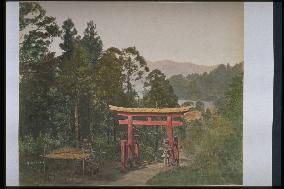
The torii gate on the approach to Hakone Shrine

The torii gate on the approach to Hakone Shrine

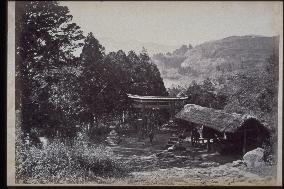
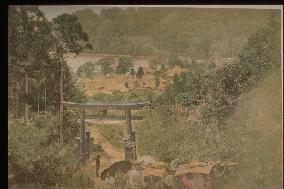
This is the Byobu Torii Gate stading at the entrance of Hakone Shrine after going down Gongen Slope of the old highway. There used to be a shack (possibly an amazake shop) on the right side of the gate during the Meiji Period. Instead, there is a shack-like place with just straw mat. Although there are many photos teken from the same angle, it is interesting to see the slight difference in each one.==Date:unknown, Place:Hakone, Photo:Usui Shuzaburo?, (Credit:Nagasaki University Library/Kyodo News Images) [Cabinet Number65‐20‐0]

  •  
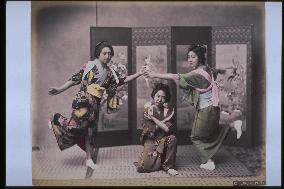
Dancing girls

Dancing girls

Women from the merchant class wearing colourful kimono perform a dance. The byobu screen at the back is illustrated with flowers and birds. The three women are dancing merrily together.==Date:1890, Place:unknown, Photo:unknown, (Credit:Nagasaki University Library/Kyodo News Images) [Cabinet Number61‐24‐0]

  •  
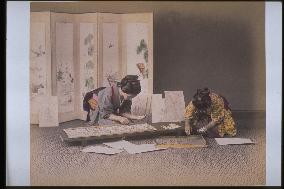
A woman sorting cotton

A woman sorting cotton

Two women are removing cotton seeds on a board. They may be a master wearing a tasuki cord and a maid in hakama skirt. A byobu screen depicting scenes from the four seasons is behind them.==Date:unknown, Place:unknown, Photo:unknown, (Credit:Nagasaki University Library/Kyodo News Images) [Cabinet Number61‐13‐0]

  •  
Lake Ashi seen from Hakone Shrine

Lake Ashi seen from Hakone Shrine

This is a byobu torii gate located at a crossing at present-day National route 1 after going down Gongen Slope after going up the Old Hakone Highway from the post town of Hata. This is a scenic point where Lake Ashinoko and the village of Moto-Hakone can be seen as well as the traffic hub. There seemed to have been teahouses and there are many photos taken at this location. One of the reasons for that is because the photography equipment was quite heavy those days and many photos were taken at the resting spots.==Date:unknown, Place:Hakone, Photo:unknown, (Credit:Nagasaki University Library/Kyodo News Images) [Cabinet Number59‐64‐0]

  •  
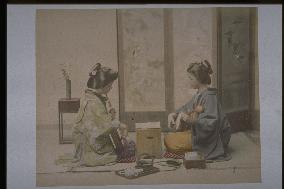
Women greeting each other

Women greeting each other

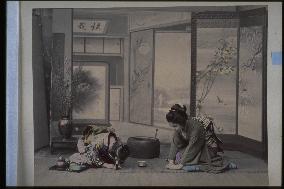
Two women in kimono are exchanging greetings, with a byobu screen visible on the right and a tsuitate partition in the back to the left. A brazier is placed in the centre, tea is served and then the women exchange greetings. The woman holding a tea tray is the host, while the woman sitting on a cushion to the right is the guest.==Date:unknown, Place:unknown, Photo:unknown, (Credit:Nagasaki University Library/Kyodo News Images) [Cabinet Number59‐51‐0]

  •  
Women eating sushi

Women eating sushi

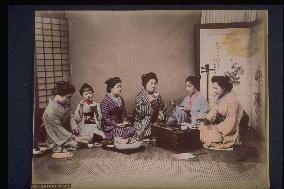
Women of the upper class are eating sushi. An earthen teapot is visible on the long brazier. An uchiwa fan is lying on the floor, but the women are dressed heavily. A curtain is visible behind the two-panel byobu screen. This is a studio photograph.==Date:unknown, Place:unknown, Photo:unknown, (Credit:Nagasaki University Library/Kyodo News Images) [Cabinet Number51‐128‐0]

  •  
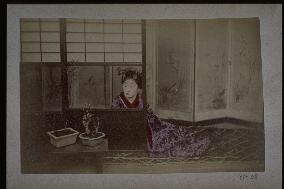
A woman in formal dress holding a bonsai

A woman in formal dress holding a bonsai

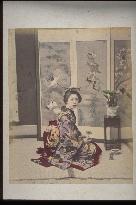
A woman in a brightly coloured kimono is sitting in front of a byobu screen. This is a coloured photograph taken in a studio. Cranes, wild geese and cherry blossoms are painted on the screen behind her. A cycad plant in a pot is placed nearby. The woman is holding a miniature bonsai plant, and two more are visible nearby.==Date:unknown, Place:unknown, Photo:unknown, (Credit:Nagasaki University Library/Kyodo News Images) [Cabinet Number51‐78‐0]

  •  
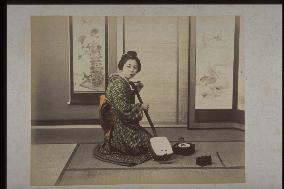
A woman with a shamisen

A woman with a shamisen

The woman's expression suggests that she is saying Who is there? What do you want? I am busy tuning my lute. This is a Japanese-style room with a flower and bird scroll on the wall and a byobu screen.==Date:unknown, Place:unknown, Photo:unknown, (Credit:Nagasaki University Library/Kyodo News Images) [Cabinet Number51‐70‐0]

  •  
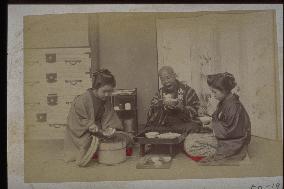
A scene of a meal

A scene of a meal

A man is about to convey cooked rice to his wide open mouth with chopsticks. The rice bowl held by the man is larger than those used by the women. A byobu screen is standing behind the three people. ==Date:unknown, Place:unknown, Photo:unknown, (Credit:Nagasaki University Library/Kyodo News Images) [Cabinet Number50‐19‐0]

  •  
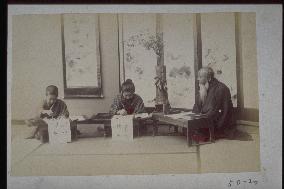
Calligraphy lesson

Calligraphy lesson

Children learn calligraphy under a master. Since this is an individual lesson, they are most likely from the wealthy class. A scroll, a byobu screen and arranged flowers are visible in the background.==Date:unknown, Place:unknown, Photo:unknown, (Credit:Nagasaki University Library/Kyodo News Images) [Cabinet Number50‐20‐0]

  •  
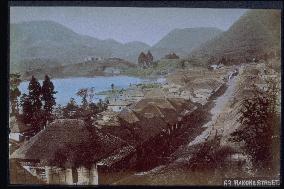
A view of the detached palace from Hakone

A view of the detached palace from Hakone

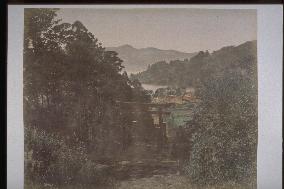
This is the old post town of Hakone viewing Odawara-cho area from Mishima-machi. The town appear any difference from what it used to be during the Edo Period and the honjins (the inns for officers and feudal lords) still show what they uded to look like. Since Hakone Imperial Villa is visible on top of Dogashima, this photo was taken after 1886. The mountain on the right is Byobu, the one in the centre with plateau is Futago, and the large one on the left is Komagadake.==Date:unknown, Place:Hakone, Photo:Tamamura Kozaburo, (Credit:Nagasaki University Library/Kyodo News Images) [Cabinet Number48‐91‐0]

  •  
Women at a brothel

Women at a brothel

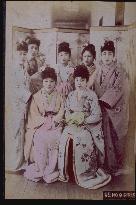
Women are lined up casually in front of a byobu screen, with the knots of their sashes in front. Their expressions are vacant, as though they are posing unwillingly.==Date:unknown, Place:unknown, Photo:Tamamura Kozaburo, (Credit:Nagasaki University Library/Kyodo News Images) [Cabinet Number48‐27‐0]

  •  
Women greeting each other

Women greeting each other

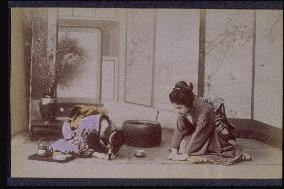
Two women in kimono are exchanging greetings, with a byobu screen visible on the right and a tsuitate partition in the back to the left. A brazier is placed in the centre, tea is served and then the women exchange greetings. The woman holding a tea tray is the host, while the woman sitting on a cushion to the right is the guest.==Date:unknown, Place:unknown, Photo:Tamamura Kozaburo, (Credit:Nagasaki University Library/Kyodo News Images) [Cabinet Number48‐24‐0]

  •  
Women greeting each other

Women greeting each other

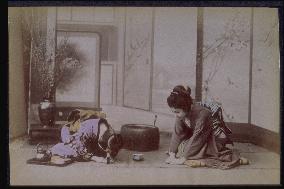
Two women in kimono are exchanging greetings, with a byobu screen visible on the right and a tsuitate partition in the back to the left. A brazier is placed in the centre, tea is served and then the women exchange greetings. The woman holding a tea tray is the host, while the woman sitting on a cushion to the right is the guest.==Date:unknown, Place:unknown, Photo:Tamamura Kozaburo, (Credit:Nagasaki University Library/Kyodo News Images) [Cabinet Number48‐12‐0]

  •  
Women relaxing with tea and tobacco

Women relaxing with tea and tobacco

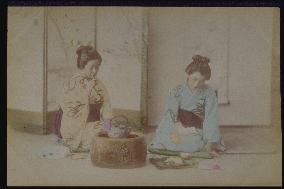
Two women are relaxing together but are not engaged in a conversation. A byobu screen is standing next to the tokonoma (alcove) and a brazier is in front of them. The combination of a fan (for summer) and a tea kettle on a brazier (for winter) is rather unnatural.==Date:unknown, Place:unknown, Photo:Tamamura Kozaburo, (Credit:Nagasaki University Library/Kyodo News Images) [Cabinet Number48‐8‐0]

  •  
The approach to Hakone Shrine

The approach to Hakone Shrine

This is the Byobu Torii Gate standing at the entrance to the approach of Hakone Shrine. At present, the gate is no longer there, but a stone monument next to the gasoline station. This is a famous scenic spot and the crossroad from the post town of Hata and from Ashinoyu. It was a popular photo spot during the Meiji Perio and there are many taken with/from the same angle.==Date:unknown, Place:Hakone, Photo:unknown, (Credit:Nagasaki University Library/Kyodo News Images) [Cabinet Number47‐18‐0]

  •  
Byobu torii gate at the approach to hakone shrine

Byobu torii gate at the approach to hakone shrine

This torii does not stand at present, only a monument next to a petrol station. But it was probably famous during the Meiji era, and many photos remain of this scene. A procession of mountain palanquins and umbrellas is seen, some of the people looking like soldiers. It is scenic spot with a view of Ashino Lake.==Date:unknown, Place:Hakone, Photo:unknown, (Credit:Nagasaki University Library/Kyodo News Images) [Cabinet Number14‐7‐0]

  •  
Byobu torii gate at the approach to hakone shrine

Byobu torii gate at the approach to hakone shrine

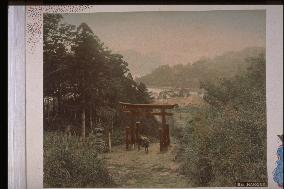
The Byobu torii at the entrance to Hakone Shinto Shrine. At present, the torii has been replaced by a stone inscription. It is a scenic spot overlooking Ashino Lake, and an important crossroad connecting Hatajuku and Sengokubara. It was a favorite motif for photographs.==Date:unknown, Place:Hakone, Photo:Ogawa Kazumasa, (Credit:Nagasaki University Library/Kyodo News Images) [Cabinet Number5‐21‐0]

  •  
Japanese screen at Uffizi Gallery

Japanese screen at Uffizi Gallery

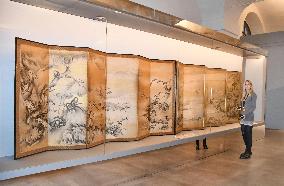
A visitor stands next to a Japanese folding screen or "byobu" at the Uffizi Gallery in Florence, Italy, on Dec. 4, 2017. (Kyodo) ==Kyodo

  • Main
  • Top
  • Editorial
  • Creative
  • About Us
  • About ILG
  • Terms of use
  • Company
  • BEHIND
  • Price List
  • Single Plan
  • Monthly Plan
  • Services
  • Shooting
  • Rights Clearance
  • Support
  • FAQ
  • How To Buy
  • Contact Us
  • Become a Partner

© KYODO NEWS IMAGES INC

All Rights Reserved.

  • Editorial
  • Olympics
  • News
  • Sports
  • Japan
  • Tech
  • Royal
  • Disaster
  • NorthKorea
  • Old Japan
  • SNS
  • Creative
  • Food
  • Japan
  • Landscape
  • Animal
  • Popular
  • #Ukraine
  • #China
  • #coronavirus
  • #N. Korea
  • #Thailand
  • #Russia
  • #Ukraine
  • #China
  • #coronavirus
  • #N. Korea
  • #Thailand
  • #Russia
  • Food
  • Japan
  • Landscape
  • Animal
  • Olympics
  • News
  • Sports
  • Japan
  • Tech
  • Royal
  • Disaster
  • NorthKorea
  • Old Japan
  • SNS