•  
Romantic train trip in Lviv on Valentines Day

Romantic train trip in Lviv on Valentines Day

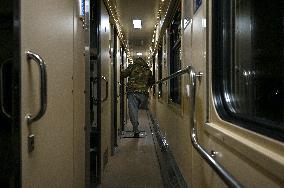
LVIV, UKRAINE - FEBRUARY 14, 2024 - A man with an amputated leg stands in the corridor of a carriage on the Train to Your retro train launched by Ukrainian Railways (Ukrzaliznytsia) to celebrate Valentines Day, Lviv, western Ukraine.

  •  
Romantic train trip in Lviv on Valentines Day

Romantic train trip in Lviv on Valentines Day

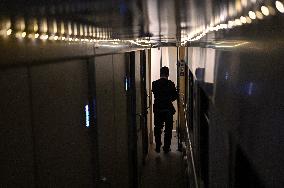
LVIV, UKRAINE - FEBRUARY 14, 2024 - A man with a broken arm and a woman enter a carriage on the Train to Your retro train launched by Ukrainian Railways (Ukrzaliznytsia) to celebrate Valentines Day, Lviv, western Ukraine

  •  
Romantic train trip in Lviv on Valentines Day

Romantic train trip in Lviv on Valentines Day

LVIV, UKRAINE - FEBRUARY 14, 2024 - A man is seen in the corridor of a carriage on the Train to Your retro train launched by Ukrainian Railways (Ukrzaliznytsia) to celebrate Valentines Day, Lviv, western Ukraine.

  •  
SLOVENIA-LJUBLJANA-GRANDPA FROST PROCESSION

SLOVENIA-LJUBLJANA-GRANDPA FROST PROCESSION

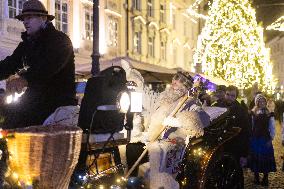
(231228) -- LJUBLJANA, Dec. 28, 2023 (Xinhua) -- A man dressed as Grandpa Frost greets visitors from his carriage during a procession in the old town of Ljubljana, Slovenia, on Dec. 27, 2023. (Photo by Zeljko Stevanic/Xinhua)

  •  
RUSSIA-ST. PETERSBURG-SUBWAY-EXPLOSION-COMMEMORATION

RUSSIA-ST. PETERSBURG-SUBWAY-EXPLOSION-COMMEMORATION

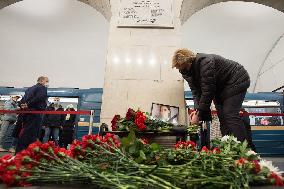
(220404) -- ST. PETERSBURG, April 4, 2022 (Xinhua) -- A man lays flowers to commemorate victims at the Technological Institute station in St. Petersburg, Russia, April 3, 2022. An explosion took place in a train carriage on the runway between two metro stations in St. Petersburg on April 3, 2017, killing at least 14 people and injuring over 50 others. (Photo by Irina Motina/Xinhua)

  •  
Angel And The Bad Man (2009)

Angel And The Bad Man (2009)

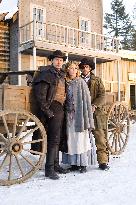
Lou Diamond Phillips, Deborah Kara Unger & Luke Perry Characters: Quirt Evans, Temperance, Loredo Film: Angel And The Bad Man (TV-Film) Usa/Can 2009, Director: Terry Ingram 05 July 2009 In this remake of John Wayne

  •  
The Man Inside film (1958)

The Man Inside film (1958)

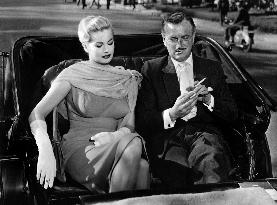
Anita Ekberg & Nigel Patrick Characters: Trudie Hall & Sam Carter Film: The Man Inside (USA 1958) Director: John Gilling 07 September 1958 Date: 07-Sep-58

  •  
Jinrikisha,a man-pulled cart,decorated with chicken scuplture

Jinrikisha,a man-pulled cart,decorated with chicken scuplture

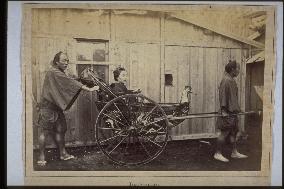
Carried on page 235 of the February 8, 1873 edition of The Far East. The article states that four years earlier there were no cars such as these but only palanquins for the nobility and commoners. Foreigners brought these types of vehicles into Japan, and entrepreneurs manufactured these boat-shaped baby car-type rickshaws.==Date:First year of Meiji, Place:unknown, Photo:unknown, (Credit:Nagasaki University Library/Kyodo News Images) [Cabinet Number17‐41‐0]

  •  
Motomiya Garden,Hikone

Motomiya Garden,Hikone

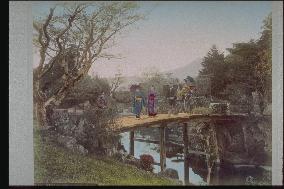
An arched bridge over the pond in a garden, with women dressed in kimono and hair done in Japanese style. In front stands a woman, and one of the two women in the centre holds an umbrella. The rickshaw man holds the pole, and the woman on the rickshaw holds an umbrella.==Date:unknown, Place:Shiga, Photo:Ogawa Kazumasa, (Credit:Nagasaki University Library/Kyodo News Images) [Cabinet Number10‐22‐0]

  •  
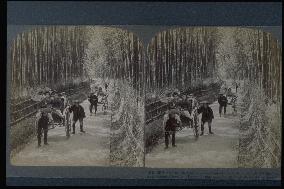
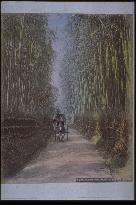
Banboo grove at uji and a jinrikisha,a man-pulled cart

Banboo grove at uji and a jinrikisha,a man-pulled cart

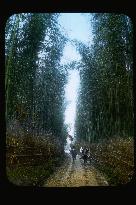
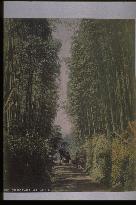
Uji was an important crossroad for maritime transport between Kyoto and Nara, and it flourished with the many cottages built by the nobility during the Heian Period. To the right and left are bamboo groves with weeds growing at the root, relatively untouched, with a rickshaw and a male passenger passing along the road.==Date:unknown, Place:Uji, Photo:Ogawa Kazumasa, (Credit:Nagasaki University Library/Kyodo News Images) [Cabinet Number6‐29‐0]

  •  
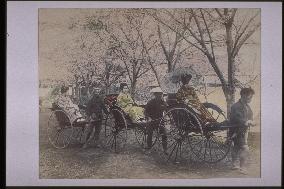
Cherry trees at Nogeyama Park

Cherry trees at Nogeyama Park

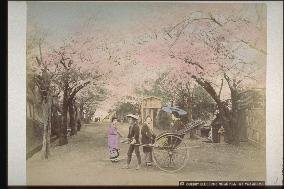
Nogeyama was a residential area for Yokohama merchants. The two greatest silk traders, Hara Zenzaburo and Mogi Sobe built magnificent residences there. After the Great Kanto Earthquake, the area became Nogeyama Park. Flower watching passengers are guided by a rickshaw man on the cherry boulevard.==Date:unknown, Place:Yokohama, Photo:Ogawa Kazumasa, (Credit:Nagasaki University Library/Kyodo News Images) [Cabinet Number7‐3‐0]

  •  
Jinrikisha,a man-pulled cart,at negishi

Jinrikisha,a man-pulled cart,at negishi

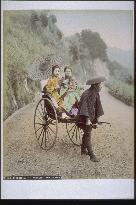
The caption reads Rickshaw of Negishi in Yokohama . A rickshaw man pulls his cart with two young women and a baby as passengers at the middle of the Fudosaka leading down to Negishi Village in Yokohama. The chief means of transport to Negishi from Yokohama was rickshaw.==Date:unknown, Place:Yokohama, Photo:Ogawa Kazumasa, (Credit:Nagasaki University Library/Kyodo News Images) [Cabinet Number6‐32‐0]

  •  
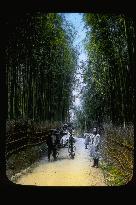
Bamboo groove at Gojozaka Slope

Bamboo groove at Gojozaka Slope

A rickshaw driver and a pedestrian pass each other in the bamboo grove at Gojo Slope. Bamboo fencing made of bamboo grass tied to bamboo poles prevents the bamboo from encroaching on the path. The path is narrow and rickshaws can barely pass each other. Taken prior to 1909, when the slope was expanded to a width of 7.2 meters.==Date:unknown, Place:Kyoto, Photo:unknown, (Credit:Nagasaki University Library/Kyodo News Images) [Cabinet Number98‐42‐0]

  •  
Bamboo groove at Gojozaka Slope

Bamboo groove at Gojozaka Slope

A girl in yukata (summer kimono) sits on a rickshaw. A man with a janome umbrella stands beside her. Bamboo fencing made of bamboo grass tied to bamboo poles prevents the bamboo from encroaching on the path. The path is narrow and rickshaws can barely pass each other. Taken prior to 1909, when the slope was expanded to a width of 7.2 meters.==Date:unknown, Place:Kyoto, Photo:unknown, (Credit:Nagasaki University Library/Kyodo News Images) [Cabinet Number98‐39‐0]

  •  
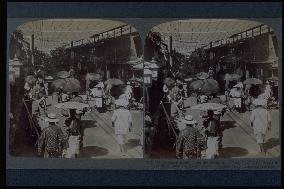
Shijo-Ohashi Avenue in summer

Shijo-Ohashi Avenue in summer

View of the downtown Shijo Street in mid-summer, 1904. The screens were used to block the strong sunlight. People using umbrellas as parasols and a rickshaw carrying a woman passenger are visible. Lanterns hang from the houses on both sides of the street. Electricity poles have been erected.==Date:1904, Place:Kyoto, Photo:Underwood, (Credit:Nagasaki University Library/Kyodo News Images) [Cabinet Number97‐46‐0]

  •  
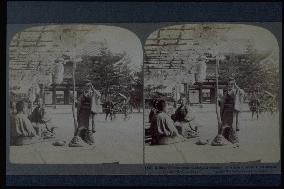
A teahouse in the precincts with a wisteria trellis

A teahouse in the precincts with a wisteria trellis

This is a teahouse in front of Otenmon Gate at Heian Shrine. Lanterns hang near the wisteria trellis. People are relaxing under the wisteria blossoms. A woman holding a parasol on a rickshaw is visible on the right, as well as Daigokuden Hall beyond the gate. The shrine was built in 1895. This may have been taken by the British photographer H. G. Ponting.==Date:unknown, Place:Kyoto, Photo:unknown, (Credit:Nagasaki University Library/Kyodo News Images) [Cabinet Number97‐43‐0]

  •  
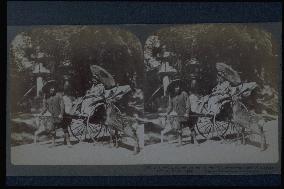
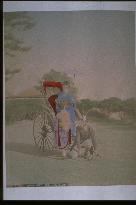
A woman on the jinrikisha,Kasuga Shrine

A woman on the jinrikisha,Kasuga Shrine

This photo captures a scene with a woman on a rickshaw feeding deer. It is hard to pinpoint the exact location, but it is probably the shrine approach of Kasuga Taisha, as stone lanterns are in the background. The woman is wearing kimono, Japanes-style chignon, and is holding a parasol. The rickshaw man is wearing zori sandals and a hat. This is a stereograph.==Date:1904, Place:Nara, Photo:Underwood, (Credit:Nagasaki University Library/Kyodo News Images) [Cabinet Number97‐21‐0]

  •  
Bamboo grooves near Kiyomizudera Temple

Bamboo grooves near Kiyomizudera Temple

Stereograph depicting rickshaws on the Gojo-zaka slope surrounded by bamboo groves. The two women, one with a parasol, are passengers on the rickshaw pulled by the man with an amigasa hat. Bamboo fencing made of bamboo grass tied to bamboo poles prevents the bamboo from encroaching upon the path. Taken prior to 1909, when the slope was expanded to a width of 7.2 meters. Taken by Herbert G. Ponting in 1904.==Date:1904, Place:Kyoto, Photo:Underwood, (Credit:Nagasaki University Library/Kyodo News Images) [Cabinet Number97‐1‐0]

  •  
Women on jinrikishas

Women on jinrikishas

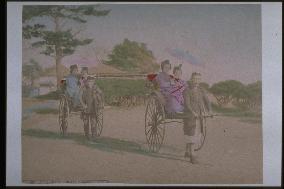
Three kimono-clad women are riding three jinrikisha (rickshaws). The women in front and rear are holding an umbrella. The first rickshaw man wears a sacerdotal robe, long underwear and straw sandals, while the one in the middle wears a straw hat and long underwear, and the third man wears a head towel, sacerdotal robe and long underwear. House roofs are visible under the cherry trees in the background.==Date:unknown, Place:unknown, Photo:unknown, (Credit:Nagasaki University Library/Kyodo News Images) [Cabinet Number96‐56‐0]

  •  
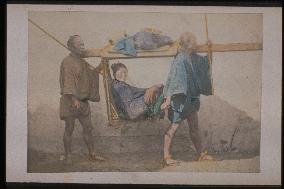
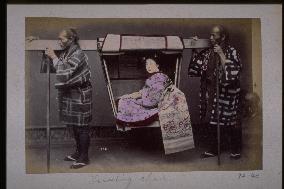
A woman in a basket palanquin

A woman in a basket palanquin

This may be a shitekago because the straw curtain seems to be rolled up. This kind of palanquin was made simply of four bamboo poles and braided bamboo sticks with straw curtain attached. The palanquin bearers had no set uniforms but carried ikizue (breath sticks) to regulate breathing. ==Date:unknown, Place:unknown, Photo:unknown, (Credit:Nagasaki University Library/Kyodo News Images) [Cabinet Number96‐10‐0]

  •  
Women on jinrikishas

Women on jinrikishas

Kimono-clad women hold umbrellas on jinrikisha (rickshaws). The rickshaw man in front wears a straw hat, hanten coat, a stomach warmer, long underwear, and heavy cloth socks. The short-haired rickshaw man in the rear is similarly dressed. This was taken near the wooden fence of a large residence.==Date:unknown, Place:unknown, Photo:A. Farsari, (Credit:Nagasaki University Library/Kyodo News Images) [Cabinet Number95‐20‐0]

  •  
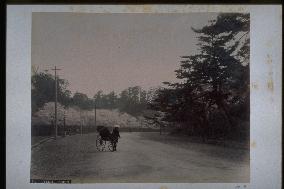
Cherry trees and jinrikishas,Ueno Park

Cherry trees and jinrikishas,Ueno Park

Kuromon Street in Ueno Park is viewed from the south. Turning right on this street today, one would find the Tokyo Metropolitan Museum. Toshogu Shrine is deep in the woods behind the cherry trees in the centre. It seems to be early morning in the park, when the rickshaw man is the only person viewing the cherry blossoms.==Date:unknown, Place:Tokyo, Photo:unknown, (Credit:Nagasaki University Library/Kyodo News Images) [Cabinet Number93‐9‐0]

  •  
A woman in a basket palanquin

A woman in a basket palanquin

The woman is riding a shitekago used by the general public in the Edo Period. This kind of palanquin was made simply of four bamboo poles and braided bamboo sticks with straw curtain attached. The palanquin bearers are wearing short coats and straw sandals and holding ikizue (breath sticks) to regulate breathing while walking.==Date:unknown, Place:unknown, Photo:unknown, (Credit:Nagasaki University Library/Kyodo News Images) [Cabinet Number92‐43‐0]

  •  
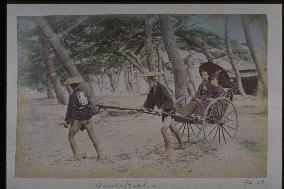
Women on jinrikishas

Women on jinrikishas

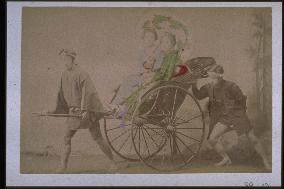
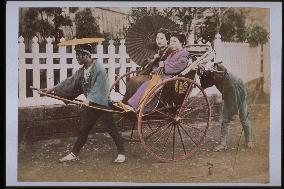
Two kimono-clad women are riding a jinrikisha (rickshaw). One of them is holding an umbrella. The rickshaw man wears a straw hat, a hanten coat, long underwear and straw sandals. The rickshaw man pulling on the left is wearing a loincloth. Many pine trees are visible in the background. This seems to have been taken on a beach.==Date:unknown, Place:Kanagawa, Photo:Kusakabe Kinbei, (Credit:Nagasaki University Library/Kyodo News Images) [Cabinet Number92‐42‐0]

  •  
A girl in a basket palanquin

A girl in a basket palanquin

This may be a shitekago because the straw curtain seems to be rolled up. This kind of palanquin was made simply of four bamboo poles and braided bamboo sticks with straw curtain attached. The palanquin bearers had no set uniforms but carried ikizue (breath sticks) to regulate breathing. ==Date:unknown, Place:unknown, Photo:unknown, (Credit:Nagasaki University Library/Kyodo News Images) [Cabinet Number91‐26‐0]

  •  
Women on jinrikishas

Women on jinrikishas

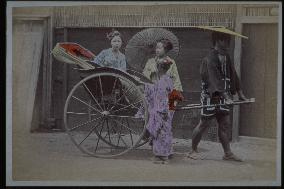
Two kimono-clad women are riding a jinrikisha (rickshaw). One of them is holding an umbrella while the other one is holding a bundle of flowers. The long haired rickshaw man in front is wearing a head towel, a hanten coat, long underwear and straw sandals. The rickshaw man in the rear is dressed in the same fashion and is pushing the cart. He is barefoot. Somethink like trees are visible in the back, but this was probably taken in a studio.==Date:unknown, Place:unknown, Photo:unknown, (Credit:Nagasaki University Library/Kyodo News Images) [Cabinet Number89‐18‐0]

  •  
A girl in a basket palanquin

A girl in a basket palanquin

This may be a shitekago because the straw curtain seems to be rolled up. This kind of palanquin was made simply of four bamboo poles and braided bamboo sticks with straw curtain attached. The palanquin bearers had no set uniforms but carried ikizue (breath sticks) to regulate breathing. ==Date:unknown, Place:unknown, Photo:unknown, (Credit:Nagasaki University Library/Kyodo News Images) [Cabinet Number88‐47‐0]

  •  
Bamboo groove at Gojozaka Slope

Bamboo groove at Gojozaka Slope

A rickshaw driver in a happi coat sits on his rickshaw posing for the camera. Bamboo fencing made of bamboo grass tied to bamboo poles prevents the bamboo from encroaching upon the path. The path is narrow and rickshaws can barely pass each other. Taken prior to 1909, when the slope was expanded to a width of 7.2 meters.==Date:unknown, Place:Kyoto, Photo:unknown, (Credit:Nagasaki University Library/Kyodo News Images) [Cabinet Number88‐8‐0]

  •  
A woman on a jinrikisha

A woman on a jinrikisha

One woman holding an umbrella is on a jinrikisha (rickshaw), while another woman is about to get on. The rickshaw driver is kneeling with his left leg up, assisting the woman. He is wearing a head towel, a sacerdotal robe, long underwear, and heavy cloth socks. Trees are seen behind. The photograph must have been taken outside on a road.==Date:unknown, Place:unknown, Photo:unknown, (Credit:Nagasaki University Library/Kyodo News Images) [Cabinet Number86‐30‐0]

  •  
A girl on a jinrikisha

A girl on a jinrikisha

A kimono-clad woman is riding a jinrikisha (rickshaw). The rickshaw man poses with his right leg in the air. His hair is close-cropped and he is wearing a twisted head towel, long sleeve coat, stomach warmer, long underwear and straw sandals. The other man in front wears similar attire. The man in the rear pushing the hood is not wearing a stomach warmer. This was taken on a road lined with pine trees.==Date:unknown, Place:unknown, Photo:unknown, (Credit:Nagasaki University Library/Kyodo News Images) [Cabinet Number86‐24‐0]

  •  
A woman on a jinrikisha

A woman on a jinrikisha

A kimono-clad woman is riding a jinrikisha (rickshaw). The rickshaw man wears a twisted head towel, sacerdotal robe, long underwear and straw sandals. The background scene shows trees and a fence on the right and houses and trees on the left.==Date:unknown, Place:unknown, Photo:unknown, (Credit:Nagasaki University Library/Kyodo News Images) [Cabinet Number86‐23‐0]

  •  
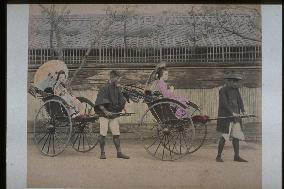
Women on jinrikishas

Women on jinrikishas

Two kimono-clad women hold European umbrellas on two jinrikisha (rickshaws). The short-haired rickshaw man in front wears a sacerdotal robe, stomach warmer, long underwear and heavy cloth socks, while the man in the rear wears a twisted head towel, sacerdotal robe, stomach warmer, long underwear and heavy cloth socks. Trees and thatch-roof houses are visible in the background.==Date:unknown, Place:unknown, Photo:unknown, (Credit:Nagasaki University Library/Kyodo News Images) [Cabinet Number86‐22‐0]

  •  
Women on jinrikishas

Women on jinrikishas

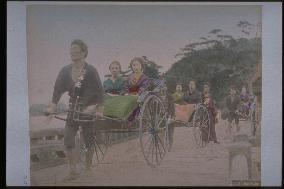
Women are riding on three jinrikisha (rickshaws). The women are all in kimono. The rickshaw men in the front and middle wear inhanten coats, long underwear and straw sandals, while the rickshaw man in the rear wears a sacerdotal robe, long underwear and straw sandals. He is holding an umbrella. This seems to have been taken on a bridge.==Date:unknown, Place:unknown, Photo:unknown, (Credit:Nagasaki University Library/Kyodo News Images) [Cabinet Number84‐20‐0]

  •  
Women on jinrikishas

Women on jinrikishas

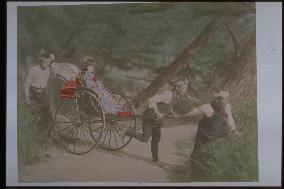
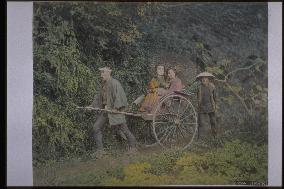
Two kimono-clad women are holding an umbrella on a jinrikisha (rickshaw). The rickshaw man in front has a shaved head and wears a head towel, sacerdotal robe and long underwear. The rickshaw man pushing from behind is wearing a bamboo hat, sacerdotal robe, stomach warmer, long underwear and straw sandals. This seems to have been taken in the mountains.==Date:unknown, Place:unknown, Photo:A. Farsari, (Credit:Nagasaki University Library/Kyodo News Images) [Cabinet Number82‐58‐0]

  •  
Horikiri Iris Garden

Horikiri Iris Garden

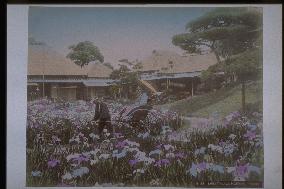
Visitors used rickshaws to tour the iris garden. The words Horitetsu Konai (Horitetsu Ground) are printed on the rickshaw man's hanten jacket. The buildings in the background appear to be, not arbors, but the residence of the garden caretaker. Since irises bloom in the rainy season, people with umbrellas are usually portrayed in these photographs.==Date:unknown, Place:Tokyo, Photo:A. Farsari, (Credit:Nagasaki University Library/Kyodo News Images) [Cabinet Number81‐11‐0]

  •  
Bamboo groove at Gojozaka Slope

Bamboo groove at Gojozaka Slope

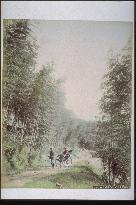
A man pulling a rickshaw and a woman with goods to be sold, carried in baskets suspended from a yoke, stand at Gojo-zaka slope which is surrounded by bamboo brush. Bamboo grass grows thickly on both sides of the road. The broken bamboo on both sides in the foreground was probably cut to prevent the bamboo grass from spreading to the road. The path is narrow and rickshaws can barely pass each other. Taken prior to 1909 when the slope was expanded to a width of 7.2 meters.==Date:unknown, Place:Kyoto, Photo:Tamamura Kozaburo, (Credit:Nagasaki University Library/Kyodo News Images) [Cabinet Number80‐5‐0]

  •  
Women on jinrikishas

Women on jinrikishas

Two kimono-clad women are holding open umbrellas on a jinrikisha (rickshaw). The rickshaw man has a topknot and wears a head towel, a sacerdotal robe, long underwear, and straw sandals. This was taken in front of a large house with stone pavement in front.==Date:unknown, Place:unknown, Photo:R. Stillfried, (Credit:Nagasaki University Library/Kyodo News Images) [Cabinet Number78‐90‐0]

  •  
Women on jinrikishas

Women on jinrikishas

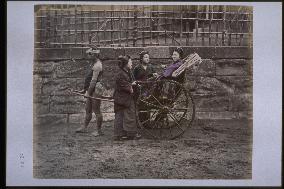
A kimono-clad woman is riding a jinrikisha (rickshaw), with two other women at each side. The rickshaw man has a topknot and wears a head towel, a stomach warmer, loincloth and straw sandals. A bamboo fence is visible on the stone embankment in the back.==Date:unknown, Place:unknown, Photo:R. Stillfried, (Credit:Nagasaki University Library/Kyodo News Images) [Cabinet Number78‐83‐0]

  •  
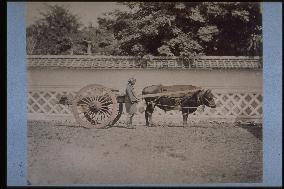
An ox cart

An ox cart

The ox-drawn cart was used to transport luggage. A yoke was placed on the cow, and a tripod protruding from the cart was connected to the yoke for the cow to pull. The cow carriage that noblemen used in the Heian Period was called gissha to differentiate it from that used by commoners.==Date:unknown, Place:unknown, Photo:R. Stillfried, (Credit:Nagasaki University Library/Kyodo News Images) [Cabinet Number76‐39‐0]

  •  
Girls on jinrikishas

Girls on jinrikishas

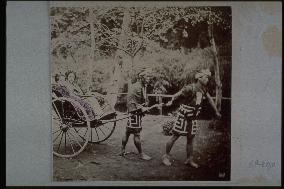
Two kimono-clad women are riding a jinrikisha (rickshaw). One rickshaw man holds the bar while the other pulls. They have topknots and wear head towels, inhanten coats and long underwear. The man in front wears straw sandals, while the man in the rear is barefoot. The background setting is a cluster of trees.==Date:unknown, Place:unknown, Photo:unknown, (Credit:Nagasaki University Library/Kyodo News Images) [Cabinet Number69‐80‐2]

  •  
Girls on jinrikishas

Girls on jinrikishas

Two kimono-clad women are riding a jinrikisha (rickshaw). One is holding an umbrella. The rickshaw man wears a bamboo hat, inhanten coat, stomach warmer, long underwear and tabi socks. This was taken in front of a large residence.==Date:unknown, Place:unknown, Photo:unknown, (Credit:Nagasaki University Library/Kyodo News Images) [Cabinet Number69‐57‐0]

  •  
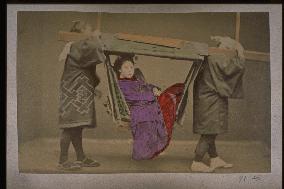
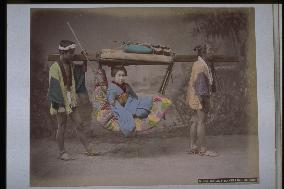
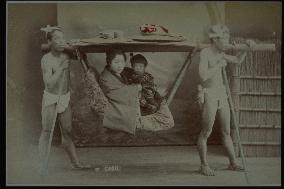
A mother and her daughter in a basket palanquin

A mother and her daughter in a basket palanquin

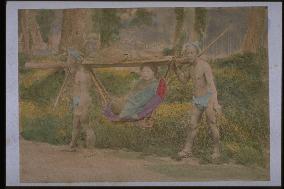
The kago (palanquin) was widely used in the Edo Period. Many types were developed for different social classes and purposes. This palanquin has no straw curtain and so is probably a yamakago used for mountain passages. A cushion was used to absorb shocks. The bearers are wearing loincloths, straw sandals and headbands, and they are holding ikizue (breath sticks) to regulate breathing while walking.==Date:unknown, Place:unknown, Photo:unknown, (Credit:Nagasaki University Library/Kyodo News Images) [Cabinet Number69‐56‐0]

  •  
A woman on a jinrikisha

A woman on a jinrikisha

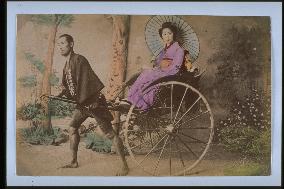
A kimono-clad woman and hair in Western style is holding a Western-style umbrella and riding alone on a jinrikisha (rickshaw). The rickshaw man wears a bamboo hat, sacerdotal robe, long underwear and straw sandals. A scene of mountains and rivers is painted on the wall in the back. This photograph must have been taken in a studio.==Date:unknown, Place:unknown, Photo:unknown, (Credit:Nagasaki University Library/Kyodo News Images) [Cabinet Number69‐55‐0]

  •  
Jinrikishas and girls

Jinrikishas and girls

A young kimono-clad woman is riding a jinrikisha (rickshaw). Girls are standing on each side, with and without an umbrella. The rickshaw man is wearing a bamboo hat, an inhanten coat, long underwear and straw sandals. The photograph was probably taken outdoors.==Date:unknown, Place:unknown, Photo:unknown, (Credit:Nagasaki University Library/Kyodo News Images) [Cabinet Number69‐36‐0]

  •  
A woman on a jinrikisha

A woman on a jinrikisha

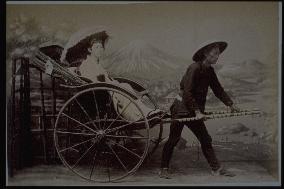
A kimono-clad woman is holding an umbrella and riding a jinrikisha (rickshaw). The rickshaw man is barefoot, has a shaved head, and wears a sacerdotal robe and long underwear. Trees are visible in the back, but this was probably taken in a studio.==Date:unknown, Place:unknown, Photo:unknown, (Credit:Nagasaki University Library/Kyodo News Images) [Cabinet Number69‐6‐0]

  •  
Women on jinrikishas

Women on jinrikishas

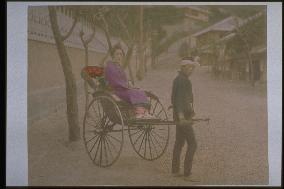
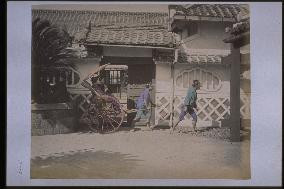
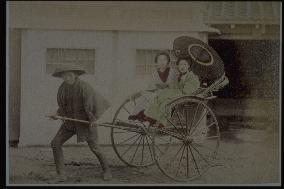
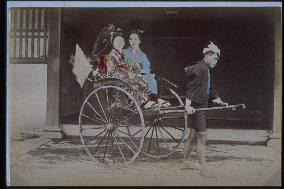
Two kimono-clad women ride a jinrikisha (rickshaw). One of them is holding a small decorative umbrella. A flag-like object is visible behind the rickshaw. The rickshaw man is wearing a head towel, sacerdotal robe, long underwear, and straw sandals. This was taken on the stone pavement in front of a house.==Date:unknown, Place:unknown, Photo:unknown, (Credit:Nagasaki University Library/Kyodo News Images) [Cabinet Number69‐8‐0]

  •  
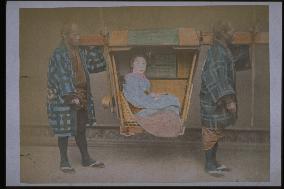
palanquin bearers

palanquin bearers

The woman is riding a shitekago used by the general public in the Edo Period. This kind of palanquin was made simply of four bamboo poles and braided bamboo sticks with straw curtain attached. The palanquin bearers are wearing short coats and straw sandals and holding ikizue (breath sticks) to regulate breathing while walking.==Date:unknown, Place:unknown, Photo:unknown, (Credit:Nagasaki University Library/Kyodo News Images) [Cabinet Number64‐36‐0]

  •  
Women on jinrikishas

Women on jinrikishas

Two kimono-clad women hold umbrellas, one opened and one folded, on a jinrikisha (rickshaw). The rickshaw man holding the bar wears a bamboo hat, a sacerdotal robe, long underwear and straw sandals. Another rickshaw man with a topknot, long underwear and a head towel is pushing the cart in the rear. The background scene shows a European-style wooden fence on a stone embankment.==Date:unknown, Place:unknown, Photo:unknown, (Credit:Nagasaki University Library/Kyodo News Images) [Cabinet Number64‐39‐0]

  •  
A jinrikisha

A jinrikisha

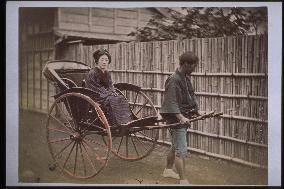
A kimono-clad woman is riding a jinrikisha (rickshaw). A short-haired man in a sacerdotal robe, long underwear and a pair of tabi socks is holding the bar. A house and bamboo fence are seen in the back. The photograph was taken outdoors.==Date:unknown, Place:unknown, Photo:unknown, (Credit:Nagasaki University Library/Kyodo News Images) [Cabinet Number64‐38‐0]

  •  
palanquin bearers

palanquin bearers

The kago (palanquin) was widely used in the Edo Period. Many types were developed for different social classes and purposes. This palanquin has no straw curtain and so is probably a yamakago used for mountain passages. A cushion was used to absorb shocks. The bearers are wearing loincloths, straw sandals and headbands, and they are holding ikizue (breath sticks) to regulate breathing while walking.==Date:unknown, Place:unknown, Photo:unknown, (Credit:Nagasaki University Library/Kyodo News Images) [Cabinet Number64‐37‐0]

  • Main
  • Top
  • Editorial
  • Creative
  • About Us
  • About ILG
  • Terms of use
  • Company
  • BEHIND
  • Price List
  • Single Plan
  • Monthly Plan
  • Services
  • Shooting
  • Rights Clearance
  • Support
  • FAQ
  • How To Buy
  • Contact Us
  • Become a Partner

© KYODO NEWS IMAGES INC

All Rights Reserved.

  • Editorial
  • Olympics
  • News
  • Sports
  • Japan
  • Tech
  • Royal
  • Disaster
  • NorthKorea
  • Old Japan
  • SNS
  • Creative
  • Food
  • Japan
  • Landscape
  • Animal
  • Popular
  • #Ukraine
  • #Russia
  • #coronavirus
  • #N. Korea
  • #Thailand
  • #China
  • #Ukraine
  • #Russia
  • #coronavirus
  • #N. Korea
  • #Thailand
  • #China
  • Food
  • Japan
  • Landscape
  • Animal
  • Olympics
  • News
  • Sports
  • Japan
  • Tech
  • Royal
  • Disaster
  • NorthKorea
  • Old Japan
  • SNS