•  
China debuts prototype of fastest high-speed train in the world

China debuts prototype of fastest high-speed train in the world

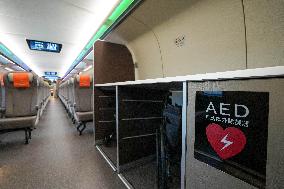
This photo shows an interior view of a carriage of the CR450AF bullet train in Beijing, capital of China, on December 29, 2024. A prototype of the CR450 bullet train that will run at 400 kilometers per hour debuted in Beijing on Sunday, said the country's railway operator China State Railway Group Co., Ltd. The train is capable of running at 450 kilometers per hour in test. Photo by Ju Huanzong/Xinhua/ABACAPRESS.COM

  •  
China debuts prototype of fastest high-speed train in the world

China debuts prototype of fastest high-speed train in the world

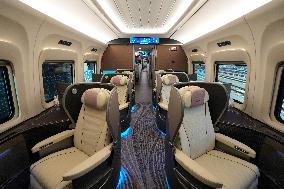
This photo shows an interior view of a business class carriage of the CR450AF bullet train in Beijing, capital of China, on December 29, 2024. A prototype of the CR450 bullet train that will run at 400 kilometers per hour debuted in Beijing on Sunday, said the country's railway operator China State Railway Group Co., Ltd. The train is capable of running at 450 kilometers per hour in test. Photo by Ju Huanzong/Xinhua/ABACAPRESS.COM

  •  
China debuts prototype of fastest high-speed train in the world

China debuts prototype of fastest high-speed train in the world

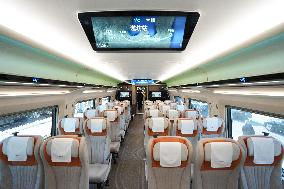
This photo shows an interior view of the economy class carriage of the CR450AF bullet train in Beijing, capital of China, on December 29, 2024. A prototype of the CR450 bullet train that will run at 400 kilometers per hour debuted in Beijing on Sunday, said the country's railway operator China State Railway Group Co., Ltd. The train is capable of running at 450 kilometers per hour in test. Photo by Ju Huanzong/Xinhua/ABACAPRESS.COM

  •  
China debuts prototype of fastest high-speed train in the world

China debuts prototype of fastest high-speed train in the world

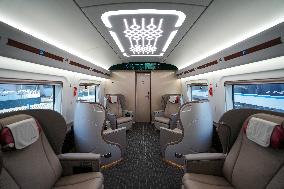
This photo shows an interior view of a business class carriage of the CR450BF bullet train in Beijing, capital of China, on December 29, 2024. A prototype of the CR450 bullet train that will run at 400 kilometers per hour debuted in Beijing on Sunday, said the country's railway operator China State Railway Group Co., Ltd. The train is capable of running at 450 kilometers per hour in test. Photo by Ju Huanzong/Xinhua/ABACAPRESS.COM

  •  

Storm Kathleen Brings Strong Winds, High Waves To Ireland, UK Coasts 2

Storm Kathleen brought strong winds to Ireland, Northern Ireland, Scotland and parts of western England on Saturday, April 6. Videos posted on social media show big waves hitting the coasts across the regions.

  •  
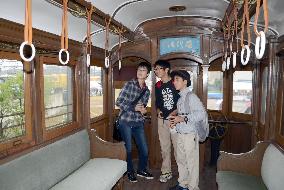
Interior of century-old wooden train carriage exhibited in Nara

Interior of century-old wooden train carriage exhibited in Nara

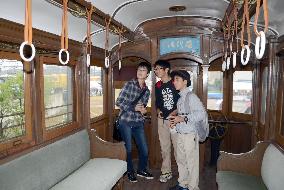
KASHIHARA, Japan - Visitors view the interior of a "Debo 1 type" wooden train carriage, manufactured in 1913 and used on the Kintetsu Nara line, exhibited in Kashiba, Nara Prefecture in western Japan, on Nov. 1, 2014. The interior, usually kept out of bounds for preservation purposes, was open to a limited number of visitors as part of the line's 100th anniversary commemorative events.

  •  
Motomiya Garden,Hikone

Motomiya Garden,Hikone

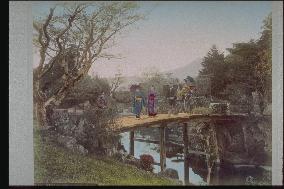
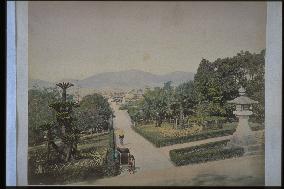
An arched bridge over the pond in a garden, with women dressed in kimono and hair done in Japanese style. In front stands a woman, and one of the two women in the centre holds an umbrella. The rickshaw man holds the pole, and the woman on the rickshaw holds an umbrella.==Date:unknown, Place:Shiga, Photo:Ogawa Kazumasa, (Credit:Nagasaki University Library/Kyodo News Images) [Cabinet Number10‐22‐0]

  •  
Honmoku Point seen from the Fudozaka slope

Honmoku Point seen from the Fudozaka slope

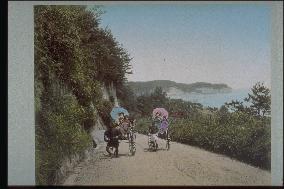
The promenade from the Bluff past Negishi hill was the Fudosaka yunning straight down to the seaside. At the foot of a slope is Mississippi Bay. Two rickshaw men each pull a family on their vehicles.==Date:unknown, Place:Yokohama, Photo:Ogawa Kazumasa, (Credit:Nagasaki University Library/Kyodo News Images) [Cabinet Number10‐9‐0]

  •  
Jinrikisha,a man-pulled cart,at negishi

Jinrikisha,a man-pulled cart,at negishi

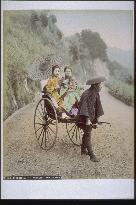
The caption reads Rickshaw of Negishi in Yokohama . A rickshaw man pulls his cart with two young women and a baby as passengers at the middle of the Fudosaka leading down to Negishi Village in Yokohama. The chief means of transport to Negishi from Yokohama was rickshaw.==Date:unknown, Place:Yokohama, Photo:Ogawa Kazumasa, (Credit:Nagasaki University Library/Kyodo News Images) [Cabinet Number6‐32‐0]

  •  
Shijo-Ohashi Avenue in summer

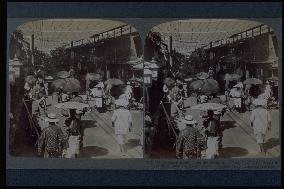
Shijo-Ohashi Avenue in summer

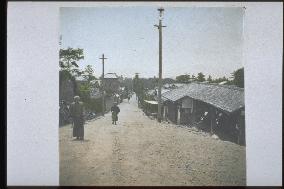
View of the downtown Shijo Street in mid-summer, 1904. The screens were used to block the strong sunlight. People using umbrellas as parasols and a rickshaw carrying a woman passenger are visible. Lanterns hang from the houses on both sides of the street. Electricity poles have been erected.==Date:1904, Place:Kyoto, Photo:Underwood, (Credit:Nagasaki University Library/Kyodo News Images) [Cabinet Number97‐46‐0]

  •  
Cherry trees at Nogeyama Park

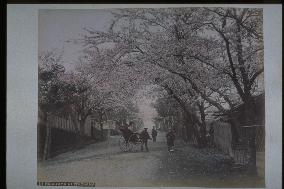
Cherry trees at Nogeyama Park

Present-day Koyo Slope. Iseyama Kotaijingu Shrine and Naritasan Yokohama Temple (a.k.a. Noge Fudo) were built in the Mt. Noge area in 1870. The summit commanded a panoramic view of the port and the city, and many people came here to enjoy the cherry blossoms and the autumn colours.==Date:unknown, Place:Yokohama, Photo:unknown, (Credit:Nagasaki University Library/Kyodo News Images) [Cabinet Number93‐26‐0]

  •  
Mt. Fuji seen from the Otome Pass

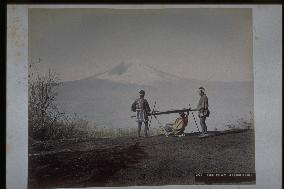
Mt. Fuji seen from the Otome Pass

Mt. Fuji viewed from Otome Pass at the border of Shizuoka and Kanagawa Prefectures, facing west. Otome Pass is part of the road to Gotenba, Shizuoka Prefecture via Sengokubara (Kanagawa) and Hakone. It has been famous since ancient times for its spectacular view of Mt. Fuji. During the Edo Period, travel restrictions were enforced and people were not allowed to pass. This photograph taken at the top of the pass shows a woman in a palanquin, with the bearers on both sides.==Date:unknown, Place:Shizuoka, Photo:unknown, (Credit:Nagasaki University Library/Kyodo News Images) [Cabinet Number93‐1‐0]

  •  
The Sanmon Gate of Yasaka Shrine,Gion,Kyoto

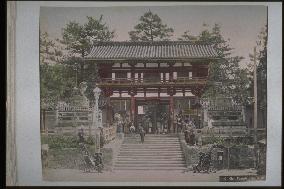
The Sanmon Gate of Yasaka Shrine,Gion,Kyoto

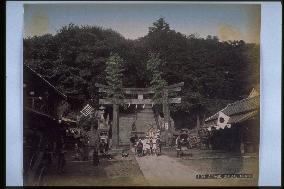
View of the western romon gate of Yasaka Shinto Shrine. Statues of komainu (guardian dogs) stand on both sides of the gate. Rickshaw drivers are relaxing while women and children stand in front of the stone walls and gate. A gaslight and electric pole are visible near the stone walls. The gate roof was covered with hinoki tree bark in 1497 and re-covered with roof tiles during the Eiroku Period (1558-1570). The gate in the picture is painted red, with a kirizuma style roof and roof tiles. There are statues of two ministers within the shrine grounds.==Date:unknown, Place:Kyoto, Photo:unknown, (Credit:Nagasaki University Library/Kyodo News Images) [Cabinet Number87‐37‐0]

  •  
A teahouse,Shimogamo,Kyoto

A teahouse,Shimogamo,Kyoto

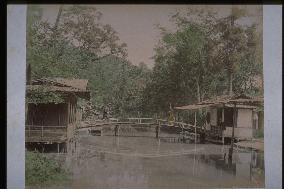
View of the Mitarashi River at Shimogamo Shinto Shrine. A woman riding a rickshaw and a woman with a parasol are passing each other on a bridge. There are summer pavilions on both sides of the river. The source of Mitarashi River is a spring at Mitarashi Shrine within the Shimogamo Shinto Shrine precincts. In the Meiji Period, bonfires were lit along the river and summer pavilions were built from which to observe them. In the back is Tadashi Forest.==Date:unknown, Place:Kyoto, Photo:unknown, (Credit:Nagasaki University Library/Kyodo News Images) [Cabinet Number85‐26‐0]

  •  
Shijo-dori Avenue,Gion

Shijo-dori Avenue,Gion

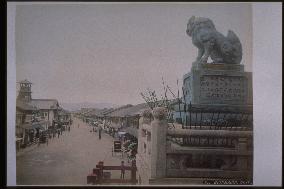
Western view of Shijo Street (at the foot of the stone stairs of Gion) from the western gate of Yasaka Shrine. The stone statue of a guardian dog on the right was built by Iwata Chubei, Koizumi Shinshichi, and other residents of Kankoboko-cho, Shijo-dori-Muromachi-Higashi-iru in 1882 as a wish for family peace and prosperity. The Pagoda on the left at Yaei Elementary School was used to spot fires. The street was widened in later days. Rickshaws are parked in front of the houses.==Date:unknown, Place:Kyoto, Photo:A. Farsari, (Credit:Nagasaki University Library/Kyodo News Images) [Cabinet Number82‐12‐0]

  •  
Mt. Fuji seen from a bridge on the Tokaido Road

Mt. Fuji seen from a bridge on the Tokaido Road

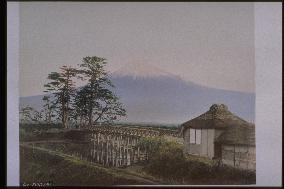
Northern view of Mt. Fuji from Kawai Bridge in Suzukawa, Fuji City. The bridge crosses Numa River on the Tokaido Highway. Pine trees are growing on the west side of the bridge. Huts with thatched roofs stand on the east side, which serves as a harbor. The absence of carriage tracks on the bridge indicates that this photograph was taken before 1891.==Date:unknown, Place:Shizuoka, Photo:A. Farsari, (Credit:Nagasaki University Library/Kyodo News Images) [Cabinet Number82‐1‐0]

  •  
Women gazing at the town from Mt. Takashima,Yokohama

Women gazing at the town from Mt. Takashima,Yokohama

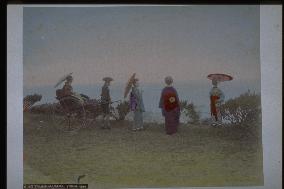
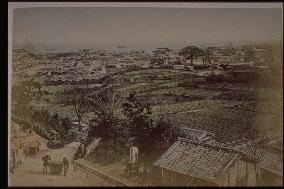
Mt. Takashima was named after Takashima Kaemon, who had been contracted to reclaim the land from the sea for train tracks and who built a villa on the hill (present-day Takashima-dai) looking down on the railroad. The villa was completed in the 1880s, and its garden, which commanded a panoramic view of the city, was opened to the public.==Date:unknown, Place:Yokohama, Photo:A. Farsari, (Credit:Nagasaki University Library/Kyodo News Images) [Cabinet Number81‐41‐0]

  •  
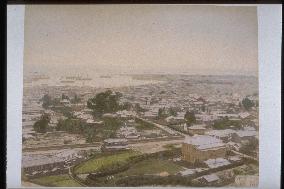
The Yokohama Customs Inspection office and the main pier

The Yokohama Customs Inspection office and the main pier

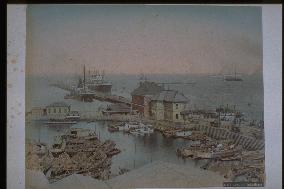
Panoramic view of the great pier from Yokohama Customs Building. The curved stone-walled quay stretching from the edge of the pier to the left was called the Elephant Trunk and was one of the protrusions of Igirisu Hatoba (British Wharf) built at the time of the port-opening.==Date:unknown, Place:Yokohama, Photo:A. Farsari, (Credit:Nagasaki University Library/Kyodo News Images) [Cabinet Number81‐8‐0]

  •  
Suma coast

Suma coast

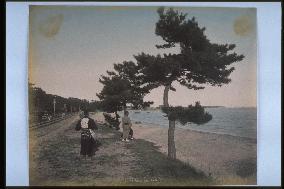
Eastern view from what is now Sumaura Park. This scenic area is famous as the site of a decisive battle between the Genji and Heike clans in 1184. Since the Sanyo Railway Company's Hyogo-Himeji Line opened in December 1888, this photograph was probably taken between 1890 and 1910. The former Saigoku Kaido Highway (present-day National Route #2) stretches along the other side of the railroad tracks.==Date:unknown, Place:Kobe, Photo:unknown, (Credit:Nagasaki University Library/Kyodo News Images) [Cabinet Number56‐24‐0]

  •  
The hundred-step Otokozaka slope at Mt. Atago

The hundred-step Otokozaka slope at Mt. Atago

Mt. Atago is a small hill of only 26 meters in height. However, because it was located in a flat area, it was known for its panoramic view and became a favourite spot to enjoy the New Year's sunrise, moon viewing and snow viewing. This photograph depicts a festival day around 1897. Children are carrying a mikoshi (portable shrine). On the right is the liquor shop Konishiya. At present, the shop stands in the foreground and its name has been changed to Atago Konishi.==Date:unknown, Place:Tokyo, Photo:unknown, (Credit:Nagasaki University Library/Kyodo News Images) [Cabinet Number53‐21‐0]

  •  
A view of the city from the Otani Main Tomb,Nishi Honganji Temple

A view of the city from the Otani Main Tomb,Nishi Honganji Temple

The temple approach is seen from the sanmon gate of Nishi-Otani Temple, facing west. The city of Kyoto and the Nishiyama Mountain Range are visible in the background. A stone lantern stands in front of the gate. The garden is well maintained and has cycad trees. A driver, his rickshaw and a person with an umbrella are visible at the gate. Tall trees are visible to the north.==Date:unknown, Place:Kyoto, Photo:unknown, (Credit:Nagasaki University Library/Kyodo News Images) [Cabinet Number52‐23‐0]

  •  
Beach of Izu and Zuso Jinsha Railway

Beach of Izu and Zuso Jinsha Railway

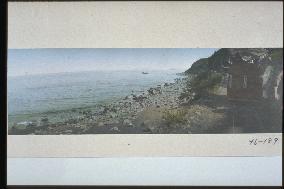
Photos with the number 46 are from an individual's collection taken in Japan and China. Many photos of the time are single photos, while this is a series of photos in an individual's album. It is a view of the seaside, but the location is unknown.==Date:unknown, Place:Shizuoka, Photo:unknown, (Credit:Nagasaki University Library/Kyodo News Images) [Cabinet Number46‐189‐0]

  •  
Ueno Park

Ueno Park

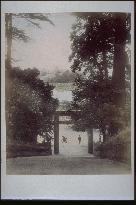
Shinobazu Pond is seen from the top of the stone steps at Shinobazuguchi at Toshogu. The bench of the teahouse across the road is visible along with a rickshaw. This is a part of present-day Ueno Zoo. Nakajima, site of Benten-do and the pond with lotuses, can also be seen.==Date:unknown, Place:Tokyo, Photo:unknown, (Credit:Nagasaki University Library/Kyodo News Images) [Cabinet Number47‐2‐0]

  •  
Kenshun-mon Gate at Kyoto Imperial Palace

Kenshun-mon Gate at Kyoto Imperial Palace

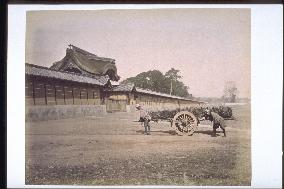
North-northwestern view of Kenshun-mon Gate and tsuijibei (earthen wall) of the Kyoto Imperial Palace seen from the Omiya Gosho Imperial Street. The gate is a magnificent example of the mukai-karahafu style. The wall has five portals called anamon (literally, hole gates). The ground, which at present is covered with gravel, is scattered with weeds and small stones. Two men pull a cart with straw bundles. Taken by Ueda Kuichi.==Date:unknown, Place:Kyoto, Photo:Uchida Kuichi, (Credit:Nagasaki University Library/Kyodo News Images) [Cabinet Number42‐8‐0]

  •  
Entire view of nikko hachi-ishi

Entire view of nikko hachi-ishi

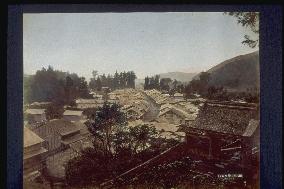
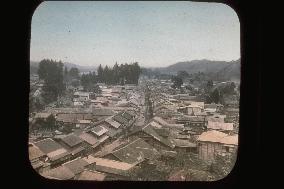
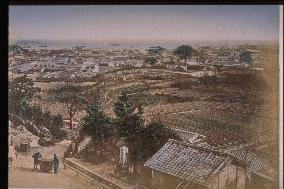
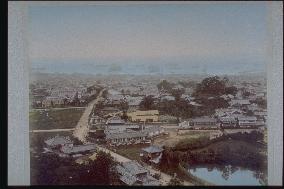
The town of Nikko Hatsuishi seen from the middle of the mountain of Kannonji to the west. Nikko Kaido made a turn in the location of the present Kannonji and the Nikko City Office, leading to the Kami bridge which is at the entrance of Nikko Shaji.==Date:unknown, Place:Nikko, Photo:unknown, (Credit:Nagasaki University Library/Kyodo News Images) [Cabinet Number37‐10‐0]

  •  
Entire view of nikko hachi-ishi

Entire view of nikko hachi-ishi

A photo of the city of Hatsuishi of Nikko from the middle of the western side of the mountain of Kannonji. Near Kannonji and the present Nikko City Office, Nikko Road took a turn leading to Kami Bridge at the entrance to Nikko Shrine.==Date:unknown, Place:Nikko, Photo:unknown, (Credit:Nagasaki University Library/Kyodo News Images) [Cabinet Number31‐40‐0]

  •  
Row of houses on a slope

Row of houses on a slope

View of the approach to Yasaka Shinto Shrine looking west from the front gate of Maruyama Yaami Hotel. There is a rickshaw garage by the light post. An old man with a cane and a boy wearing hakama walk along the road. A Western-style building with hipped roof is visible to the left. This photo was taken after 1892, when electricity was introduced to Kyoto.==Date:unknown, Place:Kyoto, Photo:unknown, (Credit:Nagasaki University Library/Kyodo News Images) [Cabinet Number46‐93‐0]

  •  
Garden with iris in bloom

Garden with iris in bloom

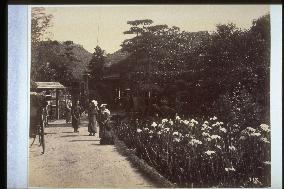
An unpretentious view of an iris garden. This is rare among the old photos, which usually portray beautiful women. It is a sort of snap shot, and gives this photo a lively oppearance. The rickshaw on the left edge evokes the feeling of the times.==Date:unknown, Place:unknown, Photo:unknown, (Credit:Nagasaki University Library/Kyodo News Images) [Cabinet Number19‐16‐0]

  •  
Streets,houses,and the sea of KOBE

Streets,houses,and the sea of KOBE

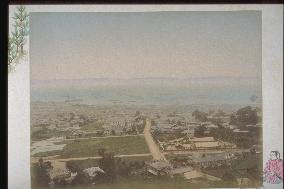
To avoid turmoil when opening up the port, Kobe was designated as a foreigh settlement slightly re moved from the port of Hyogo. But the location was blessed with a good harbour and rapidly developed into an international trade city transcending Hyogo.==Date:unknown, Place:Kobe, Photo:unknown, (Credit:Nagasaki University Library/Kyodo News Images) [Cabinet Number15‐35‐0]

  •  
Streets,houses,and the sea of KOBE

Streets,houses,and the sea of KOBE

A view of the city along the beach and the port from the Bluff of Kobe. People are carrying baggage and boats can be seen in the distance.==Date:unknown, Place:Kobe, Photo:unknown, (Credit:Nagasaki University Library/Kyodo News Images) [Cabinet Number14‐37‐0]

  •  
KOBE coastal street

KOBE coastal street

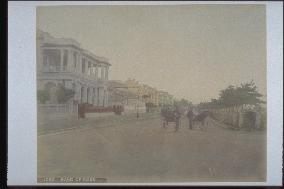
This is a view of Kobe Bund (waterfront street in the Kobe Foreign Settlement) looking east from the western edge of the street in the mid-Meiji Period. To the right is Meriken-Hatoba. The buildings from the left are: the British-run Hongkong and Shanghai Bank at No.2, the American-run Smith, Baker & Co. at No.3, the German, Italian, and Russian Consulates at No.5, and finally the French-run Compagnie des Messageries Maritimes at No.6. ==Date:Meiji era, Place:Kobe, Photo:Tamamura Kozaburo, (Credit:Nagasaki University Library/Kyodo News Images) [Cabinet Number11‐42‐0]

  •  
Honmoku Point seen from the Fudozaka slope

Honmoku Point seen from the Fudozaka slope

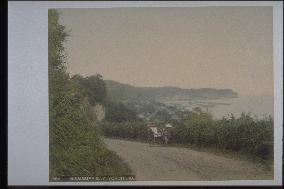
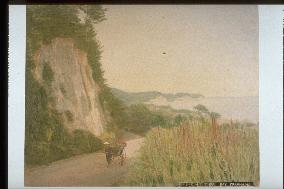
The promenade from the Bluff to the Negishi hills descends to the seaside by the Fudosaka in the photo. Mississippi Bay is visible from the slope. A rickshaw man pulls an empty carriage on the promenade.==Date:unknown, Place:Yokohama, Photo:Tamamura Kozaburo, (Credit:Nagasaki University Library/Kyodo News Images) [Cabinet Number11‐24‐0]

  •  
Lake Chuzenji

Lake Chuzenji

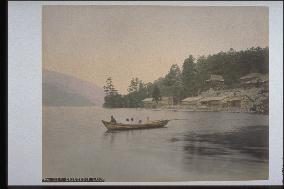
The view of Chuguji of Futarasan Shrine on the north bank of Chuzenji Lake. Huts for Buddhist trainees stand along the bank. The Kannondo and the two huts to the left of the torii were destroyed by the river swirling with mud in 1902. Three women and a helmsman are in the boat.==Date:Before 35th year of Meiji, Place:Nikko, Photo:unknown, (Credit:Nagasaki University Library/Kyodo News Images) [Cabinet Number11‐20‐0]

  •  
Town and harbour from hill

Town and harbour from hill

A view of the city and harbour of Kobe from the hills. Some ships are anchored in the harbour.==Date:unknown, Place:Kobe, Photo:Ogawa Kazumasa, (Credit:Nagasaki University Library/Kyodo News Images) [Cabinet Number10‐30‐0]

  •  
A panoramic view of Kobe

A panoramic view of Kobe

A view of Kobe Harbour from Yamate. On the occasion of the opening of the harbour to foreigners in 1861, the area to the east from Ikuta River to Uji River was designated as a foreign settlement. This area developed into what is now Kobe City.==Date:unknown, Place:Kobe, Photo:Ogawa Kazumasa, (Credit:Nagasaki University Library/Kyodo News Images) [Cabinet Number5‐47‐0]

  •  
Mt. Fuji seen from the Otome Pass

Mt. Fuji seen from the Otome Pass

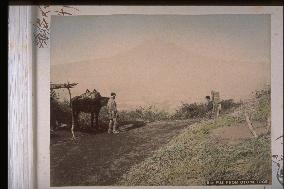
A vendor and road-horse man departing from the tea house at the ridge. Otome Ridge was located on the border of Gotemba and Hakone, at a height of 1005 meters above sea level. It is said to be the oldest road over Mt.Hakone, but it was not used during the Edo era when the route was regulated.==Date:unknown, Place:Shizuoka, Photo:Ogawa Kazumasa, (Credit:Nagasaki University Library/Kyodo News Images) [Cabinet Number5‐15‐0]

  •  
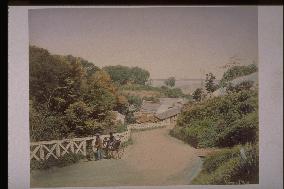
A view of the harbour from Yamate

A view of the harbour from Yamate

The caption reads Bluff, Yokohama in English, but this is a view of the sea from the Yamate hills. A rickshaw man pulls his cart with a lady passenger up the street with wooden handrails, perhaps Jizozaka.==Date:unknown, Place:Yokohama, Photo:Kusakabe Kinbei, (Credit:Nagasaki University Library/Kyodo News Images) [Cabinet Number3‐10‐0]

  •  
A jinrikisha going up the Fudozaka slope

A jinrikisha going up the Fudozaka slope

The caption reads Mississippi Bay, Yokohama in English. The photo shows Fudosaka road descending from Negishi to Honmoku Beach. To the right is Mississippi Bay (Negishi Bay). A rickshaw man pulls a passenger on a rickshaw in the direction of Negishi.==Date:unknown, Place:Yokohama, Photo:Kusakabe Kinbei, (Credit:Nagasaki University Library/Kyodo News Images) [Cabinet Number2‐26‐0]

  •  
Streets,houses,and the sea of KOBE

Streets,houses,and the sea of KOBE

Since the opening of Kobe to foreigners in 1868, the city has developed as an international port representing Japan. Thus there are many historical sites, similar to Yokohama, that tell of the opening of Japan to trade with foreign countries and the development of maritime transport.==Date:unknown, Place:Kobe, Photo:Kusakabe Kinbei, (Credit:Nagasaki University Library/Kyodo News Images) [Cabinet Number2‐3‐0]

  •  
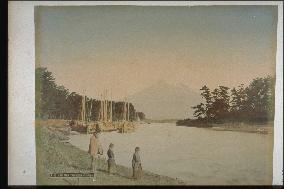
Mt. Fuji seen from Numakawa,Tagonoura

Mt. Fuji seen from Numakawa,Tagonoura

The Numa River belongs to the Fuji River system which runs along the west of Ukishimagahara to the north banks of Suruga Bay. The anchored boats may be Japanese-style boats or Bezai boats of the time. Fuji River, with its abundant water, was an important means of maritime transport, connecting the Kofu Basin and Tokai area.==Date:unknown, Place:Shizuoka, Photo:Kusakabe Kinbei, (Credit:Nagasaki University Library/Kyodo News Images) [Cabinet Number1‐40‐0]

  •  
Interior of century-old wooden train carriage exhibited in Nara

Interior of century-old wooden train carriage exhibited in Nara

KASHIHARA, Japan - Visitors view the interior of a "Debo 1 type" wooden train carriage, manufactured in 1913 and used on the Kintetsu Nara line, exhibited in Kashiba, Nara Prefecture in western Japan, on Nov. 1, 2014. The interior, usually kept out of bounds for preservation purposes, was open to a limited number of visitors as part of the line's 100th anniversary commemorative events. (Kyodo)

  • Main
  • Top
  • Editorial
  • Creative
  • About Us
  • About ILG
  • Terms of use
  • Company
  • BEHIND
  • Price List
  • Single Plan
  • Monthly Plan
  • Services
  • Shooting
  • Rights Clearance
  • Support
  • FAQ
  • How To Buy
  • Contact Us
  • Become a Partner

© KYODO NEWS IMAGES INC

All Rights Reserved.

  • Editorial
  • Olympics
  • News
  • Sports
  • Japan
  • Tech
  • Royal
  • Disaster
  • NorthKorea
  • Old Japan
  • SNS
  • Creative
  • Food
  • Japan
  • Landscape
  • Animal
  • Popular
  • #Ukraine
  • #Thailand
  • #coronavirus
  • #N. Korea
  • #Russia
  • #China
  • #Ukraine
  • #Thailand
  • #coronavirus
  • #N. Korea
  • #Russia
  • #China
  • Food
  • Japan
  • Landscape
  • Animal
  • Olympics
  • News
  • Sports
  • Japan
  • Tech
  • Royal
  • Disaster
  • NorthKorea
  • Old Japan
  • SNS