•  
China Expands Green Belt Around Its Largest Desert

China Expands Green Belt Around Its Largest Desert

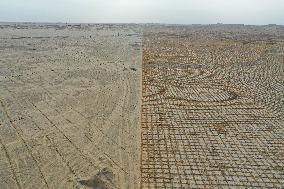
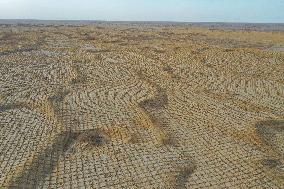
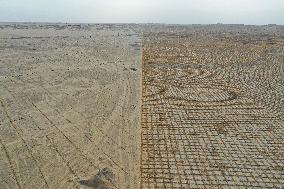
An aerial drone photo taken on April 8, 2025 shows checkerboard sand barriers at a sand-control zone in Minfeng County of Hotan Prefecture, northwest China's Xinjiang Uygur Autonomous Region. Photo by Ding Lei/Xinhua/ABACAPRESS.COM

  •  
Taklimakan Desert Control Afforestation - China

Taklimakan Desert Control Afforestation - China

An aerial drone photo taken on April 8, 2025 shows checkerboard sand barriers in Minfeng County of Hotan Prefecture, northwest China's Xinjiang Uygur Autonomous Region. The Taklimakan Desert in northwest China's Xinjiang Uygur Autonomous Region covers 337,600 square kilometers and its circumference measures 3,046 kilometers, making it the largest desert in China and the second-largest drifting desert in the world. Thanks to decades-long sand prevention and control efforts, the Taklimakan Desert was completely encircled with a sand-blocking green belt on Nov. 28, 2024. In 2025, Xinjiang aims to afforest a land area of about 796,000 hectares, including 562,666 hectares for frontline control in the Taklimakan Desert. These afforestations form a part of the Three-North Shelterbelt Forest Program, the world's largest afforestation program, which tackles desertification in northwest, north and northeast China. Meanwhile, Xinjiang will further widen the sand-blocking green belt and enhance desert-locking efforts to

  •  
Taklimakan Desert Control Afforestation - China

Taklimakan Desert Control Afforestation - China

An aerial drone photo taken on April 8, 2025 shows checkerboard sand barriers at a sand-control zone in Minfeng County of Hotan Prefecture, northwest China's Xinjiang Uygur Autonomous Region. The Taklimakan Desert in northwest China's Xinjiang Uygur Autonomous Region covers 337,600 square kilometers and its circumference measures 3,046 kilometers, making it the largest desert in China and the second-largest drifting desert in the world. Thanks to decades-long sand prevention and control efforts, the Taklimakan Desert was completely encircled with a sand-blocking green belt on Nov. 28, 2024. In 2025, Xinjiang aims to afforest a land area of about 796,000 hectares, including 562,666 hectares for frontline control in the Taklimakan Desert. These afforestations form a part of the Three-North Shelterbelt Forest Program, the world's largest afforestation program, which tackles desertification in northwest, north and northeast China. Meanwhile, Xinjiang will further widen the sand-blocking green belt and enhance des

  •  
Chinese Experience in Desert Controi

Chinese Experience in Desert Controi

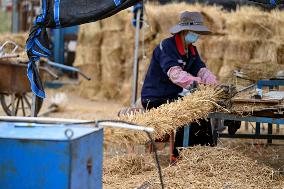
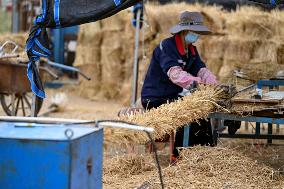
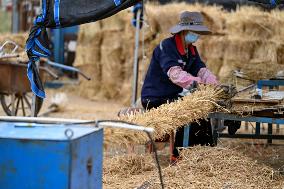
Workers produce straw checkerboard materials in Zhongwei of northwest China's Ningxia Hui Autonomous Region, May 29, 2024. In the 1950s, to protect China's first railway that runs through a desert, the city of Zhongwei embarked on a journey of desert mitigation. Scientists at the Shapotou Desert Research and Experiment Station, part of the Northwest Institute of Eco-Environment and Resources of the Chinese Academy of Sciences, along with local residents, developed straw checkerboards to stabilize the sand and prevent dunes from shifting. Tang Ximing, a senior engineer at a state-owned forestry farm in Zhongwei, crafted a steel tool that differs from regular shovels by featuring two horizontal bars at the front tip. This innovative tool enables the planting of seedling roots 50 centimeters deep into the moist sand layer. This simple tool increases the survival rate of afforestation by 25 percent to over 85 percent. It has been widely promoted and used in afforestation projects across other regions in northern

  •  
(VistaNingxia)CHINA-NINGXIA-ZHONGWEI-ENVIRONMENT-SAND CONTROL (CN)

(VistaNingxia)CHINA-NINGXIA-ZHONGWEI-ENVIRONMENT-SAND CONTROL (CN)

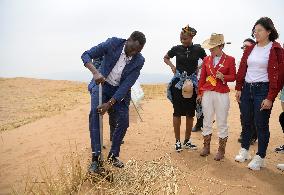
(240616) -- ZHONGWEI, June 16, 2024 Photo by Xinhua/ABACAPRESS.COM) -- A Kenyan Ph.D. candidate (1st L) of Peking University tries to set up a part of the straw checkerboard in the Tengger Desert, northwest China's Ningxia Hui Autonomous Region, May 31, 2024. In the 1950s, to protect China's first railway that runs through a desert, the city of Zhongwei embarked on a journey of desert mitigation. Scientists at the Shapotou Desert Research and Experiment Station, part of the Northwest Institute of Eco-Environment and Resources of the Chinese Academy of Sciences, along with local residents, developed straw checkerboards to stabilize the sand and prevent dunes from shifting. Tang Ximing, a senior engineer at a state-owned forestry farm in Zhongwei, crafted a steel tool that differs from regular shovels by featuring two horizontal bars at the front tip. This innovative tool enables the planting of seedling roots 50 centimeters deep into the moist sand layer. This simple tool increases the survival rate of affores

  •  
(VistaNingxia)CHINA-NINGXIA-ZHONGWEI-ENVIRONMENT-SAND CONTROL (CN)

(VistaNingxia)CHINA-NINGXIA-ZHONGWEI-ENVIRONMENT-SAND CONTROL (CN)

(240616) -- ZHONGWEI, June 16, 2024 Photo by Xinhua/ABACAPRESS.COM) -- Workers produce straw checkerboard materials in Zhongwei of northwest China's Ningxia Hui Autonomous Region, May 29, 2024. In the 1950s, to protect China's first railway that runs through a desert, the city of Zhongwei embarked on a journey of desert mitigation. Scientists at the Shapotou Desert Research and Experiment Station, part of the Northwest Institute of Eco-Environment and Resources of the Chinese Academy of Sciences, along with local residents, developed straw checkerboards to stabilize the sand and prevent dunes from shifting. Tang Ximing, a senior engineer at a state-owned forestry farm in Zhongwei, crafted a steel tool that differs from regular shovels by featuring two horizontal bars at the front tip. This innovative tool enables the planting of seedling roots 50 centimeters deep into the moist sand layer. This simple tool increases the survival rate of afforestation by 25 percent to over 85 percent. It has been widely promot

  •  
(VistaNingxia)CHINA-NINGXIA-ZHONGWEI-ENVIRONMENT-SAND CONTROL (CN)

(VistaNingxia)CHINA-NINGXIA-ZHONGWEI-ENVIRONMENT-SAND CONTROL (CN)

(240616) -- ZHONGWEI, June 16, 2024 (Xinhua) -- A Kenyan Ph.D. candidate (1st L) of Peking University tries to set up a part of the straw checkerboard in the Tengger Desert, northwest China's Ningxia Hui Autonomous Region, May 31, 2024. In the 1950s, to protect China's first railway that runs through a desert, the city of Zhongwei embarked on a journey of desert mitigation. Scientists at the Shapotou Desert Research and Experiment Station, part of the Northwest Institute of Eco-Environment and Resources of the Chinese Academy of Sciences, along with local residents, developed straw checkerboards to stabilize the sand and prevent dunes from shifting. Tang Ximing, a senior engineer at a state-owned forestry farm in Zhongwei, crafted a steel tool that differs from regular shovels by featuring two horizontal bars at the front tip. This innovative tool enables the planting of seedling roots 50 centimeters deep into the moist sand layer. This simple tool increases the survival rate of afforestation by 25 percen

  •  
(VistaNingxia)CHINA-NINGXIA-ZHONGWEI-ENVIRONMENT-SAND CONTROL (CN)

(VistaNingxia)CHINA-NINGXIA-ZHONGWEI-ENVIRONMENT-SAND CONTROL (CN)

(240616) -- ZHONGWEI, June 16, 2024 (Xinhua) -- Workers produce straw checkerboard materials in Zhongwei of northwest China's Ningxia Hui Autonomous Region, May 29, 2024. In the 1950s, to protect China's first railway that runs through a desert, the city of Zhongwei embarked on a journey of desert mitigation. Scientists at the Shapotou Desert Research and Experiment Station, part of the Northwest Institute of Eco-Environment and Resources of the Chinese Academy of Sciences, along with local residents, developed straw checkerboards to stabilize the sand and prevent dunes from shifting. Tang Ximing, a senior engineer at a state-owned forestry farm in Zhongwei, crafted a steel tool that differs from regular shovels by featuring two horizontal bars at the front tip. This innovative tool enables the planting of seedling roots 50 centimeters deep into the moist sand layer. This simple tool increases the survival rate of afforestation by 25 percent to over 85 percent. It has been widely promoted and used in affo

  •  

Thai expat amazed by China's anti-desertification efforts

STORY: Thai expat amazed by China's anti-desertification efforts DATELINE: June 17, 2023 LENGTH: 0:02:35 LOCATION: YINCHUAN, China CATEGORY: ENVIRONMENT SHOTLIST: 1 SOUNDBITE (English): RUEANG NGAM NAMRIN, Thai student, Ningxia Medical University STORYLINE: A Thai expat living in China's Ningxia Hui Autonomous Region visited an ecological reserve and learned how to make straw checkerboard barriers, one of the most effective and widely used measures for fixing sand dunes in the region. SOUNDBITE (English): RUEANG NGAM NAMRIN, Thai student, Ningxia Medical University "Hello, guys! This is my first time in desert. This place is called Baijitan in China's Yinchuan here. I was really excited because this is my first time in a desert. At first, I thought it would be hotter, like a very hot and dry place, but apparently it's really windy. And these are my friends, we are here today, doing the checkerboard (sand barriers) here, like for the desert to not fall down apart. It's a very interesting activity, and I'm

  •  
Ruins of 'checkerboard moat' unearthed at Matsue Castle

Ruins of 'checkerboard moat' unearthed at Matsue Castle

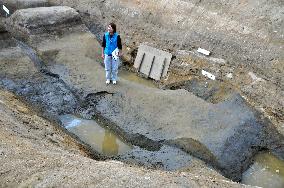
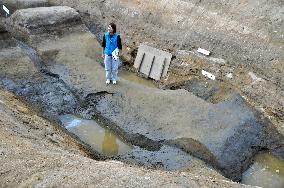
MATSUE, Japan - Parts of a "checkerboard moat" unearthed in the ruins of Matsue Castle in Matsue, western Japan, are shown on Oct. 16, 2014. The moat, crisscrossed by raised sections to hinder attackers' progress, is so named for its resemblance to the playing board of the Japanese chess "shogi."

  •  
CHINA-FIGHT AGAINST DESERTIFICATION

CHINA-FIGHT AGAINST DESERTIFICATION

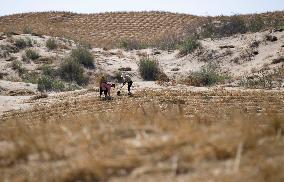
(220617) -- BEIJING, June 17, 2022 (Xinhua) -- Sand control workers make straw checkerboard barriers in the Baijitan national ecological reserve of Lingwu on the southwest edge of Maowusu Desert, northwest China's Ningxia Hui Autonomous Region, June 16, 2022. TO GO WITH XINHUA HEADLINES OF JUNE 17, 2022 (Xinhua/Yang Zhisen)

  •  
CHINA-FIGHT AGAINST DESERTIFICATION

CHINA-FIGHT AGAINST DESERTIFICATION

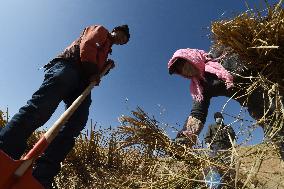
(220617) -- BEIJING, June 17, 2022 (Xinhua) -- Guo Xi (L), sand control worker of Babusha Forest Farm, makes straw checkerboard sand barriers in Gulang County, northwest China's Gansu Province, March 6, 2020. TO GO WITH XINHUA HEADLINES OF JUNE 17, 2022 (Xinhua/Fan Peishen)

  •  
CHINA-NINGXIA-MAOWUSU DESERT-SAND CONTROL (CN)

CHINA-NINGXIA-MAOWUSU DESERT-SAND CONTROL (CN)

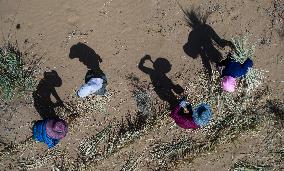
(220617) -- YINCHUAN, June 17, 2022 (Xinhua) -- In this aerial photo, sand control workers make straw checkerboard barriers in the Baijitan national ecological reserve of Lingwu, northwest China's Ningxia Hui Autonomous Region, June 16, 2022. Thanks to three generations of dedicated sand control efforts, a 42,000-hectare oasis has been created in the Baijitan national ecological reserve of Lingwu on the southwest edge of the vast Maowusu Desert. The oasis has now become an important protective barrier for the ecological system in northwestern China. In order to effectively control the desert, locals have dedicated themselves to developing profitable agriculture by transforming the desert into farmland and planting vegetables and fruits which could be sold in the market. Aquaculture and eco-tourism have also been developed to boost locals' income. (Xinhua/Yang Zhisen)

  •  

China making headway in combating desertification

STORY: China making headway in combating desertification DATELINE: June 17, 2022 LENGTH: 00:02:34 LOCATION: Beijing CATEGORY: ENVIRONMENT SHOTLIST: 1. various of desertified land 2. SOUNDBITE 1 (Chinese): HAO LIBO, Zhongwei Shapotou National Nature Reserve, Ningxia 3. SOUNDBITE 2 (Chinese): PATIGUL YASIN, Staff member, Desertification control station of Qiemo County STORYLINE: Friday marks the the World Day to Combat Desertification and Drought, which is observed by the United Nations on June 17 every year. As a country troubled by serious soil erosion, land desertification and soil salinization, China faces an arduous task in its afforestation work. Many places in the country have taken measures to tackle desertification. In the southern edge of China's Tengger Desert, straw checkerboards are used to combat desertification. It's a dune fixation technique in which straw is placed on the surface of the desert in the shape of a checkerboard. The "straw-checkerboard mode" has prevented the desert from en

  •  
Ruins of 'checkerboard moat' unearthed at Matsue Castle

Ruins of 'checkerboard moat' unearthed at Matsue Castle

MATSUE, Japan - Parts of a "checkerboard moat" unearthed in the ruins of Matsue Castle in Matsue, western Japan, are shown on Oct. 16, 2014. The moat, crisscrossed by raised sections to hinder attackers' progress, is so named for its resemblance to the playing board of the Japanese chess "shogi." (Kyodo)

  • Main
  • Top
  • Editorial
  • Creative
  • About Us
  • About ILG
  • Terms of use
  • Company
  • BEHIND
  • Price List
  • Single Plan
  • Monthly Plan
  • Services
  • Shooting
  • Rights Clearance
  • Support
  • FAQ
  • How To Buy
  • Contact Us
  • Become a Partner

© KYODO NEWS IMAGES INC

All Rights Reserved.

  • Editorial
  • Olympics
  • News
  • Sports
  • Japan
  • Tech
  • Royal
  • Disaster
  • NorthKorea
  • Old Japan
  • SNS
  • Creative
  • Food
  • Japan
  • Landscape
  • Animal
  • Popular
  • #Ukraine
  • #Thailand
  • #coronavirus
  • #N. Korea
  • #China
  • #Russia
  • #Ukraine
  • #Thailand
  • #coronavirus
  • #N. Korea
  • #China
  • #Russia
  • Food
  • Japan
  • Landscape
  • Animal
  • Olympics
  • News
  • Sports
  • Japan
  • Tech
  • Royal
  • Disaster
  • NorthKorea
  • Old Japan
  • SNS