•  
Illustration - 2025 Madrid Summer Pools Season

Illustration - 2025 Madrid Summer Pools Season

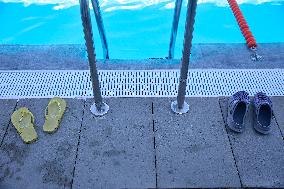
Flip-flops and clogs in the pool at the Centro Deportivo Municipal Mistral, May 28, 2025, in Madrid (Spain). The municipal swimming pool season opened last May 15 until September 7. Photo by Jesus Hellín/Europa Press/ABACAPRESS.COM

  •  
Competition held for piling 'geta' wooden clogs

Competition held for piling 'geta' wooden clogs

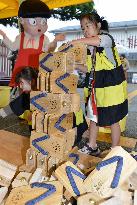
YONAGO, Japan - Participants pile up "geta" wooden clogs in Sakaiminato, Tottori Prefecture, on Nov. 9, 2014, during a competition to heap up the signature footwear of a main character in the popular comic series "GeGeGe no Kitaro" authored by Shigeru Mizuki, a native of the western Japanese city.

  •  
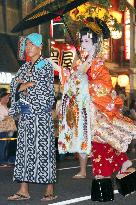
East come to Latin-America at Havana fashion show

East come to Latin-America at Havana fashion show

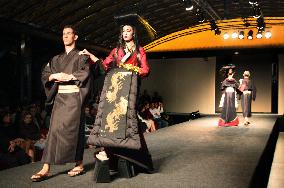
HAVANA, Cuba - A Cuban model (front R) walks down the catwalk wearing kimono and clogs inspired by ''oiran'' (high-class prostitutes) together with a male model, also in kimono, during a fashion show featuring designer Junko Koshino's creations at Hotel Nacional de Cuba in Havana on Dec. 20, 2009. Models wearing Japanese-inspired fashions also performed Latin dance steps on the catwalk at the event celebrating the 80th anniversary of Japan-Cuba relations.

  •  
New Kimono style in summer

New Kimono style in summer

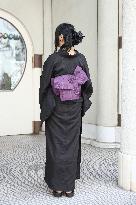
New way to wear yukata Usamajyo. Yukata is a traditional Japanese costume that was born in the Heian period (794-1192) and is also a type of kimono. Unlike a formal kimono, you can wear yukata freely. The number of places to wear it has expanded, and the number of people who wear it increased. People wear it to go to festivals, fireworks and V-kei bands the demand for these special yukatas is increasing. August 5, 2011 , Tokyo, Japan.(Credit:style-arena.jp/Kyodo News Images)

  •  
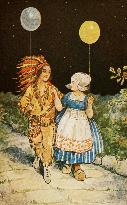
Children's Party American Indian and Dutch girl

Children's Party American Indian and Dutch girl

Two children make their way along a garden path to a fancy dress party in costume. The boy is dressed as a Native American Indian complete with feathered head dress and the little girl is in traditional Dutch costume complete with clogs. Both children hold balloons. Date: 1919

  •  
Courtesan parade held in Sapporo, northern Japan

Courtesan parade held in Sapporo, northern Japan

A popular "oiran" (courtesan) parade is performed during the Susukino Festival in Sapporo, capital of Japan's northernmost prefecture of Hokkaido, on its opening day on Aug. 6, 2015. Bar hostess "Yuzu" (R), acting as a feudal-age courtesan, walked slowly in traditional manner on a street in the popular Susukino entertainment district, wearing a colorful kimono and a pair of tall wooden clogs. (Kyodo) ==Kyodo

  •  
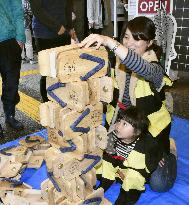
Clog-stacking contest held in west Japan city famous for comics

Clog-stacking contest held in west Japan city famous for comics

A mother and child take part in a contest to stack as many Japanese "geta" wooden sandals as possible in one minute on Nov. 8, 2015, in Sakaiminato, Tottori Prefecture. The western Japan city is the hometown of Shigeru Mizuki, author of the "GeGeGe no Kitaro" ghost comic series, which features its lead character Kitaro in signature geta clogs. (Kyodo) ==Kyodo

  •  
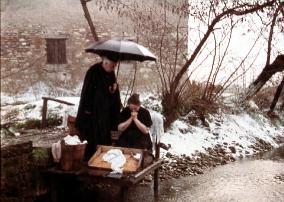
L'ALBERO DEGLI ZOCCOLI aka THE TREE OF WOODEN CLOGS

L'ALBERO DEGLI ZOCCOLI aka THE TREE OF WOODEN CLOGS

L'ALBERO DEGLI ZOCCOLI aka THE TREE OF WOODEN CLOGS [ITALY 1978] Date: 1978

  •  
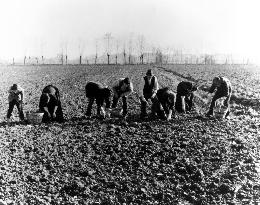
L'ALBERO DEGLI ZOCCOLI

L'ALBERO DEGLI ZOCCOLI

L'ALBERO DEGLI ZOCCOLI [ITALY 1978] aka THE TREE OF WOODEN CLOGS Date: 1978

  •  
L'ALBERO DEGLI ZOCCOLI aka THE TREE OF WOODEN CLOGS

L'ALBERO DEGLI ZOCCOLI aka THE TREE OF WOODEN CLOGS

L'ALBERO DEGLI ZOCCOLI aka THE TREE OF WOODEN CLOGS [ITALY 1978] Date: 1978

  •  
L'ALBERO DEGLI ZOCCOLI aka THE TREE OF WOODEN CLOGS

L'ALBERO DEGLI ZOCCOLI aka THE TREE OF WOODEN CLOGS

L'ALBERO DEGLI ZOCCOLI aka THE TREE OF WOODEN CLOGS [ITALY 1978] Date: 1978

  •  
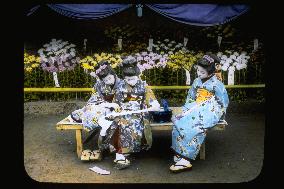
A chrysanthemem exhibition at Nozawa Garden

A chrysanthemem exhibition at Nozawa Garden

Three girls are reading a letter. Behind them, many types of chrysanthemum flowers are in full bloom in an exhibition. Their hair is in momoware style and they wear furisode kimono and bokkuri wooden clogs. This was typical attire for an outing in the Meiji and Taisho Periods.==Date:unknown, Place:unknown, Photo:unknown, (Credit:Nagasaki University Library/Kyodo News Images) [Cabinet Number98‐48‐0]

  •  
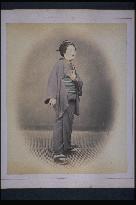
A woman assuming a pose

A woman assuming a pose

This seems to be a woman refusing to be photographed because she is wearing only a pair of wooden clogs on her feet.==Date:about 1870, Place:unknown, Photo:unknown, (Credit:Nagasaki University Library/Kyodo News Images) [Cabinet Number96‐60‐0]

  •  
Women in Okano Garden

Women in Okano Garden

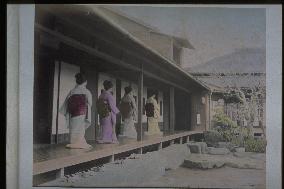
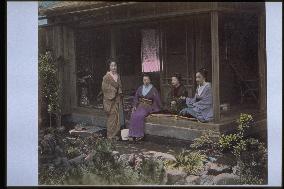
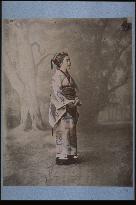
Four women are quietly going to the back of the house, dragging their kimono bottoms and looking at the garden. This photograph has a good perspective. A sharp eye will notice that there are five pairs of geta clogs on the step but only four women. Where is the other person? The old tree in the garden may be a plum tree.==Date:unknown, Place:Tokyo, Photo:A. Farsari, (Credit:Nagasaki University Library/Kyodo News Images) [Cabinet Number95‐19‐0]

  •  
A geta clog craftsman

A geta clog craftsman

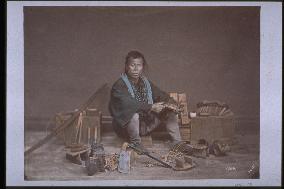
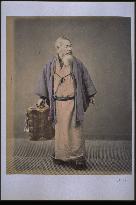
This craftsman walks around the city offering his services in repairing wooden geta clogs, supports for clogs, and thongs. He carries his tools, like a hatchet, plane, and chisels, in a tool box hanging from a balancing pole. His hair is combed in typical craftsman's style, and he wears a hanten coat, gaiters and straw sandals. This is a studio photograph.==Date:unknown, Place:unknown, Photo:Usui Shuzaburo, (Credit:Nagasaki University Library/Kyodo News Images) [Cabinet Number94‐38‐0]

  •  
A woman holding an umbrella

A woman holding an umbrella

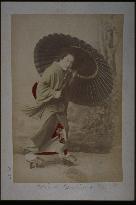
A woman is walking in the wind and rain, holding a janome umbrella and wearing wooden clogs with high supports and rain covers. The strong wind has blown open the bottom of her kimono, exposing her bright coloured under-garment.==Date:unknown, Place:unknown, Photo:unknown, (Credit:Nagasaki University Library/Kyodo News Images) [Cabinet Number92‐37‐0]

  •  
A girl playing with a ball

A girl playing with a ball

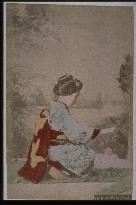
A girl stoops to play with a ball. She is wearing a loosely-tied sash and bokkuri wooden clogs. The photograph skillfully captures the white hairpin in her gleaming black hair and her white hands bouncing the ball.==Date:unknown, Place:unknown, Photo:unknown, (Credit:Nagasaki University Library/Kyodo News Images) [Cabinet Number89‐20‐0]

  •  
Woman playing a blindfold game (treasure mine and gold mine)

Woman playing a blindfold game (treasure mine and gold mine)

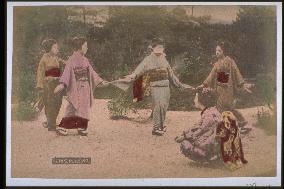
Young women are enjoying a game in a Japanese garden with stone lanterns. Their sashes are tied in loose darari-musubi style, and they are wearing bokkuri wooden clogs. The red colour of the juban (undergarment) is peeping through the hem of their kimono. They are of course posing for this photograph. The English title on the lower left reads GIRLS PLAYING. This is a typical photograph produced for foreigners.==Date:unknown, Place:unknown, Photo:unknown, (Credit:Nagasaki University Library/Kyodo News Images) [Cabinet Number89‐14‐0]

  •  
A geta clog shop

A geta clog shop

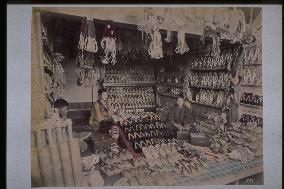
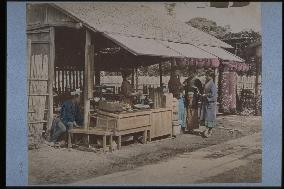
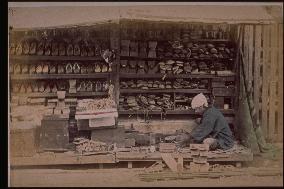
A geta (wooden clogs) shop displays different types of clogs, straw sandals, and thongs. The shop owner is sitting on the right with his wife in the centre. The man on the left may be an apprentice. The shop also sells bangasa (coarse oil-paper umbrellas).==Date:unknown, Place:unknown, Photo:unknown, (Credit:Nagasaki University Library/Kyodo News Images) [Cabinet Number85‐45‐0]

  •  
Girls holding insect cages

Girls holding insect cages

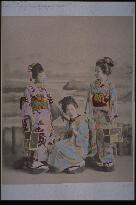
Two young women are standing holding insect cages. The woman in the middle is holding some kind of stick. All three women are wearing kabbori wooden clogs with high supports.==Date:unknown, Place:unknown, Photo:Kajima Seibei, (Credit:Nagasaki University Library/Kyodo News Images) [Cabinet Number84‐4‐0]

  •  
A Kakubeejishi

A Kakubeejishi

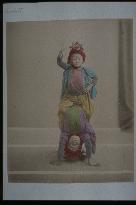
A ritual lion dance called Echigo Jishi. Performers were boys of about 10 years old who did handstands and somersaults wearing a skirt like robe and a pair of wooden clogs. The boys' master accompanied their acrobatics on drums. They carried a drum in front and held a lion's mask during the performance. Two boys performed this lion dance, which flourished during the Edo Period and influenced the music and dance of the time.==Date:unknown, Place:unknown, Photo:unknown, (Credit:Nagasaki University Library/Kyodo News Images) [Cabinet Number83‐21‐0]

  •  
A woman wearing a hood of nobility

A woman wearing a hood of nobility

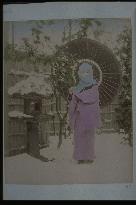
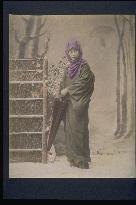
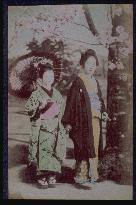
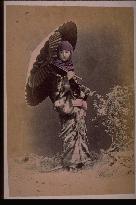
This is a scene of a woman holding a janome-gasa (bull's eye umbrella) on a snowy day, wearing a haori coat for an outing, a pair of wooden clogs with high supports, and an okoso-zukin (combination hood and veil). This was a typical winter costume for young women. Snow has accumulated on a stone lantern.==Date:unknown, Place:unknown, Photo:unknown, (Credit:Nagasaki University Library/Kyodo News Images) [Cabinet Number83‐9‐0]

  •  
A woman wearing a hood of nobility

A woman wearing a hood of nobility

This is a scene of a woman on a snowy day holding a janome-gasa (bull's eye umbrella), wearing a thickly lined kimono for an outing, a pair of wooden clogs with high supports and an okoso-zukin (combination hood and veil). This was a typical costume for young women going outdoors in winter.==Date:unknown, Place:unknown, Photo:unknown, (Credit:Nagasaki University Library/Kyodo News Images) [Cabinet Number79‐36‐0]

  •  
Samurai warriors

Samurai warriors

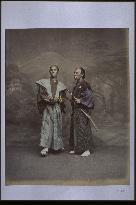
This photograph of two samurai comes from the album Views & Costumes by Stillfried & Andersen. The backdrop belongs to Stillfried's studio. Both samurai are wearing official hakama trousers and vests with family crests. The man on the left is wearing high geta clogs for rainy weather.==Date:unknown, Place:unknown, Photo:R. Stillfried, (Credit:Nagasaki University Library/Kyodo News Images) [Cabinet Number78‐70‐0]

  •  
A woman

A woman

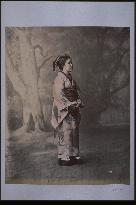
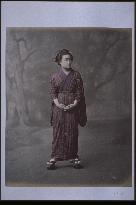
The bold design suggests that the kimono was made from nobori textile. The red embroidery of court attire and a tying string are visible. The woman is wearing a pair of lacquered black wooden clogs. These characteristics reflect the influence of the nobility at the time.==Date:unknown, Place:unknown, Photo:R. Stillfried, (Credit:Nagasaki University Library/Kyodo News Images) [Cabinet Number78‐69‐0]

  •  
A dentist

A dentist

The man has side-locks and a beard and is wearing a haori coat and a pair of wooden clogs with high supports. The writing on the box with metal reinforced corners suggests that he is a town doctor. It reads: All herbal medicine are inside.==Date:unknown, Place:unknown, Photo:R. Stillfried, (Credit:Nagasaki University Library/Kyodo News Images) [Cabinet Number78‐71‐0]

  •  
A pregnant mother

A pregnant mother

This is one of the photographs in the album by Stillfried and Andersen. A pregnant woman wearing everyday clothes and tall geta clogs poses in front of a backdrop. The woman does not seem to be a professional model. Taken in 1868.==Date:unknown, Place:unknown, Photo:R. Stillfried, (Credit:Nagasaki University Library/Kyodo News Images) [Cabinet Number78‐61‐0]

  •  
Women relaxing on a veranda

Women relaxing on a veranda

Four geisha are relaxing on the engawa porch of a guest room with windows, looking at the garden. The woman on the left has her hair arranged in marumage style with floral hairpins and her striped sash tied in chidori-musubi fashion. She is holding a shamisen lute. The slightly elderly woman next to her is wearing black lacquer clogs with high supports. Next to her is an apprentice geisha, and the woman on the far right wears a brightly coloured kimono. A reed chair is visible on the right. Taken in the late Meiji or Taisho Period.==Date:unknown, Place:unknown, Photo:R. Stillfried, (Credit:Nagasaki University Library/Kyodo News Images) [Cabinet Number77‐49‐0]

  •  
A teahouse serving dango (dumplings)

A teahouse serving dango (dumplings)

The woman has her kimono sleeves pulled up with a cord across the back. She is wearing an apron. At the store front there are long, round lanterns with the store's name written on them. The customer on the left has a modern hairstyle. The men standing are wearing haori jackets and hakama trousers with high geta clogs.==Date:unknown, Place:unknown, Photo:R. Stillfried, (Credit:Nagasaki University Library/Kyodo News Images) [Cabinet Number76‐41‐0]

  •  
A woman

A woman

The bold design suggests that the kimono was made from nobori textile. The red embroidery of court attire and a tying string are visible. The woman is wearing a pair of lacquered black wooden clogs. These characteristics reflect the influence of the nobility at the time.==Date:unknown, Place:unknown, Photo:R. Stillfried, (Credit:Nagasaki University Library/Kyodo News Images) [Cabinet Number76‐8‐0]

  •  
Two men

Two men

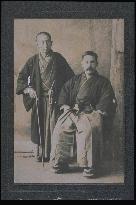
Two middle-aged men pose in a photograph studio. The man standing holds a stick in his hand, while the man sitting wears geta clogs. Taken in 1905. The words Teramachi Sanjo Kitae-iru written on the lower right indicate that it was taken at the Tsubameya Studio (Teramachi Sanjo-ue) run by Imamoto Yujiro.==Date:1905, Place:Kyoto, Photo:unknown, (Credit:Nagasaki University Library/Kyodo News Images) [Cabinet Number72‐234‐0]

  •  
A master and his attendants

A master and his attendants

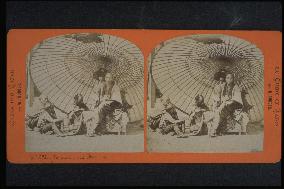
This is a stereograph designed by Wilhelm Burger for the French market entitled China and Japan. A master with one of his geta clogs removed relaxes under a huge umbrella. His servants sit on the ground waiting for him.==Date:unknown, Place:unknown, Photo:Wilhelm Burger, (Credit:Nagasaki University Library/Kyodo News Images) [Cabinet Number70‐23‐0]

  •  
A woman carrying a child on her back

A woman carrying a child on her back

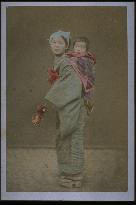
A woman is carrying a baby on her back, and she has a hand towel on her head. She is holding a denden daiko to pacify the baby. She is wearing komachi geta clogs.==Date:unknown, Place:unknown, Photo:unknown, (Credit:Nagasaki University Library/Kyodo News Images) [Cabinet Number64‐2‐0]

  •  
A woman in male attire

A woman in male attire

A woman is dressed in samurai costume. She has side locks and a sword at her waist and wears a pair of wooden clogs. This is a photograph of a woman dressed as a dignified man.==Date:unknown, Place:unknown, Photo:R. Stillfried, (Credit:Nagasaki University Library/Kyodo News Images) [Cabinet Number63‐9‐0]

  •  
A woman

A woman

The bold design suggests that the kimono was made from nobori textile. The red embroidery of court attire and a tying string are visible. The woman is wearing a pair of lacquered black wooden clogs. These characteristics reflect the influence of the nobility at the time.==Date:unknown, Place:unknown, Photo:R. Stillfried, (Credit:Nagasaki University Library/Kyodo News Images) [Cabinet Number63‐7‐0]

  •  
Women sitting on chairs

Women sitting on chairs

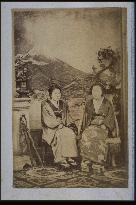
Two women wear wooden clogs with high supports. Both appear to be older geisha with hair arranged in inase-fu marumage style. They are sitting on chairs and wear kimono with black collars and haori coats. On the left, two umbrellas are leaning against the candle stand. Mt. Fuji is painted on the curtain hanging behind, and a European carpet is spread on the floor. This is a studio photograph.==Date:unknown, Place:unknown, Photo:unknown, (Credit:Nagasaki University Library/Kyodo News Images) [Cabinet Number55‐24‐6]

  •  
A woman wearing a hood of nobility

A woman wearing a hood of nobility

This is a scene of a woman holding a janome-gasa (bull's eye umbrella) on a snowy day. She is wearing a haori coat for an outing, a pair of wooden clogs with high supports, and a okoso-zukin (combination hood and veil). This was a graceful winter costume for women going outdoors.==Date:unknown, Place:unknown, Photo:unknown, (Credit:Nagasaki University Library/Kyodo News Images) [Cabinet Number51‐112‐0]

  •  
A woman holding a small model boat

A woman holding a small model boat

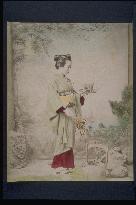
A young woman holds a wooden model ship in one hand and a branch in the other. The little ship may be a yakata-bune (banquet houseboat). The red juban (undergarment visible at the hem of her kimono and her wooden clogs catch the eye. This is a coloured photograph taken in a studio that probably provided the pail and flower pots as props.==Date:unknown, Place:unknown, Photo:unknown, (Credit:Nagasaki University Library/Kyodo News Images) [Cabinet Number51‐111‐0]

  •  
Women relaxing at a teahouse in a park

Women relaxing at a teahouse in a park

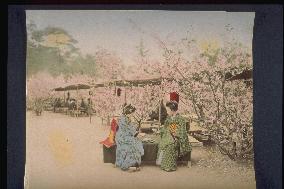
When spring comes many flower viewers visit places famous for cherry blossoms. Shops that serve tea or sweets are indispensable to these picnic resorts. Many people are visible. The woman on the left is wearing a kimono in furisode style with the sash hanging loosely and a pair of wooden clogs. The comb also has a flower design suited to the atmosphere of spring gaiety.==Date:unknown, Place:unknown, Photo:unknown, (Credit:Nagasaki University Library/Kyodo News Images) [Cabinet Number51‐73‐0]

  •  
A girl holding an umbrella and her attendant wearing a straw raincoat

A girl holding an umbrella and her attendant wearing a straw raincoat

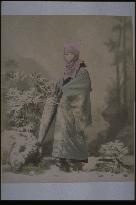
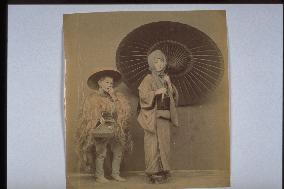
The woman is holding a janome (snake's eye) umbrella, so named because the centre of the umbrella looks like the eye of a snake. The attendant is barefoot and wearing a rattan shade and a straw raincoat. The woman is wearing a crepe scarf over her head and wooden clogs with high supports.==Date:unknown, Place:unknown, Photo:unknown, (Credit:Nagasaki University Library/Kyodo News Images) [Cabinet Number51‐65‐0]

  •  
A geta clog craftsman

A geta clog craftsman

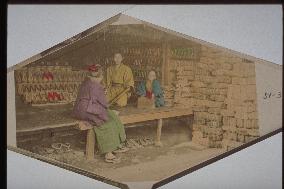
A customer is choosing footwear in a geta (wooden clogs) shop, with the shop owner and his apprentice on the right. Many clogs, straw sandals, and thongs are displayed on the shelves inside the shop. On the right side of the shop is a pile of raw materials used to make clogs.==Date:unknown, Place:unknown, Photo:unknown, (Credit:Nagasaki University Library/Kyodo News Images) [Cabinet Number51‐3‐0]

  •  
An oiran and a waitress

An oiran and a waitress

The oiran (courtesan) is accompanied by two young attendants called kamuro. They are wearing wooden clogs with high supports, typical footwear for courtesans.==Date:unknown, Place:unknown, Photo:unknown, (Credit:Nagasaki University Library/Kyodo News Images) [Cabinet Number49‐49‐0]

  •  
Girls holding dolls and fans

Girls holding dolls and fans

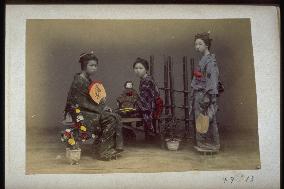
Girls enjoy the cool air of evening with close friends, wearing single-layer summer kimono and clogs with middle supports. The scene of people resting on a bench with fans exudes the poetic charm of summer.==Date:unknown, Place:unknown, Photo:unknown, (Credit:Nagasaki University Library/Kyodo News Images) [Cabinet Number49‐13‐0]

  •  
Parents and their daughter going out

Parents and their daughter going out

The girl holds a janomegasa umbrella and wears wooden clogs. She has a round face and large clear eyes. The mother seems to be a wealthy woman of the merchant class called a goshinzo-san. She looks neat and well dressed.==Date:unknown, Place:unknown, Photo:Tamamura Kozaburo, (Credit:Nagasaki University Library/Kyodo News Images) [Cabinet Number48‐44‐0]

  •  
A mother and her daughters

A mother and her daughters

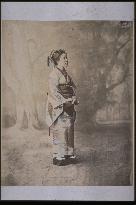
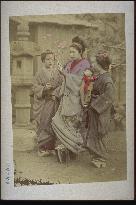
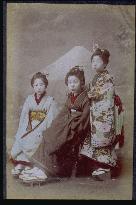
This is a studio photograph of three women, probably a mother and her two daughters. Mt. Fuji is painted on the curtain in the back. This is a typical coloured souvenir photograph produced for foreign visitors. The floral hairpins, sash tied in the darari-musubi style and wooden clogs were all popular among girls of the Meiji Period.==Date:unknown, Place:unknown, Photo:Tamamura Kozaburo, (Credit:Nagasaki University Library/Kyodo News Images) [Cabinet Number48‐34‐0]

  •  
A woman playing with a ball

A woman playing with a ball

A girl stoops to play with a ball. She is wearing a loosely-tied sash and bokkuri wooden clogs. The photograph skillfully captures the white hairpin in her gleaming black hair and her white hands bouncing the ball.==Date:unknown, Place:unknown, Photo:Tamamura Kozaburo, (Credit:Nagasaki University Library/Kyodo News Images) [Cabinet Number48‐31‐0]

  •  
Disciplinant blowing a trumpet shell

Disciplinant blowing a trumpet shell

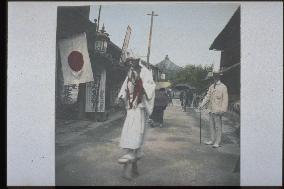
An ascetic wearing high geta clogs blows a triton while walking eastward on the old Hanaya-machi Street. A Caucasian man wearing white clothes is watching him with interest. This is the busy Nishihonganji Temple quarter with advertisements, lanterns, gas lights at shop fronts, and Buddhist accessory shops. The Kyozo (Sutra Repository) of Nishihonganji Temple is visible over Horikawa River through the foliage.==Date:unknown, Place:Kyoto, Photo:unknown, (Credit:Nagasaki University Library/Kyodo News Images) [Cabinet Number46‐112‐0]

  •  
A girl holding an umbrella

A girl holding an umbrella

A girl in a hood over her kimono wears high-heeled clogs and walks in the rain along a road. (Dramatized photo)==Date:unknown, Place:unknown, Photo:unknown, (Credit:Nagasaki University Library/Kyodo News Images) [Cabinet Number15‐25‐0]

  •  
A geta clog craftsman

A geta clog craftsman

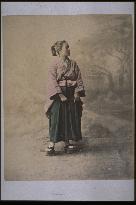
The geta (Japanese clogs) have a long history, going back to the Yayoi era. But they became widely popular only in the Edo era. During the reign of the Shogun Yoshimune, the sanmaiba geta became the footwear for prostitutes. Red high-heeled pokkuri (sandals) became a trend among young girls, and geta became an important fashion item. When Japanese women dressed mainly in kimono, geta craftsmen had a variety of geta in their shops.==Date:unknown, Place:unknown, Photo:unknown, (Credit:Nagasaki University Library/Kyodo News Images) [Cabinet Number15‐5‐0]

  •  
Girl cleaning a garden

Girl cleaning a garden

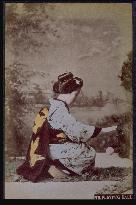
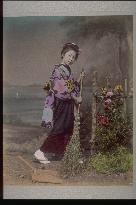
A girl wearing clogs sweeps the garden clean with a bamboo broom. A wooden dustpan is placed by her foot. A chrysanthemum fence stands to the right of the girl.==Date:unknown, Place:unknown, Photo:Ogawa Kazumasa, (Credit:Nagasaki University Library/Kyodo News Images) [Cabinet Number10‐49‐0]

  • Main
  • Top
  • Editorial
  • Creative
  • About Us
  • About ILG
  • Terms of use
  • Company
  • BEHIND
  • Price List
  • Single Plan
  • Monthly Plan
  • Services
  • Shooting
  • Rights Clearance
  • Support
  • FAQ
  • How To Buy
  • Contact Us
  • Become a Partner

© KYODO NEWS IMAGES INC

All Rights Reserved.

  • Editorial
  • Olympics
  • News
  • Sports
  • Japan
  • Tech
  • Royal
  • Disaster
  • NorthKorea
  • Old Japan
  • SNS
  • Creative
  • Food
  • Japan
  • Landscape
  • Animal
  • Popular
  • #Ukraine
  • #China
  • #coronavirus
  • #N. Korea
  • #Thailand
  • #Russia
  • #Ukraine
  • #China
  • #coronavirus
  • #N. Korea
  • #Thailand
  • #Russia
  • Food
  • Japan
  • Landscape
  • Animal
  • Olympics
  • News
  • Sports
  • Japan
  • Tech
  • Royal
  • Disaster
  • NorthKorea
  • Old Japan
  • SNS