•  
Miyanoshita naraya inn

Miyanoshita naraya inn

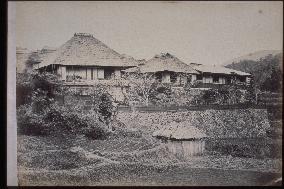
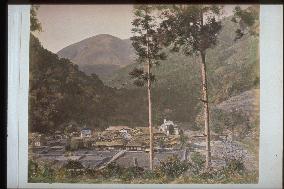
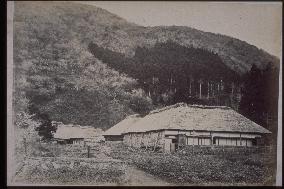
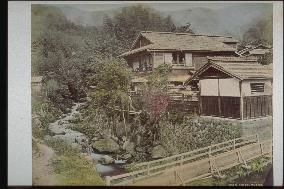
A Japanese building of the Naraya Hotel in Miyanoshita. This coincides with the information book of the seven spas. It was destroyed in the fire of 1884. This is an important photo because few pictures taken before that time remain. Emperor Meiji stayed at this hotel in 1874.==Date:unknown, Place:Hakone, Photo:unknown, (Credit:Nagasaki University Library/Kyodo News Images) [Cabinet Number19‐43‐0]

  •  
An inn in Nikko

An inn in Nikko

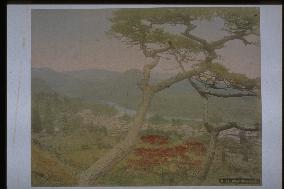
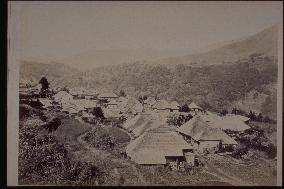
Higashi-machi (Hatsuishi-machi, Miyuki-machi, Inari-machi, Ishiya-machi) is viewed from the summit of the mountain to the south of Nikko-machi. The woods to the left centre is the Sannai area, where there are shrines and temples, such as Toshogu. The small mountain in the centre is Toyama. The Daiya and Inari Rivers meet at the foot of the mountain.==Date:unknown, Place:Nikko, Photo:unknown, (Credit:Nagasaki University Library/Kyodo News Images) [Cabinet Number88‐19‐0]

  •  
The Hakone post town

The Hakone post town

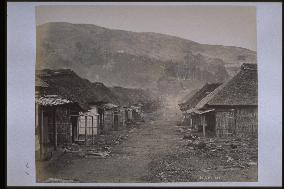
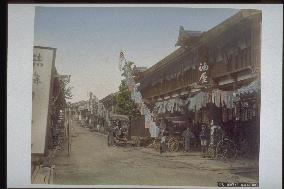
According to the sign of the house on the right, it is Hatago (inn) Yorozuya Chozaemon at Odawara-cho in the post town of Hakone when facing Mishima-cho. The street in the centre is Tokaido Highway. A few people are visible afar. There are photos with many people with the same layout. This was probably taken in autumn of 1871 and the telegraph pole established in 1873 between Tokyo and Nagasaki cannot be seen yet.==Date:unknown, Place:Hakone, Photo:R. Stillfried, (Credit:Nagasaki University Library/Kyodo News Images) [Cabinet Number78‐8‐0]

  •  
The Hakone post town

The Hakone post town

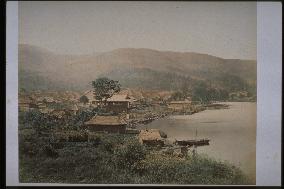
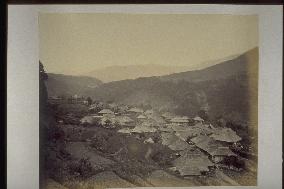
This photo depicts the post town of Hakone viewed from around the old Hakone check point site. The two-storied house behind the tree in the centre is Hatago Hafuya (present-day Hokone Hotel), an inn for commoners. The huge thatched roofed houses behind are, Kawada Honjin, an officially appointed inn for feudal lords, Koma Honjin, Ishiuchi Honjin, and Amano Heizaemon Honjin. Compared to catalogue # 2945, the backyards of honjins appear to be sticking out to Lake Ashinoko. The mountain behind on the left is Mt. Kurakake and the one in the centre is Hakone Pass.==Date:unknown, Place:Hakone, Photo:unknown, (Credit:Nagasaki University Library/Kyodo News Images) [Cabinet Number64‐46‐0]

  •  
Yumoto Spa

Yumoto Spa

A photo of Yumoto spa. The western building amidst the trees is the Fukujuro Kinsenro built in 1878. In the Kanagawa prefecture Hakone Electric Generations published in 1895, the tower of the western building cannot be seen, so this photo must be taken before that.==Date:unknown, Place:Hakone, Photo:Suzuki Shin-ichi, (Credit:Nagasaki University Library/Kyodo News Images) [Cabinet Number41‐9‐0]

  •  
Inns at Nakasendo Oiwake

Inns at Nakasendo Oiwake

Could be the eastern edge of Oiwake juku, over the Shojin Bridge and a little further onwards. Aburaya can be seen to the right, but this hotel prospered even when Oiwake became rather bleak during the Meiji and Taisho eras. The fact that many novelists such as Hori Tatsuo stayed there is famous.==Date:unknown, Place:Nagano, Photo:Kusakabe Kinbei, (Credit:Nagasaki University Library/Kyodo News Images) [Cabinet Number38‐49‐0]

  •  
Miyanoshita village

Miyanoshita village

The Naraya Hotel can be seen, but not the Fujiya Hotel, so this photo was taken before 1877. Miyanoshita was a spa from the old days, with inns such as Fujiya, Naraya and Yamadaya and was famous for the stone bath of the Taiko in Sokokura. Baelz and Chamberlain also enjoyed the scenery.==Date:unknown, Place:Hakone, Photo:F. Beato, (Credit:Nagasaki University Library/Kyodo News Images) [Cabinet Number36‐6‐0]

  •  
The Hakone post town

The Hakone post town

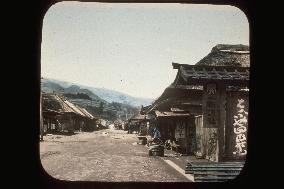
A photo of the middle level of Odawara city in Hakonejuku. The panel at the right corner is that of the hotel, Hafuya Shiroemon. Hafuya is the predecessor of the present Hakone Hotel, which is now owned by the Fujiya Hotel. A person rests among the tobacco signs.==Date:unknown, Place:Hakone, Photo:unknown, (Credit:Nagasaki University Library/Kyodo News Images) [Cabinet Number31‐72‐0]

  •  
Tonosawa Spa

Tonosawa Spa

A photo of Sawa Spa with Chitose Bridge over Haya River at the centre. To the left of the bridge is the Gyokusendo (presently the Shin Tamanoyu), to the right is Tamanoyu (presently Fukujuro in Tonosawa), and to the rear is Ichinoyu, Suzuki (presently Kansuiro), Fujiya and the former Fukujuro etc.==Date:unknown, Place:Hakone, Photo:unknown, (Credit:Nagasaki University Library/Kyodo News Images) [Cabinet Number31‐25‐0]

  •  
Ashinoyu hot spring

Ashinoyu hot spring

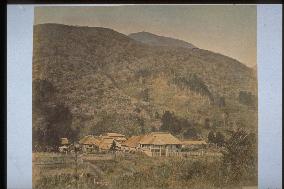
An overall view of the Ashinoyu Spa. The centre is the inn Matsuzakaya. To its right is Yoshidaya. To the left rear is Kinokuniya, and to the front of Kinokuniya is Iseya, to the left is Kameya, and the farthest left is probably Daikokuya. Compared to the photo numbered 5-18, there are fewer houses, so it must be a photo taken before that.==Date:unknown, Place:Hakone, Photo:unknown, (Credit:Nagasaki University Library/Kyodo News Images) [Cabinet Number26‐30‐0]

  •  
Ashinoyu hot spring

Ashinoyu hot spring

The building on the right is Matsuzakaya, and in the centre is Kinokuniya. Ashino Spa was destroyed by fire directly after this photo was taken in 1872, so this is a rare photo that captures the scenery before that time. It is also seen in The Far East vol. 2-15.==Date:unknown, Place:Hakone, Photo:unknown, (Credit:Nagasaki University Library/Kyodo News Images) [Cabinet Number19‐45‐0]

  •  
Miyanoshita Spa

Miyanoshita Spa

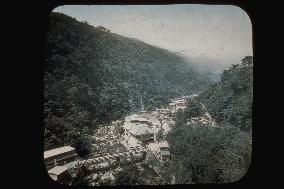
A view of Miyanoshita Hot Springs in the autumn of 1872. In the right background is the Japanese-style Naraya Hotel, where many foreigners stayed there from the early days. There were still no wide roads where rickshaws could pass, so travelers had to rely on palanquins. The mountain to the right is Myojodake.==Date:unknown, Place:Hakone, Photo:unknown, (Credit:Nagasaki University Library/Kyodo News Images) [Cabinet Number19‐37‐0]

  •  
OYAMA

OYAMA

The caption reads View of Oyama in English, This is an entrance for mountain climbers near the Oyamadera in Mt. Amefuri of the Tanzawa range. This temple is for spiritual training, and many people worshipped at the temple. A town developed at the foot of the mountain, and many pilgrim's lodgings were built.==Date:unknown, Place:Kanagawa, Photo:Ogawa Kazumasa, (Credit:Nagasaki University Library/Kyodo News Images) [Cabinet Number7‐17‐0]

  • Main
  • Top
  • Editorial
  • Creative
  • About Us
  • About ILG
  • Terms of use
  • Company
  • BEHIND
  • Price List
  • Single Plan
  • Monthly Plan
  • Services
  • Shooting
  • Rights Clearance
  • Support
  • FAQ
  • How To Buy
  • Contact Us
  • Become a Partner

© KYODO NEWS IMAGES INC

All Rights Reserved.

  • Editorial
  • Olympics
  • News
  • Sports
  • Japan
  • Tech
  • Royal
  • Disaster
  • NorthKorea
  • Old Japan
  • SNS
  • Creative
  • Food
  • Japan
  • Landscape
  • Animal
  • Popular
  • #Ukraine
  • #China
  • #coronavirus
  • #N. Korea
  • #Thailand
  • #Russia
  • #Ukraine
  • #China
  • #coronavirus
  • #N. Korea
  • #Thailand
  • #Russia
  • Food
  • Japan
  • Landscape
  • Animal
  • Olympics
  • News
  • Sports
  • Japan
  • Tech
  • Royal
  • Disaster
  • NorthKorea
  • Old Japan
  • SNS