•  
Rice planting

Rice planting

Seven men and women stand in a line to plant rice. The second from left and far right are women, wearing towels in anesama style with their kimono sleeves tucked with cords. The men wear towels over their heads, tied at the nose or sashes tied around the forehead. On the other side of the paddy field is a man wearing a straw hat and carrying a balancing pole with the seedlings, watching the planting.==Date:unknown, Place:unknown, Photo:Kusakabe Kinbei, (Credit:Nagasaki University Library/Kyodo News Images) [Cabinet Number2‐44‐0]

  •  
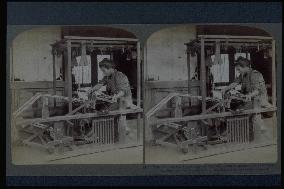
Weaving at a farmer's house

Weaving at a farmer's house

The weaving device is a tall model. The women are barefoot and have their kimono sleeves pulled up with cords. The tattered shoji screens suggest that this is a weaving room. The English caption indicates that these are farmers' wives weaving cotton cloth.==Date:1904, Place:unknown, Photo:Underwood, (Credit:Nagasaki University Library/Kyodo News Images) [Cabinet Number97‐52‐0]

  •  
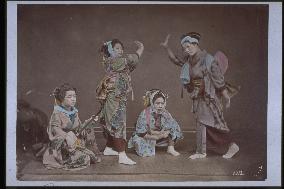
Dancing women

Dancing women

All of the dancers and musicians wear head towels. The dancers have the sleeves of their kimono pulled up with cords. The woman on the right has a fan inserted in the sash at her back. This is a scene of dancing at a festival.==Date:unknown, Place:unknown, Photo:Usui Shuzaburo, (Credit:Nagasaki University Library/Kyodo News Images) [Cabinet Number94‐18‐0]

  •  
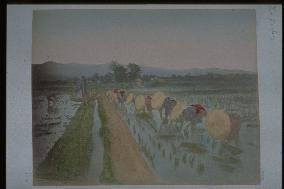
Rice planting

Rice planting

Women wear bamboo hats and kimono with sleeves pulled up with cords. This may be a religious rite performed in a rice paddy belonging to a Shinto shrine. The rice planting has been finished in the area behind the women. This scene was probably staged for the camera.==Date:unknown, Place:unknown, Photo:unknown, (Credit:Nagasaki University Library/Kyodo News Images) [Cabinet Number83‐15‐0]

  •  
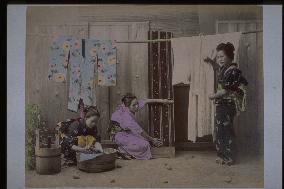
Women washing clothes

Women washing clothes

Kimono are being dried on bamboo poles. People aired clothes and books in the sun, in places where a breeze blows on a sunny non-humid day to prevent moisture, dust, and insects from damaging the items. The girl in the centre is doing araihari (explained in #2353). The girls all have their sleeves pulled up with cords.==Date:unknown, Place:unknown, Photo:A. Farsari, (Credit:Nagasaki University Library/Kyodo News Images) [Cabinet Number81‐40‐0]

  •  
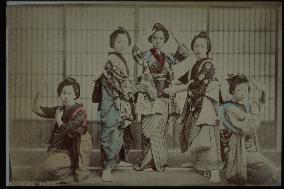
Girls doing teodori dance

Girls doing teodori dance

Five young women take a dancing pose. They appear to be apprentice maiko dancers. Every woman except the one on the right has the upper part of her kimono off. The sleeves of the undergarments are pulled up with cords.==Date:unknown, Place:unknown, Photo:unknown, (Credit:Nagasaki University Library/Kyodo News Images) [Cabinet Number69‐52‐0]

  •  
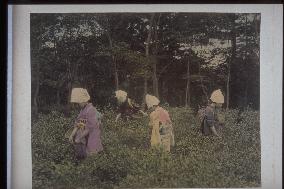
Tea picking

Tea picking

Women are picking tea leaves. They have cloths on their heads and their sleeves pulled up with cords. The kimono and sashes suggest that they are daughters of well-to-do-families working as apprentices. Each woman is picking randomly, and there are no furrows in the field. It is likely not a real setting.==Date:unknown, Place:unknown, Photo:unknown, (Credit:Nagasaki University Library/Kyodo News Images) [Cabinet Number51‐100‐0]

  •  
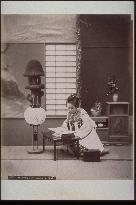
A dancer reading a book

A dancer reading a book

The woman reading a book is wearing a winter coat with the collar folded back and tied with cords. There is a lantern in front of the desk to provide light.==Date:unknown, Place:unknown, Photo:unknown, (Credit:Nagasaki University Library/Kyodo News Images) [Cabinet Number51‐59‐0]

  •  
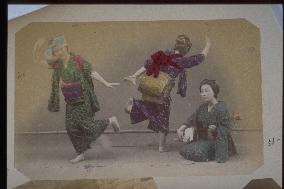
Women performing ozashiki dance

Women performing ozashiki dance

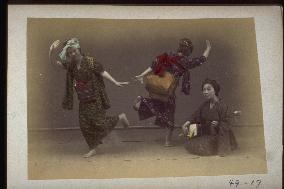
One woman is wearing a hachimaki (head towel). Three women are dancing to the music of a shamisen (three-stringed lute), their sleeves tied up with cords and their legs lifted high. This is a playful, not traditional and refined, dance.==Date:unknown, Place:unknown, Photo:unknown, (Credit:Nagasaki University Library/Kyodo News Images) [Cabinet Number51‐2‐0]

  •  
Women performing ozashiki dance

Women performing ozashiki dance

One woman is wearing a hachimaki (head towel). Three women are dancing to the music of a shamisen (three-stringed lute), their sleeves tied up with cords and their legs lifted high. This is a playful, not traditional and refined, dance.==Date:unknown, Place:unknown, Photo:unknown, (Credit:Nagasaki University Library/Kyodo News Images) [Cabinet Number49‐17‐0]

  •  
Rice planting

Rice planting

Seven men and women stand in a line to plant rice. The second from left and far right are women, wearing towels in anesama style with their kimono sleeves tucked with cords. The men wear towels over their heads, tied at the nose or sashes tied around the forehead. On the other side of the paddy field is a man wearing a straw hat and carrying a balancing pole with the seedlings, watching the planting.==Date:unknown, Place:unknown, Photo:Kusakabe Kinbei, (Credit:Nagasaki University Library/Kyodo News Images) [Cabinet Number40‐46‐0]

  •  
Landlady carrying dishes

Landlady carrying dishes

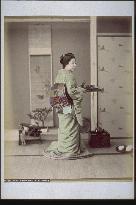
A woman with her back to the camera carries a large dish of food on a tray. A scroll hangs in the alcove in the rear, together with a bonsai pot and hand drum. On the tatami mats are shimedaiko (a tunable drum with the skin attached to the tuner with cords) and a brazier with a kettle on it. A pot and cups placed on a tray can also be seen.==Date:unknown, Place:unknown, Photo:Ogawa Kazumasa, (Credit:Nagasaki University Library/Kyodo News Images) [Cabinet Number6‐47‐0]

  •  
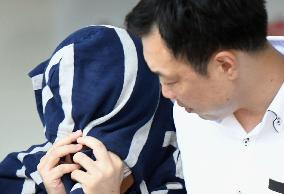
Dealer charged with illegal blood handling sent to prosecutors

Dealer charged with illegal blood handling sent to prosecutors

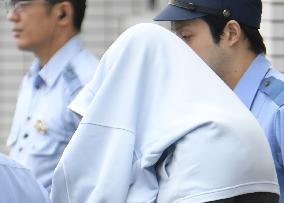
Tsuneo Shinozaki, who heads a cord blood sales company in Tsukuba, northeast of Tokyo, has his face covered in Matsuyama, western Japan, on Aug. 28, 2017, as he is referred by police to prosecutors for his allegedly illegal handling of blood from umbilical cords and placenta. (Kyodo) ==Kyodo

  •  
Police arrest 6 suspects over unauthorized therapy using cord blood

Police arrest 6 suspects over unauthorized therapy using cord blood

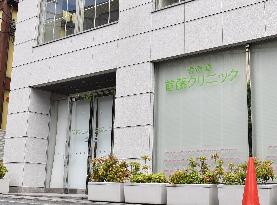
Photo taken Aug. 27, 2017, shows Tokyo's Omotesando Shuto Clinic, run by Shinsuke Shuto, who is among six people arrested the same day on suspicion of involvement in unauthorized stem cell therapies using blood collected from umbilical cords and placenta after childbirth. Shuto allegedly administered cord blood to patients between July 2016 and April 2017 without reporting the treatment to the government. (Kyodo) ==Kyodo

  •  
Police arrest 6 suspects over unauthorized therapy using cord blood

Police arrest 6 suspects over unauthorized therapy using cord blood

Shinsuke Shuto (L) is seen at Matsuyama airport, western Japan, on Aug. 27, 2017, after being arrested on suspicion of involvement in unauthorized stem cell therapies using blood collected from umbilical cords and placenta after childbirth. Shuto is one of six people arrested the same day across Japan for suspected involvement in such therapies. (Kyodo) ==Kyodo

  • Main
  • Top
  • Editorial
  • Creative
  • About Us
  • About ILG
  • Terms of use
  • Company
  • BEHIND
  • Price List
  • Single Plan
  • Monthly Plan
  • Services
  • Shooting
  • Rights Clearance
  • Support
  • FAQ
  • How To Buy
  • Contact Us
  • Become a Partner

© KYODO NEWS IMAGES INC

All Rights Reserved.

  • Editorial
  • Olympics
  • News
  • Sports
  • Japan
  • Tech
  • Royal
  • Disaster
  • NorthKorea
  • Old Japan
  • SNS
  • Creative
  • Food
  • Japan
  • Landscape
  • Animal
  • Popular
  • #Ukraine
  • #China
  • #coronavirus
  • #N. Korea
  • #Thailand
  • #Russia
  • #Ukraine
  • #China
  • #coronavirus
  • #N. Korea
  • #Thailand
  • #Russia
  • Food
  • Japan
  • Landscape
  • Animal
  • Olympics
  • News
  • Sports
  • Japan
  • Tech
  • Royal
  • Disaster
  • NorthKorea
  • Old Japan
  • SNS