•  
Hamamatsu to host mascot character contest in 2015

Hamamatsu to host mascot character contest in 2015

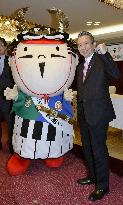
TOKYO, Japan - Mascot character Shusse Daimyo Ieyasu-kun of Hamamatsu (L) in Shizuoka Prefecture poses with Mayor Yasutomo Suzuki at a press conference held in Tokyo on Jan. 14, 2015, to announce the selection of the central Japan city as host of the 2015 national contest for mascot characters in November.

  •  
Hamamatsu to host 2015 national mascot character contest

Hamamatsu to host 2015 national mascot character contest

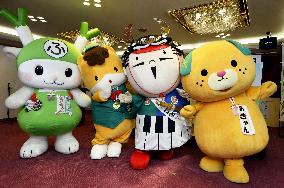
TOKYO, Japan - Shusse Daimyo Ieyasu-kun (2nd from R), a mascot character of Hamamatsu in Shizuoka Prefecture, central Japan, likened to feudal warlord Tokugawa Ieyasu, poses in Tokyo on Jan. 14, 2015, with the winners of the previous year's national mascot contest. Hamamatsu was selected the same day to host the 2015 contest.

  •  
19th-century daimyo mansion model found in Vienna

19th-century daimyo mansion model found in Vienna

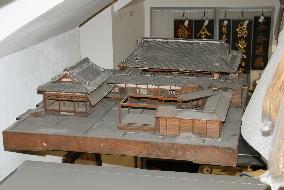
VIENNA, Austria - Photo shows a 19th-century scale model of the mansion of a Japanese daimyo feudal lord at the Museum of Ethnology in Vienna on Feb. 11, 2013. At center in the front is a ''noh'' performance stage. The wooden model, which was sent by the government of Meiji era Japan for the fifth world exposition held in Vienna in 1873 and found at the museum's depot in 1995, will be repaired as a major exhibit at the museum from around 2016.

  •  
19th-century daimyo mansion model found in Vienna

19th-century daimyo mansion model found in Vienna

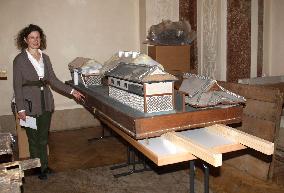
VIENNA, Austria - Bettina Zorn, head of the East Asian Collections at the Museum of Ethnology in Vienna, explains a 19th-century scale model of the mansion of a Japanese daimyo feudal lord at the museum on Feb. 11, 2013. The wooden model, which was sent by the government of Meiji era Japan for the fifth world exposition held in Vienna in 1873 and found at the museum's depot in 1995 by Zorn, will be repaired as a major exhibit at the museum from around 2016.

  •  
19th-century daimyo mansion model found in Vienna

19th-century daimyo mansion model found in Vienna

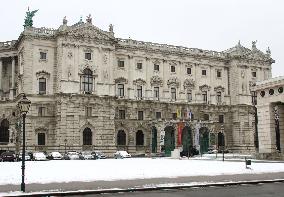
VIENNA, Austria - Photo shows the Museum of Ethnology in Vienna on Feb. 11, 2013. A 19th-century scale model of the mansion of a Japanese daimyo feudal lord, which was sent by the government of Meiji era Japan for the fifth world exposition held in Vienna in 1873, was found at the museum's depot in 1995. The wooden model will be repaired as a major exhibit at the museum from around 2016.

  •  
Samurai warriors festival

Samurai warriors festival

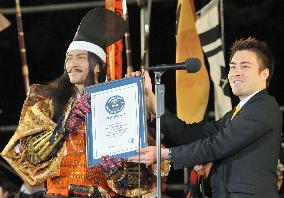
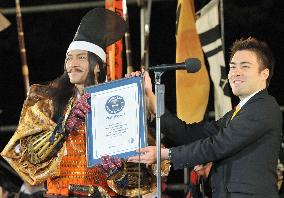
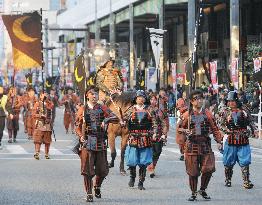
KOFU, Japan - Actor Ikki Sawamura (L), dressed as Takeda Shingen, a 16th century daimyo (feudal lord), receives a Guinness World Records certificate in Kofu, Yamanashi Prefecture, on April 7, 2012. A total of 1,061 people dressed as feudal-era samurai warriors took part in the Shingen-ko (Lord Shingen) festival that day. The event was listed in the Guinness Book of World Records as the largest-ever gathering of samurai.

  •  
Samurai warriors festival

Samurai warriors festival

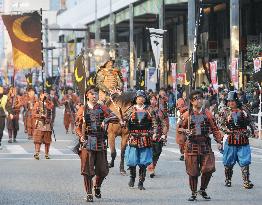
KOFU, Japan - A total of 1,061 people clad as feudal-era samurai warriors march along a road during the Shingen-ko (Lord Shingen) festival in Kofu, Yamanashi Prefecture, on April 7, 2012. The event to honor Takeda Shingen, a 16th century daimyo (feudal lord), was listed in the Guinness Book of World Records as the largest-ever gathering of samurai.

  •  
2 men fall to deaths from overhead Fukuoka parking lot

2 men fall to deaths from overhead Fukuoka parking lot

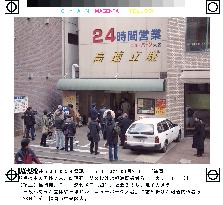
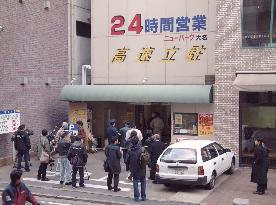
FUKUOKA, Japan - Two men examining a lift to move vehicles in overhead parking lot New Park Daimyo (in the photo) in downtown Fukuoka, southwestern Japan, fell to their deaths from the parking lot Jan. 28.

  •  
16th century medal unearthed from ruins in southwestern Japan

16th century medal unearthed from ruins in southwestern Japan

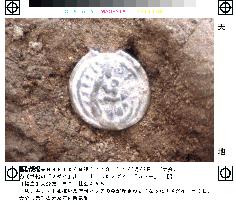
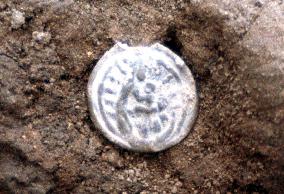
OITA, Japan - Photo taken Aug. 3 shows a medal believed to be worn by a Christian in the 16th century. It has been unearthed from ruins in Oita Prefecture of a house occupied by Otomo Sorin (1530-1587), a Christian daimyo or feudal lord who welcomed Christianity. It is the second of its kind to be found in Japan.

  •  
Bronze statue of Havana's 1st Japanese envoy unveiled

Bronze statue of Havana's 1st Japanese envoy unveiled

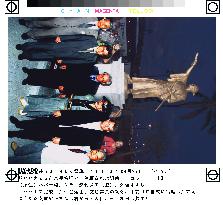
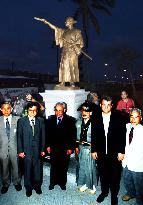
HAVANA, Cuba - A bronze statue of Japan's first official envoy to visit what is now Cuba in 1614, while on his way to Europe on a mission with a Japanese delegation, is unveiled at a park in Havana on April 26. The 1.6-meter statue was erected in memory of Hasekura Tsunenaga (1571-1622), a retainer of Date Masamune, a ''daimyo'' or feudal lord of Sendai in northeastern Japan. Standing in samurai attire (3rd from R) is Norimasa Hasekura, 60, Tsunenaga's descendant.

  •  
Christian daimyo Takayama's statuette moves to Manila

Christian daimyo Takayama's statuette moves to Manila

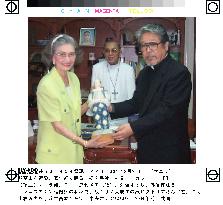
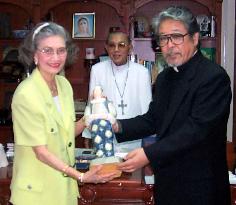
MANILA, Philippines - Japanese priest Toru Nishimoto (R) presents a statuett of Takayama Ukon, a Christian daimyo exiled to the Philippines, to Victoria Quirino Delgado, daughter of former President Elpidio Quirino. Standing at the center is Manila Archbishop Jaime Cardinal Sin. Nishimoto said the statuette was meant to express the Japanese people's gratitude to the late president and friendship with the Filipino people.

  •  
2 men fall to deaths from overhead Fukuoka parking lot

2 men fall to deaths from overhead Fukuoka parking lot

FUKUOKA, Japan - Two men examining a lift to move vehicles in overhead parking lot New Park Daimyo (in the photo) in downtown Fukuoka, southwestern Japan, fell to their deaths from the parking lot Jan. 28.

  •  
Bronze statue of Havana's 1st Japanese envoy unveiled

Bronze statue of Havana's 1st Japanese envoy unveiled

HAVANA, Cuba - A bronze statue of Japan's first official envoy to visit what is now Cuba in 1614, while on his way to Europe on a mission with a Japanese delegation, is unveiled at a park in Havana on April 26. The 1.6-meter statue was erected in memory of Hasekura Tsunenaga (1571-1622), a retainer of Date Masamune, a ''daimyo'' or feudal lord of Sendai in northeastern Japan. Standing in samurai attire (3rd from R) is Norimasa Hasekura, 60, Tsunenaga's descendant.

  •  
Takeda Shingen (1521-1573) - Military Leader

Takeda Shingen (1521-1573) - Military Leader

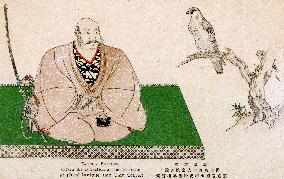
Takeda Shingen (1521-1573) - a pre-eminent daimyo in feudal Japan with exceptional military prestige in the late stage of the Sengoku period. Date: circa 1570

  •  
Hiroshima Castle, Hiroshima, Japan

Hiroshima Castle, Hiroshima, Japan

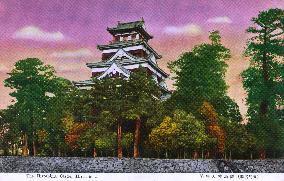
Hiroshima Castle (Carp Castle), Japan - home of the daimyo (feudal lord) of the Hiroshima han (fief). Constructed in the 1590s, but destroyed by the atomic bombing on 6th August 1945. Rebuilt in 1958, and now serving as a museum of Hiroshima's history prior to World War II. Date: circa 1910s

  •  
Counting compensation money for murder of Mr Richardson

Counting compensation money for murder of Mr Richardson

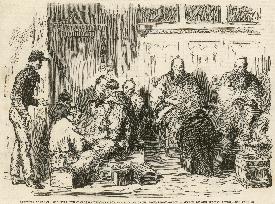
Sketches in Japan: Counting the compensation money for the murder of Mr Richardson. Charles Lennox Richardson was a Yokohama based merchant who was killed by a large armed retinue of Shimazu Hisamitsu, the regent and father of Shimazu Tadayoshi, the daimyo of Satsuma. The Namamugi Incident, (also known sometimes as the Kanagawa Incident, and as the Richardson Affair) was a samurai assault on foreign nationals in Japan on September 14, 1862, which resulted in the August 1863 bombardment of Kagoshima, during the Late Tokugawa shogunate. In Japanese the bombardment is described as a war between the United Kingdom and Satsuma domain, the Anglo-Satsuma War. The picture shows the Japanese paying out compensation in the aftermath of the war. Date: 1863

  •  
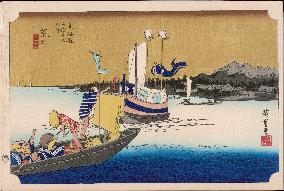
Hiroshige - 53 Stations of the Tokaido - Print 32

Hiroshige - 53 Stations of the Tokaido - Print 32

32 Arai - A large ferry boat, with an awning round it, taking a daimyo across from Maisaka, followed by a smaller boat with his retainers. A high range of hills on the further shore; golden sky. Travellers made the journey from Maisaka to Arai Station by ferryboat. On the shore was a government barrier station for the inspection of travellers. The compound remains largely intact even today. Utagawa Hiroshige (1797 - 1858). The Fifty-Three Stations of the Tokaido - Hoeido edition (1831-4) Date: 1831 - 1834

  •  
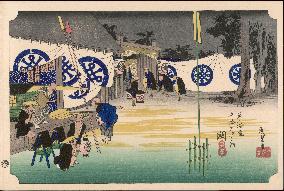
Hiroshige - 53 Stations of the Tokaido - Print 48

Hiroshige - 53 Stations of the Tokaido - Print 48

48 Seki - View outside a resthouse in the early morning, where a daimyo is stopping, the retainers preparing, by the aid of lanterns, to proceed on the journey. Each station was required to maintain lodging houses for travellers. The inn shown is one for upper class travellers such as Shogunate officials and feudal lords. Retinue are making preparations for a feudal lord to leave from the lodging house. Utagawa Hiroshige (1797 - 1858). The Fifty-Three Stations of the Tokaido - Hoeido edition (1831-4) Date: 1831 - 1834

  •  
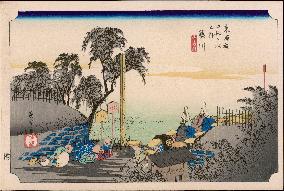
Hiroshige - 53 Stations of the Tokaido - Print 38

Hiroshige - 53 Stations of the Tokaido - Print 38

38 Fujikawa - The head of a daimyo's procession at the entrance to a village, and three peasants making obeisance as it passes. The most frequent user of the highway was the feudal lord with his retinue. Commoners who came across the procession had to kneel down on the ground to pay their respects and stay there until the procession had passed. Utagawa Hiroshige (1797 - 1858). The Fifty-Three Stations of the Tokaido - Hoeido edition (1831-4) Date: 1831 - 1834

  •  
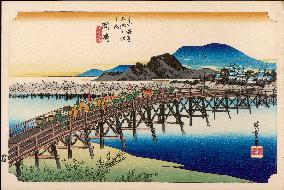
Hiroshige - 53 Stations of the Tokaido - Print 39

Hiroshige - 53 Stations of the Tokaido - Print 39

39 Okazaki - A daimyo's cort觥 crossing the bridge over the Yahagi River towards the village and castle on the further bank; in the background a blue hill, printed from colour blocks only. Tokugawa Ieyasu, the founder of the Tokugawa Shogunate, was born in the castle shown in the prints. The bridge over the Yahagi River, flowing west of the castle, was the largest on the entire highway. Utagawa Hiroshige (1797 - 1858). The Fifty-Three Stations of the Tokaido - Hoeido edition (1831-4) Date: 1831 - 1834

  •  
Hiroshige - 53 Stations of the Tokaido - Print 33

Hiroshige - 53 Stations of the Tokaido - Print 33

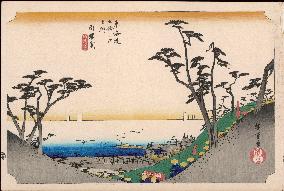
33 Shirasuka - View out to sea through a dip in the hill, at the foot of which a daimyo's procession is passing; clumps of trees to right and left. The view of the seascape from Shiomizaka Slope near this station was one of the most picturesque of all the fifty-three stations, with the blue Pacific Ocean framed by outreaching branches of pine trees. A long procession of a feudal lord descends the hill towards Shirasuka Station.Utagawa Hiroshige (1797 - 1858). The Fifty-Three Stations of the Tokaido - Hoeido edition (1831-4) Date: 1831 - 1834

  •  
Hiroshige - 53 Stations of the Tokaido - Print 11

Hiroshige - 53 Stations of the Tokaido - Print 11

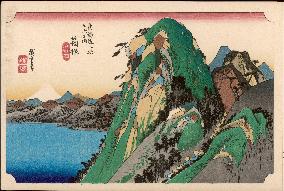
11 Hakone - A high peak, round the base of which, through a gorge, a daimyo's cort觥 is wending it's way; on the left the Hakone Lake, with Fuji in the distance. The Hakone pass was the most arduous stretch of the entire Tokaido Highway. It was steep and difficult to climb, and harboured many roaming bandits. However, the pass abounded in scenic spots and hot spring resorts and continues to attact many visitors.Utagawa Hiroshige (1797 - 1858). The Fifty-Three Stations of the Tokaido - Hoeido edition (1831-4) Date: 1831 - 1834

  •  
Hiroshige - 53 Stations of the Tokaido - Print 10

Hiroshige - 53 Stations of the Tokaido - Print 10

10 Odawara - A daimyo's cort觥 being carried across the River Sakawa; the background a mass of high, jagged hills, the most distant printed from colour-blocks only. This station flourished in its position at the entrance to Hakone pass, the most arduous part of the highway. Utagawa Hiroshige (1797 - 1858). The Fifty-Three Stations of the Tokaido - Hoeido edition (1831-4) Date: 1831 - 1834

  •  
Hiroshige - 53 Stations of the Tokaido - Print 1

Hiroshige - 53 Stations of the Tokaido - Print 1

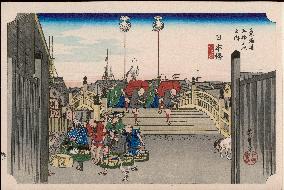
1 Nihonbashi - View looking across Nihon Bridge, Edo, from whence all distances were measured with a daimyo's cort觥 coming into view over the summit. In the foreground is a group of five fish-vendors (and a sixth partly hidden) getting out of the way, on the left, and two dogs on the right. This bridge was located in the centre of Edo and was the starting point of the Tokaido Highway. Utagawa Hiroshige (1797 - 1858). The Fifty-Three Stations of the Tokaido - Hoeido edition (1831-4) Date: 1831 - 1834

  •  
Hiroshige - 53 Stations of the Tokaido - Print 2

Hiroshige - 53 Stations of the Tokaido - Print 2

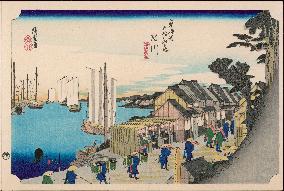
2 Shinagawa - A street of houses backing on to the seashore, and the tail-end of a daimyo's procession passing along it; behind the houses ships moored in the bay. Being the first station on the highway, Shinagawa was thronged with travellers coming and going. The road was lined with many teahouses, restaurants and entertainment quarters. The bay, seen in Hiroshige's picture, has been reclaimed and now forms a part of Tokyo. Utagawa Hiroshige (1797 - 1858). The Fifty-Three Stations of the Tokaido - Hoeido edition (1831-4) Date: 1831 - 1834

  •  
Hiroshige - 53 Stations of the Tokaido - Print 25

Hiroshige - 53 Stations of the Tokaido - Print 25

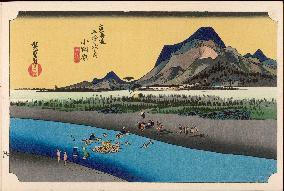
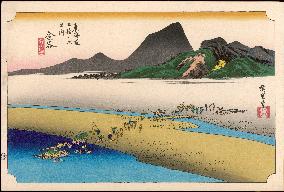
25 Kanaya - Beyond the wide sandy flats of the river, across which a daimyo's cort觥 is being carried, rises a jumble of foot hills, in a crevice of which nestles a village. In the background a high range of curiously hump-shaped mountains, printed in graded black from colour-blocks only; golden sky at the top. A panoramic view of the landscape accentuates the expansive flat plain of the dry river bed. A variety of travellers attempt to wade across the river with the help of porters. Utagawa Hiroshige (1797 - 1858). The Fifty-Three Stations of the Tokaido - Hoeido edition (1831-4) Date: 1831 - 1834

  •  
Daimyo street near west gate of imperial palace

Daimyo street near west gate of imperial palace

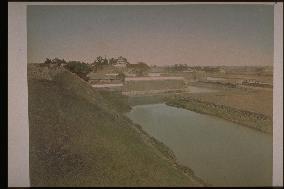
A residence of a daimyo (lord) can be seen across the moat. There were three kinds of residences for daimyo in Edo: the Kami Yashiki, Naka Yashiki and Shimo Yashiki. The residence adjoining Edo castle is a Kami Yashiki.==Date:unknown, Place:Tokyo, Photo:Kusakabe Kinbei, (Credit:Nagasaki University Library/Kyodo News Images) [Cabinet Number4‐8‐0]

  •  
Daimyo Gyoretsu (a feudal lord's procession) and spectators

Daimyo Gyoretsu (a feudal lord's procession) and spectators

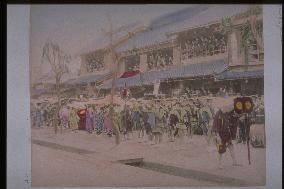
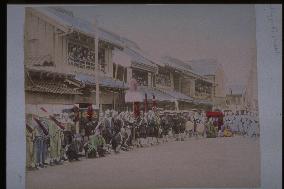
Daimyo Gyoretsu (a feudal lord's procession) and spectators==Date:unknown, Place:unknown, Photo:unknown, (Credit:Nagasaki University Library/Kyodo News Images)

  •  
Daimyo Gyoretsu (a feudal lord's procession) and spectators

Daimyo Gyoretsu (a feudal lord's procession) and spectators

Daimyo Gyoretsu (a feudal lord's procession) and spectators==Date:unknown, Place:unknown, Photo:unknown, (Credit:Nagasaki University Library/Kyodo News Images)

  •  
Lake Ashi

Lake Ashi

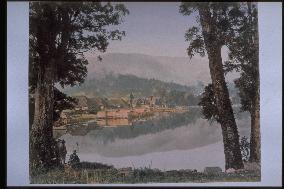
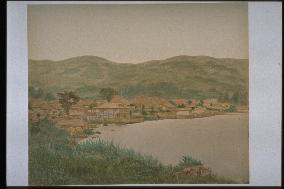
This is the post town of Hakone as seen from what was once the Hakone barrier station. The buildings on the banks of Lake Ashinoko are part of the thatched roofed building complex, the honjin. The large structures with thatched roofs to the right are officially appointed inns (Honjin). Feudal lords stayed or rested here during the Sankinkoutai (A bi-annual period of madatory alternate residence in Edo for feudal lords, known as Daimyo). The mountain in the background is Mt. Kurakake. There appear to be craftsmen looking at the lake in the foreground.==Date:unknown, Place:Hakone, Photo:R. Stillfried, (Credit:Nagasaki University Library/Kyodo News Images) [Cabinet Number77‐17‐0]

  •  
Lake Ashi

Lake Ashi

This is the post town of Hakone as seen from what was once the Hakone barrier station. The two-storied building projecting into Lake Ashinoko is the Hafuya Inn (present day Hakone Hotel). The large structures with thatched roofs to its right are officially appointed inns (Honjin) for the feudal lords (Daimyo) and other noblemen. They are from the left, Kawada Honjin, Koma Honjin, Ishiuchi Honjin, and Amano Heizaemon Honjin. The mountain on the left is Mt. Kurakake, and Hakone Pass is located to the right.==Date:unknown, Place:Hakone, Photo:unknown, (Credit:Nagasaki University Library/Kyodo News Images) [Cabinet Number59‐34‐2]

  •  
ITSUKUSHIMA shrine

ITSUKUSHIMA shrine

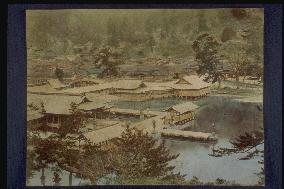
Itsukushima Shinto Shrine at Miyajima was built in 592, when Emperor Suiko succeeded to the throne. It served as a place of worship for the imperial family as well as for the daimyo (feudal lords) during the Warring State Period. At the end of the Heian Period, Taira-no-Kiyomori completed the shrine buildings that are still standing today.==Date:unknown, Place:Miyajima, Photo:unknown, (Credit:Nagasaki University Library/Kyodo News Images) [Cabinet Number37‐15‐0]

  •  
Mail runner with tattoos

Mail runner with tattoos

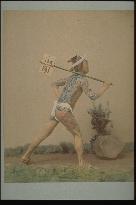
The hikyaku (courier) developed as a means of communication in the Edo era. According to the rank of the person using the hikyaku, there were tsugi hikyaku , daimyo hikyaku and machi hikyaku . The tattoo was a popular symbol of virility in the Edo era. Running naked, the hikyaku was proud of the tattoo which he wore instead of a coat.==Date:unknown, Place:unknown, Photo:unknown, (Credit:Nagasaki University Library/Kyodo News Images) [Cabinet Number18‐4‐0]

  •  
Honjin,an officially appointed inn for daimyo,in a post town

Honjin,an officially appointed inn for daimyo,in a post town

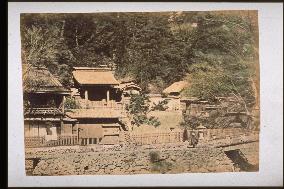
A honjin (officially appointed inn) is a place of lodging for war lords, officials of the Shogunate and the aristocracy. The origin is derived from Ashikaga Yoshiaki, who raised a plaque at his lodging on the way to Kyoto. The characteristics are spacious grounds with a gate entrance and rooms in the upper tier. The honjin developed with the sankinkotai (warlord's alternate-year residence in Edo), and its managers were allowed to have last names and to wear swords.==Date:unknown, Place:unknown, Photo:unknown, (Credit:Nagasaki University Library/Kyodo News Images) [Cabinet Number13‐24‐0]

  •  
Samurai warriors festival

Samurai warriors festival

KOFU, Japan - Actor Ikki Sawamura (L), dressed as Takeda Shingen, a 16th century daimyo (feudal lord), receives a Guinness World Records certificate in Kofu, Yamanashi Prefecture, on April 7, 2012. A total of 1,061 people dressed as feudal-era samurai warriors took part in the Shingen-ko (Lord Shingen) festival that day. The event was listed in the Guinness Book of World Records as the largest-ever gathering of samurai. (Kyodo)

  •  
Samurai warriors festival

Samurai warriors festival

KOFU, Japan - A total of 1,061 people clad as feudal-era samurai warriors march along a road during the Shingen-ko (Lord Shingen) festival in Kofu, Yamanashi Prefecture, on April 7, 2012. The event to honor Takeda Shingen, a 16th century daimyo (feudal lord), was listed in the Guinness Book of World Records as the largest-ever gathering of samurai. (Kyodo)

  •  
Daimyo street near west gate of imperial palace

Daimyo street near west gate of imperial palace

Daimyo street near west gate of imperial palace==Date:unknown, Place:Tokyo, Photo:unknown, (Credit:Nagasaki University Library/Kyodo News Images)

  •  
Ritsurin Garden in western Japan

Ritsurin Garden in western Japan

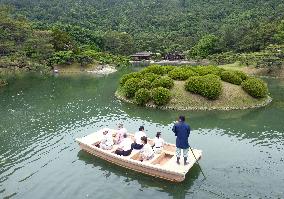
A tour boat operates on a trial basis on a lake at Ritsurin Garden, a "daimyo" feudal load garden in Takamatsu, Kagawa Prefecture, on June 11, 2012. (Kyodo) ==Kyodo

  •  
Ritsurin Garden in western Japan

Ritsurin Garden in western Japan

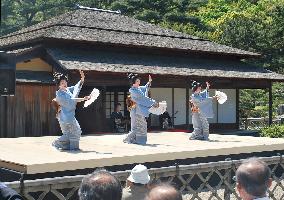
Kanazawa Geigi, or Geishas from Kanazawa, Ishikawa Prefecture, perform a dance on the stage at Ritsurin Garden, a "daimyo" feudal lord garden in Takamatsu, Kagawa Prefecture, on April 25, 2010. (Kyodo) ==Kyodo

  •  
Ritsurin Garden in western Japan

Ritsurin Garden in western Japan

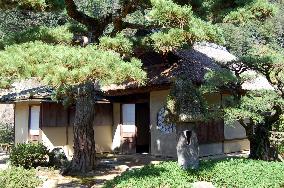
Undated file photo shows a tea room at Ritsurin Garden, a "daimyo" feudal lord garden in Takamatsu, Kagawa Prefecture. (Kyodo) ==Kyodo

  •  
16th century medal unearthed from ruins in southwestern Japan

16th century medal unearthed from ruins in southwestern Japan

OITA, Japan - Photo taken Aug. 3 shows a medal believed to be worn by a Christian in the 16th century. It has been unearthed from ruins in Oita Prefecture of a house occupied by Otomo Sorin (1530-1587), a Christian daimyo or feudal lord who welcomed Christianity. It is the second of its kind to be found in Japan.

  •  
Christian daimyo Takayama's statuette moves to Manila

Christian daimyo Takayama's statuette moves to Manila

MANILA, Philippines - Japanese priest Toru Nishimoto (R) presents a statuett of Takayama Ukon, a Christian daimyo exiled to the Philippines, to Victoria Quirino Delgado, daughter of former President Elpidio Quirino. Standing at the center is Manila Archbishop Jaime Cardinal Sin. Nishimoto said the statuette was meant to express the Japanese people's gratitude to the late president and friendship with the Filipino people.

  • Main
  • Top
  • Editorial
  • Creative
  • About Us
  • About ILG
  • Terms of use
  • Company
  • BEHIND
  • Price List
  • Single Plan
  • Monthly Plan
  • Services
  • Shooting
  • Rights Clearance
  • Support
  • FAQ
  • How To Buy
  • Contact Us
  • Become a Partner

© KYODO NEWS IMAGES INC

All Rights Reserved.

  • Editorial
  • Olympics
  • News
  • Sports
  • Japan
  • Tech
  • Royal
  • Disaster
  • NorthKorea
  • Old Japan
  • SNS
  • Creative
  • Food
  • Japan
  • Landscape
  • Animal
  • Popular
  • #Ukraine
  • #China
  • #coronavirus
  • #N. Korea
  • #Russia
  • #Thailand
  • #Ukraine
  • #China
  • #coronavirus
  • #N. Korea
  • #Russia
  • #Thailand
  • Food
  • Japan
  • Landscape
  • Animal
  • Olympics
  • News
  • Sports
  • Japan
  • Tech
  • Royal
  • Disaster
  • NorthKorea
  • Old Japan
  • SNS