•  
Tie-Dye Technique Of Bai Ethnic Group - Chin

Tie-Dye Technique Of Bai Ethnic Group - Chin

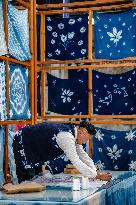
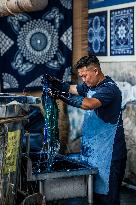
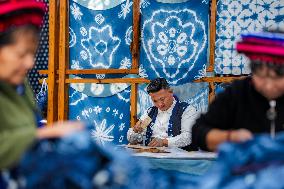
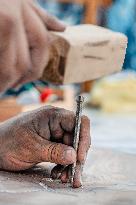
Duan Yuan, an inheritor of the tie-dye technique of Bai ethnic group, makes tie-dye designs in a dyehouse in Zhoucheng Village of Dali Bai Autonomous Prefecture, southwest China's Yunnan Province, November 21, 2025. Known as the hometown of the tie-dye technique of Bai ethnic group, Zhoucheng Village hosts over 200 households engaging in tie-dye businesses, with the number of employees exceeding 4,000. As a traditional folk technique of the Bai ethnic group, tie-dye boasts a history spanning over a thousand years and was included in the first batch of China's national intangible cultural heritage list in 2006. Tying and dyeing are the core steps in the process of making indigo tie-dye products. Artisans use needles and threads to create various patterns on the fabric, which are then dyed with plant-based dyes, resulting in blue backgrounds adorned with vivid white patterns. Photo by Hu Chao/Xinhua/ABACAPRESS.COM

  •  
Tie-Dye Technique Of Bai Ethnic Group - Chin

Tie-Dye Technique Of Bai Ethnic Group - Chin

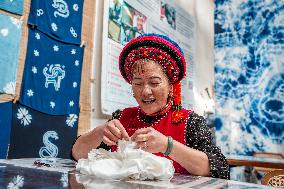
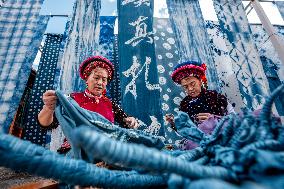
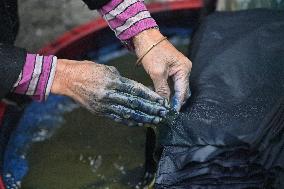
Duan Yinmei, an inheritor of the tie-dye technique of Bai ethnic group, creates knots on fabrics in a dyehouse in Zhoucheng Village of Dali Bai Autonomous Prefecture, southwest China's Yunnan Province, November 21, 2025. Known as the hometown of the tie-dye technique of Bai ethnic group, Zhoucheng Village hosts over 200 households engaging in tie-dye businesses, with the number of employees exceeding 4,000. As a traditional folk technique of the Bai ethnic group, tie-dye boasts a history spanning over a thousand years and was included in the first batch of China's national intangible cultural heritage list in 2006. Tying and dyeing are the core steps in the process of making indigo tie-dye products. Artisans use needles and threads to create various patterns on the fabric, which are then dyed with plant-based dyes, resulting in blue backgrounds adorned with vivid white patterns. Photo by Hu Chao/Xinhua/ABACAPRESS.COM

  •  
Tie-Dye Technique Of Bai Ethnic Group - Chin

Tie-Dye Technique Of Bai Ethnic Group - Chin

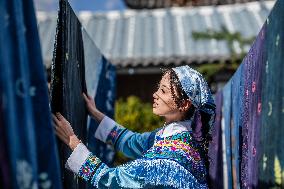
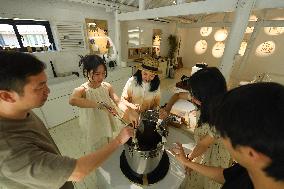
A woman experiences the tie-dye technique of Bai ethnic group in a dyehouse in Zhoucheng Village of Dali Bai Autonomous Prefecture, southwest China's Yunnan Province, November 21, 2025. Known as the hometown of the tie-dye technique of Bai ethnic group, Zhoucheng Village hosts over 200 households engaging in tie-dye businesses, with the number of employees exceeding 4,000. As a traditional folk technique of the Bai ethnic group, tie-dye boasts a history spanning over a thousand years and was included in the first batch of China's national intangible cultural heritage list in 2006. Tying and dyeing are the core steps in the process of making indigo tie-dye products. Artisans use needles and threads to create various patterns on the fabric, which are then dyed with plant-based dyes, resulting in blue backgrounds adorned with vivid white patterns. Photo by Hu Chao/Xinhua/ABACAPRESS.COM

  •  
Tie-Dye Technique Of Bai Ethnic Group - Chin

Tie-Dye Technique Of Bai Ethnic Group - Chin

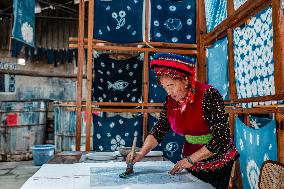
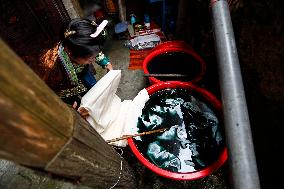
Duan Yinmei, an inheritor of the tie-dye technique of Bai ethnic group, dyes patterns on fabrics in a dyehouse in Zhoucheng Village of Dali Bai Autonomous Prefecture, southwest China's Yunnan Province, November 21, 2025. Known as the hometown of the tie-dye technique of Bai ethnic group, Zhoucheng Village hosts over 200 households engaging in tie-dye businesses, with the number of employees exceeding 4,000. As a traditional folk technique of the Bai ethnic group, tie-dye boasts a history spanning over a thousand years and was included in the first batch of China's national intangible cultural heritage list in 2006. Tying and dyeing are the core steps in the process of making indigo tie-dye products. Artisans use needles and threads to create various patterns on the fabric, which are then dyed with plant-based dyes, resulting in blue backgrounds adorned with vivid white patterns. Photo by Hu Chao/Xinhua/ABACAPRESS.COM

  •  
Tie-Dye Technique Of Bai Ethnic Group - Chin

Tie-Dye Technique Of Bai Ethnic Group - Chin

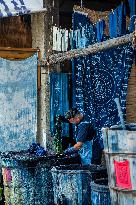
Duan Yuan, an inheritor of the tie-dye technique of Bai ethnic group, rinses dyed fabrics in a dyehouse in Zhoucheng Village of Dali Bai Autonomous Prefecture, southwest China's Yunnan Province, November 21, 2025. Known as the hometown of the tie-dye technique of Bai ethnic group, Zhoucheng Village hosts over 200 households engaging in tie-dye businesses, with the number of employees exceeding 4,000. As a traditional folk technique of the Bai ethnic group, tie-dye boasts a history spanning over a thousand years and was included in the first batch of China's national intangible cultural heritage list in 2006. Tying and dyeing are the core steps in the process of making indigo tie-dye products. Artisans use needles and threads to create various patterns on the fabric, which are then dyed with plant-based dyes, resulting in blue backgrounds adorned with vivid white patterns. Photo by Hu Chao/Xinhua/ABACAPRESS.COM

  •  
Tie-Dye Technique Of Bai Ethnic Group - Chin

Tie-Dye Technique Of Bai Ethnic Group - Chin

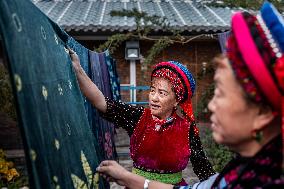
Duan Yinmei (L), an inheritor of the tie-dye technique of Bai ethnic group, and handicraftsman Duan Lilan dry tie-dye fabrics in a dyehouse in Zhoucheng Village of Dali Bai Autonomous Prefecture, southwest China's Yunnan Province, November 21, 2025. Known as the hometown of the tie-dye technique of Bai ethnic group, Zhoucheng Village hosts over 200 households engaging in tie-dye businesses, with the number of employees exceeding 4,000. As a traditional folk technique of the Bai ethnic group, tie-dye boasts a history spanning over a thousand years and was included in the first batch of China's national intangible cultural heritage list in 2006. Tying and dyeing are the core steps in the process of making indigo tie-dye products. Artisans use needles and threads to create various patterns on the fabric, which are then dyed with plant-based dyes, resulting in blue backgrounds adorned with vivid white patterns. Photo by Hu Chao/Xinhua/ABACAPRESS.COM

  •  
Tie-Dye Technique Of Bai Ethnic Group - Chin

Tie-Dye Technique Of Bai Ethnic Group - Chin

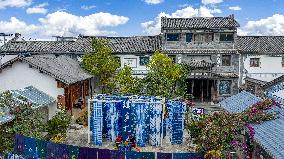
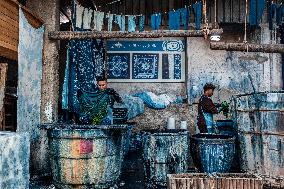
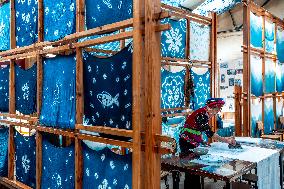
An aerial drone photo shows a scene at a dyehouse in Zhoucheng Village of Dali Bai Autonomous Prefecture, southwest China's Yunnan Province, November 21, 2025. Known as the hometown of the tie-dye technique of Bai ethnic group, Zhoucheng Village hosts over 200 households engaging in tie-dye businesses, with the number of employees exceeding 4,000. As a traditional folk technique of the Bai ethnic group, tie-dye boasts a history spanning over a thousand years and was included in the first batch of China's national intangible cultural heritage list in 2006. Tying and dyeing are the core steps in the process of making indigo tie-dye products. Artisans use needles and threads to create various patterns on the fabric, which are then dyed with plant-based dyes, resulting in blue backgrounds adorned with vivid white patterns. Photo by Hu Chao/Xinhua/ABACAPRESS.COM

  •  
Tie-Dye Technique Of Bai Ethnic Group - Chin

Tie-Dye Technique Of Bai Ethnic Group - Chin

Duan Yinmei (L), an inheritor of the tie-dye technique of Bai ethnic group, and handicraftsman Duan Lilan untie knots on fabrics in a dyehouse in Zhoucheng Village of Dali Bai Autonomous Prefecture, southwest China's Yunnan Province, November 21, 2025. Known as the hometown of the tie-dye technique of Bai ethnic group, Zhoucheng Village hosts over 200 households engaging in tie-dye businesses, with the number of employees exceeding 4,000. As a traditional folk technique of the Bai ethnic group, tie-dye boasts a history spanning over a thousand years and was included in the first batch of China's national intangible cultural heritage list in 2006. Tying and dyeing are the core steps in the process of making indigo tie-dye products. Artisans use needles and threads to create various patterns on the fabric, which are then dyed with plant-based dyes, resulting in blue backgrounds adorned with vivid white patterns. Photo by Hu Chao/Xinhua/ABACAPRESS.COM

  •  
Tie-Dye Technique Of Bai Ethnic Group - Chin

Tie-Dye Technique Of Bai Ethnic Group - Chin

Duan Yinmei (L), an inheritor of the tie-dye technique of Bai ethnic group, and handicraftsman Duan Lilan untie knots on fabrics in a dyehouse in Zhoucheng Village of Dali Bai Autonomous Prefecture, southwest China's Yunnan Province, November 21, 2025. Known as the hometown of the tie-dye technique of Bai ethnic group, Zhoucheng Village hosts over 200 households engaging in tie-dye businesses, with the number of employees exceeding 4,000. As a traditional folk technique of the Bai ethnic group, tie-dye boasts a history spanning over a thousand years and was included in the first batch of China's national intangible cultural heritage list in 2006. Tying and dyeing are the core steps in the process of making indigo tie-dye products. Artisans use needles and threads to create various patterns on the fabric, which are then dyed with plant-based dyes, resulting in blue backgrounds adorned with vivid white patterns. Photo by Hu Chao/Xinhua/ABACAPRESS.COM

  •  
Tie-Dye Technique Of Bai Ethnic Group - Chin

Tie-Dye Technique Of Bai Ethnic Group - Chin

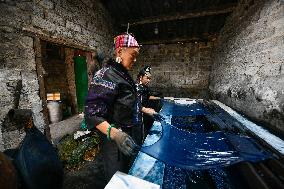
Duan Yuan (L), an inheritor of the tie-dye technique of Bai ethnic group, dyes fabrics in a dyehouse in Zhoucheng Village of Dali Bai Autonomous Prefecture, southwest China's Yunnan Province, November 21, 2025. Known as the hometown of the tie-dye technique of Bai ethnic group, Zhoucheng Village hosts over 200 households engaging in tie-dye businesses, with the number of employees exceeding 4,000. As a traditional folk technique of the Bai ethnic group, tie-dye boasts a history spanning over a thousand years and was included in the first batch of China's national intangible cultural heritage list in 2006. Tying and dyeing are the core steps in the process of making indigo tie-dye products. Artisans use needles and threads to create various patterns on the fabric, which are then dyed with plant-based dyes, resulting in blue backgrounds adorned with vivid white patterns. Photo by Hu Chao/Xinhua/ABACAPRESS.COM

  •  
Tie-Dye Technique Of Bai Ethnic Group - Chin

Tie-Dye Technique Of Bai Ethnic Group - Chin

Duan Yuan, an inheritor of the tie-dye technique of Bai ethnic group, makes tie-dye designs in a dyehouse in Zhoucheng Village of Dali Bai Autonomous Prefecture, southwest China's Yunnan Province, November 21, 2025. Known as the hometown of the tie-dye technique of Bai ethnic group, Zhoucheng Village hosts over 200 households engaging in tie-dye businesses, with the number of employees exceeding 4,000. As a traditional folk technique of the Bai ethnic group, tie-dye boasts a history spanning over a thousand years and was included in the first batch of China's national intangible cultural heritage list in 2006. Tying and dyeing are the core steps in the process of making indigo tie-dye products. Artisans use needles and threads to create various patterns on the fabric, which are then dyed with plant-based dyes, resulting in blue backgrounds adorned with vivid white patterns. Photo by Hu Chao/Xinhua/ABACAPRESS.COM

  •  
Tie-Dye Technique Of Bai Ethnic Group - Chin

Tie-Dye Technique Of Bai Ethnic Group - Chin

Duan Yuan, an inheritor of the tie-dye technique of Bai ethnic group, dyes fabrics in a dyehouse in Zhoucheng Village of Dali Bai Autonomous Prefecture, southwest China's Yunnan Province, November 21, 2025. Known as the hometown of the tie-dye technique of Bai ethnic group, Zhoucheng Village hosts over 200 households engaging in tie-dye businesses, with the number of employees exceeding 4,000. As a traditional folk technique of the Bai ethnic group, tie-dye boasts a history spanning over a thousand years and was included in the first batch of China's national intangible cultural heritage list in 2006. Tying and dyeing are the core steps in the process of making indigo tie-dye products. Artisans use needles and threads to create various patterns on the fabric, which are then dyed with plant-based dyes, resulting in blue backgrounds adorned with vivid white patterns. Photo by Hu Chao/Xinhua/ABACAPRESS.COM

  •  
Tie-Dye Technique Of Bai Ethnic Group - Chin

Tie-Dye Technique Of Bai Ethnic Group - Chin

Duan Yuan, an inheritor of the tie-dye technique of Bai ethnic group, dyes fabrics in a dyehouse in Zhoucheng Village of Dali Bai Autonomous Prefecture, southwest China's Yunnan Province, November 21, 2025. Known as the hometown of the tie-dye technique of Bai ethnic group, Zhoucheng Village hosts over 200 households engaging in tie-dye businesses, with the number of employees exceeding 4,000. As a traditional folk technique of the Bai ethnic group, tie-dye boasts a history spanning over a thousand years and was included in the first batch of China's national intangible cultural heritage list in 2006. Tying and dyeing are the core steps in the process of making indigo tie-dye products. Artisans use needles and threads to create various patterns on the fabric, which are then dyed with plant-based dyes, resulting in blue backgrounds adorned with vivid white patterns. Photo by Hu Chao/Xinhua/ABACAPRESS.COM

  •  
Tie-Dye Technique Of Bai Ethnic Group - Chin

Tie-Dye Technique Of Bai Ethnic Group - Chin

Duan Yuan, an inheritor of the tie-dye technique of Bai ethnic group, makes tie-dye designs in a dyehouse in Zhoucheng Village of Dali Bai Autonomous Prefecture, southwest China's Yunnan Province, November 21, 2025. Known as the hometown of the tie-dye technique of Bai ethnic group, Zhoucheng Village hosts over 200 households engaging in tie-dye businesses, with the number of employees exceeding 4,000. As a traditional folk technique of the Bai ethnic group, tie-dye boasts a history spanning over a thousand years and was included in the first batch of China's national intangible cultural heritage list in 2006. Tying and dyeing are the core steps in the process of making indigo tie-dye products. Artisans use needles and threads to create various patterns on the fabric, which are then dyed with plant-based dyes, resulting in blue backgrounds adorned with vivid white patterns. Photo by Hu Chao/Xinhua/ABACAPRESS.COM

  •  
Tie-Dye Technique Of Bai Ethnic Group - Chin

Tie-Dye Technique Of Bai Ethnic Group - Chin

Duan Yinmei, an inheritor of the tie-dye technique of Bai ethnic group, unties knots on fabrics in a dyehouse in Zhoucheng Village of Dali Bai Autonomous Prefecture, southwest China's Yunnan Province, November 21, 2025. Known as the hometown of the tie-dye technique of Bai ethnic group, Zhoucheng Village hosts over 200 households engaging in tie-dye businesses, with the number of employees exceeding 4,000. As a traditional folk technique of the Bai ethnic group, tie-dye boasts a history spanning over a thousand years and was included in the first batch of China's national intangible cultural heritage list in 2006. Tying and dyeing are the core steps in the process of making indigo tie-dye products. Artisans use needles and threads to create various patterns on the fabric, which are then dyed with plant-based dyes, resulting in blue backgrounds adorned with vivid white patterns. Photo by Hu Chao/Xinhua/ABACAPRESS.COM

  •  
Tie-Dye Technique Of Bai Ethnic Group - Chin

Tie-Dye Technique Of Bai Ethnic Group - Chin

Duan Yinmei, an inheritor of the tie-dye technique of Bai ethnic group, dyes patterns on fabrics in a dyehouse in Zhoucheng Village of Dali Bai Autonomous Prefecture, southwest China's Yunnan Province, November 21, 2025. Known as the hometown of the tie-dye technique of Bai ethnic group, Zhoucheng Village hosts over 200 households engaging in tie-dye businesses, with the number of employees exceeding 4,000. As a traditional folk technique of the Bai ethnic group, tie-dye boasts a history spanning over a thousand years and was included in the first batch of China's national intangible cultural heritage list in 2006. Tying and dyeing are the core steps in the process of making indigo tie-dye products. Artisans use needles and threads to create various patterns on the fabric, which are then dyed with plant-based dyes, resulting in blue backgrounds adorned with vivid white patterns. Photo by Hu Chao/Xinhua/ABACAPRESS.COM

  •  
Tie-Dye Technique Of Bai Ethnic Group - Chin

Tie-Dye Technique Of Bai Ethnic Group - Chin

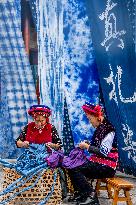
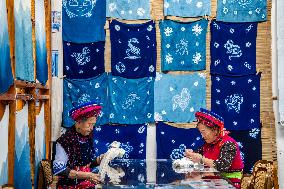
Duan Yinmei (R), an inheritor of the tie-dye technique of Bai ethnic group, and handicraftsman Duan Lilan create knots on fabrics in a dyehouse in Zhoucheng Village of Dali Bai Autonomous Prefecture, southwest China's Yunnan Province, November 21, 2025. Known as the hometown of the tie-dye technique of Bai ethnic group, Zhoucheng Village hosts over 200 households engaging in tie-dye businesses, with the number of employees exceeding 4,000. As a traditional folk technique of the Bai ethnic group, tie-dye boasts a history spanning over a thousand years and was included in the first batch of China's national intangible cultural heritage list in 2006. Tying and dyeing are the core steps in the process of making indigo tie-dye products. Artisans use needles and threads to create various patterns on the fabric, which are then dyed with plant-based dyes, resulting in blue backgrounds adorned with vivid white patterns. Photo by Hu Chao/Xinhua/ABACAPRESS.COM

  •  
U.S. to remove synthetic dyes from food

U.S. to remove synthetic dyes from food

U.S. Seretary of Health and Human Services Robert F. Kennedy Jr. holds a press conference in Washington on April 22, 2025, over a plan to phase out the use of synthetic dyes in America's food supply.

  •  
(ZhejiangPictorial)CHINA-ZHEJIANG-SONGYANG COUNTY-VILLAGE-RENOVATION (CN)

(ZhejiangPictorial)CHINA-ZHEJIANG-SONGYANG COUNTY-VILLAGE-RENOVATION (CN)

(240718) -- LISHUI, July 18, 2024 Photo by Xinhua/ABACAPRESS.COM) -- Hu Juan (C), a young maker from central China's Hunan Province, dyes cloths with her students in Songzhuang Village of Songyang County, east China's Zhejiang Province, July 18, 2024. Nestled in the mountains, Songzhuang Village of Songyang County boasts a history of over 600 years and preserves many traditional residences. In recent years, local government has renovated old houses and ancient paths and introduced new business forms to attract young talents to start their businesses there. Photo by Xinhua/ABACAPRESS.COM/Weng Xinyang)

  •  
(ZhejiangPictorial) CHINA-ZHEJIANG-TEXTILE INDUSTRY-DEVELOPMENT (CN)

(ZhejiangPictorial) CHINA-ZHEJIANG-TEXTILE INDUSTRY-DEVELOPMENT (CN)

(240315) -- SHAOXING, March 15, 2024 (Xinhua) -- Robots handle dyes on an automated weighing and mixing system at a company in Keqiao District of Shaoxing, east China's Zhejiang Province, March 14, 2024. Keqiao District of Shaoxing is a cluster base for the textile industry, housing more than 8,000 textile businesses with an output value of over 100 billion yuan(about 13.9 billion U.S. dollars). In recent years, the district has promoted transformation and upgrading, introducing environmentally friendly machinery and innovative technologies. The local traditional industry, initially labor-intensive, is making a switch to a low-pollution, high-tech, and high-value advanced manufacturing segment. (Xinhua/Weng Xinyang)

  •  
(EnchantingGuangxi)CHINA-GUANGXI-MIAO ETHNIC GROUP-TRADITIONAL COSTUME (CN)

(EnchantingGuangxi)CHINA-GUANGXI-MIAO ETHNIC GROUP-TRADITIONAL COSTUME (CN)

(230903) -- RONGSHUI, Sept. 3, 2023 (Xinhua) -- Liang Zuying dyes the white cloth in Wuying Village on the border between south China's Guangxi Zhuang Autonomous Region and southwest China's Guizhou Province, on Aug. 31, 2023. Wuying Village is a Miao ethnic group hamlet that nestles snugly in the towering mountains stretching across the border between Guangxi and Guizhou. "Liang Bu", named for its glistening appearance, is a kind of traditional hand-made cloth of Miao ethnic group. Women of Miao ethnic group in Wuying plant woad in spring and harvest it in fall. They soak woad in water for days before mixing it with materials such as lime, to make the dye for "Liang Bu". It usually takes months to make a piece of "Liang Bu" after repeated process of dip-dyeing, drying, pounding, applying egg white and steaming. The cloth gradually becomes glistening owing to tens of thousands of poundings by villagers with traditional wooden hammers. After cutting, sewing, embroidery and ironing, a set of glossy "Lia

  •  
(EnchantingGuangxi)CHINA-GUANGXI-MIAO ETHNIC GROUP-TRADITIONAL COSTUME (CN)

(EnchantingGuangxi)CHINA-GUANGXI-MIAO ETHNIC GROUP-TRADITIONAL COSTUME (CN)

(230903) -- RONGSHUI, Sept. 3, 2023 (Xinhua) -- Pan Huami dyes the cloth in Wuying Village on the border between south China's Guangxi Zhuang Autonomous Region and southwest China's Guizhou Province, on Sept. 2, 2023. Wuying Village is a Miao ethnic group hamlet that nestles snugly in the towering mountains stretching across the border between Guangxi and Guizhou. "Liang Bu", named for its glistening appearance, is a kind of traditional hand-made cloth of Miao ethnic group. Women of Miao ethnic group in Wuying plant woad in spring and harvest it in fall. They soak woad in water for days before mixing it with materials such as lime, to make the dye for "Liang Bu". It usually takes months to make a piece of "Liang Bu" after repeated process of dip-dyeing, drying, pounding, applying egg white and steaming. The cloth gradually becomes glistening owing to tens of thousands of poundings by villagers with traditional wooden hammers. After cutting, sewing, embroidery and ironing, a set of glossy "Liang Bu" cl

  •  
CHINA-GUIZHOU-MIAO EMBROIDERER-ETHNIC INTANGIBLE HERITAGE (CN)

CHINA-GUIZHOU-MIAO EMBROIDERER-ETHNIC INTANGIBLE HERITAGE (CN)

(230724) -- GUIYANG, July 24, 2023 (Xinhua) -- Pan Yuzhen (front), an inheritor of the intangible cultural heritage of Miao embroidery of the Miao ethnic group, dyes cloth with her daughter Zhang Yanmei in Taijiang County of Qiandongnan Miao and Dong Autonomous Prefecture, southwest China's Guizhou Province, May 30, 2023. TO GO WITH "Across China: Miao embroiderer takes ethnic intangible heritage to world stage" (Xinhua/Yang Wenbin)

  •  

Open days at farms held in France

STORY: Open days at farms held in France DATELINE: May 2, 2023 LENGTH: 00:01:16 LOCATION: Paris CATEGORY: SOCIETY SHOTLIST: 1. various of people visiting farms 2. SOUNDBITE 1 (French): DAVID CHATAIGNON, Farmer 3. various of people visiting farms STORYLINE: In France, the last weekend of April is the occasion when people can visit several hundred farms across the country and learn about farm work. The "From Farm to Farm" event, created some 30 years ago, aims to inform the public of the modes of agricultural production and strengthen the link between urban and rural areas. Some farmers also consider this event as an opportunity to combat certain prejudices about their profession. SOUNDBITE (French): DAVID CHATAIGNON, Farmer "Not all farmers are putting pesticides and chemical fertilizers on their fields. We don't use chemical fertilizers, dyes, or food preservatives. With the visits, we show people concretely how we work." Xinhua News Agency correspondents reporting from Paris. (XHTV)

  •  
Thai woman makes good living by plucking gray hairs

Thai woman makes good living by plucking gray hairs

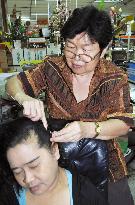
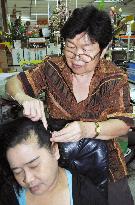
BANGKOK, Thailand - Woranan Dodocha plucks gray hairs from a customer at a store in Bangkok on April 21, 2011. Customers seeking to rid of their gray hairs without using dyes find the answer at Woranan's store, where she uses a comb and tweezers to pull them out one by one.

  •  
Pink and beige hair dyes for young girls to be launched

Pink and beige hair dyes for young girls to be launched

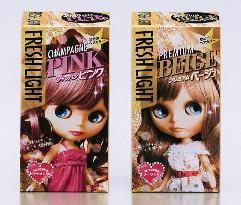
TOKYO, Japan - This photo shows the hair dyes Champagne Pink and Premium Beige that Schwarzkopf & Henkel K.K. based in Tokyo will launch on Feb. 15, 2010 as new items in its mainstay Fresh Light series.

  •  
A 1912

A 1912

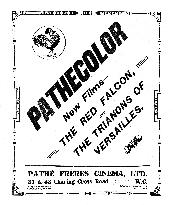
A 1912 advertisement for the PATHECOLOR system. Through separate stencils for each area of colour, coloured dyes are applied to black and white films. A very successful system, with beautiful results, it survived at least to the end of the 1920s A 1912 advertisement for the PATHECOLOR system. Through separate stencils for each area of colour, coloured dyes are applied to black and white films. A very successful system, with beautiful results, it survived at least to the end of the 1920s

  •  
Pink and beige hair dyes for young girls to be launched

Pink and beige hair dyes for young girls to be launched

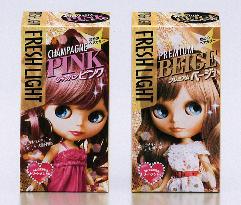
TOKYO, Japan - This photo shows the hair dyes Champagne Pink and Premium Beige that Schwarzkopf & Henkel K.K. based in Tokyo will launch on Feb. 15, 2010 as new items in its mainstay Fresh Light series. (Kyodo)

  •  
Thai woman makes good living by plucking gray hairs

Thai woman makes good living by plucking gray hairs

BANGKOK, Thailand - Woranan Dodocha plucks gray hairs from a customer at a store in Bangkok on April 21, 2011. Customers seeking to rid of their gray hairs without using dyes find the answer at Woranan's store, where she uses a comb and tweezers to pull them out one by one. (Kyodo)

  • Main
  • Top
  • Editorial
  • Creative
  • About Us
  • About ILG
  • Terms of use
  • Company
  • BEHIND
  • Price List
  • Single Plan
  • Monthly Plan
  • Services
  • Shooting
  • Rights Clearance
  • Support
  • FAQ
  • How To Buy
  • Contact Us
  • Become a Partner

© KYODO NEWS IMAGES INC

All Rights Reserved.

  • Editorial
  • Olympics
  • News
  • Sports
  • Japan
  • Tech
  • Royal
  • Disaster
  • NorthKorea
  • Old Japan
  • SNS
  • Creative
  • Food
  • Japan
  • Landscape
  • Animal
  • Popular
  • #Ukraine
  • #Thailand
  • #coronavirus
  • #N. Korea
  • #Russia
  • #China
  • #Ukraine
  • #Thailand
  • #coronavirus
  • #N. Korea
  • #Russia
  • #China
  • Food
  • Japan
  • Landscape
  • Animal
  • Olympics
  • News
  • Sports
  • Japan
  • Tech
  • Royal
  • Disaster
  • NorthKorea
  • Old Japan
  • SNS