•  
Illustration - Provence

Illustration - Provence

FRANCE. ALPES-DE-HAUTE-PROVENCE (04), VERDON REGIONAL NATURE PARK. MOUSTIERS-SAINTE-MARIE, A VILLAGE FAMOUS FOR ITS CRAFTS AND EARTHENWARE. LABELLED THE MOST BEAUTIFUL VILLAGE IN FRANCE Photo by Paul Palau/Only France/ABACAPRESS.COM

  •  
XINHUA PHOTOS OF THE DAY

XINHUA PHOTOS OF THE DAY

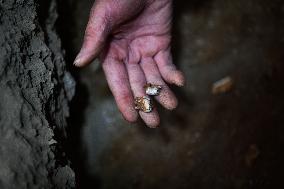
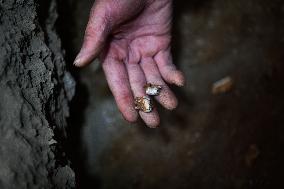
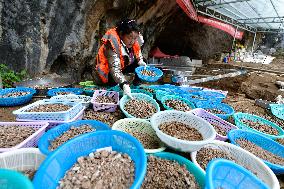
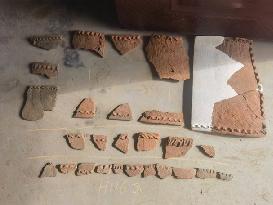
(240126) -- BEIJING, Jan. 26, 2024 (Xinhua) -- This photo taken on Jan. 24, 2024 shows archaeological samples unearthed from Chuandong Site in Puding County, southwest China's Guizhou Province. Large quantities of artifacts made of stone, bone and horn have been unearthed at Chuandong Site in Puding County, southwest China's Guizhou Province, indicating prehistoric human activity dating back more than 55,000 years. Chuandong Site, first discovered in 1978, is believed to have existed across the end of the middle Paleolithic Period, the late Paleolithic Period and the Neolithic Age. Over two years of excavation work, the third one since 1978, researchers discovered a new soil layer at the site, where they found more than 100,000 animal bones, over 10,000 pieces of earthenware and stoneware, and more than 2,500 items made of bone or horn. (Xinhua/Yang Wenbin)

  •  
CHINA-GUIZHOU-PUDING-CHUANDONG SITE-NEW FINDING (CN)

CHINA-GUIZHOU-PUDING-CHUANDONG SITE-NEW FINDING (CN)

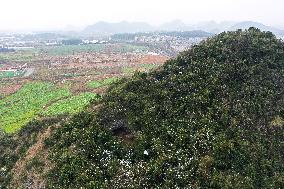
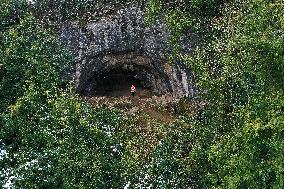
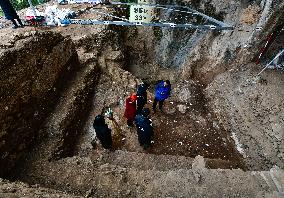
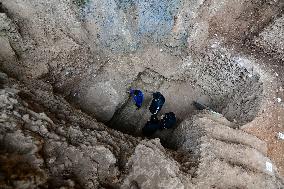
(240125) -- PUDING, Jan. 25, 2024 (Xinhua) -- An aerial drone photo taken on Jan. 24, 2024 shows a view of Chuandong Site in Puding County, southwest China's Guizhou Province. Large quantities of artifacts made of stone, bone and horn have been unearthed at Chuandong Site in Puding County, southwest China's Guizhou Province, indicating prehistoric human activity dating back more than 55,000 years. Chuandong Site, first discovered in 1978, is believed to have existed across the end of the middle Paleolithic Period, the late Paleolithic Period and the Neolithic Age. Over two years of excavation work, the third one since 1978, researchers discovered a new soil layer at the site, where they found more than 100,000 animal bones, over 10,000 pieces of earthenware and stoneware, and more than 2,500 items made of bone or horn. (Xinhua/Yang Wenbin)

  •  
CHINA-GUIZHOU-PUDING-CHUANDONG SITE-NEW FINDING (CN)

CHINA-GUIZHOU-PUDING-CHUANDONG SITE-NEW FINDING (CN)

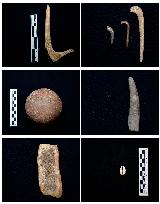
(240125) -- PUDING, Jan. 25, 2024 (Xinhua) -- This combo photo taken on Jan. 24, 2024 shows archaeological samples unearthed from Chuandong Site in Puding County, southwest China's Guizhou Province. Large quantities of artifacts made of stone, bone and horn have been unearthed at Chuandong Site in Puding County, southwest China's Guizhou Province, indicating prehistoric human activity dating back more than 55,000 years. Chuandong Site, first discovered in 1978, is believed to have existed across the end of the middle Paleolithic Period, the late Paleolithic Period and the Neolithic Age. Over two years of excavation work, the third one since 1978, researchers discovered a new soil layer at the site, where they found more than 100,000 animal bones, over 10,000 pieces of earthenware and stoneware, and more than 2,500 items made of bone or horn. (Xinhua/Yang Wenbin)

  •  
CHINA-GUIZHOU-PUDING-CHUANDONG SITE-NEW FINDING (CN)

CHINA-GUIZHOU-PUDING-CHUANDONG SITE-NEW FINDING (CN)

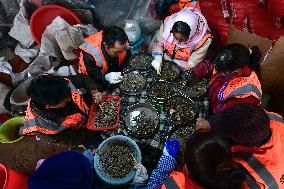
(240125) -- PUDING, Jan. 25, 2024 (Xinhua) -- Workers sort findings unearthed from Chuandong Site in Puding County, southwest China's Guizhou Province, Jan. 24, 2024. Large quantities of artifacts made of stone, bone and horn have been unearthed at Chuandong Site in Puding County, southwest China's Guizhou Province, indicating prehistoric human activity dating back more than 55,000 years. Chuandong Site, first discovered in 1978, is believed to have existed across the end of the middle Paleolithic Period, the late Paleolithic Period and the Neolithic Age. Over two years of excavation work, the third one since 1978, researchers discovered a new soil layer at the site, where they found more than 100,000 animal bones, over 10,000 pieces of earthenware and stoneware, and more than 2,500 items made of bone or horn. (Xinhua/Yang Wenbin)

  •  
CHINA-GUIZHOU-PUDING-CHUANDONG SITE-NEW FINDING (CN)

CHINA-GUIZHOU-PUDING-CHUANDONG SITE-NEW FINDING (CN)

(240125) -- PUDING, Jan. 25, 2024 (Xinhua) -- This photo taken on Jan. 24, 2024 shows archaeological samples unearthed from Chuandong Site in Puding County, southwest China's Guizhou Province. Large quantities of artifacts made of stone, bone and horn have been unearthed at Chuandong Site in Puding County, southwest China's Guizhou Province, indicating prehistoric human activity dating back more than 55,000 years. Chuandong Site, first discovered in 1978, is believed to have existed across the end of the middle Paleolithic Period, the late Paleolithic Period and the Neolithic Age. Over two years of excavation work, the third one since 1978, researchers discovered a new soil layer at the site, where they found more than 100,000 animal bones, over 10,000 pieces of earthenware and stoneware, and more than 2,500 items made of bone or horn. (Xinhua/Yang Wenbin)

  •  
CHINA-GUIZHOU-PUDING-CHUANDONG SITE-NEW FINDING (CN)

CHINA-GUIZHOU-PUDING-CHUANDONG SITE-NEW FINDING (CN)

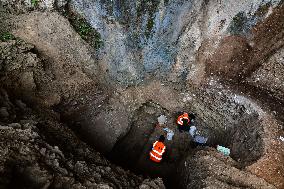
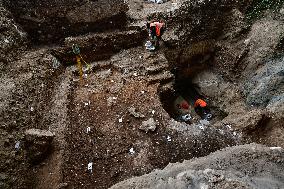
(240125) -- PUDING, Jan. 25, 2024 (Xinhua) -- Staff members conduct work at Chuandong Site in Puding County, southwest China's Guizhou Province, Jan. 24, 2024. Large quantities of artifacts made of stone, bone and horn have been unearthed at Chuandong Site in Puding County, southwest China's Guizhou Province, indicating prehistoric human activity dating back more than 55,000 years. Chuandong Site, first discovered in 1978, is believed to have existed across the end of the middle Paleolithic Period, the late Paleolithic Period and the Neolithic Age. Over two years of excavation work, the third one since 1978, researchers discovered a new soil layer at the site, where they found more than 100,000 animal bones, over 10,000 pieces of earthenware and stoneware, and more than 2,500 items made of bone or horn. (Xinhua/Yang Wenbin)

  •  
CHINA-GUIZHOU-PUDING-CHUANDONG SITE-NEW FINDING (CN)

CHINA-GUIZHOU-PUDING-CHUANDONG SITE-NEW FINDING (CN)

(240125) -- PUDING, Jan. 25, 2024 (Xinhua) -- An aerial drone photo taken on Jan. 24, 2024 shows a view of Chuandong Site in Puding County, southwest China's Guizhou Province. Large quantities of artifacts made of stone, bone and horn have been unearthed at Chuandong Site in Puding County, southwest China's Guizhou Province, indicating prehistoric human activity dating back more than 55,000 years. Chuandong Site, first discovered in 1978, is believed to have existed across the end of the middle Paleolithic Period, the late Paleolithic Period and the Neolithic Age. Over two years of excavation work, the third one since 1978, researchers discovered a new soil layer at the site, where they found more than 100,000 animal bones, over 10,000 pieces of earthenware and stoneware, and more than 2,500 items made of bone or horn. (Xinhua/Yang Wenbin)

  •  
CHINA-GUIZHOU-PUDING-CHUANDONG SITE-NEW FINDING (CN)

CHINA-GUIZHOU-PUDING-CHUANDONG SITE-NEW FINDING (CN)

(240125) -- PUDING, Jan. 25, 2024 (Xinhua) -- Staff members conduct work at Chuandong Site in Puding County, southwest China's Guizhou Province, Jan. 24, 2024. Large quantities of artifacts made of stone, bone and horn have been unearthed at Chuandong Site in Puding County, southwest China's Guizhou Province, indicating prehistoric human activity dating back more than 55,000 years. Chuandong Site, first discovered in 1978, is believed to have existed across the end of the middle Paleolithic Period, the late Paleolithic Period and the Neolithic Age. Over two years of excavation work, the third one since 1978, researchers discovered a new soil layer at the site, where they found more than 100,000 animal bones, over 10,000 pieces of earthenware and stoneware, and more than 2,500 items made of bone or horn. (Xinhua/Yang Wenbin)

  •  
CHINA-GUIZHOU-PUDING-CHUANDONG SITE-NEW FINDING (CN)

CHINA-GUIZHOU-PUDING-CHUANDONG SITE-NEW FINDING (CN)

(240125) -- PUDING, Jan. 25, 2024 (Xinhua) -- Archaeological expert and students discuss at Chuandong Site in Puding County, southwest China's Guizhou Province, Jan. 24, 2024. Large quantities of artifacts made of stone, bone and horn have been unearthed at Chuandong Site in Puding County, southwest China's Guizhou Province, indicating prehistoric human activity dating back more than 55,000 years. Chuandong Site, first discovered in 1978, is believed to have existed across the end of the middle Paleolithic Period, the late Paleolithic Period and the Neolithic Age. Over two years of excavation work, the third one since 1978, researchers discovered a new soil layer at the site, where they found more than 100,000 animal bones, over 10,000 pieces of earthenware and stoneware, and more than 2,500 items made of bone or horn. (Xinhua/Yang Wenbin)

  •  
CHINA-GUIZHOU-PUDING-CHUANDONG SITE-NEW FINDING (CN)

CHINA-GUIZHOU-PUDING-CHUANDONG SITE-NEW FINDING (CN)

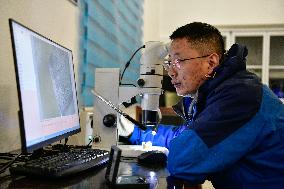
(240125) -- PUDING, Jan. 25, 2024 (Xinhua) -- Zhang Xinglong, an expert with the Guizhou provincial cultural relics and archaeology institute, examines archaeological samples unearthed from Chuandong Site under a microscope in Puding County, southwest China's Guizhou Province, Jan. 24, 2024. Large quantities of artifacts made of stone, bone and horn have been unearthed at Chuandong Site in Puding County, southwest China's Guizhou Province, indicating prehistoric human activity dating back more than 55,000 years. Chuandong Site, first discovered in 1978, is believed to have existed across the end of the middle Paleolithic Period, the late Paleolithic Period and the Neolithic Age. Over two years of excavation work, the third one since 1978, researchers discovered a new soil layer at the site, where they found more than 100,000 animal bones, over 10,000 pieces of earthenware and stoneware, and more than 2,500 items made of bone or horn. (Xinhua/Yang Wenbin)

  •  
CHINA-GUIZHOU-PUDING-CHUANDONG SITE-NEW FINDING (CN)

CHINA-GUIZHOU-PUDING-CHUANDONG SITE-NEW FINDING (CN)

(240125) -- PUDING, Jan. 25, 2024 (Xinhua) -- A worker arranges findings unearthed from Chuandong Site in Puding County, southwest China's Guizhou Province, Jan. 24, 2024. Large quantities of artifacts made of stone, bone and horn have been unearthed at Chuandong Site in Puding County, southwest China's Guizhou Province, indicating prehistoric human activity dating back more than 55,000 years. Chuandong Site, first discovered in 1978, is believed to have existed across the end of the middle Paleolithic Period, the late Paleolithic Period and the Neolithic Age. Over two years of excavation work, the third one since 1978, researchers discovered a new soil layer at the site, where they found more than 100,000 animal bones, over 10,000 pieces of earthenware and stoneware, and more than 2,500 items made of bone or horn. (Xinhua/Yang Wenbin)

  •  
CHINA-GUIZHOU-PUDING-CHUANDONG SITE-NEW FINDING (CN)

CHINA-GUIZHOU-PUDING-CHUANDONG SITE-NEW FINDING (CN)

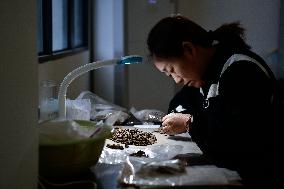
(240125) -- PUDING, Jan. 25, 2024 (Xinhua) -- A staff member sorts findings unearthed from Chuandong Site at a work site of the Guizhou provincial cultural relics and archaeology institute in Puding County, southwest China's Guizhou Province, Jan. 24, 2024. Large quantities of artifacts made of stone, bone and horn have been unearthed at Chuandong Site in Puding County, southwest China's Guizhou Province, indicating prehistoric human activity dating back more than 55,000 years. Chuandong Site, first discovered in 1978, is believed to have existed across the end of the middle Paleolithic Period, the late Paleolithic Period and the Neolithic Age. Over two years of excavation work, the third one since 1978, researchers discovered a new soil layer at the site, where they found more than 100,000 animal bones, over 10,000 pieces of earthenware and stoneware, and more than 2,500 items made of bone or horn. (Xinhua/Yang Wenbin)

  •  
CHINA-GUIZHOU-PUDING-CHUANDONG SITE-NEW FINDING (CN)

CHINA-GUIZHOU-PUDING-CHUANDONG SITE-NEW FINDING (CN)

(240125) -- PUDING, Jan. 25, 2024 (Xinhua) -- Archaeological expert and students discuss at Chuandong Site in Puding County, southwest China's Guizhou Province, Jan. 24, 2024. Large quantities of artifacts made of stone, bone and horn have been unearthed at Chuandong Site in Puding County, southwest China's Guizhou Province, indicating prehistoric human activity dating back more than 55,000 years. Chuandong Site, first discovered in 1978, is believed to have existed across the end of the middle Paleolithic Period, the late Paleolithic Period and the Neolithic Age. Over two years of excavation work, the third one since 1978, researchers discovered a new soil layer at the site, where they found more than 100,000 animal bones, over 10,000 pieces of earthenware and stoneware, and more than 2,500 items made of bone or horn. (Xinhua/Yang Wenbin)

  •  
CHINA-HENAN-EARTHENWARE-UNEARTH (CN)

CHINA-HENAN-EARTHENWARE-UNEARTH (CN)

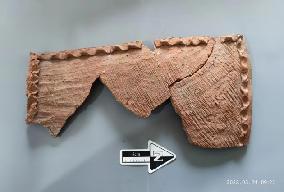
(231222) -- ZHENGZHOU, Dec. 22, 2023 (Xinhua) -- This photo taken on May 24, 2023 shows the tile-shaped earthenware unearthed at the ruins of Beiyangping in the city of Lingbao, central China's Henan Province. TO GO WITH "5,800-yr-old tile-shaped earthenware found in central China" (Xinhua)

  •  
CHINA-HENAN-EARTHENWARE-UNEARTH (CN)

CHINA-HENAN-EARTHENWARE-UNEARTH (CN)

(231222) -- ZHENGZHOU, Dec. 22, 2023 (Xinhua) -- This photo taken on May 24, 2023 shows the tile-shaped earthenware unearthed at the ruins of Beiyangping in the city of Lingbao, central China's Henan Province. TO GO WITH "5,800-yr-old tile-shaped earthenware found in central China" (Xinhua)

  •  
Production Of Clay Musical Drum - Kashimir

Production Of Clay Musical Drum - Kashimir

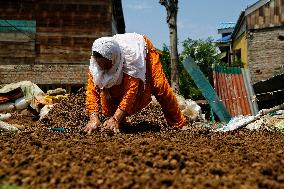
A woman spreads out clods of clay to dry in the sun before they are sculpted into Tumbaknari and other earthenware on the outskirts of Srinagar. In Kashmiri weddings, traditional music holds immense cultural significance, and the Tumbaknari—a musical instrument—takes centre stage in expressing the emotions of joy and love. Commonly used during weddings by womenfolk, Tumbaknari has its roots traced back to Central Asia but has found its home in Kashmir, where it has been cherished for centuries. The locally made Tumbaknari mainly consists of clay, with animal skin used at its bottom to produce a beautiful sound that complements the vocals. On August 10,2023 in Srinagar Kashmir, India. Photo by Firdous Nazir/Eyepix Group/ABACAPRESS.COM

  •  
IRAQ-BAGHDAD-POTTERY-MAKING

IRAQ-BAGHDAD-POTTERY-MAKING

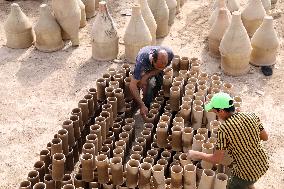
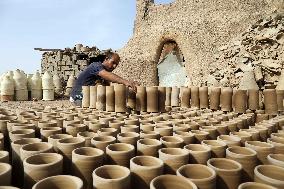
(230528) -- BAGHDAD, May 28, 2023 (Xinhua) -- Safaa al-Kawaz (L), a pottery workshop owner, arranges earthenware together with an assistant in the Nahrawan area near Baghdad, Iraq, May 27, 2023. Pottery-making in Iraq has been an enduring profession which is deeply rooted in the civilizations of Mesopotamia. (Xinhua/Khalil Dawood)

  •  
IRAQ-BAGHDAD-POTTERY-MAKING

IRAQ-BAGHDAD-POTTERY-MAKING

(230528) -- BAGHDAD, May 28, 2023 (Xinhua) -- Safaa al-Kawaz, a pottery workshop owner, arranges earthenware in the Nahrawan area near Baghdad, Iraq, May 27, 2023. Pottery-making in Iraq has been an enduring profession which is deeply rooted in the civilizations of Mesopotamia. (Xinhua/Khalil Dawood)

  •  
Massive pottery plates found in Kyoto

Massive pottery plates found in Kyoto

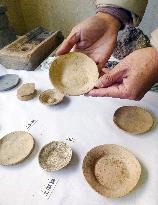
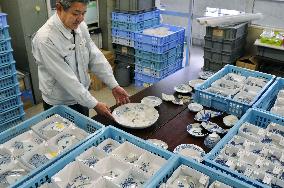
KYOTO, Japan - A massive amount of earthenware plates, believed to date back to a period from the 12th to 16th centuries, is shown in Kyoto, western Japan, on Jan. 8, 2015. Unearthed from more than 70 holes at an excavation site in the ancient Japanese capital, the holes are believed to be either for rituals or burials.

  •  
Ancient-era coins, pot found at Todai-ji temple

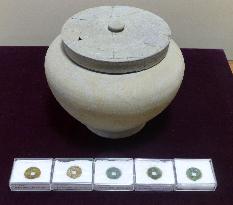
Ancient-era coins, pot found at Todai-ji temple

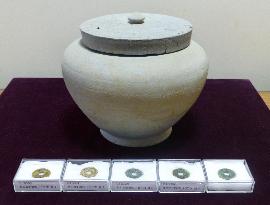
KASHIHARA, Japan - Five "Wado-kaichin" coins, Japan's first circulated copper coinage, kept in an earthenware pot in the Heian era (eighth-12th centuries), are shown together with the pot at the Todai-ji temple in Nara, western Japan, on July 10, 2014.

  •  
Ancient-era coins, pot found at Todai-ji temple

Ancient-era coins, pot found at Todai-ji temple

KASHIHARA, Japan - Five "Wado-kaichin" coins, Japan's first circulated copper coinage, kept in an earthenware pot in the Heian era (eighth-12th centuries), are shown together with the pot at the Todai-ji temple in Nara, western Japan, on July 10, 2014.

  •  
Inax to build more plants in Vietnam, China

Inax to build more plants in Vietnam, China

TOKONAME, Japan - Inax Corp. President Ryuichi Kawamoto speaks at a press conference in Tokoname, Aichi Prefecture, on July 12. He said the sanitary earthenware maker will build two plants in Vietnam and one in China at a total cost of 5.3 billion yen.

  •  
Tomb mound in Shiga Pref., dated to early 3rd century

Tomb mound in Shiga Pref., dated to early 3rd century

OTSU, Japan - A local education board official points to the remains of the Jingokamezuka tomb mound in the town of Notogawa in Shiga Prefecture on Feb. 28. The board said the tomb mound has been confirmed to date to the early third century after some 20 shards of earthenware made in the period were found in gutters around it.

  •  
One of the oldest rectangular tombs found in western Japan

One of the oldest rectangular tombs found in western Japan

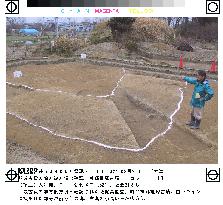
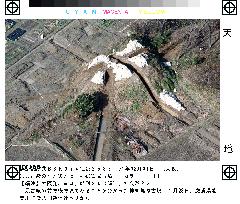
NOTOGAWA, Japan - An ancient tomb in the town of Notogawa in Shiga Prefecture, western Japan, is one of the oldest burial mounds in the country with a square rear and rectangular frontage, dating from the early 3rd century, researchers said Feb. 1. The Notogawa Town Education Board, which has been excavating the tomb since December, said it has discovered at the Jingo-Kameyama Tomb site earthenware believed to date from the Yayoi period (300 BC to AD 300).

  •  
Tihar Preparation in Nepal

Tihar Preparation in Nepal

A woman arranges garlands of globe amaranth flowers ahead of the upcoming Tihar festival in Gundu village, on the outskirts of Kathmandu on November 4, 2020. (Credit:Sunil Pradhan/Kyodo News Images)

  •  
Tihar Preparation in Nepal

Tihar Preparation in Nepal

A potter makes earthenware oil lamps in preparation for the upcoming Tihar festival in Bhaktapur, on the outskirts of Kathmandu on November 4, 2020. (Credit:Sunil Pradhan/Kyodo News Images)

  •  
Tihar Preparation in Nepal

Tihar Preparation in Nepal

A woman arranges garlands of globe amaranth flowers ahead of the upcoming Tihar festival in Gundu village, on the outskirts of Kathmandu on November 4, 2020. (Credit:Sunil Pradhan/Kyodo News Images)

  •  
Tihar Preparation in Nepal

Tihar Preparation in Nepal

A woman arranges garlands of globe amaranth flowers ahead of the upcoming Tihar festival in Gundu village, on the outskirts of Kathmandu on November 4, 2020. (Credit:Sunil Pradhan/Kyodo News Images)

  •  
Tihar Preparation in Nepal

Tihar Preparation in Nepal

A woman arranges garlands of globe amaranth flowers ahead of the upcoming Tihar festival in Gundu village, on the outskirts of Kathmandu on November 4, 2020. (Credit:Sunil Pradhan/Kyodo News Images)

  •  
Tihar Preparation in Nepal

Tihar Preparation in Nepal

A woman prepare garlands of globe amaranth flowers ahead of the upcoming Tihar festival in Gundu village, on the outskirts of Kathmandu on November 4, 2020. (Credit:Sunil Pradhan/Kyodo News Images)

  •  
Tihar Preparation in Nepal

Tihar Preparation in Nepal

A woman arranges garlands of globe amaranth flowers ahead of the upcoming Tihar festival in Gundu village, on the outskirts of Kathmandu on November 4, 2020. (Credit:Sunil Pradhan/Kyodo News Images)

  •  
Tihar Preparation in Nepal

Tihar Preparation in Nepal

A woman prepare garlands of globe amaranth flowers ahead of the upcoming Tihar festival in Gundu village, on the outskirts of Kathmandu on November 4, 2020. (Credit:Sunil Pradhan/Kyodo News Images)

  •  
Tihar Preparation in Nepal

Tihar Preparation in Nepal

A woman carries out freshly made earthenware oil lamps to dry under the sunlight in preparation for the upcoming Tihar festival in Bhaktapur, on the outskirts of Kathmandu on November 4, 2020. (Credit:Sunil Pradhan/Kyodo News Images)

  •  
Tihar Preparation in Nepal

Tihar Preparation in Nepal

A woman arranges garlands of globe amaranth flowers ahead of the upcoming Tihar festival in Gundu village, on the outskirts of Kathmandu on November 4, 2020. (Credit:Sunil Pradhan/Kyodo News Images)

  •  
Tihar Preparation in Nepal

Tihar Preparation in Nepal

A woman arranges garlands of globe amaranth flowers ahead of the upcoming Tihar festival in Gundu village, on the outskirts of Kathmandu on November 4, 2020. (Credit:Sunil Pradhan/Kyodo News Images)

  •  
Tihar Preparation in Nepal

Tihar Preparation in Nepal

A potter makes earthenware oil lamps in preparation for the upcoming Tihar festival in Bhaktapur, on the outskirts of Kathmandu on November 4, 2020. (Credit:Sunil Pradhan/Kyodo News Images)

  •  
Tihar Preparation in Nepal

Tihar Preparation in Nepal

A potter makes earthenware oil lamps in preparation for the upcoming Tihar festival in Bhaktapur, on the outskirts of Kathmandu on November 4, 2020. (Credit:Sunil Pradhan/Kyodo News Images)

  •  
Tihar Preparation in Nepal

Tihar Preparation in Nepal

A potter makes earthenware oil lamps in preparation for the upcoming Tihar festival in Bhaktapur, on the outskirts of Kathmandu on November 4, 2020. (Credit:Sunil Pradhan/Kyodo News Images)

  •  
Inax to build more plants in Vietnam, China

Inax to build more plants in Vietnam, China

TOKONAME, Japan - Inax Corp. President Ryuichi Kawamoto speaks at a press conference in Tokoname, Aichi Prefecture, on July 12. He said the sanitary earthenware maker will build two plants in Vietnam and one in China at a total cost of 5.3 billion yen. (Kyodo)

  •  
The Siege of Tsing-Tau

The Siege of Tsing-Tau

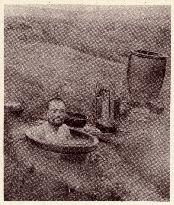
A Japanese soldier taking a bath in an earthenware jar, at the siege of Tsing-Tau. Date: 1915

  •  
Clay coins made amid scarce metal supply toward end of WWII

Clay coins made amid scarce metal supply toward end of WWII

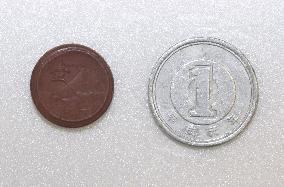
A 1 "sen" coin (L) made from baked clay in Japan toward the end of World War II amid metal shortages is on display alongside a 1 yen coin issued in 1989 for comparison at an earthenware museum on July 3, 2015, in Seto, Aichi Prefecture, central Japan. (Kyodo) ==Kyodo

  •  
Japanese woman recalls wartime work at ceramic coin factory

Japanese woman recalls wartime work at ceramic coin factory

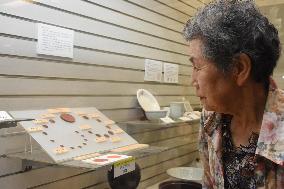
Miyae Suzuki, an 83-year-old housewife from Seto, Aichi Prefecture, looks at ceramic coins showcased at an earthenware museum in the central Japanese city in May 2015. Suzuki worked as a junior high school student at a factory to produce such coins for the government toward the end of World War II amid metal shortages. (Kyodo) ==Kyodo

  •  
Earthenware vertical coffins discovered in Nara

Earthenware vertical coffins discovered in Nara

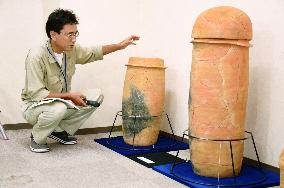
A man talks about vertical cylindrical earthenware coffins that were discovered in the Akoda tomb group (made around the late 6th century to mid-7th century) in Nara, western Japan, at the Nara National Research Institute for Cultural Properties' Center for Archaeological Operations on June 29, 2015. This was the first discovery in Japan of earthenware coffins for vertical positioning. (Kyodo) ==Kyodo

  •  
Promoting traditional octopus pot fishing in western Japan

Promoting traditional octopus pot fishing in western Japan

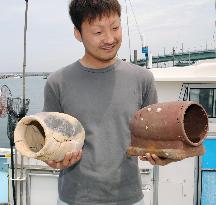
A man shows an earthenware octopus pot (L) excavated from the Ebisubata ruins and a modern version made of plastic in Sennan, Osaka Prefecture, western Japan, on May 25, 2015. The area has been practicing traditional octopus fishing using pots instead of nets. (Kyodo) ==Kyodo

  •  
Ritzy pottery found from middle-class feudal warrior's house

Ritzy pottery found from middle-class feudal warrior's house

Some 1,200 pieces of pottery and porcelain, including ritzy Hizen ware in the early Edo period (1603-1867), are on display in Matsue, Shimane Prefecture, western Japan, on Jan. 6, 2015. Unearthed from the homestead of a feudal middle-class "samurai" warrior belonging to the Matsue Domain, the ceramics are baffling experts as only a warlord could afford such earthenware. (Kyodo) ==Kyodo

  •  
Earthenware fragments from 9th-century salt-making facility

Earthenware fragments from 9th-century salt-making facility

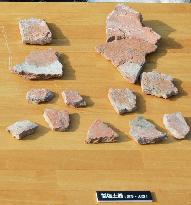
Photo taken in Higashimatsushima, Miyagi Prefecture, Oct. 15, 2015, shows thick, large earthenware fragments found in the remains of a ninth-century salt-making facility in the northeastern Japanese city's Enohama shell mound. (Kyodo) ==Kyodo

  •  
Earthenware fragments from 9th-century salt-making facility

Earthenware fragments from 9th-century salt-making facility

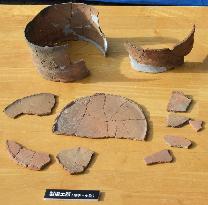
Photo taken in Higashimatsushima, Miyagi Prefecture, on Oct. 15, 2015, shows thin, small earthenware fragments found in the remains of a ninth-century salt-making facility in the northeastern Japanese city's Enohama shell mound. (Kyodo) ==Kyodo

  •  
Work possibly by noted artist Taro Okamoto displayed in west Japan

Work possibly by noted artist Taro Okamoto displayed in west Japan

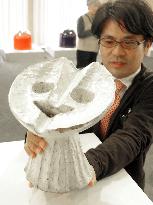
A piece of earthenware work believed to have been made by Japanese artist Taro Okamoto, noted for his avant-garde paintings and sculpture, is shown in Koka, Shiga Prefecture, on Sept. 18, 2015. The work, titled "Face," was discovered at a home in the western Japanese city. (Kyodo) ==Kyodo

  •  
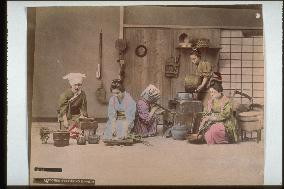
Cooking

Cooking

The English caption reads, Preparing a meal in the kitchen . Five young women prepare a meal in the kitchen. The scene includes a stove for cooking rice, bamboo for blowing the fire, grating stick with earthenware mortar, Japanese onions being cut on a cutting board, and some burdock in the pail. The kitchen tools hanging on the walls are interesting.==Date:unknown, Place:unknown, Photo:unknown, (Credit:Nagasaki University Library/Kyodo News Images) [Cabinet Number18‐29‐0]

  • Main
  • Top
  • Editorial
  • Creative
  • About Us
  • About ILG
  • Terms of use
  • Company
  • BEHIND
  • Price List
  • Single Plan
  • Monthly Plan
  • Services
  • Shooting
  • Rights Clearance
  • Support
  • FAQ
  • How To Buy
  • Contact Us
  • Become a Partner

© KYODO NEWS IMAGES INC

All Rights Reserved.

  • Editorial
  • Olympics
  • News
  • Sports
  • Japan
  • Tech
  • Royal
  • Disaster
  • NorthKorea
  • Old Japan
  • SNS
  • Creative
  • Food
  • Japan
  • Landscape
  • Animal
  • Popular
  • #Ukraine
  • #China
  • #coronavirus
  • #N. Korea
  • #Thailand
  • #Russia
  • #Ukraine
  • #China
  • #coronavirus
  • #N. Korea
  • #Thailand
  • #Russia
  • Food
  • Japan
  • Landscape
  • Animal
  • Olympics
  • News
  • Sports
  • Japan
  • Tech
  • Royal
  • Disaster
  • NorthKorea
  • Old Japan
  • SNS