•  
Tokyo Electron Device signboard and logo

Tokyo Electron Device signboard and logo

Tokyo Electron Device signboard and logo=November 5,2025,Tokyo

  •  
Tokyo Electron Device signboard and logo

Tokyo Electron Device signboard and logo

Tokyo Electron Device signboard and logo=November 5,2025,Tokyo

  •  
Tokyo Electron Device signboard and logo

Tokyo Electron Device signboard and logo

Tokyo Electron Device signboard and logo=November 5,2025,Tokyo

  •  
Semiconductor factory in Miyagi

Semiconductor factory in Miyagi

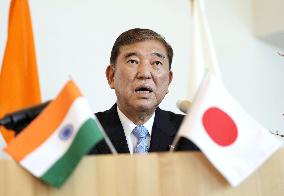
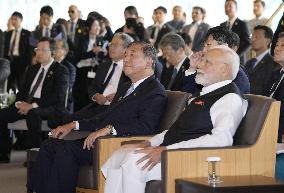
Japanese Prime Minister Shigeru Ishiba meets the press following an inspection with Indian Prime Minister Narendra Modi of a Tokyo Electron semiconductor factory in Taiwa in the northeastern Japan prefecture of Miyagi on Aug. 30, 2025.

  •  
Indian Prime Minister Modi in Japan

Indian Prime Minister Modi in Japan

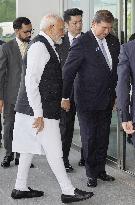
Japanese Prime Minister Shigeru Ishiba (R) and Indian Prime Minister Narendra Modi (L) visit a Tokyo Electron semiconductor factory in Taiwa in the northeastern Japan prefecture of Miyagi on Aug. 30, 2025.

  •  
Indian Prime Minister Modi in Japan

Indian Prime Minister Modi in Japan

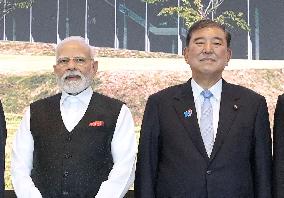
Japanese Prime Minister Shigeru Ishiba (R) and Indian Prime Minister Narendra Modi pose for a photo during a visit to a Tokyo Electron semiconductor factory in Taiwa in the northeastern Japan prefecture of Miyagi on Aug. 30, 2025.

  •  
Indian Prime Minister Modi in Japan

Indian Prime Minister Modi in Japan

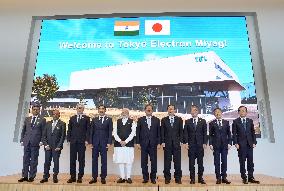
Japanese Prime Minister Shigeru Ishiba (C, R) and Indian Prime Minister Narendra Modi (C, L) pose for a photo during a visit to a Tokyo Electron semiconductor factory in Taiwa in the northeastern Japan prefecture of Miyagi on Aug. 30, 2025.

  •  
Indian Prime Minister Modi in Japan

Indian Prime Minister Modi in Japan

Photo shows Japanese Prime Minister Shigeru Ishiba (2nd from R) and Indian Prime Minister Narendra Modi (far R) during a visit to a Tokyo Electron semiconductor factory in Taiwa in the northeastern Japan prefecture of Miyagi on Aug. 30, 2025.

  •  
Science Popularization Carnival Activity in Zhangye

Science Popularization Carnival Activity in Zhangye

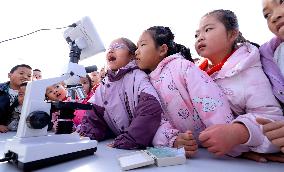
ZHANGYE, CHINA - MARCH 19, 2025 - Students conduct an experiment with an electron microscope at the stadium of Jin 'anyuan School in Ganzhou district of Zhangye city, Northwest China's Gansu province on March 19, 2025.

  •  
CES tech show in Las Vegas

CES tech show in Las Vegas

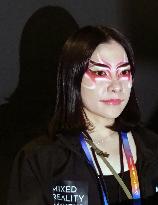
A model demonstrates technology that projects a chosen makeup image onto the user's face, adjusting it to their facial shape. The technology, developed by Japanese cosmetics maker Kose Corp. and Tokyo Electron Device Ltd., was unveiled at CES, an annual consumer electronics trade show, in Las Vegas on Jan. 8, 2025.

  •  
Artificial Blood Vessel

Artificial Blood Vessel

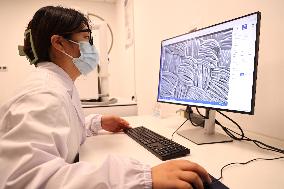
BINZHOU, CHINA - AUGUST 22, 2024 - A researcher uses a scanning electron microscope to observe the coating of artificial blood vessels at the research and development laboratory of Pleasant Group in Binzhou High-tech Industrial Development Zone, East China's Shandong province, Aug 22, 2024.

  •  
Artificial Blood Vessel

Artificial Blood Vessel

BINZHOU, CHINA - AUGUST 22, 2024 - A researcher uses a scanning electron microscope to observe the coating of artificial blood vessels at the research and development laboratory of Pleasant Group in Binzhou High-tech Industrial Development Zone, East China's Shandong province, Aug 22, 2024.

  •  
XINHUA PHOTOS OF THE DAY

XINHUA PHOTOS OF THE DAY

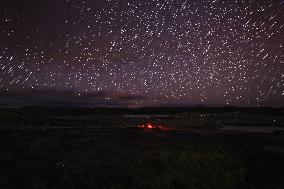
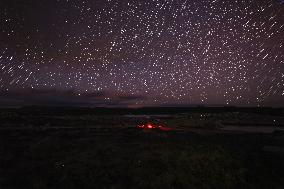
(240227) -- BEIJING, Feb. 27, 2024 (Xinhua) -- This composite photo taken on April 21, 2023 shows the Large High Altitude Air Shower Observatory (LHAASO) at an altitude of 4,410 meters on Mount Haizi in Daocheng County, southwest China's Sichuan Province. China's cosmic ray observatory has discovered a giant ultra-high-energy gamma-ray bubble structure, about ten million times larger than our solar system, in the Cygnus star-forming region, around 5,000 light years from Earth. Based on the observations made by China's LHAASO, scientists identified that star-forming region as one source of the cosmic rays in the Milky Way with an energy level higher than 10 peta-electron volts (quadrillion electron volts or PeV), about 1,000 times more than the record high achieved by any manmade accelerator on Earth. (Xinhua/Jin Liwang)

  •  
(EyesonSci) CHINA-LHAASO-GAMMA-RAY-DISCOVERY (CN)

(EyesonSci) CHINA-LHAASO-GAMMA-RAY-DISCOVERY (CN)

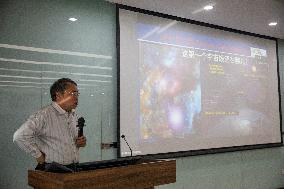
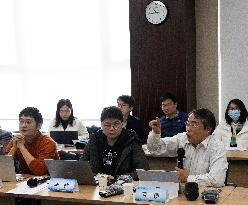
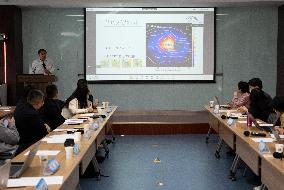
(240226) -- BEIJING, Feb. 26, 2024 (Xinhua) -- Cao Zhen, principal investigator of Large High Altitude Air Shower Observatory (LHAASO) and an academician of Chinese Academy of Sciences (CAS), introduces research findings at the Institute of High Energy Physics of CAS, in Beijing, capital of China, Feb. 22, 2024. China's cosmic ray observatory has discovered a giant ultra-high-energy gamma-ray bubble structure, about ten million times larger than our solar system, in the Cygnus star-forming region, around 5,000 light years from Earth. Based on the observations made by China's LHAASO, scientists identified that star-forming region as one source of the cosmic rays in the Milky Way with an energy level higher than 10 peta-electron volts (quadrillion electron volts or PeV), about 1,000 times more than the record high achieved by any manmade accelerator on Earth. (Xinhua/Jin Liwang)

  •  
(EyesonSci) CHINA-LHAASO-GAMMA-RAY-DISCOVERY (CN)

(EyesonSci) CHINA-LHAASO-GAMMA-RAY-DISCOVERY (CN)

(240226) -- BEIJING, Feb. 26, 2024 (Xinhua) -- This composite photo taken on April 21, 2023 shows the Large High Altitude Air Shower Observatory (LHAASO) at an altitude of 4,410 meters on Mount Haizi in Daocheng County, southwest China's Sichuan Province. China's cosmic ray observatory has discovered a giant ultra-high-energy gamma-ray bubble structure, about ten million times larger than our solar system, in the Cygnus star-forming region, around 5,000 light years from Earth. Based on the observations made by China's LHAASO, scientists identified that star-forming region as one source of the cosmic rays in the Milky Way with an energy level higher than 10 peta-electron volts (quadrillion electron volts or PeV), about 1,000 times more than the record high achieved by any manmade accelerator on Earth. (Xinhua/Jin Liwang)

  •  
(EyesonSci) CHINA-LHAASO-GAMMA-RAY-DISCOVERY (CN)

(EyesonSci) CHINA-LHAASO-GAMMA-RAY-DISCOVERY (CN)

(240226) -- BEIJING, Feb. 26, 2024 (Xinhua) -- Cao Zhen (1st R, front), principal investigator of Large High Altitude Air Shower Observatory (LHAASO) and an academician of Chinese Academy of Sciences (CAS), answers questions at the Institute of High Energy Physics of CAS, in Beijing, capital of China, Feb. 22, 2024. China's cosmic ray observatory has discovered a giant ultra-high-energy gamma-ray bubble structure, about ten million times larger than our solar system, in the Cygnus star-forming region, around 5,000 light years from Earth. Based on the observations made by China's LHAASO, scientists identified that star-forming region as one source of the cosmic rays in the Milky Way with an energy level higher than 10 peta-electron volts (quadrillion electron volts or PeV), about 1,000 times more than the record high achieved by any manmade accelerator on Earth. (Xinhua/Jin Liwang)

  •  
(EyesonSci) CHINA-LHAASO-GAMMA-RAY-DISCOVERY (CN)

(EyesonSci) CHINA-LHAASO-GAMMA-RAY-DISCOVERY (CN)

(240226) -- BEIJING, Feb. 26, 2024 (Xinhua) -- Cao Zhen (at the podium), principal investigator of Large High Altitude Air Shower Observatory (LHAASO) and an academician of Chinese Academy of Sciences (CAS), introduces research findings at the Institute of High Energy Physics of CAS, in Beijing, capital of China, Feb. 22, 2024. China's cosmic ray observatory has discovered a giant ultra-high-energy gamma-ray bubble structure, about ten million times larger than our solar system, in the Cygnus star-forming region, around 5,000 light years from Earth. Based on the observations made by China's LHAASO, scientists identified that star-forming region as one source of the cosmic rays in the Milky Way with an energy level higher than 10 peta-electron volts (quadrillion electron volts or PeV), about 1,000 times more than the record high achieved by any manmade accelerator on Earth. (Xinhua/Jin Liwang)

  •  
Tokyo Electron Device signage and logo

Tokyo Electron Device signage and logo

Tokyo Electron Device signage and logo=Date:October 14, 2023, Place:Kanagawa

  •  
Tokyo Electron Device signage and logo

Tokyo Electron Device signage and logo

Tokyo Electron Device signage and logo=Date:October 14, 2023, Place:Kanagawa

  •  
CHINA-JIANGSU-MUSCULATURE FOSSILS-DISCOVERY (CN)

CHINA-JIANGSU-MUSCULATURE FOSSILS-DISCOVERY (CN)

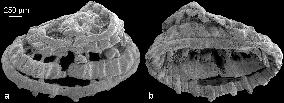
(231011) -- NANJING, Oct. 11, 2023 (Xinhua) -- This electron microscope image shows the newly discovered musculature fossils dating back some 535 million years. TO GO WITH "535-million-year-old animal microfossils with rare preserved muscle discovered in China" (Xinhua)

  •  
Bedbugs Study - Lyon

Bedbugs Study - Lyon

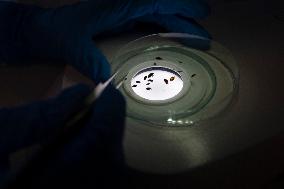
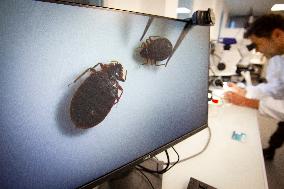
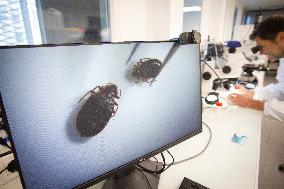
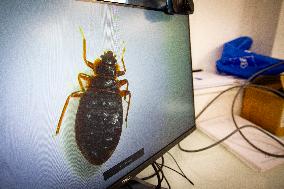
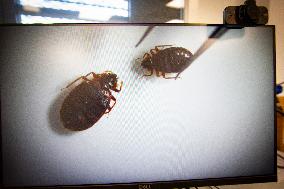
A researcher observes bedbugs in an electron microscope, study on bedbugs, at the biometrics and evolutionary biology laboratory, Lyon, France on October 5, 2023. The French environment ministry said bedbugs have made a resurgence since disappearing in the 1950s due to international travel and increased resistance to pesticides. Photo by Thibaut Durand/ABACAPRESS.COM

  •  
Bedbugs Study - Lyon

Bedbugs Study - Lyon

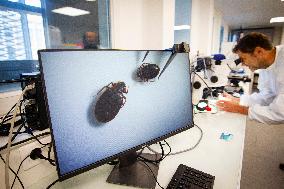
A researcher observes bedbugs in an electron microscope, study on bedbugs, at the biometrics and evolutionary biology laboratory, Lyon, France on October 6, 2023. The French environment ministry said bedbugs have made a resurgence since disappearing in the 1950s due to international travel and increased resistance to pesticides. Photo by Thibaut Durand/ABACAPRESS.COM

  •  
Bedbugs Study - Lyon

Bedbugs Study - Lyon

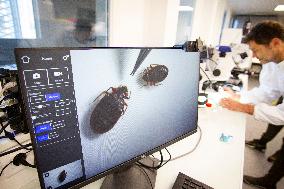
A researcher observes bedbugs in an electron microscope, study on bedbugs, at the biometrics and evolutionary biology laboratory, Lyon, France on October 6, 2023. The French environment ministry said bedbugs have made a resurgence since disappearing in the 1950s due to international travel and increased resistance to pesticides. Photo by Thibaut Durand/ABACAPRESS.COM

  •  
Bedbugs Study - Lyon

Bedbugs Study - Lyon

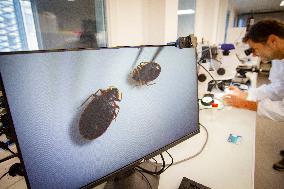
A researcher observes bedbugs in an electron microscope, study on bedbugs, at the biometrics and evolutionary biology laboratory, Lyon, France on October 6, 2023. The French environment ministry said bedbugs have made a resurgence since disappearing in the 1950s due to international travel and increased resistance to pesticides. Photo by Thibaut Durand/ABACAPRESS.COM

  •  
Bedbugs Study - Lyon

Bedbugs Study - Lyon

A researcher observes bedbugs in an electron microscope, study on bedbugs, at the biometrics and evolutionary biology laboratory, Lyon, France on October 6, 2023. The French environment ministry said bedbugs have made a resurgence since disappearing in the 1950s due to international travel and increased resistance to pesticides. Photo by Thibaut Durand/ABACAPRESS.COM

  •  
Bedbugs Study - Lyon

Bedbugs Study - Lyon

A researcher observes bedbugs in an electron microscope, study on bedbugs, at the biometrics and evolutionary biology laboratory, Lyon, France on October 6, 2023. The French environment ministry said bedbugs have made a resurgence since disappearing in the 1950s due to international travel and increased resistance to pesticides. Photo by Thibaut Durand/ABACAPRESS.COM

  •  
Bedbugs Study - Lyon

Bedbugs Study - Lyon

A researcher observes bedbugs in an electron microscope, study on bedbugs, at the biometrics and evolutionary biology laboratory, Lyon, France on October 6, 2023. The French environment ministry said bedbugs have made a resurgence since disappearing in the 1950s due to international travel and increased resistance to pesticides. Photo by Thibaut Durand/ABACAPRESS.COM

  •  
Bedbugs Study - Lyon

Bedbugs Study - Lyon

A researcher observes bedbugs in an electron microscope, study on bedbugs, at the biometrics and evolutionary biology laboratory, Lyon, France on October 6, 2023. The French environment ministry said bedbugs have made a resurgence since disappearing in the 1950s due to international travel and increased resistance to pesticides. Photo by Thibaut Durand/ABACAPRESS.COM

  •  

3 scientists share 2023 Nobel Physics Prize

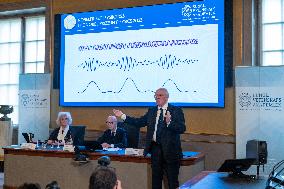
STORY: 3 scientists share 2023 Nobel Physics Prize DATELINE: Oct. 4, 2023 LENGTH: 00:02:15 LOCATION: Stockholm CATEGORY: SCIENCE SHOTLIST: 1. various of the press conference and photos of laureates of the 2023 Nobel Prize in Physics 2. various of the Royal Swedish Academy of Sciences STORYLINE: Three scientists, Pierre Agostini, Ferenc Krausz and Anne L'Huillier, won the 2023 Nobel Prize in Physics "for experimental methods that generate attosecond pulses of light for the study of electron dynamics in matter," the Royal Swedish Academy of Sciences announced here Tuesday. "The three Nobel Laureates in Physics 2023 are being recognized for their experiments, which have given humanity new tools for exploring the world of electrons inside atoms and molecules," the academy said in a statement. "The three scientists have demonstrated a way to create extremely short pulses of light that can be used to measure the rapid processes in which electrons move or change energy," it added. In a telephone interview on-s

  •  
SWEDEN-STOCKHOLM-2023 NOBEL PRIZE-PHYSICS

SWEDEN-STOCKHOLM-2023 NOBEL PRIZE-PHYSICS

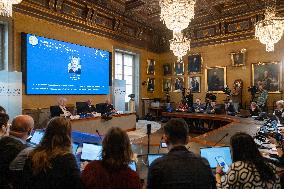
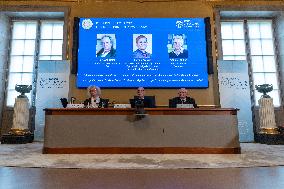
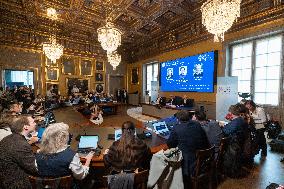
(231003) -- STOCKHOLM, Oct. 3, 2023 (Xinhua) -- The announcement of the 2023 Nobel Prize in Physics is held at the Royal Swedish Academy of Sciences in Stockholm, Sweden, Oct. 3, 2023. Three scientists, Pierre Agostini, Ferenc Krausz and Anne L'Huillier, won the 2023 Nobel Prize in Physics "for experimental methods that generate attosecond pulses of light for the study of electron dynamics in matter," the Royal Swedish Academy of Sciences announced here Tuesday. (Photo by Wei Xuechao/Xinhua)

  •  
SWEDEN-STOCKHOLM-2023 NOBEL PRIZE-PHYSICS

SWEDEN-STOCKHOLM-2023 NOBEL PRIZE-PHYSICS

(231003) -- STOCKHOLM, Oct. 3, 2023 (Xinhua) -- Mats Larsson, member of the Nobel Committee for Physics, explains the achievements made by the 2023 Nobel laureates in Physics during the prize announcement at the Royal Swedish Academy of Sciences in Stockholm, Sweden, Oct. 3, 2023. Three scientists, Pierre Agostini, Ferenc Krausz and Anne L'Huillier, won the 2023 Nobel Prize in Physics "for experimental methods that generate attosecond pulses of light for the study of electron dynamics in matter," the Royal Swedish Academy of Sciences announced here Tuesday. (Photo by Wei Xuechao/Xinhua)

  •  
SWEDEN-STOCKHOLM-2023 NOBEL PRIZE-PHYSICS

SWEDEN-STOCKHOLM-2023 NOBEL PRIZE-PHYSICS

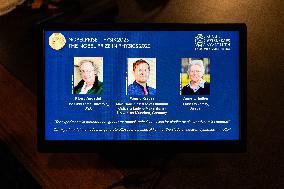
(231003) -- STOCKHOLM, Oct. 3, 2023 (Xinhua) -- Portraits of Nobel Laureates in Physics 2023 Pierre Agostini (L), Ferenc Krausz (C) and Anne L'Huillier are shown on a screen during the prize announcement at the Royal Swedish Academy of Sciences in Stockholm, Sweden, Oct. 3, 2023. Three scientists, Pierre Agostini, Ferenc Krausz and Anne L'Huillier, won the 2023 Nobel Prize in Physics "for experimental methods that generate attosecond pulses of light for the study of electron dynamics in matter," the Royal Swedish Academy of Sciences announced here Tuesday. (Photo by Wei Xuechao/Xinhua)

  •  
SWEDEN-STOCKHOLM-2023 NOBEL PRIZE-PHYSICS

SWEDEN-STOCKHOLM-2023 NOBEL PRIZE-PHYSICS

(231003) -- STOCKHOLM, Oct. 3, 2023 (Xinhua) -- Portraits of Nobel Laureates in Physics 2023 Pierre Agostini (L), Ferenc Krausz (C) and Anne L'Huillier are shown on a screen during the prize announcement at the Royal Swedish Academy of Sciences in Stockholm, Sweden, Oct. 3, 2023. Three scientists, Pierre Agostini, Ferenc Krausz and Anne L'Huillier, won the 2023 Nobel Prize in Physics "for experimental methods that generate attosecond pulses of light for the study of electron dynamics in matter," the Royal Swedish Academy of Sciences announced here Tuesday. (Photo by Wei Xuechao/Xinhua)

  •  
SWEDEN-STOCKHOLM-2023 NOBEL PRIZE-PHYSICS

SWEDEN-STOCKHOLM-2023 NOBEL PRIZE-PHYSICS

(231003) -- STOCKHOLM, Oct. 3, 2023 (Xinhua) -- The announcement of the 2023 Nobel Prize in Physics is held at the Royal Swedish Academy of Sciences in Stockholm, Sweden, Oct. 3, 2023. Three scientists, Pierre Agostini, Ferenc Krausz and Anne L'Huillier, won the 2023 Nobel Prize in Physics "for experimental methods that generate attosecond pulses of light for the study of electron dynamics in matter," the Royal Swedish Academy of Sciences announced here Tuesday. (Photo by Wei Xuechao/Xinhua)

  •  
CHINA-ANHUI-HEFEI-LUNAR SOIL-ART EXPO (CN)

CHINA-ANHUI-HEFEI-LUNAR SOIL-ART EXPO (CN)

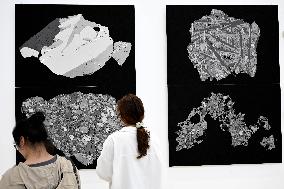
(230420) -- HEFEI, April 20, 2023 (Xinhua) -- Visitors view back-scatter electron micrographs of lunar soil particles at an exhibition themed on lunar soil research achievements in University of Science and Technology of China, in Hefei, east China's Anhui Province, April 19, 2023. The exhibition starting Monday displays exhibits made by scientists, artists and engineers based on micrographs of lunar soil particles brought back by the Chang'e-5 probe. In 2020, China's Chang'e-5 mission retrieved samples from the moon weighing about 1,731 grams. (Xinhua/Huang Bohan)

  •  
Tokyo Electron to merge with Applied Materials

Tokyo Electron to merge with Applied Materials

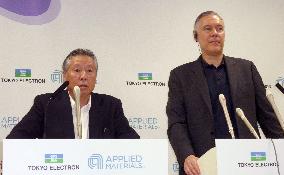
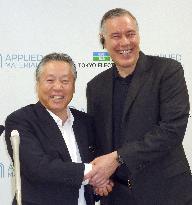
TOKYO, Japan - Tetsuro Higashi (L), chairman and president of semiconductor manufacturing equipment maker Tokyo Electron Ltd., and Gary Dickerson, chief executive officer of California-based Applied Materials Inc., hold a press conference in Tokyo on Sept. 24, 2013, to announce that the two companies will merge in the second half of 2014.

  •  
Tokyo Electron to merge with Applied Materials

Tokyo Electron to merge with Applied Materials

TOKYO, Japan - Tetsuro Higashi (L), chairman and president of semiconductor manufacturing equipment maker Tokyo Electron Ltd., and Gary Dickerson, chief executive officer of California-based Applied Materials Inc., shake hands during a press conference in Tokyo on Sept. 24, 2013. The two companies announced they will merge in the second half of 2014.

  •  
Physicist Tonomura dies at 70

Physicist Tonomura dies at 70

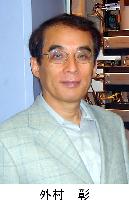
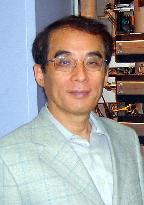
TOKYO, Japan - File photo taken in August 2006 shows Japanese physicist Akira Tonomura. A fellow at electronics giant Hitachi Ltd. tipped as a future Nobel Prize winner for years, Tonomura died of pancreatic cancer early on May 2, 2012, at a hospital in Hidaka, Saitama Prefecture. He was 70. Tonomura was known for developing electron holography for observing microscopic structures in matter using the wave nature of electrons and confirming the so-called Aharonov-Bohm effect, the existence of which had long been disputed among physicists.

  •  
X-ray free electron laser facility SACLA

X-ray free electron laser facility SACLA

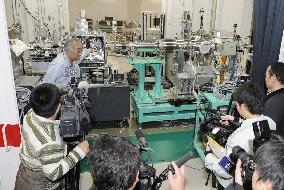
OSAKA, Japan - Photo taken in the town of Sayo, Hyogo Prefecture, on Feb. 6, 2012, shows the inside of SACLA, a cutting-edge X-ray Free Electron Laser (XFEL) facility, which was unveiled the same day by the Japanese government-backed laboratory Riken.

  •  
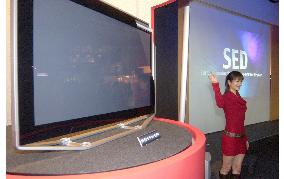
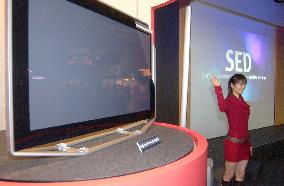
Toshiba, Canon delay next-generation SED TV's release till late 2007

Toshiba, Canon delay next-generation SED TV's release till late 2007

TOKYO, Japan - Toshiba Corp. and Canon Inc. said on March 8 their alliance will delay the release of a next-generation high quality-image TV, known as a surface-conduction electron-emitter display television, or SED TV (in photo taken on Oct. 4, 2005), until the October-December period of 2007 from the originally planned release date this spring. A Canon official said the two decided to put off the release as they have found it hard to cut production costs quickly enough.

  •  
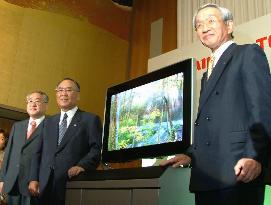
Canon, Toshiba to start joint venture for new flat-screen panels

Canon, Toshiba to start joint venture for new flat-screen panels

TOKYO, Japan - Canon Inc. President Fujio Mitarai (2nd from L) and Toshiba Corp. President Tadashi Okamura pose at a press conference in Tokyo on Sept. 14 after announcing an agreement to establish a joint venture for the development, production and marketing of a new flat-screen panel called surface-conduction electron-emitter display or SED. The new company, SED Inc., will make SED panels primarily for large flat-screen televisions, with production planned to begin in 2005.

  •  
Perovskite solar cell device developed by Yamagata University

Perovskite solar cell device developed by Yamagata University

Professor Kenshi Sano and his team at Yamagata University have developed a perovskite solar cell with a structure called "reverse type" fabricated by a low-temperature formation process of 150 degrees C or lower. So far, the conversion efficiency of the low-temperature formation and inverse-type structure has been 17-19%, but using Yamagata University's organic EL manufacturing technology, they have confirmed a conversion efficiency of over 20%. Conventionally, solar cells have been fabricated using a high-temperature formation method called the "forward type," in which an electron transport layer (titania) is baked on top of a special transparent conductive film using a high-temperature process (approximately 500 degrees C). The research team at Yamagata University has been working on the inverse type device structure, which can reduce the process temperature. (Photo taken on May 23, 2019, location unknown, credit: Nikkan Kogyo Shimbun / Kyodo News Images)

  •  
Canon, Toshiba to start joint venture for new flat-screen panels

Canon, Toshiba to start joint venture for new flat-screen panels

TOKYO, Japan - Canon Inc. President Fujio Mitarai (2nd from L) and Toshiba Corp. President Tadashi Okamura pose at a press conference in Tokyo on Sept. 14 after announcing an agreement to establish a joint venture for the development, production and marketing of a new flat-screen panel called surface-conduction electron-emitter display or SED. The new company, SED Inc., will make SED panels primarily for large flat-screen televisions, with production planned to begin in 2005. (Kyodo)

  •  
Toshiba, Canon delay next-generation SED TV's release till late

Toshiba, Canon delay next-generation SED TV's release till late

TOKYO, Japan - Toshiba Corp. and Canon Inc. said on March 8 their alliance will delay the release of a next-generation high quality-image TV, known as a surface-conduction electron-emitter display television, or SED TV (in photo taken on Oct. 4, 2005), until the October-December period of 2007 from the originally planned release date this spring. A Canon official said the two decided to put off the release as they have found it hard to cut production costs quickly enough. (Kyodo)

  •  

MILLION-VOLT ELECTRON MICRO SCOPE

MILLION-VOLT ELECTRON MICRO SCOPE==Date:Oct, 1966, Place:,JAPAN, (Credit:INTERNATIONAL MOTION PICTURE/Kyodo News Images)

  •  
Mechanism developed to study platinum degradation in fuel cells

Mechanism developed to study platinum degradation in fuel cells

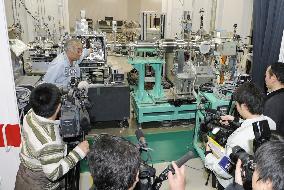
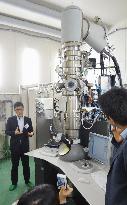
A Toyota Motor Corp. engineer (L), standing next to a transmission electron microscope, explains to the press in Nagoya, central Japan, on May 18, 2015, about a mechanism jointly developed by the automaker and Japan Fine Ceramics Center to observe platinum degradation in fuel cells. (Kyodo) ==Kyodo

  •  
Tokyo Electron announces cancellation of merger with Applied Materials

Tokyo Electron announces cancellation of merger with Applied Materials

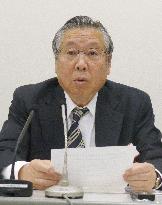
Tokyo Electron Ltd. Chairman, President and CEO Tetsuro Higashi announced on April 27, 2015 the cancellation of the chipmaking equipment maker's planned merger with global industry leader Applied Materials Inc. due to a dispute with the U.S. Justice Department. (Kyodo) ==Kyodo

  •  
Physicist Tonomura dies at 70

Physicist Tonomura dies at 70

TOKYO, Japan - File photo taken in August 2006 shows Japanese physicist Akira Tonomura. A fellow at electronics giant Hitachi Ltd. tipped as a future Nobel Prize winner for years, Tonomura died of pancreatic cancer early on May 2, 2012, at a hospital in Hidaka, Saitama Prefecture. He was 70. Tonomura was known for developing electron holography for observing microscopic structures in matter using the wave nature of electrons and confirming the so-called Aharonov-Bohm effect, the existence of which had long been disputed among physicists. (Kyodo)

  •  
X-ray free electron laser facility SACLA

X-ray free electron laser facility SACLA

OSAKA, Japan - Photo taken in the town of Sayo, Hyogo Prefecture, on Feb. 6, 2012, shows the inside of SACLA, a cutting-edge X-ray Free Electron Laser (XFEL) facility, which was unveiled the same day by the Japanese government-backed laboratory Riken. (Kyodo)

  • Main
  • Top
  • Editorial
  • Creative
  • About Us
  • About ILG
  • Terms of use
  • Company
  • BEHIND
  • Price List
  • Single Plan
  • Monthly Plan
  • Services
  • Shooting
  • Rights Clearance
  • Support
  • FAQ
  • How To Buy
  • Contact Us
  • Become a Partner

© KYODO NEWS IMAGES INC

All Rights Reserved.

  • Editorial
  • Olympics
  • News
  • Sports
  • Japan
  • Tech
  • Royal
  • Disaster
  • NorthKorea
  • Old Japan
  • SNS
  • Creative
  • Food
  • Japan
  • Landscape
  • Animal
  • Popular
  • #Ukraine
  • #China
  • #coronavirus
  • #N. Korea
  • #Thailand
  • #Russia
  • #Ukraine
  • #China
  • #coronavirus
  • #N. Korea
  • #Thailand
  • #Russia
  • Food
  • Japan
  • Landscape
  • Animal
  • Olympics
  • News
  • Sports
  • Japan
  • Tech
  • Royal
  • Disaster
  • NorthKorea
  • Old Japan
  • SNS