•  
First images From Copernicus Sentinel-5A

First images From Copernicus Sentinel-5A

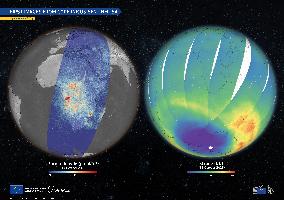
Handout photo dated October 13, 2025 shows Copernicus Sentinel-5A has delivered its first images after its launch on 13 August 2025, marking a significant milestone in the monitoring of air quality from space. The Sentinel-5 mission provides observations of key air pollutants, essential climate variables, and stratospheric ozone, which is the protective layer shielding life on Earth from harmful ultraviolet radiation. This visualisation, created with Sentinel-5A data acquired on 13 October 2025, shows atmospheric concentrations of two trace gases: ozone (O₃) and formaldehyde (HCHO). The image on the left presents the formaldehyde vertical column density. Elevated concentrations along the northwestern coast of Angola are linked to emissions from wildfires, while increased levels over the Central African Republic stem from a combination of fire activity and biogenic emissions. The image on the right shows a global map of ozone. The hole in stratospheric ozone above Antarctica is clearly visible, with column den

  •  
Maintenance Workers Fix Locomotive Parts - Nairobi

Maintenance Workers Fix Locomotive Parts - Nairobi

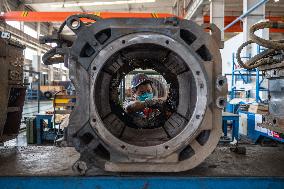
A maintenance worker paints insulating layer for locomotive parts in the repair workshop of the Mombasa-Nairobi Railway in Nairobi, Kenya, Jan. 23, 2025. Launched in May 2017, the Mombasa-Nairobi Railway, spanning approximately 480 km, connects the large Indian Ocean city of Mombasa with Nairobi, the country's capital and largest city. It is Kenya's first modern railway since independence and is hailed as a flagship project under the Belt and Road cooperation between China and Kenya. After eight years of operation, Africa Star Railway Operation Company (Afristar), the company operating the Mombasa-Nairobi Railway, initiated a maintenance program for 41 passenger cars and 10 locomotives on Jan. 15. With plans to complete the maintenance by May 31, these tasks will decrease the failure rate of locomotives during operation and ensure continuous safe and smooth transportation for its clients. Photo by Wang Guansen/Xinhua/ABACAPRESS.COM

  •  
China First 350km/h Mixed-layer Bridge in Nanchang

China First 350km/h Mixed-layer Bridge in Nanchang

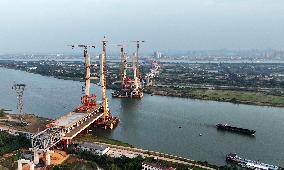
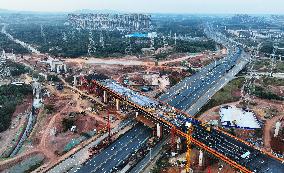
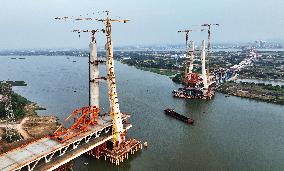
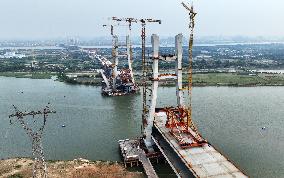
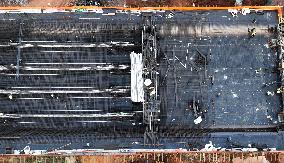
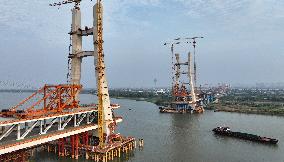
NANCHANG, CHINA - OCTOBER 10, 2024 - Construction workers are working in China's Nanchang-Jiujiang High-speed Railway Ganjiang River Highway and Railway Bridge, the China's first 350km/h mixed-layer bridge, in Nanchang, Jiangsu province, China, Oct 10, 2024.

  •  
China First 350km/h Mixed-layer Bridge in Nanchang

China First 350km/h Mixed-layer Bridge in Nanchang

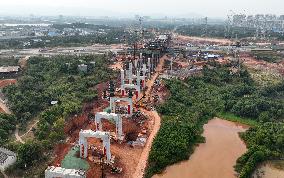
NANCHANG, CHINA - OCTOBER 10, 2024 - Construction workers are working in China's Nanchang-Jiujiang High-speed Railway Ganjiang River Highway and Railway Bridge, the China's first 350km/h mixed-layer bridge, in Nanchang, Jiangsu province, China, Oct 10, 2024.

  •  
China First 350km/h Mixed-layer Bridge in Nanchang

China First 350km/h Mixed-layer Bridge in Nanchang

NANCHANG, CHINA - OCTOBER 10, 2024 - Construction workers are working in China's Nanchang-Jiujiang High-speed Railway Ganjiang River Highway and Railway Bridge, the China's first 350km/h mixed-layer bridge, in Nanchang, Jiangsu province, China, Oct 10, 2024.

  •  
China First 350km/h Mixed-layer Bridge in Nanchang

China First 350km/h Mixed-layer Bridge in Nanchang

NANCHANG, CHINA - OCTOBER 10, 2024 - Construction workers are working in China's Nanchang-Jiujiang High-speed Railway Ganjiang River Highway and Railway Bridge, the China's first 350km/h mixed-layer bridge, in Nanchang, Jiangsu province, China, Oct 10, 2024.

  •  
China First 350km/h Mixed-layer Bridge in Nanchang

China First 350km/h Mixed-layer Bridge in Nanchang

NANCHANG, CHINA - OCTOBER 10, 2024 - Construction workers are working in China's Nanchang-Jiujiang High-speed Railway Ganjiang River Highway and Railway Bridge, the China's first 350km/h mixed-layer bridge, in Nanchang, Jiangsu province, China, Oct 10, 2024.

  •  
China First 350km/h Mixed-layer Bridge in Nanchang

China First 350km/h Mixed-layer Bridge in Nanchang

NANCHANG, CHINA - OCTOBER 10, 2024 - Construction workers are working in China's Nanchang-Jiujiang High-speed Railway Ganjiang River Highway and Railway Bridge, the China's first 350km/h mixed-layer bridge, in Nanchang, Jiangsu province, China, Oct 10, 2024.

  •  
China First 350km/h Mixed-layer Bridge in Nanchang

China First 350km/h Mixed-layer Bridge in Nanchang

NANCHANG, CHINA - OCTOBER 10, 2024 - Construction workers are working in China's Nanchang-Jiujiang High-speed Railway Ganjiang River Highway and Railway Bridge, the China's first 350km/h mixed-layer bridge, in Nanchang, Jiangsu province, China, Oct 10, 2024.

  •  
(FOCUS)CHINA-SICHUAN-SANXINGDUI RUINS-DISCOVERIES-WORKSHOP-JADE-STONE (CN)

(FOCUS)CHINA-SICHUAN-SANXINGDUI RUINS-DISCOVERIES-WORKSHOP-JADE-STONE (CN)

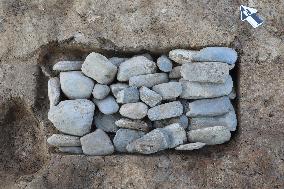
(240723) -- CHENGDU, July 23, 2024 Photo by Xinhua/ABACAPRESS.COM) -- This file photo taken on March 13, 2023 shows the first layer of a stone axe pit discovered at the Sanxingdui Ruins site in Guanghan City, southwest China's Sichuan Province. Archaeological authorities have recently unveiled groundbreaking discoveries, including a jade and stone artifact "workshop" dating back over 3,400 years, at the legendary Sanxingdui Ruins site. The new finds offer vital insights into the origins of various precious cultural relics and highlight the remarkable achievements of ancient Chinese civilization. (Sichuan cultural relics and archaeology research institute/Handout via Xinhua/ABACAPRESS.COM

  •  
Chinese Experience in Desert Controi

Chinese Experience in Desert Controi

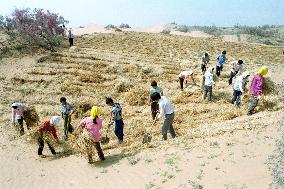
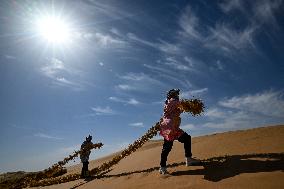
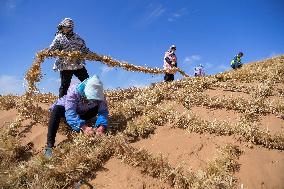
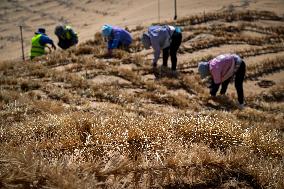
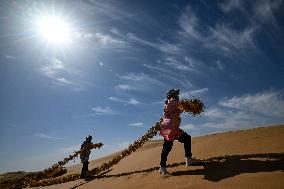
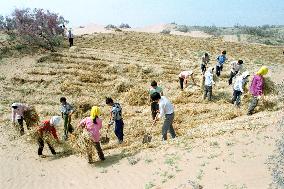
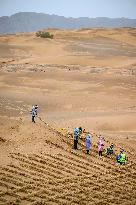
Workers set up straw checkerboards in Zhongwei, northwest China's Ningxia Hui Autonomous Region, Sept. 24, 1994. In the 1950s, to protect China's first railway that runs through a desert, the city of Zhongwei embarked on a journey of desert mitigation. Scientists at the Shapotou Desert Research and Experiment Station, part of the Northwest Institute of Eco-Environment and Resources of the Chinese Academy of Sciences, along with local residents, developed straw checkerboards to stabilize the sand and prevent dunes from shifting. Tang Ximing, a senior engineer at a state-owned forestry farm in Zhongwei, crafted a steel tool that differs from regular shovels by featuring two horizontal bars at the front tip. This innovative tool enables the planting of seedling roots 50 centimeters deep into the moist sand layer. This simple tool increases the survival rate of afforestation by 25 percent to over 85 percent. It has been widely promoted and used in afforestation projects across other regions in northern China. In

  •  
Chinese Experience in Desert Controi

Chinese Experience in Desert Controi

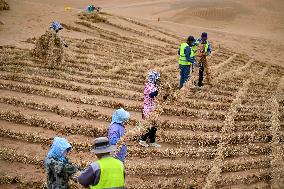
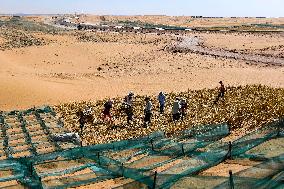
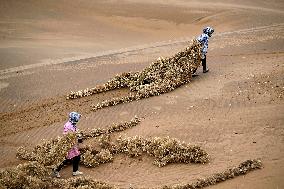
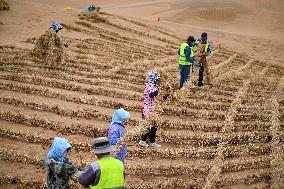
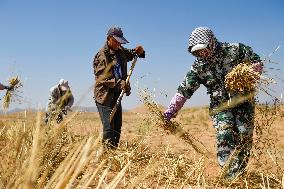
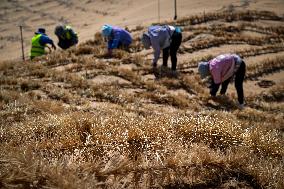
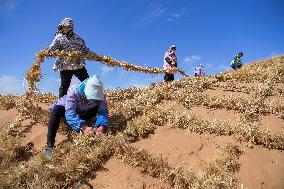
Workers pave straw checkerboards in the Tengger Desert, in Zhongwei of northwest China's Ningxia Hui Autonomous Region, May 29, 2024. In the 1950s, to protect China's first railway that runs through a desert, the city of Zhongwei embarked on a journey of desert mitigation. Scientists at the Shapotou Desert Research and Experiment Station, part of the Northwest Institute of Eco-Environment and Resources of the Chinese Academy of Sciences, along with local residents, developed straw checkerboards to stabilize the sand and prevent dunes from shifting. Tang Ximing, a senior engineer at a state-owned forestry farm in Zhongwei, crafted a steel tool that differs from regular shovels by featuring two horizontal bars at the front tip. This innovative tool enables the planting of seedling roots 50 centimeters deep into the moist sand layer. This simple tool increases the survival rate of afforestation by 25 percent to over 85 percent. It has been widely promoted and used in afforestation projects across other regions i

  •  
Chinese Experience in Desert Controi

Chinese Experience in Desert Controi

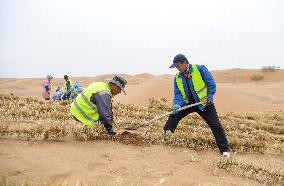
Workers pave straw checkerboards in the Tengger Desert, in Zhongwei of northwest China's Ningxia Hui Autonomous Region, May 30, 2024. In the 1950s, to protect China's first railway that runs through a desert, the city of Zhongwei embarked on a journey of desert mitigation. Scientists at the Shapotou Desert Research and Experiment Station, part of the Northwest Institute of Eco-Environment and Resources of the Chinese Academy of Sciences, along with local residents, developed straw checkerboards to stabilize the sand and prevent dunes from shifting. Tang Ximing, a senior engineer at a state-owned forestry farm in Zhongwei, crafted a steel tool that differs from regular shovels by featuring two horizontal bars at the front tip. This innovative tool enables the planting of seedling roots 50 centimeters deep into the moist sand layer. This simple tool increases the survival rate of afforestation by 25 percent to over 85 percent. It has been widely promoted and used in afforestation projects across other regions i

  •  
Chinese Experience in Desert Controi

Chinese Experience in Desert Controi

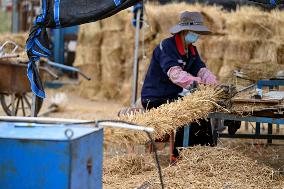
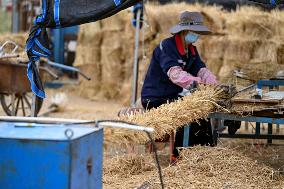
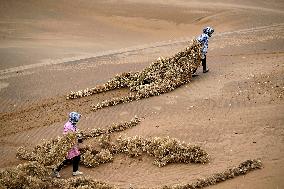
Workers produce straw checkerboard materials in Zhongwei of northwest China's Ningxia Hui Autonomous Region, May 29, 2024. In the 1950s, to protect China's first railway that runs through a desert, the city of Zhongwei embarked on a journey of desert mitigation. Scientists at the Shapotou Desert Research and Experiment Station, part of the Northwest Institute of Eco-Environment and Resources of the Chinese Academy of Sciences, along with local residents, developed straw checkerboards to stabilize the sand and prevent dunes from shifting. Tang Ximing, a senior engineer at a state-owned forestry farm in Zhongwei, crafted a steel tool that differs from regular shovels by featuring two horizontal bars at the front tip. This innovative tool enables the planting of seedling roots 50 centimeters deep into the moist sand layer. This simple tool increases the survival rate of afforestation by 25 percent to over 85 percent. It has been widely promoted and used in afforestation projects across other regions in northern

  •  
Chinese Experience in Desert Controi

Chinese Experience in Desert Controi

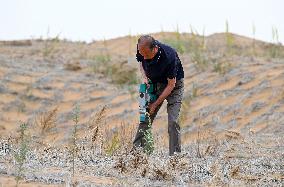
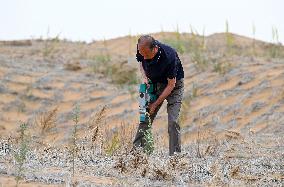
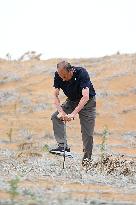
Tang Ximing, a senior engineer at a state-owned forestry farm in Zhongwei, demonstrates an upgraded electric seedling planter invented by himself in northwest China's Ningxia Hui Autonomous Region, June 1, 2024. In the 1950s, to protect China's first railway that runs through a desert, the city of Zhongwei embarked on a journey of desert mitigation. Scientists at the Shapotou Desert Research and Experiment Station, part of the Northwest Institute of Eco-Environment and Resources of the Chinese Academy of Sciences, along with local residents, developed straw checkerboards to stabilize the sand and prevent dunes from shifting. Tang Ximing, a senior engineer at a state-owned forestry farm in Zhongwei, crafted a steel tool that differs from regular shovels by featuring two horizontal bars at the front tip. This innovative tool enables the planting of seedling roots 50 centimeters deep into the moist sand layer. This simple tool increases the survival rate of afforestation by 25 percent to over 85 percent. It has

  •  
Chinese Experience in Desert Controi

Chinese Experience in Desert Controi

Workers set up straw checkerboards in Zhongwei, northwest China's Ningxia Hui Autonomous Region, June 13, 2019. In the 1950s, to protect China's first railway that runs through a desert, the city of Zhongwei embarked on a journey of desert mitigation. Scientists at the Shapotou Desert Research and Experiment Station, part of the Northwest Institute of Eco-Environment and Resources of the Chinese Academy of Sciences, along with local residents, developed straw checkerboards to stabilize the sand and prevent dunes from shifting. Tang Ximing, a senior engineer at a state-owned forestry farm in Zhongwei, crafted a steel tool that differs from regular shovels by featuring two horizontal bars at the front tip. This innovative tool enables the planting of seedling roots 50 centimeters deep into the moist sand layer. This simple tool increases the survival rate of afforestation by 25 percent to over 85 percent. It has been widely promoted and used in afforestation projects across other regions in northern China. In 2

  •  
Chinese Experience in Desert Controi

Chinese Experience in Desert Controi

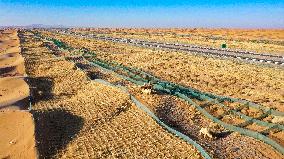
An aerial drone photo taken on Sept. 7, 2020 shows workers paving straw checkerboards near a section of an express way in the Tengger Desert, northwest China's Ningxia Hui Autonomous Region. In the 1950s, to protect China's first railway that runs through a desert, the city of Zhongwei embarked on a journey of desert mitigation. Scientists at the Shapotou Desert Research and Experiment Station, part of the Northwest Institute of Eco-Environment and Resources of the Chinese Academy of Sciences, along with local residents, developed straw checkerboards to stabilize the sand and prevent dunes from shifting. Tang Ximing, a senior engineer at a state-owned forestry farm in Zhongwei, crafted a steel tool that differs from regular shovels by featuring two horizontal bars at the front tip. This innovative tool enables the planting of seedling roots 50 centimeters deep into the moist sand layer. This simple tool increases the survival rate of afforestation by 25 percent to over 85 percent. It has been widely promoted

  •  
Chinese Experience in Desert Controi

Chinese Experience in Desert Controi

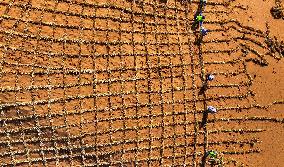
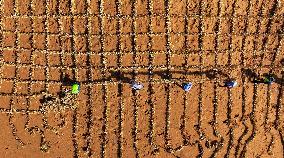
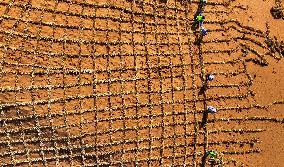
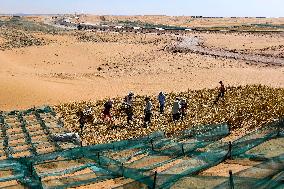
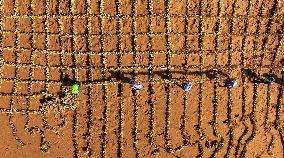
An aerial drone photo taken on May 30, 2024 shows workers paving straw checkerboards in the Tengger Desert, in Zhongwei of northwest China's Ningxia Hui Autonomous Region. In the 1950s, to protect China's first railway that runs through a desert, the city of Zhongwei embarked on a journey of desert mitigation. Scientists at the Shapotou Desert Research and Experiment Station, part of the Northwest Institute of Eco-Environment and Resources of the Chinese Academy of Sciences, along with local residents, developed straw checkerboards to stabilize the sand and prevent dunes from shifting. Tang Ximing, a senior engineer at a state-owned forestry farm in Zhongwei, crafted a steel tool that differs from regular shovels by featuring two horizontal bars at the front tip. This innovative tool enables the planting of seedling roots 50 centimeters deep into the moist sand layer. This simple tool increases the survival rate of afforestation by 25 percent to over 85 percent. It has been widely promoted and used in affores

  •  
Chinese Experience in Desert Controi

Chinese Experience in Desert Controi

An aerial drone photo taken on May 30, 2024 shows workers paving straw checkerboards in the Tengger Desert, in Zhongwei of northwest China's Ningxia Hui Autonomous Region. In the 1950s, to protect China's first railway that runs through a desert, the city of Zhongwei embarked on a journey of desert mitigation. Scientists at the Shapotou Desert Research and Experiment Station, part of the Northwest Institute of Eco-Environment and Resources of the Chinese Academy of Sciences, along with local residents, developed straw checkerboards to stabilize the sand and prevent dunes from shifting. Tang Ximing, a senior engineer at a state-owned forestry farm in Zhongwei, crafted a steel tool that differs from regular shovels by featuring two horizontal bars at the front tip. This innovative tool enables the planting of seedling roots 50 centimeters deep into the moist sand layer. This simple tool increases the survival rate of afforestation by 25 percent to over 85 percent. It has been widely promoted and used in affores

  •  
Chinese Experience in Desert Controi

Chinese Experience in Desert Controi

Workers pave straw checkerboards in the Tengger Desert, in Zhongwei of northwest China's Ningxia Hui Autonomous Region, May 29, 2024. In the 1950s, to protect China's first railway that runs through a desert, the city of Zhongwei embarked on a journey of desert mitigation. Scientists at the Shapotou Desert Research and Experiment Station, part of the Northwest Institute of Eco-Environment and Resources of the Chinese Academy of Sciences, along with local residents, developed straw checkerboards to stabilize the sand and prevent dunes from shifting. Tang Ximing, a senior engineer at a state-owned forestry farm in Zhongwei, crafted a steel tool that differs from regular shovels by featuring two horizontal bars at the front tip. This innovative tool enables the planting of seedling roots 50 centimeters deep into the moist sand layer. This simple tool increases the survival rate of afforestation by 25 percent to over 85 percent. It has been widely promoted and used in afforestation projects across other regions i

  •  
Chinese Experience in Desert Controi

Chinese Experience in Desert Controi

Workers pave straw checkerboards in the Tengger Desert, in Zhongwei of northwest China's Ningxia Hui Autonomous Region, May 30, 2024. In the 1950s, to protect China's first railway that runs through a desert, the city of Zhongwei embarked on a journey of desert mitigation. Scientists at the Shapotou Desert Research and Experiment Station, part of the Northwest Institute of Eco-Environment and Resources of the Chinese Academy of Sciences, along with local residents, developed straw checkerboards to stabilize the sand and prevent dunes from shifting. Tang Ximing, a senior engineer at a state-owned forestry farm in Zhongwei, crafted a steel tool that differs from regular shovels by featuring two horizontal bars at the front tip. This innovative tool enables the planting of seedling roots 50 centimeters deep into the moist sand layer. This simple tool increases the survival rate of afforestation by 25 percent to over 85 percent. It has been widely promoted and used in afforestation projects across other regions i

  •  
Chinese Experience in Desert Controi

Chinese Experience in Desert Controi

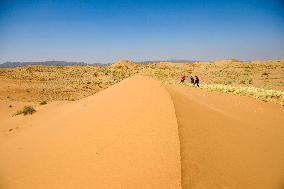
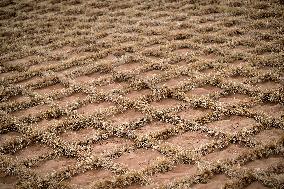
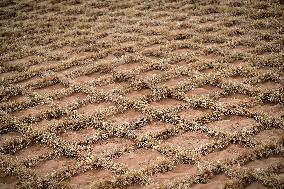
An aerial drone photo taken on May 29, 2024 shows straw checkerboards in the Tengger Desert, northwest China's Ningxia Hui Autonomous Region. In the 1950s, to protect China's first railway that runs through a desert, the city of Zhongwei embarked on a journey of desert mitigation. Scientists at the Shapotou Desert Research and Experiment Station, part of the Northwest Institute of Eco-Environment and Resources of the Chinese Academy of Sciences, along with local residents, developed straw checkerboards to stabilize the sand and prevent dunes from shifting. Tang Ximing, a senior engineer at a state-owned forestry farm in Zhongwei, crafted a steel tool that differs from regular shovels by featuring two horizontal bars at the front tip. This innovative tool enables the planting of seedling roots 50 centimeters deep into the moist sand layer. This simple tool increases the survival rate of afforestation by 25 percent to over 85 percent. It has been widely promoted and used in afforestation projects across other r

  •  
Chinese Experience in Desert Controi

Chinese Experience in Desert Controi

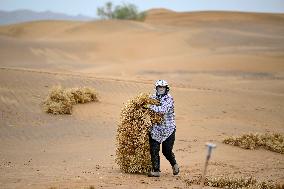
Workers carry straw checkerboards in the Tengger Desert, in Zhongwei of northwest China's Ningxia Hui Autonomous Region, May 30, 2024. In the 1950s, to protect China's first railway that runs through a desert, the city of Zhongwei embarked on a journey of desert mitigation. Scientists at the Shapotou Desert Research and Experiment Station, part of the Northwest Institute of Eco-Environment and Resources of the Chinese Academy of Sciences, along with local residents, developed straw checkerboards to stabilize the sand and prevent dunes from shifting. Tang Ximing, a senior engineer at a state-owned forestry farm in Zhongwei, crafted a steel tool that differs from regular shovels by featuring two horizontal bars at the front tip. This innovative tool enables the planting of seedling roots 50 centimeters deep into the moist sand layer. This simple tool increases the survival rate of afforestation by 25 percent to over 85 percent. It has been widely promoted and used in afforestation projects across other regions

  •  
Chinese Experience in Desert Controi

Chinese Experience in Desert Controi

An aerial drone photo taken on May 30, 2024 shows workers paving straw checkerboards in the Tengger Desert, in Zhongwei of northwest China's Ningxia Hui Autonomous Region. In the 1950s, to protect China's first railway that runs through a desert, the city of Zhongwei embarked on a journey of desert mitigation. Scientists at the Shapotou Desert Research and Experiment Station, part of the Northwest Institute of Eco-Environment and Resources of the Chinese Academy of Sciences, along with local residents, developed straw checkerboards to stabilize the sand and prevent dunes from shifting. Tang Ximing, a senior engineer at a state-owned forestry farm in Zhongwei, crafted a steel tool that differs from regular shovels by featuring two horizontal bars at the front tip. This innovative tool enables the planting of seedling roots 50 centimeters deep into the moist sand layer. This simple tool increases the survival rate of afforestation by 25 percent to over 85 percent. It has been widely promoted and used in affores

  •  
Chinese Experience in Desert Controi

Chinese Experience in Desert Controi

Workers pave straw checkerboards in the Tengger Desert, in Zhongwei of northwest China's Ningxia Hui Autonomous Region, May 30, 2024. In the 1950s, to protect China's first railway that runs through a desert, the city of Zhongwei embarked on a journey of desert mitigation. Scientists at the Shapotou Desert Research and Experiment Station, part of the Northwest Institute of Eco-Environment and Resources of the Chinese Academy of Sciences, along with local residents, developed straw checkerboards to stabilize the sand and prevent dunes from shifting. Tang Ximing, a senior engineer at a state-owned forestry farm in Zhongwei, crafted a steel tool that differs from regular shovels by featuring two horizontal bars at the front tip. This innovative tool enables the planting of seedling roots 50 centimeters deep into the moist sand layer. This simple tool increases the survival rate of afforestation by 25 percent to over 85 percent. It has been widely promoted and used in afforestation projects across other regions i

  •  
Chinese Experience in Desert Controi

Chinese Experience in Desert Controi

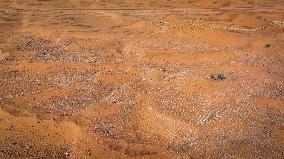
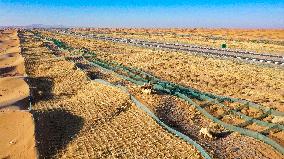
An aerial drone photo taken on Dec. 29, 2021 shows a section of an express way protected by straw checkerboards from the sand in the Tengger Desert, northwest China's Ningxia Hui Autonomous Region. In the 1950s, to protect China's first railway that runs through a desert, the city of Zhongwei embarked on a journey of desert mitigation. Scientists at the Shapotou Desert Research and Experiment Station, part of the Northwest Institute of Eco-Environment and Resources of the Chinese Academy of Sciences, along with local residents, developed straw checkerboards to stabilize the sand and prevent dunes from shifting. Tang Ximing, a senior engineer at a state-owned forestry farm in Zhongwei, crafted a steel tool that differs from regular shovels by featuring two horizontal bars at the front tip. This innovative tool enables the planting of seedling roots 50 centimeters deep into the moist sand layer. This simple tool increases the survival rate of afforestation by 25 percent to over 85 percent. It has been widely pr

  •  
(VistaNingxia)CHINA-NINGXIA-ZHONGWEI-ENVIRONMENT-SAND CONTROL (CN)

(VistaNingxia)CHINA-NINGXIA-ZHONGWEI-ENVIRONMENT-SAND CONTROL (CN)

(240616) -- ZHONGWEI, June 16, 2024 Photo by Xinhua/ABACAPRESS.COM) -- An aerial drone photo taken on May 30, 2024 shows workers paving straw checkerboards in the Tengger Desert, in Zhongwei of northwest China's Ningxia Hui Autonomous Region. In the 1950s, to protect China's first railway that runs through a desert, the city of Zhongwei embarked on a journey of desert mitigation. Scientists at the Shapotou Desert Research and Experiment Station, part of the Northwest Institute of Eco-Environment and Resources of the Chinese Academy of Sciences, along with local residents, developed straw checkerboards to stabilize the sand and prevent dunes from shifting. Tang Ximing, a senior engineer at a state-owned forestry farm in Zhongwei, crafted a steel tool that differs from regular shovels by featuring two horizontal bars at the front tip. This innovative tool enables the planting of seedling roots 50 centimeters deep into the moist sand layer. This simple tool increases the survival rate of afforestation by 25 perc

  •  
(VistaNingxia)CHINA-NINGXIA-ZHONGWEI-ENVIRONMENT-SAND CONTROL (CN)

(VistaNingxia)CHINA-NINGXIA-ZHONGWEI-ENVIRONMENT-SAND CONTROL (CN)

(240616) -- ZHONGWEI, June 16, 2024 Photo by Xinhua/ABACAPRESS.COM) -- Tang Ximing, a senior engineer at a state-owned forestry farm in Zhongwei, demonstrates an upgraded electric seedling planter invented by himself in northwest China's Ningxia Hui Autonomous Region, June 1, 2024. In the 1950s, to protect China's first railway that runs through a desert, the city of Zhongwei embarked on a journey of desert mitigation. Scientists at the Shapotou Desert Research and Experiment Station, part of the Northwest Institute of Eco-Environment and Resources of the Chinese Academy of Sciences, along with local residents, developed straw checkerboards to stabilize the sand and prevent dunes from shifting. Tang Ximing, a senior engineer at a state-owned forestry farm in Zhongwei, crafted a steel tool that differs from regular shovels by featuring two horizontal bars at the front tip. This innovative tool enables the planting of seedling roots 50 centimeters deep into the moist sand layer. This simple tool increases the s

  •  
(VistaNingxia)CHINA-NINGXIA-ZHONGWEI-ENVIRONMENT-SAND CONTROL (CN)

(VistaNingxia)CHINA-NINGXIA-ZHONGWEI-ENVIRONMENT-SAND CONTROL (CN)

(240616) -- ZHONGWEI, June 16, 2024 Photo by Xinhua/ABACAPRESS.COM) -- Workers pave straw checkerboards in the Tengger Desert, in Zhongwei of northwest China's Ningxia Hui Autonomous Region, May 30, 2024. In the 1950s, to protect China's first railway that runs through a desert, the city of Zhongwei embarked on a journey of desert mitigation. Scientists at the Shapotou Desert Research and Experiment Station, part of the Northwest Institute of Eco-Environment and Resources of the Chinese Academy of Sciences, along with local residents, developed straw checkerboards to stabilize the sand and prevent dunes from shifting. Tang Ximing, a senior engineer at a state-owned forestry farm in Zhongwei, crafted a steel tool that differs from regular shovels by featuring two horizontal bars at the front tip. This innovative tool enables the planting of seedling roots 50 centimeters deep into the moist sand layer. This simple tool increases the survival rate of afforestation by 25 percent to over 85 percent. It has been wi

  •  
(VistaNingxia)CHINA-NINGXIA-ZHONGWEI-ENVIRONMENT-SAND CONTROL (CN)

(VistaNingxia)CHINA-NINGXIA-ZHONGWEI-ENVIRONMENT-SAND CONTROL (CN)

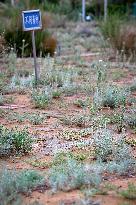
(240616) -- ZHONGWEI, June 16, 2024 Photo by Xinhua/ABACAPRESS.COM) -- The cyanobacteria soil crust is seen at Shapotou Desert Research and Experiment Station (SDRES) of the Chinese Academy of Sciences (CAS), in northwest China's Ningxia Hui Autonomous Region, May 31, 2024. In the 1950s, to protect China's first railway that runs through a desert, the city of Zhongwei embarked on a journey of desert mitigation. Scientists at the Shapotou Desert Research and Experiment Station, part of the Northwest Institute of Eco-Environment and Resources of the Chinese Academy of Sciences, along with local residents, developed straw checkerboards to stabilize the sand and prevent dunes from shifting. Tang Ximing, a senior engineer at a state-owned forestry farm in Zhongwei, crafted a steel tool that differs from regular shovels by featuring two horizontal bars at the front tip. This innovative tool enables the planting of seedling roots 50 centimeters deep into the moist sand layer. This simple tool increases the survival

  •  
(VistaNingxia)CHINA-NINGXIA-ZHONGWEI-ENVIRONMENT-SAND CONTROL (CN)

(VistaNingxia)CHINA-NINGXIA-ZHONGWEI-ENVIRONMENT-SAND CONTROL (CN)

(240616) -- ZHONGWEI, June 16, 2024 Photo by Xinhua/ABACAPRESS.COM) -- Workers set up straw checkerboards in Zhongwei, northwest China's Ningxia Hui Autonomous Region, June 13, 2019. In the 1950s, to protect China's first railway that runs through a desert, the city of Zhongwei embarked on a journey of desert mitigation. Scientists at the Shapotou Desert Research and Experiment Station, part of the Northwest Institute of Eco-Environment and Resources of the Chinese Academy of Sciences, along with local residents, developed straw checkerboards to stabilize the sand and prevent dunes from shifting. Tang Ximing, a senior engineer at a state-owned forestry farm in Zhongwei, crafted a steel tool that differs from regular shovels by featuring two horizontal bars at the front tip. This innovative tool enables the planting of seedling roots 50 centimeters deep into the moist sand layer. This simple tool increases the survival rate of afforestation by 25 percent to over 85 percent. It has been widely promoted and used

  •  
(VistaNingxia)CHINA-NINGXIA-ZHONGWEI-ENVIRONMENT-SAND CONTROL (CN)

(VistaNingxia)CHINA-NINGXIA-ZHONGWEI-ENVIRONMENT-SAND CONTROL (CN)

(240616) -- ZHONGWEI, June 16, 2024 Photo by Xinhua/ABACAPRESS.COM) -- Workers pave straw checkerboards in the Tengger Desert, in Zhongwei of northwest China's Ningxia Hui Autonomous Region, May 29, 2024. In the 1950s, to protect China's first railway that runs through a desert, the city of Zhongwei embarked on a journey of desert mitigation. Scientists at the Shapotou Desert Research and Experiment Station, part of the Northwest Institute of Eco-Environment and Resources of the Chinese Academy of Sciences, along with local residents, developed straw checkerboards to stabilize the sand and prevent dunes from shifting. Tang Ximing, a senior engineer at a state-owned forestry farm in Zhongwei, crafted a steel tool that differs from regular shovels by featuring two horizontal bars at the front tip. This innovative tool enables the planting of seedling roots 50 centimeters deep into the moist sand layer. This simple tool increases the survival rate of afforestation by 25 percent to over 85 percent. It has been wi

  •  
(VistaNingxia)CHINA-NINGXIA-ZHONGWEI-ENVIRONMENT-SAND CONTROL (CN)

(VistaNingxia)CHINA-NINGXIA-ZHONGWEI-ENVIRONMENT-SAND CONTROL (CN)

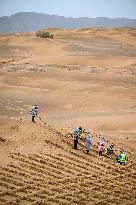
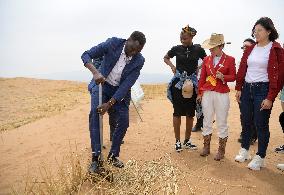
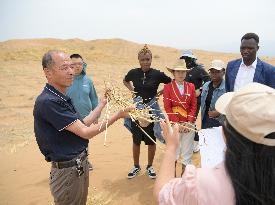
(240616) -- ZHONGWEI, June 16, 2024 Photo by Xinhua/ABACAPRESS.COM) -- A Kenyan Ph.D. candidate (1st L) of Peking University tries to set up a part of the straw checkerboard in the Tengger Desert, northwest China's Ningxia Hui Autonomous Region, May 31, 2024. In the 1950s, to protect China's first railway that runs through a desert, the city of Zhongwei embarked on a journey of desert mitigation. Scientists at the Shapotou Desert Research and Experiment Station, part of the Northwest Institute of Eco-Environment and Resources of the Chinese Academy of Sciences, along with local residents, developed straw checkerboards to stabilize the sand and prevent dunes from shifting. Tang Ximing, a senior engineer at a state-owned forestry farm in Zhongwei, crafted a steel tool that differs from regular shovels by featuring two horizontal bars at the front tip. This innovative tool enables the planting of seedling roots 50 centimeters deep into the moist sand layer. This simple tool increases the survival rate of affores

  •  
(VistaNingxia)CHINA-NINGXIA-ZHONGWEI-ENVIRONMENT-SAND CONTROL (CN)

(VistaNingxia)CHINA-NINGXIA-ZHONGWEI-ENVIRONMENT-SAND CONTROL (CN)

(240616) -- ZHONGWEI, June 16, 2024 Photo by Xinhua/ABACAPRESS.COM) -- An aerial drone photo taken on Sept. 7, 2020 shows workers paving straw checkerboards near a section of an express way in the Tengger Desert, northwest China's Ningxia Hui Autonomous Region. In the 1950s, to protect China's first railway that runs through a desert, the city of Zhongwei embarked on a journey of desert mitigation. Scientists at the Shapotou Desert Research and Experiment Station, part of the Northwest Institute of Eco-Environment and Resources of the Chinese Academy of Sciences, along with local residents, developed straw checkerboards to stabilize the sand and prevent dunes from shifting. Tang Ximing, a senior engineer at a state-owned forestry farm in Zhongwei, crafted a steel tool that differs from regular shovels by featuring two horizontal bars at the front tip. This innovative tool enables the planting of seedling roots 50 centimeters deep into the moist sand layer. This simple tool increases the survival rate of affor

  •  
(VistaNingxia)CHINA-NINGXIA-ZHONGWEI-ENVIRONMENT-SAND CONTROL (CN)

(VistaNingxia)CHINA-NINGXIA-ZHONGWEI-ENVIRONMENT-SAND CONTROL (CN)

(240616) -- ZHONGWEI, June 16, 2024 Photo by Xinhua/ABACAPRESS.COM) -- Workers pave straw checkerboards in Zhongwei, northwest China's Ningxia Hui Autonomous Region, May 29, 2024. In the 1950s, to protect China's first railway that runs through a desert, the city of Zhongwei embarked on a journey of desert mitigation. Scientists at the Shapotou Desert Research and Experiment Station, part of the Northwest Institute of Eco-Environment and Resources of the Chinese Academy of Sciences, along with local residents, developed straw checkerboards to stabilize the sand and prevent dunes from shifting. Tang Ximing, a senior engineer at a state-owned forestry farm in Zhongwei, crafted a steel tool that differs from regular shovels by featuring two horizontal bars at the front tip. This innovative tool enables the planting of seedling roots 50 centimeters deep into the moist sand layer. This simple tool increases the survival rate of afforestation by 25 percent to over 85 percent. It has been widely promoted and used in

  •  
(VistaNingxia)CHINA-NINGXIA-ZHONGWEI-ENVIRONMENT-SAND CONTROL (CN)

(VistaNingxia)CHINA-NINGXIA-ZHONGWEI-ENVIRONMENT-SAND CONTROL (CN)

(240616) -- ZHONGWEI, June 16, 2024 Photo by Xinhua/ABACAPRESS.COM) -- A worker paves straw checkerboards in the Tengger Desert, in Zhongwei of northwest China's Ningxia Hui Autonomous Region, May 30, 2024. In the 1950s, to protect China's first railway that runs through a desert, the city of Zhongwei embarked on a journey of desert mitigation. Scientists at the Shapotou Desert Research and Experiment Station, part of the Northwest Institute of Eco-Environment and Resources of the Chinese Academy of Sciences, along with local residents, developed straw checkerboards to stabilize the sand and prevent dunes from shifting. Tang Ximing, a senior engineer at a state-owned forestry farm in Zhongwei, crafted a steel tool that differs from regular shovels by featuring two horizontal bars at the front tip. This innovative tool enables the planting of seedling roots 50 centimeters deep into the moist sand layer. This simple tool increases the survival rate of afforestation by 25 percent to over 85 percent. It has been

  •  
(VistaNingxia)CHINA-NINGXIA-ZHONGWEI-ENVIRONMENT-SAND CONTROL (CN)

(VistaNingxia)CHINA-NINGXIA-ZHONGWEI-ENVIRONMENT-SAND CONTROL (CN)

(240616) -- ZHONGWEI, June 16, 2024 Photo by Xinhua/ABACAPRESS.COM) -- Workers produce straw checkerboard materials in Zhongwei of northwest China's Ningxia Hui Autonomous Region, May 29, 2024. In the 1950s, to protect China's first railway that runs through a desert, the city of Zhongwei embarked on a journey of desert mitigation. Scientists at the Shapotou Desert Research and Experiment Station, part of the Northwest Institute of Eco-Environment and Resources of the Chinese Academy of Sciences, along with local residents, developed straw checkerboards to stabilize the sand and prevent dunes from shifting. Tang Ximing, a senior engineer at a state-owned forestry farm in Zhongwei, crafted a steel tool that differs from regular shovels by featuring two horizontal bars at the front tip. This innovative tool enables the planting of seedling roots 50 centimeters deep into the moist sand layer. This simple tool increases the survival rate of afforestation by 25 percent to over 85 percent. It has been widely promot

  •  
(VistaNingxia)CHINA-NINGXIA-ZHONGWEI-ENVIRONMENT-SAND CONTROL (CN)

(VistaNingxia)CHINA-NINGXIA-ZHONGWEI-ENVIRONMENT-SAND CONTROL (CN)

(240616) -- ZHONGWEI, June 16, 2024 Photo by Xinhua/ABACAPRESS.COM) -- Workers set up straw checkerboards in Zhongwei, northwest China's Ningxia Hui Autonomous Region, Sept. 24, 1994. In the 1950s, to protect China's first railway that runs through a desert, the city of Zhongwei embarked on a journey of desert mitigation. Scientists at the Shapotou Desert Research and Experiment Station, part of the Northwest Institute of Eco-Environment and Resources of the Chinese Academy of Sciences, along with local residents, developed straw checkerboards to stabilize the sand and prevent dunes from shifting. Tang Ximing, a senior engineer at a state-owned forestry farm in Zhongwei, crafted a steel tool that differs from regular shovels by featuring two horizontal bars at the front tip. This innovative tool enables the planting of seedling roots 50 centimeters deep into the moist sand layer. This simple tool increases the survival rate of afforestation by 25 percent to over 85 percent. It has been widely promoted and use

  •  
(VistaNingxia)CHINA-NINGXIA-ZHONGWEI-ENVIRONMENT-SAND CONTROL (CN)

(VistaNingxia)CHINA-NINGXIA-ZHONGWEI-ENVIRONMENT-SAND CONTROL (CN)

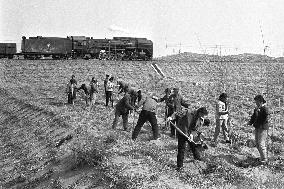
(240616) -- ZHONGWEI, June 16, 2024 Photo by Xinhua/ABACAPRESS.COM) -- Workers plant trees in straw checkerboards to protect the Baotou-Lanzhou Railway from sand in Zhongwei, northwest China's Ningxia Hui Autonomous Region, April 25, 1979. In the 1950s, to protect China's first railway that runs through a desert, the city of Zhongwei embarked on a journey of desert mitigation. Scientists at the Shapotou Desert Research and Experiment Station, part of the Northwest Institute of Eco-Environment and Resources of the Chinese Academy of Sciences, along with local residents, developed straw checkerboards to stabilize the sand and prevent dunes from shifting. Tang Ximing, a senior engineer at a state-owned forestry farm in Zhongwei, crafted a steel tool that differs from regular shovels by featuring two horizontal bars at the front tip. This innovative tool enables the planting of seedling roots 50 centimeters deep into the moist sand layer. This simple tool increases the survival rate of afforestation by 25 percent

  •  
(VistaNingxia)CHINA-NINGXIA-ZHONGWEI-ENVIRONMENT-SAND CONTROL (CN)

(VistaNingxia)CHINA-NINGXIA-ZHONGWEI-ENVIRONMENT-SAND CONTROL (CN)

(240616) -- ZHONGWEI, June 16, 2024 Photo by Xinhua/ABACAPRESS.COM) -- Tang Ximing, a senior engineer at a state-owned forestry farm in Zhongwei, demonstrates a precision seedling planter invented by himself in northwest China's Ningxia Hui Autonomous Region, June 1, 2024. In the 1950s, to protect China's first railway that runs through a desert, the city of Zhongwei embarked on a journey of desert mitigation. Scientists at the Shapotou Desert Research and Experiment Station, part of the Northwest Institute of Eco-Environment and Resources of the Chinese Academy of Sciences, along with local residents, developed straw checkerboards to stabilize the sand and prevent dunes from shifting. Tang Ximing, a senior engineer at a state-owned forestry farm in Zhongwei, crafted a steel tool that differs from regular shovels by featuring two horizontal bars at the front tip. This innovative tool enables the planting of seedling roots 50 centimeters deep into the moist sand layer. This simple tool increases the survival r

  •  
(VistaNingxia)CHINA-NINGXIA-ZHONGWEI-ENVIRONMENT-SAND CONTROL (CN)

(VistaNingxia)CHINA-NINGXIA-ZHONGWEI-ENVIRONMENT-SAND CONTROL (CN)

(240616) -- ZHONGWEI, June 16, 2024 Photo by Xinhua/ABACAPRESS.COM) -- An aerial drone photo taken on May 30, 2024 shows workers paving straw checkerboards in the Tengger Desert, in Zhongwei of northwest China's Ningxia Hui Autonomous Region. In the 1950s, to protect China's first railway that runs through a desert, the city of Zhongwei embarked on a journey of desert mitigation. Scientists at the Shapotou Desert Research and Experiment Station, part of the Northwest Institute of Eco-Environment and Resources of the Chinese Academy of Sciences, along with local residents, developed straw checkerboards to stabilize the sand and prevent dunes from shifting. Tang Ximing, a senior engineer at a state-owned forestry farm in Zhongwei, crafted a steel tool that differs from regular shovels by featuring two horizontal bars at the front tip. This innovative tool enables the planting of seedling roots 50 centimeters deep into the moist sand layer. This simple tool increases the survival rate of afforestation by 25 perc

  •  
(VistaNingxia)CHINA-NINGXIA-ZHONGWEI-ENVIRONMENT-SAND CONTROL (CN)

(VistaNingxia)CHINA-NINGXIA-ZHONGWEI-ENVIRONMENT-SAND CONTROL (CN)

(240616) -- ZHONGWEI, June 16, 2024 Photo by Xinhua/ABACAPRESS.COM) -- Workers pave straw checkerboards in the Tengger Desert, in Zhongwei of northwest China's Ningxia Hui Autonomous Region, May 29, 2024. In the 1950s, to protect China's first railway that runs through a desert, the city of Zhongwei embarked on a journey of desert mitigation. Scientists at the Shapotou Desert Research and Experiment Station, part of the Northwest Institute of Eco-Environment and Resources of the Chinese Academy of Sciences, along with local residents, developed straw checkerboards to stabilize the sand and prevent dunes from shifting. Tang Ximing, a senior engineer at a state-owned forestry farm in Zhongwei, crafted a steel tool that differs from regular shovels by featuring two horizontal bars at the front tip. This innovative tool enables the planting of seedling roots 50 centimeters deep into the moist sand layer. This simple tool increases the survival rate of afforestation by 25 percent to over 85 percent. It has been wi

  •  
(VistaNingxia)CHINA-NINGXIA-ZHONGWEI-ENVIRONMENT-SAND CONTROL (CN)

(VistaNingxia)CHINA-NINGXIA-ZHONGWEI-ENVIRONMENT-SAND CONTROL (CN)

(240616) -- ZHONGWEI, June 16, 2024 Photo by Xinhua/ABACAPRESS.COM) -- Workers carry straw checkerboards in the Tengger Desert, in Zhongwei of northwest China's Ningxia Hui Autonomous Region, May 30, 2024. In the 1950s, to protect China's first railway that runs through a desert, the city of Zhongwei embarked on a journey of desert mitigation. Scientists at the Shapotou Desert Research and Experiment Station, part of the Northwest Institute of Eco-Environment and Resources of the Chinese Academy of Sciences, along with local residents, developed straw checkerboards to stabilize the sand and prevent dunes from shifting. Tang Ximing, a senior engineer at a state-owned forestry farm in Zhongwei, crafted a steel tool that differs from regular shovels by featuring two horizontal bars at the front tip. This innovative tool enables the planting of seedling roots 50 centimeters deep into the moist sand layer. This simple tool increases the survival rate of afforestation by 25 percent to over 85 percent. It has been w

  •  
(VistaNingxia)CHINA-NINGXIA-ZHONGWEI-ENVIRONMENT-SAND CONTROL (CN)

(VistaNingxia)CHINA-NINGXIA-ZHONGWEI-ENVIRONMENT-SAND CONTROL (CN)

(240616) -- ZHONGWEI, June 16, 2024 Photo by Xinhua/ABACAPRESS.COM) -- Workers set up straw checkerboards in Zhongwei, northwest China's Ningxia Hui Autonomous Region, June 13, 2019. In the 1950s, to protect China's first railway that runs through a desert, the city of Zhongwei embarked on a journey of desert mitigation. Scientists at the Shapotou Desert Research and Experiment Station, part of the Northwest Institute of Eco-Environment and Resources of the Chinese Academy of Sciences, along with local residents, developed straw checkerboards to stabilize the sand and prevent dunes from shifting. Tang Ximing, a senior engineer at a state-owned forestry farm in Zhongwei, crafted a steel tool that differs from regular shovels by featuring two horizontal bars at the front tip. This innovative tool enables the planting of seedling roots 50 centimeters deep into the moist sand layer. This simple tool increases the survival rate of afforestation by 25 percent to over 85 percent. It has been widely promoted and used

  •  
(VistaNingxia)CHINA-NINGXIA-ZHONGWEI-ENVIRONMENT-SAND CONTROL (CN)

(VistaNingxia)CHINA-NINGXIA-ZHONGWEI-ENVIRONMENT-SAND CONTROL (CN)

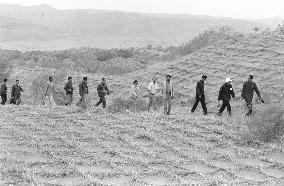
(240616) -- ZHONGWEI, June 16, 2024 Photo by Xinhua/ABACAPRESS.COM) -- Organized by United Nations Environment Programme (UNEP), international delegates inspect straw checkerboards in Zhongwei, northwest China's Ningxia Hui Autonomous Region, Oct. 14, 1981. In the 1950s, to protect China's first railway that runs through a desert, the city of Zhongwei embarked on a journey of desert mitigation. Scientists at the Shapotou Desert Research and Experiment Station, part of the Northwest Institute of Eco-Environment and Resources of the Chinese Academy of Sciences, along with local residents, developed straw checkerboards to stabilize the sand and prevent dunes from shifting. Tang Ximing, a senior engineer at a state-owned forestry farm in Zhongwei, crafted a steel tool that differs from regular shovels by featuring two horizontal bars at the front tip. This innovative tool enables the planting of seedling roots 50 centimeters deep into the moist sand layer. This simple tool increases the survival rate of afforesta

  •  
(VistaNingxia)CHINA-NINGXIA-ZHONGWEI-ENVIRONMENT-SAND CONTROL (CN)

(VistaNingxia)CHINA-NINGXIA-ZHONGWEI-ENVIRONMENT-SAND CONTROL (CN)

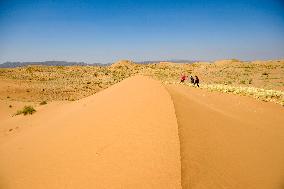
(240616) -- ZHONGWEI, June 16, 2024 Photo by Xinhua/ABACAPRESS.COM) -- An aerial drone photo taken on Dec. 29, 2021 shows a section of an express way protected by straw checkerboards from the sand in the Tengger Desert, northwest China's Ningxia Hui Autonomous Region. In the 1950s, to protect China's first railway that runs through a desert, the city of Zhongwei embarked on a journey of desert mitigation. Scientists at the Shapotou Desert Research and Experiment Station, part of the Northwest Institute of Eco-Environment and Resources of the Chinese Academy of Sciences, along with local residents, developed straw checkerboards to stabilize the sand and prevent dunes from shifting. Tang Ximing, a senior engineer at a state-owned forestry farm in Zhongwei, crafted a steel tool that differs from regular shovels by featuring two horizontal bars at the front tip. This innovative tool enables the planting of seedling roots 50 centimeters deep into the moist sand layer. This simple tool increases the survival rate o

  •  
(VistaNingxia)CHINA-NINGXIA-ZHONGWEI-ENVIRONMENT-SAND CONTROL (CN)

(VistaNingxia)CHINA-NINGXIA-ZHONGWEI-ENVIRONMENT-SAND CONTROL (CN)

(240616) -- ZHONGWEI, June 16, 2024 Photo by Xinhua/ABACAPRESS.COM) -- Workers pave straw checkerboards in the Tengger Desert, in Zhongwei of northwest China's Ningxia Hui Autonomous Region, May 30, 2024. In the 1950s, to protect China's first railway that runs through a desert, the city of Zhongwei embarked on a journey of desert mitigation. Scientists at the Shapotou Desert Research and Experiment Station, part of the Northwest Institute of Eco-Environment and Resources of the Chinese Academy of Sciences, along with local residents, developed straw checkerboards to stabilize the sand and prevent dunes from shifting. Tang Ximing, a senior engineer at a state-owned forestry farm in Zhongwei, crafted a steel tool that differs from regular shovels by featuring two horizontal bars at the front tip. This innovative tool enables the planting of seedling roots 50 centimeters deep into the moist sand layer. This simple tool increases the survival rate of afforestation by 25 percent to over 85 percent. It has been wi

  •  
(VistaNingxia)CHINA-NINGXIA-ZHONGWEI-ENVIRONMENT-SAND CONTROL (CN)

(VistaNingxia)CHINA-NINGXIA-ZHONGWEI-ENVIRONMENT-SAND CONTROL (CN)

(240616) -- ZHONGWEI, June 16, 2024 Photo by Xinhua/ABACAPRESS.COM) -- Workers pave straw checkerboards in the Tengger Desert, in Zhongwei of northwest China's Ningxia Hui Autonomous Region, May 30, 2024. In the 1950s, to protect China's first railway that runs through a desert, the city of Zhongwei embarked on a journey of desert mitigation. Scientists at the Shapotou Desert Research and Experiment Station, part of the Northwest Institute of Eco-Environment and Resources of the Chinese Academy of Sciences, along with local residents, developed straw checkerboards to stabilize the sand and prevent dunes from shifting. Tang Ximing, a senior engineer at a state-owned forestry farm in Zhongwei, crafted a steel tool that differs from regular shovels by featuring two horizontal bars at the front tip. This innovative tool enables the planting of seedling roots 50 centimeters deep into the moist sand layer. This simple tool increases the survival rate of afforestation by 25 percent to over 85 percent. It has been wi

  •  
(VistaNingxia)CHINA-NINGXIA-ZHONGWEI-ENVIRONMENT-SAND CONTROL (CN)

(VistaNingxia)CHINA-NINGXIA-ZHONGWEI-ENVIRONMENT-SAND CONTROL (CN)

(240616) -- ZHONGWEI, June 16, 2024 Photo by Xinhua/ABACAPRESS.COM) -- An aerial drone photo taken on May 29, 2024 shows straw checkerboards in the Tengger Desert, northwest China's Ningxia Hui Autonomous Region. In the 1950s, to protect China's first railway that runs through a desert, the city of Zhongwei embarked on a journey of desert mitigation. Scientists at the Shapotou Desert Research and Experiment Station, part of the Northwest Institute of Eco-Environment and Resources of the Chinese Academy of Sciences, along with local residents, developed straw checkerboards to stabilize the sand and prevent dunes from shifting. Tang Ximing, a senior engineer at a state-owned forestry farm in Zhongwei, crafted a steel tool that differs from regular shovels by featuring two horizontal bars at the front tip. This innovative tool enables the planting of seedling roots 50 centimeters deep into the moist sand layer. This simple tool increases the survival rate of afforestation by 25 percent to over 85 percent. It has

  •  
(VistaNingxia)CHINA-NINGXIA-ZHONGWEI-ENVIRONMENT-SAND CONTROL (CN)

(VistaNingxia)CHINA-NINGXIA-ZHONGWEI-ENVIRONMENT-SAND CONTROL (CN)

(240616) -- ZHONGWEI, June 16, 2024 Photo by Xinhua/ABACAPRESS.COM) -- Tang Ximing (1st L), a senior engineer at a state-owned forestry farm in Zhongwei, introduces the using of straw checkerboards to international youths in northwest China's Ningxia Hui Autonomous Region, May 31, 2024. In the 1950s, to protect China's first railway that runs through a desert, the city of Zhongwei embarked on a journey of desert mitigation. Scientists at the Shapotou Desert Research and Experiment Station, part of the Northwest Institute of Eco-Environment and Resources of the Chinese Academy of Sciences, along with local residents, developed straw checkerboards to stabilize the sand and prevent dunes from shifting. Tang Ximing, a senior engineer at a state-owned forestry farm in Zhongwei, crafted a steel tool that differs from regular shovels by featuring two horizontal bars at the front tip. This innovative tool enables the planting of seedling roots 50 centimeters deep into the moist sand layer. This simple tool increases

  • Main
  • Top
  • Editorial
  • Creative
  • About Us
  • About ILG
  • Terms of use
  • Company
  • BEHIND
  • Price List
  • Single Plan
  • Monthly Plan
  • Services
  • Shooting
  • Rights Clearance
  • Support
  • FAQ
  • How To Buy
  • Contact Us
  • Become a Partner

© KYODO NEWS IMAGES INC

All Rights Reserved.

  • Editorial
  • Olympics
  • News
  • Sports
  • Japan
  • Tech
  • Royal
  • Disaster
  • NorthKorea
  • Old Japan
  • SNS
  • Creative
  • Food
  • Japan
  • Landscape
  • Animal
  • Popular
  • #Ukraine
  • #Thailand
  • #coronavirus
  • #N. Korea
  • #Russia
  • #China
  • #Ukraine
  • #Thailand
  • #coronavirus
  • #N. Korea
  • #Russia
  • #China
  • Food
  • Japan
  • Landscape
  • Animal
  • Olympics
  • News
  • Sports
  • Japan
  • Tech
  • Royal
  • Disaster
  • NorthKorea
  • Old Japan
  • SNS