•  
Fukushima Univ. unveils new device to detect strontium-90

Fukushima Univ. unveils new device to detect strontium-90

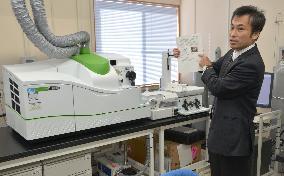
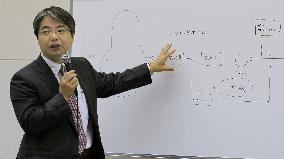
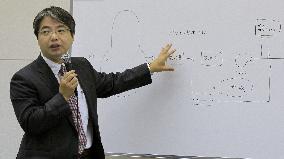
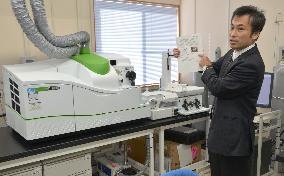
FUKUSHIMA, Japan - Yoshitaka Takagai, an associate professor at Fukushima University, explains a device his team developed to measure strontium-90, a radioactive isotope produced by nuclear fission, in Fukushima, northeastern Japan, on Nov. 27, 2014. The device is in use to analyze contaminated water at the crippled Fukushima Daiichi nuclear power plant.

  •  
Otto Hahn's grandson visits Hiroshima

Otto Hahn's grandson visits Hiroshima

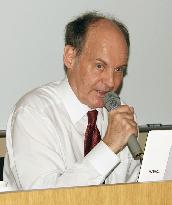
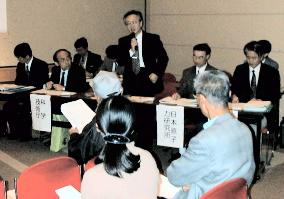
HIROSHIMA, Japan - Dietrich Hahn, a 67-year-old journalist and grandson of Otto Hahn, the German chemist who won the Nobel Prize in Chemistry for the discovery of nuclear fission, delivers a speech in Hiroshima on the night of Sept. 30, 2013. Earlier in the day, Hahn met survivors of the 1945 U.S. atomic bombing of the western Japanese city and offered flowers at the cenotaph for the victims of the attack.

  •  
Day following reactor reboot at Oi nuclear plant

Day following reactor reboot at Oi nuclear plant

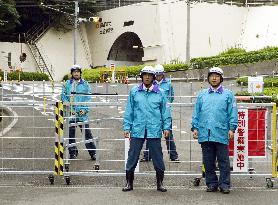
OI, Japan - Security guards stand near the entrance to Kansai Electric Power Co.'s Oi nuclear power plant in the town of Oi, Fukui Prefecture, on the Sea of Japan coast, on July 2, 2012. The No. 3 reactor at the plant attained a suspended nuclear fission chain reaction, or criticality, early in the day after it became the previous night the first reactor in Japan to be rebooted after regular checkups since 2011's Fukushima nuclear crisis.

  •  
Oi nuclear plant's No. 3 reactor attains criticality

Oi nuclear plant's No. 3 reactor attains criticality

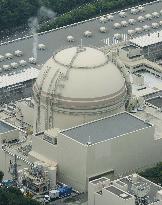
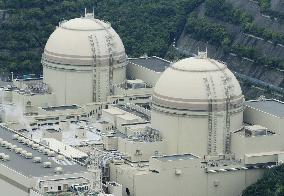
OI, Japan - Photo taken from a Kyodo News helicopter on July 2, 2012, shows the No. 3 reactor building at Kansai Electric Power Co.'s Oi nuclear power plant in the town of Oi, Fukui Prefecture, on the Sea of Japan coast. The No. 3 reactor attained a suspended nuclear fission chain reaction, or criticality, early in the day after it became the previous night the first reactor in Japan to be rebooted after regular checkups since 2011's Fukushima nuclear crisis.

  •  
Oi nuclear plant's No. 3 reactor attains criticality

Oi nuclear plant's No. 3 reactor attains criticality

OI, Japan - Photo taken from a Kyodo News helicopter on July 2, 2012, shows the No. 3 reactor building (R) at Kansai Electric Power Co.'s Oi nuclear power plant in the town of Oi, Fukui Prefecture, on the Sea of Japan coast. The No. 3 reactor attained a suspended nuclear fission chain reaction, or criticality, early in the day after it became the previous night the first reactor in Japan to be rebooted after regular checkups since 2011's Fukushima nuclear crisis.

  •  
Oi nuclear plant's No. 3 reactor attains criticality

Oi nuclear plant's No. 3 reactor attains criticality

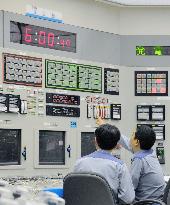
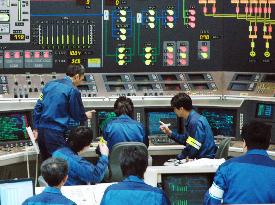
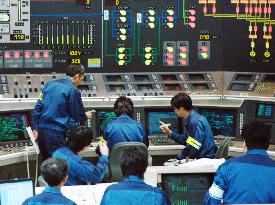
OI, Japan - Employees work on the morning of July 2, 2012, in the central control room at Kansai Electric Power Co.'s Oi nuclear power plant in the town of Oi, Fukui Prefecture, on the Sea of Japan coast, after the No. 3 reactor at the plant attained a suspended nuclear fission chain reaction, or criticality, early in the day. It became the previous night the first reactor in Japan to be rebooted after regular checkups since 2011's Fukushima nuclear crisis. (Pool photo)

  •  
Protest against nuclear reactor restart

Protest against nuclear reactor restart

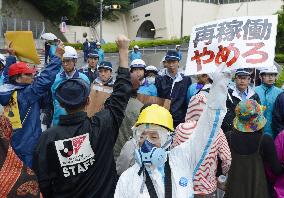
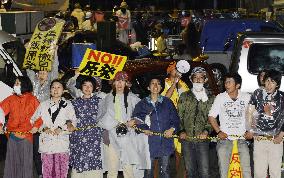
OI, Japan - People protest against the restart of a reactor in front of the Oi nuclear power plant in the town of Oi, Fukui Prefecture, on the Sea of Japan coast, on July 1, 2012. Kansai Electric Power Co. said it plans to pull out control rods that have contained fission reactions from 9 p.m. on July 1 at the plant's No. 3 reactor.

  •  
Protest against nuclear reactor restart

Protest against nuclear reactor restart

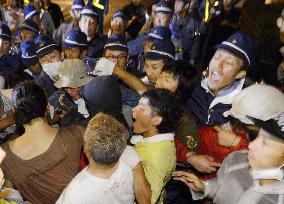
OI, Japan - People confront police around the Oi nuclear power plant in the town of Oi, Fukui Prefecture, on the Sea of Japan coast, in the early hours of July 1, 2012, in a protest against the reboot of a reactor at the plant. Kansai Electric Power Co. said it plans to pull out control rods that have contained fission reactions from 9 p.m. on July 1 at the plant's No. 3 reactor.

  •  
Protest against nuclear reactor restart

Protest against nuclear reactor restart

OI, Japan - People sit on a road around the Oi nuclear power plant in the town of Oi, Fukui Prefecture, on the Sea of Japan coast, in the early hours of July 1, 2012, in a protest against the restart of a reactor at the plant. Kansai Electric Power Co. said it plans to pull out control rods that have contained fission reactions from 9 p.m. on July 1 at the plant's No. 3 reactor.

  •  
Protest against nuclear reactor restart

Protest against nuclear reactor restart

OI, Japan - People block a road leading to the Oi nuclear power plant in the town of Oi, Fukui Prefecture, on the Sea of Japan coast, in the early hours of July 1, 2012, preventing workers' access in a protest against the restart of a reactor at the plant. Kansai Electric Power Co. said it plans to pull out control rods that have contained fission reactions from 9 p.m. on July 1 at the plant's No. 3 reactor.

  •  
Protest against nuclear reactor restart

Protest against nuclear reactor restart

OI, Japan - People sit on a road around the Oi nuclear power plant in the town of Oi, Fukui Prefecture, on the Sea of Japan coast, in the early hours of July 1, 2012, in a protest against the restart of a reactor at the plant. Kansai Electric Power Co. said it plans to pull out control rods that have contained fission reactions from 9 p.m. on July 1 at the plant's No. 3 reactor.

  •  
TEPCO finds fresh nuclear fission sign at Fukushima reactor

TEPCO finds fresh nuclear fission sign at Fukushima reactor

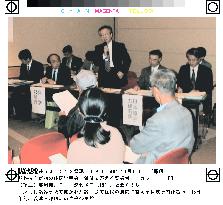
TOKYO, Japan - Junichi Matsumoto, an official of Tokyo Electric Power Co., explains the utility's injection of boric acid into the No. 2 reactor of the Fukushima Daiichi nuclear power plant during a press conference at the company's head office in Tokyo on Nov. 2, 2011. The company known as TEPCO said there may be signs of fresh nuclear fission in the reactor and that it has injected boric acid to control a possible nuclear reaction.

  •  
Quake-hit Kashiwazaki nuclear plant restarts after 2-year suspension

Quake-hit Kashiwazaki nuclear plant restarts after 2-year suspension

NIIGATA, Japan - Tokyo Electric Power Co. employees activate the withdrawal of rods for controlling nuclear fission to restart operations at the Kashiwazaki-Kariwa nuclear power plant in Niigata Prefecture on May 9. It is the first time the world's largest nuclear plant in terms of output has restarted operations since it was shut down in July 2007 when a major earthquake hit the area.

  •  
Civic group members march in memory of Tokaimura victims

Civic group members march in memory of Tokaimura victims

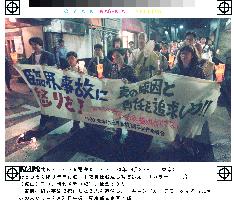
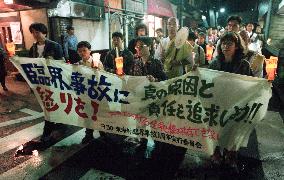
TOKYO, Japan - Antinuclear civic group members march in Tokyo on Sept. 30 in memory of two workers who died after Japan's worst nuclear accident in Tokaimura, Ibaraki Prefecture, a year ago. On Sept. 30, 1999, an explosion occurred following a nuclear fission chain reaction at a uranium-processing plant run by JCO Co. in Tokaimura, 120 kilometers northeast of Tokyo. Two plant workers died months later.

  •  
Residents briefed on Tokaimura nuclear accident

Residents briefed on Tokaimura nuclear accident

NAKA, Japan - Japanese Science and Technology Agency officials respond Nov. 13 to questions by residents near the site of Japan's worst nuclear accident in Tokaimura, Ibaraki Prefecture. The question-and-answer session was held at a public hall in Naka near Tokaimura. The Sept. 30 nuclear accident involving a nuclear fission chain reaction irradiated at least 69 people.

  •  
Quake-hit Kashiwazaki nuclear plant restarts after 2-year suspens

Quake-hit Kashiwazaki nuclear plant restarts after 2-year suspens

NIIGATA, Japan - Tokyo Electric Power Co. employees activate the withdrawal of rods for controlling nuclear fission to restart operations at the Kashiwazaki-Kariwa nuclear power plant in Niigata Prefecture on May 9. It is the first time the world's largest nuclear plant in terms of output has restarted operations since it was shut down in July 2007 when a major earthquake hit the area. (Kyodo)

  •  
Civic group members march in memory of Tokaimura victims

Civic group members march in memory of Tokaimura victims

TOKYO, Japan - Antinuclear civic group members march in Tokyo on Sept. 30 in memory of two workers who died after Japan's worst nuclear accident in Tokaimura, Ibaraki Prefecture, a year ago. On Sept. 30, 1999, an explosion occurred following a nuclear fission chain reaction at a uranium-processing plant run by JCO Co. in Tokaimura, 120 kilometers northeast of Tokyo. Two plant workers died months later.

  •  
TEPCO finds fresh nuclear fission sign at Fukushima reactor

TEPCO finds fresh nuclear fission sign at Fukushima reactor

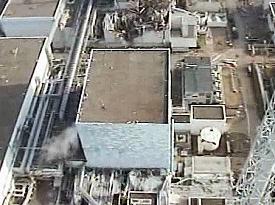
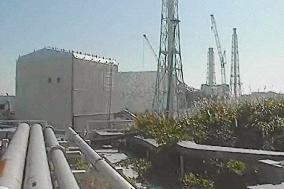
TOKYO, Japan - Photo taken from video footage shows the No. 2 reactor building of the Fukushima Daiichi nuclear power plant in April 2011 after it was severely damaged by the March 11 earthquake and tsunami. The plant's operator Tokyo Electric Power Co. said on Nov. 2, 2011, there may be signs of fresh nuclear fission in the reactor and that it has injected boric acid to control a possible nuclear reaction. (Photo courtesy of Tokyo Electric Power Co.)(Kyodo)

  •  
TEPCO finds fresh nuclear fission sign at Fukushima reactor

TEPCO finds fresh nuclear fission sign at Fukushima reactor

TOKYO, Japan - Junichi Matsumoto, an official of Tokyo Electric Power Co., explains the utility's injection of boric acid into the No. 2 reactor of the Fukushima Daiichi nuclear power plant during a press conference at the company's head office in Tokyo on Nov. 2, 2011. The company known as TEPCO said there may be signs of fresh nuclear fission in the reactor and that it has injected boric acid to control a possible nuclear reaction. (Kyodo)

  •  
Fukushima Univ. unveils new device to detect strontium-90

Fukushima Univ. unveils new device to detect strontium-90

FUKUSHIMA, Japan - Yoshitaka Takagai, an associate professor at Fukushima University, explains a device his team developed to measure strontium-90, a radioactive isotope produced by nuclear fission, in Fukushima, northeastern Japan, on Nov. 27, 2014. The device is in use to analyze contaminated water at the crippled Fukushima Daiichi nuclear power plant. (Kyodo)

  •  
Fukushima Daiichi nuclear plant's No. 2 reactor

Fukushima Daiichi nuclear plant's No. 2 reactor

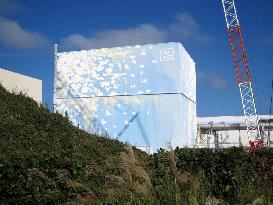
TOKYO, Japan - Supplied photo taken Sept. 29, 2011, shows the building housing the No. 2 reactor at the crippled Fukushima Daiichi nuclear power plant in Fukushima Prefecture. Tokyo Electric Power Co. said Nov. 2, 2011, it has detected xenon-133 and xenon-135, which are typically generated by nuclear fission, at the No. 2 reactor, indicating the possibility that the melted fuel inside may have temporarily gone critical. (Photo courtesy of TEPCO)(Kyodo)

  •  
TEPCO finds fresh nuclear fission sign at Fukushima reactor

TEPCO finds fresh nuclear fission sign at Fukushima reactor

TOKYO, Japan - Photo taken from video footage shows the sheet-covered No. 1 (L) and No. 2 (C) reactor buildings of the Fukushima Daiichi nuclear power plant in Fukushima Prefecture on the morning of Nov. 2, 2011. The plant's operator Tokyo Electric Power Co. said the same day there may be signs of fresh nuclear fission in the No. 2 reactor and that it has injected boric acid to control a possible nuclear reaction. (Photo courtesy of Tokyo Electric Power Co.)(Kyodo)

  •  
Residents briefed on Tokaimura nuclear accident

Residents briefed on Tokaimura nuclear accident

NAKA, Japan - Japanese Science and Technology Agency officials respond Nov. 13 to questions by residents near the site of Japan's worst nuclear accident in Tokaimura, Ibaraki Prefecture. The question-and-answer session was held at a public hall in Naka near Tokaimura. The Sept. 30 nuclear accident involving a nuclear fission chain reaction irradiated at least 69 people.

  • Main
  • Top
  • Editorial
  • Creative
  • About Us
  • About ILG
  • Terms of use
  • Company
  • BEHIND
  • Price List
  • Single Plan
  • Monthly Plan
  • Services
  • Shooting
  • Rights Clearance
  • Support
  • FAQ
  • How To Buy
  • Contact Us
  • Become a Partner

© KYODO NEWS IMAGES INC

All Rights Reserved.

  • Editorial
  • Olympics
  • News
  • Sports
  • Japan
  • Tech
  • Royal
  • Disaster
  • NorthKorea
  • Old Japan
  • SNS
  • Creative
  • Food
  • Japan
  • Landscape
  • Animal
  • Popular
  • #Ukraine
  • #Russia
  • #coronavirus
  • #N. Korea
  • #China
  • #Thailand
  • #Ukraine
  • #Russia
  • #coronavirus
  • #N. Korea
  • #China
  • #Thailand
  • Food
  • Japan
  • Landscape
  • Animal
  • Olympics
  • News
  • Sports
  • Japan
  • Tech
  • Royal
  • Disaster
  • NorthKorea
  • Old Japan
  • SNS