•  
Politics pay tribute to victims of the 17A attack in Barcelona

Politics pay tribute to victims of the 17A attack in Barcelona

(2I-D) The Minister of Justice and Democratic Quality, Ramon Espadaler, the Government Delegate in Catalonia, Carlos Prieto, the Mayor of Barcelona, Jaume Collboni, the President of the Parliament, Josep Rull, the Minister of the Interior and Public Safety, Núria Parlón, the PP councilor in the Barcelona City Council, Daniel Sirera, and the Deputy Mayor of Prevention and Security of the Barcelona City Council, Albert Batlle, the PP councilor in the Barcelona City Council, Daniel Sirera, and the deputy mayor for Prevention and Security of the Barcelona City Council, Albert Batlle, during the ceremony in tribute to the victims of the 17A attack, in La Rambla, on August 17, 2024, in Barcelona, Catalonia (Spain). During the act, tribute was paid to the victims of the attack that occurred on August 17, 2017, on the Las Ramblas promenade in Barcelona, when a mass shooting was committed with a van that covered 530 meters of the central area of the promenade. In that attack, 15 people were killed and 131 injured, fiv

  •  
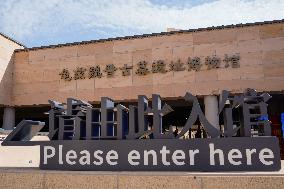
Wei And Jin Dynasties Ancient Tombs Site Museum - Kuqa City

Wei And Jin Dynasties Ancient Tombs Site Museum - Kuqa City

This photo taken on July 15, 2024. An underground museum of the Wei and Jin dynasties (220-420) ancient tombs opened on Monday in Kuqa County, an area that previously belonged to the ancient Qiuci State. The Qiuci State, which commenced in the second century BC and existed for more than 1,000 years, was one of the 36 states in the Western Regions, a term used in the Han Dynasty (206 BC-220 AD) for areas west of the Yumen Pass, including present Xinjiang and parts of Central Asia. This in-situ museum with an exhibition space of 5,000 square meters was built to protect 15 brick tomb chambers discovered in 2007 during the construction of the Youyi Road underground pass. The discovery was one of China's top ten new archaeological discoveries that year. The tomb complex was built in consistence with the Han Dynasty style brick-chambered tombs found in the central China region and along the Hexi Corridor, stretching over a distance of nearly 1,000 kilometers in northwest China's Gansu Province, which is home to fiv

  •  
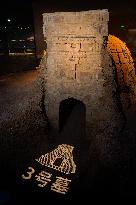
Wei And Jin Dynasties Ancient Tombs Site Museum - Kuqa City

Wei And Jin Dynasties Ancient Tombs Site Museum - Kuqa City

This photo taken on July 15, 2024. An underground museum of the Wei and Jin dynasties (220-420) ancient tombs opened on Monday in Kuqa County, an area that previously belonged to the ancient Qiuci State. The Qiuci State, which commenced in the second century BC and existed for more than 1,000 years, was one of the 36 states in the Western Regions, a term used in the Han Dynasty (206 BC-220 AD) for areas west of the Yumen Pass, including present Xinjiang and parts of Central Asia. This in-situ museum with an exhibition space of 5,000 square meters was built to protect 15 brick tomb chambers discovered in 2007 during the construction of the Youyi Road underground pass. The discovery was one of China's top ten new archaeological discoveries that year. The tomb complex was built in consistence with the Han Dynasty style brick-chambered tombs found in the central China region and along the Hexi Corridor, stretching over a distance of nearly 1,000 kilometers in northwest China's Gansu Province, which is home to fiv

  •  
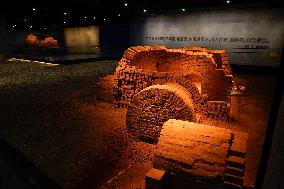
Wei And Jin Dynasties Ancient Tombs Site Museum - Kuqa City

Wei And Jin Dynasties Ancient Tombs Site Museum - Kuqa City

This photo taken on July 15, 2024. An underground museum of the Wei and Jin dynasties (220-420) ancient tombs opened on Monday in Kuqa County, an area that previously belonged to the ancient Qiuci State. The Qiuci State, which commenced in the second century BC and existed for more than 1,000 years, was one of the 36 states in the Western Regions, a term used in the Han Dynasty (206 BC-220 AD) for areas west of the Yumen Pass, including present Xinjiang and parts of Central Asia. This in-situ museum with an exhibition space of 5,000 square meters was built to protect 15 brick tomb chambers discovered in 2007 during the construction of the Youyi Road underground pass. The discovery was one of China's top ten new archaeological discoveries that year. The tomb complex was built in consistence with the Han Dynasty style brick-chambered tombs found in the central China region and along the Hexi Corridor, stretching over a distance of nearly 1,000 kilometers in northwest China's Gansu Province, which is home to fiv

  •  
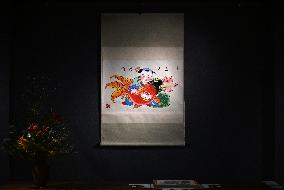
(MASTER OF CRAFTS)CHINA-TIANJIN-YANGLIUQING WOODBLOCK NEW YEAR PICTURES-INHERITOR (CN)

(MASTER OF CRAFTS)CHINA-TIANJIN-YANGLIUQING WOODBLOCK NEW YEAR PICTURES-INHERITOR (CN)

(240101) -- TIANJIN, Jan. 1, 2024 (Xinhua) -- A new year picture is displayed at the Tianjin Yangliuqing Woodblock New Year Picture Museum in Tianjin, north China, Dec. 26, 2023. Yangliuqing woodblock new year pictures, which originated from the Ming Dynasty (1368-1644), has a history of over four centuries. The pictures are noted for their delicate engraving, fine patterns, vivid figures and elegant colours. The crafts were listed as a national-level intangible cultural heritage in 2006. Tianjin Yangliuqing picture studio has been preserving and popularizing this folk art since its inauguration in 1958. Xi Wang, a Tianjin native born in 1991, became a member of the studio upon his graduation from college in 2014, and dedicated himself as the youngest inheritor of the crafts at the studio. Fascinated by the woodblock new year pictures since childhood, he said the pictures convey the happiness of people during the lunar New Year. The traditional crafts of Yangliuqing woodblock new year pictures include fiv

  •  
(MASTER OF CRAFTS)CHINA-TIANJIN-YANGLIUQING WOODBLOCK NEW YEAR PICTURES-INHERITOR (CN)

(MASTER OF CRAFTS)CHINA-TIANJIN-YANGLIUQING WOODBLOCK NEW YEAR PICTURES-INHERITOR (CN)

(240101) -- TIANJIN, Jan. 1, 2024 (Xinhua) -- A new year picture is displayed at the Tianjin Yangliuqing Woodblock New Year Picture Museum in Tianjin, north China, Dec. 26, 2023. Yangliuqing woodblock new year pictures, which originated from the Ming Dynasty (1368-1644), has a history of over four centuries. The pictures are noted for their delicate engraving, fine patterns, vivid figures and elegant colours. The crafts were listed as a national-level intangible cultural heritage in 2006. Tianjin Yangliuqing picture studio has been preserving and popularizing this folk art since its inauguration in 1958. Xi Wang, a Tianjin native born in 1991, became a member of the studio upon his graduation from college in 2014, and dedicated himself as the youngest inheritor of the crafts at the studio. Fascinated by the woodblock new year pictures since childhood, he said the pictures convey the happiness of people during the lunar New Year. The traditional crafts of Yangliuqing woodblock new year pictures include fiv

  • Main
  • Top
  • Editorial
  • Creative
  • About Us
  • About ILG
  • Terms of use
  • Company
  • BEHIND
  • Price List
  • Single Plan
  • Monthly Plan
  • Services
  • Shooting
  • Rights Clearance
  • Support
  • FAQ
  • How To Buy
  • Contact Us
  • Become a Partner

© KYODO NEWS IMAGES INC

All Rights Reserved.

  • Editorial
  • Olympics
  • News
  • Sports
  • Japan
  • Tech
  • Royal
  • Disaster
  • NorthKorea
  • Old Japan
  • SNS
  • Creative
  • Food
  • Japan
  • Landscape
  • Animal
  • Popular
  • #Ukraine
  • #China
  • #coronavirus
  • #N. Korea
  • #Russia
  • #Thailand
  • #Ukraine
  • #China
  • #coronavirus
  • #N. Korea
  • #Russia
  • #Thailand
  • Food
  • Japan
  • Landscape
  • Animal
  • Olympics
  • News
  • Sports
  • Japan
  • Tech
  • Royal
  • Disaster
  • NorthKorea
  • Old Japan
  • SNS