•  
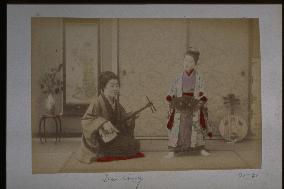
A girl dancing to the shamisen

A girl dancing to the shamisen

A young woman has finished dancing to music performed by her master on the left. A scroll is hanging in the alcove, flowers are arranged in a vase, and a gekkin (moon lute) is placed against the door behind. The fusuma door is a divider between two rooms.==Date:unknown, Place:unknown, Photo:unknown, (Credit:Nagasaki University Library/Kyodo News Images) [Cabinet Number92‐41‐0]

  •  
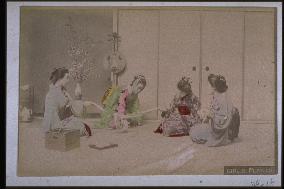
Four women playing with a rope (a hanging fox)

Four women playing with a rope (a hanging fox)

Four women are engaged in a string game called tsurigitsune. The woman on the right is playing a musical instrument. Flowers are arranged on the alcove, and a gekkin (moon lute) is hanging on the wall.==Date:unknown, Place:unknown, Photo:unknown, (Credit:Nagasaki University Library/Kyodo News Images) [Cabinet Number89‐15‐0]

  •  
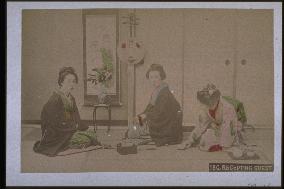
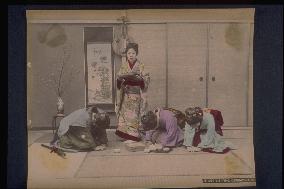
Women serving guests

Women serving guests

The colouring is poor, especially that applied to the kimono of the woman on the right. The scroll on the wall and sliding doors indicate that this was taken inside. Since there is a gekkin (moon lute), the location may be a house in Nagasaki.==Date:unknown, Place:unknown, Photo:unknown, (Credit:Nagasaki University Library/Kyodo News Images) [Cabinet Number89‐16‐0]

  •  
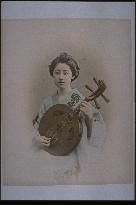
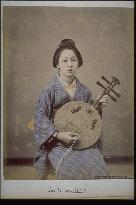
A woman playing the gekkin (an instrament of Chinese origin)

A woman playing the gekkin (an instrament of Chinese origin)

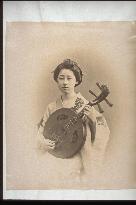
The gekkin (moon harp) is a Chinese instrument from the modern period. It was used to perform Chinese music in Japan from the end of the Edo Period through the Meiji Period. The moon harp was so named because its shape resembled the full moon.==Date:unknown, Place:unknown, Photo:unknown, (Credit:Nagasaki University Library/Kyodo News Images) [Cabinet Number79‐32‐0]

  •  
Women playing Japanese musical instraments

Women playing Japanese musical instraments

This is probably a room in traditional Japanese restaurant. The five women hold (from left) a taiko drum, tsuzumi hand-held drum, and shamisen lutes. A gekkin (moon lute), which is used in Chinese folk songs, is displayed in the alcove.==Date:unknown, Place:unknown, Photo:unknown, (Credit:Nagasaki University Library/Kyodo News Images) [Cabinet Number51‐158‐2]

  •  
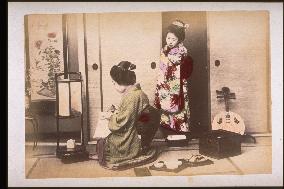
A woman writing a letter

A woman writing a letter

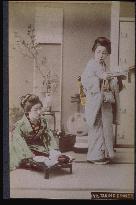
A woman is writing a letter next to an andon lamp. Chrysanthemums and birds are painted on a scroll hanging in the alcove behind. A beautifully dressed girl is looking in from the open sliding door. A gekkin (moon lute) is placed against another door.==Date:unknown, Place:unknown, Photo:unknown, (Credit:Nagasaki University Library/Kyodo News Images) [Cabinet Number51‐161‐0]

  •  
Samurai and women greeting each other

Samurai and women greeting each other

The man has placed his sword to the right and is exchanging greetings with two women in front of an alcove with a hanging scroll. They have one hand placed over the other. The English title reads VISITING CEREMONIALS. A gekkin (moon lute) is hanging on the alcove pillar.==Date:unknown, Place:unknown, Photo:unknown, (Credit:Nagasaki University Library/Kyodo News Images) [Cabinet Number51‐138‐0]

  •  
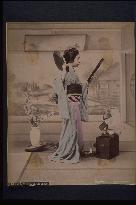
Awase-kagami

Awase-kagami

A woman is examining her hair with a set of awasekagami mirrors. The state of the hair at the back of the head was an important part of women's etiquette. A make-up box is visible on the right. A gekkin (moon lute) is visible. The background setting seems to be a painting.==Date:unknown, Place:unknown, Photo:unknown, (Credit:Nagasaki University Library/Kyodo News Images) [Cabinet Number51‐108‐0]

  •  
A woman playing the gekkin (a stringed instrament of Chinese origin) in front of a teahouse

A woman playing the gekkin (a stringed instrament of Chinese origin) in front of a teahouse

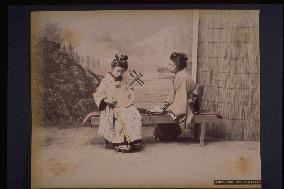
A girl plays a gekkin (moon lute) while another girl looks on. A reed screen is leaning against the wall to block the sunlight. Mt. Fuji is visible over the water.==Date:unknown, Place:unknown, Photo:unknown, (Credit:Nagasaki University Library/Kyodo News Images) [Cabinet Number51‐109‐0]

  •  
A woman playing the gekkin

A woman playing the gekkin

The gekkin (moon harp) is a Chinese instrument from the modern period. It was used to perform Chinese music in Japan from the end of the Edo Period through the Meiji Period. The moon harp was so named because its shape resembled the full moon.==Date:unknown, Place:unknown, Photo:unknown, (Credit:Nagasaki University Library/Kyodo News Images) [Cabinet Number51‐74‐0]

  •  
Women carrying dishes

Women carrying dishes

A woman is shown standing up with a portable meal table while another woman is about to stand up. The meal set on the table consists of miso soup, three kinds of vegetables and cooked rice. A hanging scroll and flowers arranged in a pot are visible in the tokonoma alcove behind them, and a gekkin lute is placed against the wall. This type of room is called an ozashiki.==Date:unknown, Place:unknown, Photo:Tamamura Kozaburo, (Credit:Nagasaki University Library/Kyodo News Images) [Cabinet Number48‐37‐0]

  •  
A woman playing the gekkin (a stringed instrament of Chinese origin)

A woman playing the gekkin (a stringed instrament of Chinese origin)

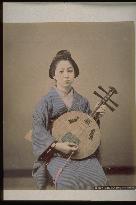
The word gekkin (moon koto) originates from the shape of the full moon and the sound similar to that of the koto. It is a Chinese string instrument that appeared in the Sung dynasty. It was introduced to Japan during the Edo era and gained popularity during the Meiji era. The instrument is played by plucking the strings with a plectrum.==Date:unknown, Place:unknown, Photo:A. Farsari, (Credit:Nagasaki University Library/Kyodo News Images) [Cabinet Number18‐5‐0]

  •  
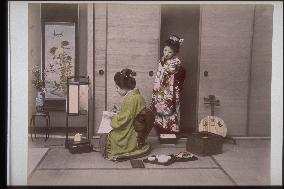
A woman writing a letter

A woman writing a letter

A woman sits in front of a lantern writing a letter on a scroll with a brush, and another woman watches her through the open paper door. On the tatami mat are a big tray with a writing tool box, tea pot and tea cup.A big plate with sweets, a brazier and gekkin lute stands by the sliding doors.==Date:unknown, Place:unknown, Photo:unknown, (Credit:Nagasaki University Library/Kyodo News Images) [Cabinet Number16‐12‐0]

  •  
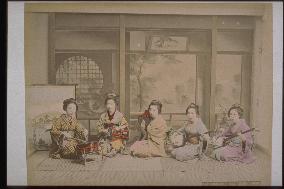
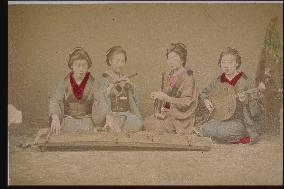
Women playing Japanese musical instraments

Women playing Japanese musical instraments

Four women wearing kimono and hair done in Japanese style play the koto, minteki (lute used for Ming music), teikin and gekkin.==Date:unknown, Place:unknown, Photo:unknown, (Credit:Nagasaki University Library/Kyodo News Images) [Cabinet Number12‐1‐0]

  •  
A woman playing the gekkin (a stringed instrament of Chinese origin)

A woman playing the gekkin (a stringed instrament of Chinese origin)

The word gekkin (moon harp) is derived from the body shaped in a circle resembling the full moon, and the sound resembling the koto. A Chinese string instrument dating back to the Sung dynasty, it was brought to Japan in the Edo era.==Date:Middle Meiji, Place:unknown, Photo:Kusakabe Kinbei, (Credit:Nagasaki University Library/Kyodo News Images) [Cabinet Number1‐8‐0]

  • Main
  • Top
  • Editorial
  • Creative
  • About Us
  • About ILG
  • Terms of use
  • Company
  • BEHIND
  • Price List
  • Single Plan
  • Monthly Plan
  • Services
  • Shooting
  • Rights Clearance
  • Support
  • FAQ
  • How To Buy
  • Contact Us
  • Become a Partner

© KYODO NEWS IMAGES INC

All Rights Reserved.

  • Editorial
  • Olympics
  • News
  • Sports
  • Japan
  • Tech
  • Royal
  • Disaster
  • NorthKorea
  • Old Japan
  • SNS
  • Creative
  • Food
  • Japan
  • Landscape
  • Animal
  • Popular
  • #Ukraine
  • #Russia
  • #coronavirus
  • #N. Korea
  • #Thailand
  • #China
  • #Ukraine
  • #Russia
  • #coronavirus
  • #N. Korea
  • #Thailand
  • #China
  • Food
  • Japan
  • Landscape
  • Animal
  • Olympics
  • News
  • Sports
  • Japan
  • Tech
  • Royal
  • Disaster
  • NorthKorea
  • Old Japan
  • SNS