•  
NASA Selects SpaceX for Dragonfly Mission to Titan

NASA Selects SpaceX for Dragonfly Mission to Titan

Handout photo dated 2024 shows Artist’s concept of Dragonfly soaring over the dunes of Saturn’s moon Titan. NASA has selected SpaceX to provide launch services for the Dragonfly mission, a rotorcraft lander mission under NASA’s New Frontiers Program, designed to explore Saturn’s moon Titan. The mission will sample materials and determine surface composition in different geologic settings, advancing our search for the building blocks of life. The firm-fixed-price contract has a value of approximately $256.6 million, which includes launch services and other mission related costs. The Dragonfly mission currently has a targeted launch period from July 5, 2028, to July 25, 2028, on a SpaceX Falcon Heavy rocket from Launch Complex 39A at NASA’s Kennedy Space Center in Florida. Dragonfly centers on novel approach to planetary exploration, employing a rotorcraft-lander to travel between and sample diverse sites on Saturn’s largest moon. With contributions from partners around the globe, Dragonfly’s scientific payload

  •  
Fault investigation at reactor site

Fault investigation at reactor site

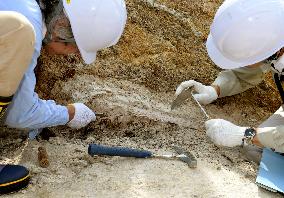
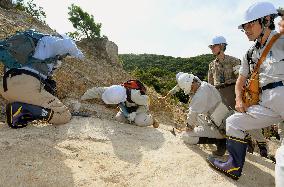
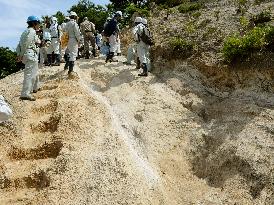
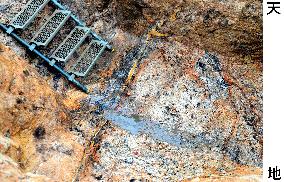
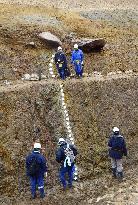
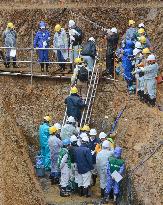
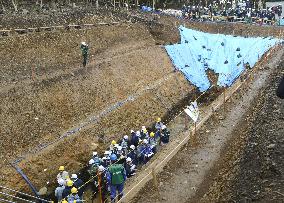
TSURUGA, Japan - A team of experts appointed by the Nuclear Regulation Authority examines a fault in the town of Mihama, Fukui Prefecture, on July 17, 2013. They started the two-day investigation into the activity of some geologic faults running beneath the Monju prototype fast-breeder reactor in the prefecture. (Pool photo)

  •  
Fault investigation at reactor site

Fault investigation at reactor site

TSURUGA, Japan - A team of experts appointed by the Nuclear Regulation Authority examines a fault in the town of Mihama, Fukui Prefecture, on July 17, 2013. They started the two-day investigation into the activity of some geologic faults running beneath the Monju prototype fast-breeder reactor in the prefecture. (Pool photo)

  •  
Fault investigation at reactor site

Fault investigation at reactor site

TSURUGA, Japan - A team of experts appointed by the Nuclear Regulation Authority examines a fault in the town of Mihama, Fukui Prefecture, on July 17, 2013. They started the two-day investigation into the activity of some geologic faults running beneath the Monju prototype fast-breeder reactor in the prefecture. (Pool photo)

  •  
Fault investigation at reactor site

Fault investigation at reactor site

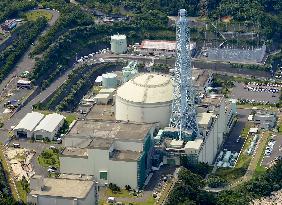
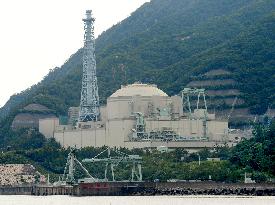
TSURUGA, Japan - Photo taken from a Kyodo News helicopter shows the Monju prototype fast-breeder reactor in Tsuruga, Fukui Prefecture, on July 17, 2013, the day a team of experts appointed by the Nuclear Regulation Authority started a two-day investigation into the activity of some geologic faults running beneath the reactor.

  •  
Fault investigation at reactor site

Fault investigation at reactor site

TSURUGA, Japan - Photo shows the Monju prototype fast-breeder reactor in Tsuruga, Fukui Prefecture, on July 17, 2013, the day a team of experts appointed by the Nuclear Regulation Authority started a two-day investigation into the activity of some geologic faults running beneath the reactor.

  •  
Fault under Tsuruga plant

Fault under Tsuruga plant

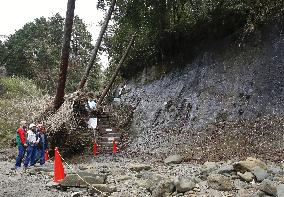
TOKYO, Japan - This December 2012 file photo shows a geologic fault, known as D-1, running directly underneath the No. 2 reactor at Japan Atomic Power Co.'s Tsuruga plant in Fukui Prefecture. A panel of experts under Japan's Nuclear Regulation Authority reaffirmed on Jan. 28, 2013, that the fault is likely to be active.

  •  
Faults at Higashidori nuclear plant

Faults at Higashidori nuclear plant

TOKYO, Japan - Kunihiko Shimazaki, a commissioner of the Nuclear Regulation Authority, holds a press conference in Tokyo on Dec. 20, 2012. A panel of experts led by Shimazaki agreed the same day that geologic faults under Tohoku Electric Power Co.'s Higashidori atomic power plant in Aomori Prefecture are likely to be active, rejecting earlier arguments by the utility.

  •  
Faults at Higashidori nuclear plant

Faults at Higashidori nuclear plant

TOKYO, Japan - File photo taken Dec. 14, 2012, shows a panel of experts conducting a survey on a geologic fault called F-9 (marked with white dots) at Tohoku Electric Power Co.'s Higashidori atomic power plant in Aomori Prefecture. The panel agreed Dec. 20, 2012, that faults under the nuclear plant are likely to be active, rejecting earlier arguments by the utility.

  •  
Study on fault at Oi nuclear plant

Study on fault at Oi nuclear plant

OI, Japan - A team from the Nuclear Regulation Authority examines a ditch on the premises of Kansai Electric Power Co.'s Oi nuclear power station in the town of Oi, Fukui Prefecture, on Nov. 2, 2012, during an investigation to check whether a geologic fault running underneath the plant should be considered as active.

  •  
Study on fault at Oi nuclear plant

Study on fault at Oi nuclear plant

OI, Japan - A team from the Nuclear Regulation Authority examines a ditch on the premises of Kansai Electric Power Co.'s Oi nuclear power station in the town of Oi, Fukui Prefecture, on Nov. 2, 2012, during an investigation to check whether a geologic fault running underneath the plant should be considered as active.

  •  
CHINA-SHANDONG-MOUNT TAISHAN-WORLD HERITAGE (CN)

CHINA-SHANDONG-MOUNT TAISHAN-WORLD HERITAGE (CN)

(220606) -- JINAN, June 6, 2022 (Xinhua) -- Aerial photo taken on May 26, 2022 shows tourists viewing sunrise in Mount Taishan in east China's Shandong Province. A large and impressive rock mass rising to over 1,500 meters, where graceful bridges, gateways or pavilions contrast with pine forests or rocky cliffs, Mount Taishan is considered one of China's most beautiful scenic spots and a symbolization of ancient Chinese civilizations and beliefs. Located in the eastern province of Shandong, Mount Taishan is home to more than 18,000 ancient and precious trees, as well as over 300 species of wild birds. As a famous sacred mountain of China, it has also been a place of worship and royal ceremonies in ancient times. With its natural and cultural values well interconnected, Mount Taishan was listed as the first World Cultural and Natural Heritage site of China by UNESCO in 1987. The humanistic and ecological environment of Taishan has been well preserved through ancient times. The age-old geologic

  •  
CHINA-SHANDONG-MOUNT TAISHAN-WORLD HERITAGE (CN)

CHINA-SHANDONG-MOUNT TAISHAN-WORLD HERITAGE (CN)

(220606) -- JINAN, June 6, 2022 (Xinhua) -- Aerial photo taken on May 26, 2022 shows tourists viewing sunrise in Mount Taishan in east China's Shandong Province. A large and impressive rock mass rising to over 1,500 meters, where graceful bridges, gateways or pavilions contrast with pine forests or rocky cliffs, Mount Taishan is considered one of China's most beautiful scenic spots and a symbolization of ancient Chinese civilizations and beliefs. Located in the eastern province of Shandong, Mount Taishan is home to more than 18,000 ancient and precious trees, as well as over 300 species of wild birds. As a famous sacred mountain of China, it has also been a place of worship and royal ceremonies in ancient times. With its natural and cultural values well interconnected, Mount Taishan was listed as the first World Cultural and Natural Heritage site of China by UNESCO in 1987. The humanistic and ecological environment of Taishan has been well preserved through ancient times. The age-old geologic

  •  
Stratum representing "Chibanian" geologic age

Stratum representing "Chibanian" geologic age

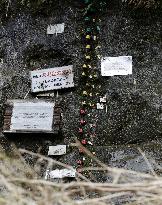
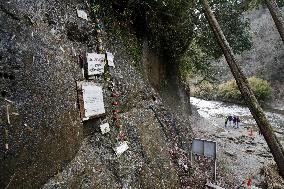
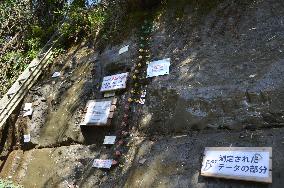
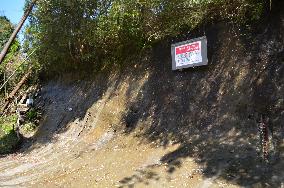
Photo taken Jan. 17, 2020, shows a stratum discovered in Ichihara in Chiba Prefecture, east of Tokyo, from which the name "Chibanian" for the geologic age spanning 770,000 to 126,000 years ago derives. The name meaning "Chiba age" was formally adopted the same day at an executive meeting of the International Union of Geological Sciences in Busan, South Korea. (Kyodo) ==Kyodo

  •  
Stratum representing "Chibanian" geologic age

Stratum representing "Chibanian" geologic age

Photo taken Jan. 17, 2020, shows a stratum discovered in Ichihara in Chiba Prefecture, east of Tokyo, from which the name "Chibanian" for the geologic age spanning 770,000 to 126,000 years ago derives. The name meaning "Chiba age" was formally adopted the same day at an executive meeting of the International Union of Geological Sciences in Busan, South Korea. (Kyodo) ==Kyodo

  •  
Stratum representing "Chibanian" geologic age

Stratum representing "Chibanian" geologic age

Photo taken Jan. 17, 2020, shows a stratum discovered in Ichihara in Chiba Prefecture, east of Tokyo, from which the name "Chibanian" for the geologic age spanning 770,000 to 126,000 years ago derives. The name meaning "Chiba age" was formally adopted the same day at an executive meeting of the International Union of Geological Sciences in Busan, South Korea. (Kyodo) ==Kyodo

  •  
Stratum representing "Chibanian" geologic age

Stratum representing "Chibanian" geologic age

Photo taken Jan. 17, 2020, shows a stratum discovered in Ichihara in Chiba Prefecture, east of Tokyo, from which the name "Chibanian" for the geologic age spanning 770,000 to 126,000 years ago derives. The name meaning "Chiba age" was formally adopted the same day at an executive meeting of the International Union of Geological Sciences in Busan, South Korea. (Kyodo) ==Kyodo

  •  
Japan researchers to seek to have Chiba stratum represent geologic age

Japan researchers to seek to have Chiba stratum represent geologic age

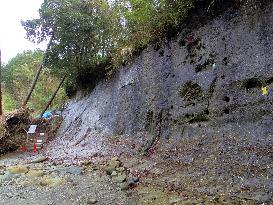
Photo taken April 25, 2017, shows a stratum in Ichihara, Chiba Prefecture, where evidence of the last geomagnetic reversal occurring 770,000 years ago was found preserved in good condition. Based on this stratum, Japanese researchers will file an application in May 2017 with an international geological organization to have the name "Chibanian" represent the middle Pleistocene stage. (Kyodo) ==Kyodo

  •  
Japan researchers to seek to have Chiba stratum represent geologic age

Japan researchers to seek to have Chiba stratum represent geologic age

Photo taken April 25, 2017, shows a stratum in Ichihara, Chiba Prefecture, where evidence of the last geomagnetic reversal occurring 770,000 years ago was found preserved in good condition. Based on this stratum, Japanese researchers will file an application in May 2017 with an international geological organization to have the name "Chibanian" represent the middle Pleistocene stage. (Kyodo) ==Kyodo

  • Main
  • Top
  • Editorial
  • Creative
  • About Us
  • About ILG
  • Terms of use
  • Company
  • BEHIND
  • Price List
  • Single Plan
  • Monthly Plan
  • Services
  • Shooting
  • Rights Clearance
  • Support
  • FAQ
  • How To Buy
  • Contact Us
  • Become a Partner

© KYODO NEWS IMAGES INC

All Rights Reserved.

  • Editorial
  • Olympics
  • News
  • Sports
  • Japan
  • Tech
  • Royal
  • Disaster
  • NorthKorea
  • Old Japan
  • SNS
  • Creative
  • Food
  • Japan
  • Landscape
  • Animal
  • Popular
  • #Ukraine
  • #Thailand
  • #coronavirus
  • #N. Korea
  • #China
  • #Russia
  • #Ukraine
  • #Thailand
  • #coronavirus
  • #N. Korea
  • #China
  • #Russia
  • Food
  • Japan
  • Landscape
  • Animal
  • Olympics
  • News
  • Sports
  • Japan
  • Tech
  • Royal
  • Disaster
  • NorthKorea
  • Old Japan
  • SNS