•  

Chinese solution to desertification in BRI countries highlighted at forum in China's Xinjiang

STORY: Chinese solution to desertification in BRI countries highlighted at forum in China's Xinjiang DATELINE: June 12, 2023 LENGTH: 00:01:41 LOCATION: URUMQI, China CATEGORY: ENVIRONMENT SHOTLIST: 1. various of the forum 2. various of grass in the desert 3. SOUNDBITE 1 (Chinese): ZHANG YUANMING, Head of Xinjiang Institute of Ecology and Geography, Chinese Academy of Sciences 4. various of grass in the desert 5. various of the forum 6. SOUNDBITE 2 (Chinese): ENDRIAS GETA, Deputy Minister of the Ministry of Irrigation and Lowland Development, Ethiopia 7. various of the forum STORYLINE: Experts and officials attending a forum on desertification control in China's Xinjiang have said that the Chinese solution to desertification is helping advance green development in Belt and Road countries. Over the years, China has made significant achievements in environmental protection. Meanwhile, it is ready to share its rich expertise with the world. An expert from the Chinese Academy of Sciences said his institute ha

  •  
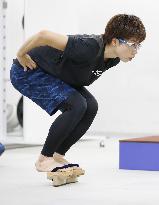
Japanese speed skater Nao Kodaira

Japanese speed skater Nao Kodaira

NAGANO, Japan, Dec. 30 Kyodo - Japanese women's speed skater Nao Kodaira is pictured training at M-Wave ice arena in Nagano on Oct. 2, 2017. Kodaira is using special "geta" sandals that help strengthen balance.

  •  
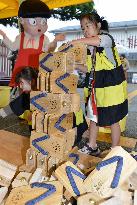
Competition held for piling 'geta' wooden clogs

Competition held for piling 'geta' wooden clogs

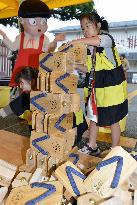
YONAGO, Japan - Participants pile up "geta" wooden clogs in Sakaiminato, Tottori Prefecture, on Nov. 9, 2014, during a competition to heap up the signature footwear of a main character in the popular comic series "GeGeGe no Kitaro" authored by Shigeru Mizuki, a native of the western Japanese city.

  •  
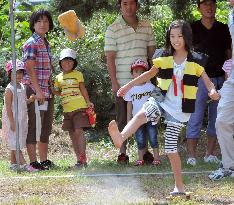
Girl competes in "geta" sandal toss competition

Girl competes in "geta" sandal toss competition

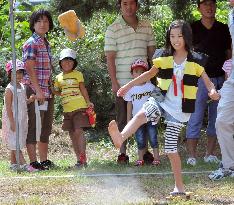
YONAGO, Japan - A girl tosses a Japanese "geta" sandal at a competition in Sakaiminato, Tottori Prefecture, western Japan, on Aug. 30, 2014. The "Gegege no Kitaro Geta Toss Competition" features "Gegege no Kitaro," a phantom boy created by comic artist Shigeru Mizuki born in the city on the Sea of Japan in 1922.

  •  
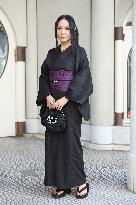
New Kimono style in summer

New Kimono style in summer

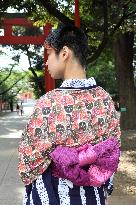
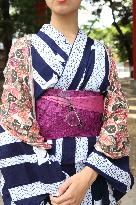
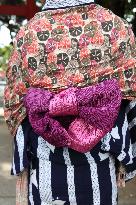
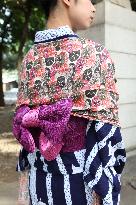
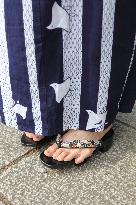
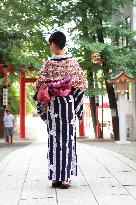
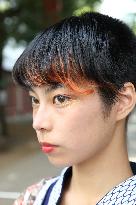
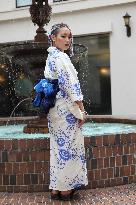
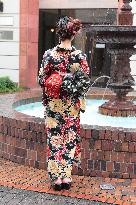
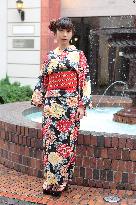
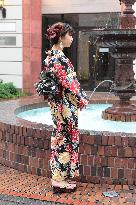
New way to wear yukata Usamajyo. Yukata is a traditional Japanese costume that was born in the Heian period (794-1192) and is also a type of kimono. Unlike a formal kimono, you can wear yukata freely. The number of places to wear it has expanded, and the number of people who wear it increased. People wear it to go to festivals, fireworks and V-kei bands the demand for these special yukatas is increasing. August 5, 2011 , Tokyo, Japan.(Credit:style-arena.jp/Kyodo News Images)

  •  
New Kimono style in summer

New Kimono style in summer

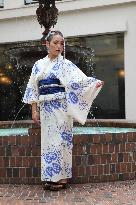
New way to wear yukata Usamajyo. Yukata is a traditional Japanese costume that was born in the Heian period (794-1192) and is also a type of kimono. Unlike a formal kimono, you can wear yukata freely. The number of places to wear it has expanded, and the number of people who wear it increased. People wear it to go to festivals, fireworks and V-kei bands the demand for these special yukatas is increasing. August 5, 2011 , Tokyo, Japan.(Credit:style-arena.jp/Kyodo News Images)

  •  
New Kimono style in summer

New Kimono style in summer

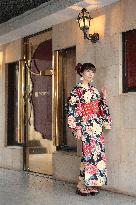
New way to wear yukata Usamajyo. Yukata is a traditional Japanese costume that was born in the Heian period (794-1192) and is also a type of kimono. Unlike a formal kimono, you can wear yukata freely. The number of places to wear it has expanded, and the number of people who wear it increased. People wear it to go to festivals, fireworks and V-kei bands the demand for these special yukatas is increasing. August 5, 2011 , Tokyo, Japan.(Credit:style-arena.jp/Kyodo News Images)

  •  
Japanese Yukata Style

Japanese Yukata Style

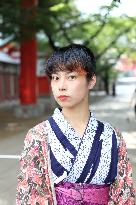
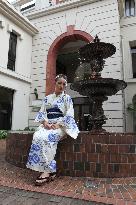
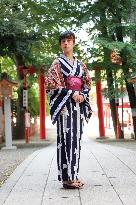
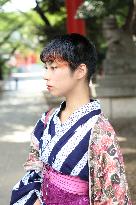
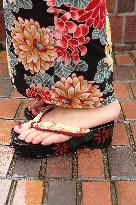
New style of Japanese summer traditional costume "Yukata" . Yukata can be said to be a summer tradition in Japan. In recent years, not only traditional ones, but also various types such as Geisha style, Gothic Lolita style, and for gals / gal men have become popular. Many people enjoy yukata with arranging hairstyles and accessories. August 8, 2015, Shinjuku, Tokyo, Japan.(Credit:style-arena.jp/Kyodo News Images)

  •  
Japanese Yukata Style

Japanese Yukata Style

New style of Japanese summer traditional costume "Yukata" . Yukata can be said to be a summer tradition in Japan. In recent years, not only traditional ones, but also various types such as Geisha style, Gothic Lolita style, and for gals / gal men have become popular. Many people enjoy yukata with arranging hairstyles and accessories. August 8, 2015, Shinjuku, Tokyo, Japan.(Credit:style-arena.jp/Kyodo News Images)

  •  
Japanese Yukata Style

Japanese Yukata Style

New style of Japanese summer traditional costume "Yukata" . Yukata can be said to be a summer tradition in Japan. In recent years, not only traditional ones, but also various types such as Geisha style, Gothic Lolita style, and for gals / gal men have become popular. Many people enjoy yukata with arranging hairstyles and accessories. August 8, 2015, Shinjuku, Tokyo, Japan.(Credit:style-arena.jp/Kyodo News Images)

  •  
Japanese Yukata Style

Japanese Yukata Style

New style of Japanese summer traditional costume "Yukata" . Yukata can be said to be a summer tradition in Japan. In recent years, not only traditional ones, but also various types such as Geisha style, Gothic Lolita style, and for gals / gal men have become popular. Many people enjoy yukata with arranging hairstyles and accessories. August 8, 2015, Shinjuku, Tokyo, Japan.(Credit:style-arena.jp/Kyodo News Images)

  •  
Japanese Yukata Style

Japanese Yukata Style

New style of Japanese summer traditional costume "Yukata" . Yukata can be said to be a summer tradition in Japan. In recent years, not only traditional ones, but also various types such as Geisha style, Gothic Lolita style, and for gals / gal men have become popular. Many people enjoy yukata with arranging hairstyles and accessories. August 8, 2015, Shinjuku, Tokyo, Japan.(Credit:style-arena.jp/Kyodo News Images)

  •  
Japanese Yukata Style

Japanese Yukata Style

New style of Japanese summer traditional costume "Yukata" . Yukata can be said to be a summer tradition in Japan. In recent years, not only traditional ones, but also various types such as Geisha style, Gothic Lolita style, and for gals / gal men have become popular. Many people enjoy yukata with arranging hairstyles and accessories. August 8, 2015, Shinjuku, Tokyo, Japan.(Credit:style-arena.jp/Kyodo News Images)

  •  
Japanese Yukata Style

Japanese Yukata Style

New style of Japanese summer traditional costume "Yukata" . Yukata can be said to be a summer tradition in Japan. In recent years, not only traditional ones, but also various types such as Geisha style, Gothic Lolita style, and for gals / gal men have become popular. Many people enjoy yukata with arranging hairstyles and accessories. August 8, 2015, Shinjuku, Tokyo, Japan.(Credit:style-arena.jp/Kyodo News Images)

  •  
Japanese Yukata Style

Japanese Yukata Style

New style of Japanese summer traditional costume "Yukata" . Yukata can be said to be a summer tradition in Japan. In recent years, not only traditional ones, but also various types such as Geisha style, Gothic Lolita style, and for gals / gal men have become popular. Many people enjoy yukata with arranging hairstyles and accessories. August 8, 2015, Shinjuku, Tokyo, Japan.(Credit:style-arena.jp/Kyodo News Images)

  •  
Japanese Yukata Style

Japanese Yukata Style

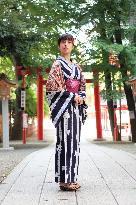
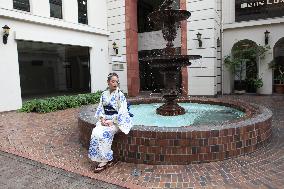
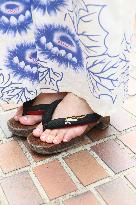
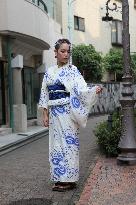
New style of Japanese summer traditional costume "Yukata" NONOKO. Yukata can be said to be a summer tradition in Japan. In recent years, not only traditional ones, but also various types such as Geisha style, Gothic Lolita style, and for gals / gal men have become popular. Many people enjoy yukata with arranging hairstyles and accessories. August 7, 2015, Harajuku, Tokyo, Japan.(Credit:style-arena.jp/Kyodo News Images)

  •  
Japanese Yukata Style

Japanese Yukata Style

New style of Japanese summer traditional costume "Yukata" . Yukata can be said to be a summer tradition in Japan. In recent years, not only traditional ones, but also various types such as Geisha style, Gothic Lolita style, and for gals / gal men have become popular. Many people enjoy yukata with arranging hairstyles and accessories. August 8, 2015, Shinjuku, Tokyo, Japan.(Credit:style-arena.jp/Kyodo News Images)

  •  
Japanese Yukata Style

Japanese Yukata Style

New style of Japanese summer traditional costume "Yukata" . Yukata can be said to be a summer tradition in Japan. In recent years, not only traditional ones, but also various types such as Geisha style, Gothic Lolita style, and for gals / gal men have become popular. Many people enjoy yukata with arranging hairstyles and accessories. August 8, 2015, Shinjuku, Tokyo, Japan.(Credit:style-arena.jp/Kyodo News Images)

  •  
Japanese Yukata Style

Japanese Yukata Style

New style of Japanese summer traditional costume "Yukata" . Yukata can be said to be a summer tradition in Japan. In recent years, not only traditional ones, but also various types such as Geisha style, Gothic Lolita style, and for gals / gal men have become popular. Many people enjoy yukata with arranging hairstyles and accessories. August 8, 2015, Shinjuku, Tokyo, Japan.(Credit:style-arena.jp/Kyodo News Images)

  •  
Japanese Yukata Style

Japanese Yukata Style

New style of Japanese summer traditional costume "Yukata" NONOKO. Yukata can be said to be a summer tradition in Japan. In recent years, not only traditional ones, but also various types such as Geisha style, Gothic Lolita style, and for gals / gal men have become popular. Many people enjoy yukata with arranging hairstyles and accessories. August 7, 2015, Harajuku, Tokyo, Japan.(Credit:style-arena.jp/Kyodo News Images)

  •  
Japanese Yukata Style

Japanese Yukata Style

New style of Japanese summer traditional costume "Yukata" NONOKO. Yukata can be said to be a summer tradition in Japan. In recent years, not only traditional ones, but also various types such as Geisha style, Gothic Lolita style, and for gals / gal men have become popular. Many people enjoy yukata with arranging hairstyles and accessories. August 7, 2015, Harajuku, Tokyo, Japan.(Credit:style-arena.jp/Kyodo News Images)

  •  
Japanese Yukata Style

Japanese Yukata Style

New style of Japanese summer traditional costume "Yukata" NONOKO. Yukata can be said to be a summer tradition in Japan. In recent years, not only traditional ones, but also various types such as Geisha style, Gothic Lolita style, and for gals / gal men have become popular. Many people enjoy yukata with arranging hairstyles and accessories. August 7, 2015, Harajuku, Tokyo, Japan.(Credit:style-arena.jp/Kyodo News Images)

  •  
Japanese Yukata Style

Japanese Yukata Style

New style of Japanese summer traditional costume "Yukata" NONOKO. Yukata can be said to be a summer tradition in Japan. In recent years, not only traditional ones, but also various types such as Geisha style, Gothic Lolita style, and for gals / gal men have become popular. Many people enjoy yukata with arranging hairstyles and accessories. August 7, 2015, Harajuku, Tokyo, Japan.(Credit:style-arena.jp/Kyodo News Images)

  •  
Japanese Yukata Style

Japanese Yukata Style

New style of Japanese summer traditional costume "Yukata" NONOKO. Yukata can be said to be a summer tradition in Japan. In recent years, not only traditional ones, but also various types such as Geisha style, Gothic Lolita style, and for gals / gal men have become popular. Many people enjoy yukata with arranging hairstyles and accessories. August 7, 2015, Harajuku, Tokyo, Japan.(Credit:style-arena.jp/Kyodo News Images)

  •  
Japanese Yukata Style

Japanese Yukata Style

New style of Japanese summer traditional costume "Yukata" Akane. Yukata can be said to be a summer tradition in Japan. In recent years, not only traditional ones, but also various types such as Geisha style, Gothic Lolita style, and for gals / gal men have become popular. Many people enjoy yukata with arranging hairstyles and accessories. August 29, 2015,Harajuku, Tokyo, Japan.(Credit:style-arena.jp/Kyodo News Images)

  •  
Japanese Yukata Style

Japanese Yukata Style

New style of Japanese summer traditional costume "Yukata" Akane. Yukata can be said to be a summer tradition in Japan. In recent years, not only traditional ones, but also various types such as Geisha style, Gothic Lolita style, and for gals / gal men have become popular. Many people enjoy yukata with arranging hairstyles and accessories. August 29, 2015,Harajuku, Tokyo, Japan.(Credit:style-arena.jp/Kyodo News Images)

  •  
Japanese Yukata Style

Japanese Yukata Style

New style of Japanese summer traditional costume "Yukata" Akane. Yukata can be said to be a summer tradition in Japan. In recent years, not only traditional ones, but also various types such as Geisha style, Gothic Lolita style, and for gals / gal men have become popular. Many people enjoy yukata with arranging hairstyles and accessories. August 29, 2015,Harajuku, Tokyo, Japan.(Credit:style-arena.jp/Kyodo News Images)

  •  
Japanese Yukata Style

Japanese Yukata Style

New style of Japanese summer traditional costume "Yukata" Akane. Yukata can be said to be a summer tradition in Japan. In recent years, not only traditional ones, but also various types such as Geisha style, Gothic Lolita style, and for gals / gal men have become popular. Many people enjoy yukata with arranging hairstyles and accessories. August 29, 2015,Harajuku, Tokyo, Japan.(Credit:style-arena.jp/Kyodo News Images)

  •  
Japanese Yukata Style

Japanese Yukata Style

New style of Japanese summer traditional costume "Yukata" Akane. Yukata can be said to be a summer tradition in Japan. In recent years, not only traditional ones, but also various types such as Geisha style, Gothic Lolita style, and for gals / gal men have become popular. Many people enjoy yukata with arranging hairstyles and accessories. August 29, 2015,Harajuku, Tokyo, Japan.(Credit:style-arena.jp/Kyodo News Images)

  •  
Japanese speed skater Nao Kodaira

Japanese speed skater Nao Kodaira

Japanese women's speed skater Nao Kodaira is pictured training at M-Wave ice arena in Nagano on Oct. 2, 2017. Kodaira is using special "geta" sandals that help strengthen balance. (Kyodo) ==Kyodo

  •  
FEATURE: Daughter on board to succeed family-owned geta business

FEATURE: Daughter on board to succeed family-owned geta business

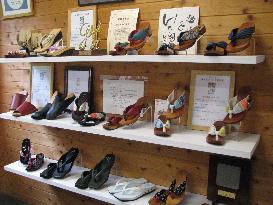
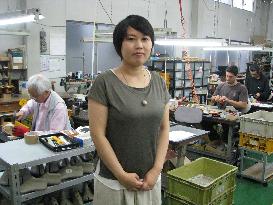
The product lineup of geta footwear company Mizutori is displayed in the office of Yukiko Mizutori, its managing director, in Shizuoka, central Japan, on May 17, 2016. (Kyodo) ==Kyodo

  •  
FEATURE: Daughter on board to succeed family-owned geta business

FEATURE: Daughter on board to succeed family-owned geta business

Yukiko Mizutori, managing director of geta footwear company Mizutori, gives a guided tour through the company's factory in Shizuoka, central Japan, on May 17, 2016. (Kyodo) ==Kyodo

  •  
FEATURE: Daughter on board to succeed family-owned geta business

FEATURE: Daughter on board to succeed family-owned geta business

Yukiko Mizutori, managing director of geta footwear company Mizutori, shows off a pair of slip-resistant acupressure geta at its showroom in Shizuoka, central Japan, on May 17, 2016. (Kyodo) ==Kyodo

  •  
Clog-stacking contest held in west Japan city famous for comics

Clog-stacking contest held in west Japan city famous for comics

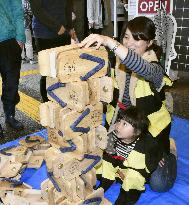
A mother and child take part in a contest to stack as many Japanese "geta" wooden sandals as possible in one minute on Nov. 8, 2015, in Sakaiminato, Tottori Prefecture. The western Japan city is the hometown of Shigeru Mizuki, author of the "GeGeGe no Kitaro" ghost comic series, which features its lead character Kitaro in signature geta clogs. (Kyodo) ==Kyodo

  •  
Women in Okano Garden

Women in Okano Garden

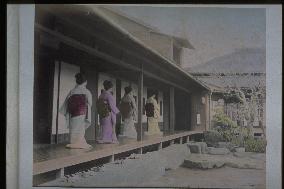
Four women are quietly going to the back of the house, dragging their kimono bottoms and looking at the garden. This photograph has a good perspective. A sharp eye will notice that there are five pairs of geta clogs on the step but only four women. Where is the other person? The old tree in the garden may be a plum tree.==Date:unknown, Place:Tokyo, Photo:A. Farsari, (Credit:Nagasaki University Library/Kyodo News Images) [Cabinet Number95‐19‐0]

  •  
A geta clog craftsman

A geta clog craftsman

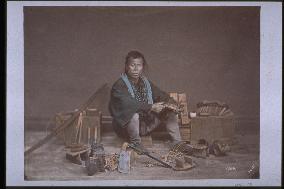
This craftsman walks around the city offering his services in repairing wooden geta clogs, supports for clogs, and thongs. He carries his tools, like a hatchet, plane, and chisels, in a tool box hanging from a balancing pole. His hair is combed in typical craftsman's style, and he wears a hanten coat, gaiters and straw sandals. This is a studio photograph.==Date:unknown, Place:unknown, Photo:Usui Shuzaburo, (Credit:Nagasaki University Library/Kyodo News Images) [Cabinet Number94‐38‐0]

  •  
A geta clog shop

A geta clog shop

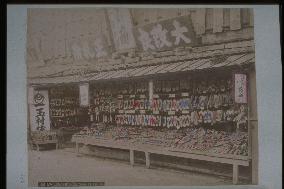
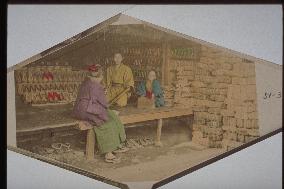
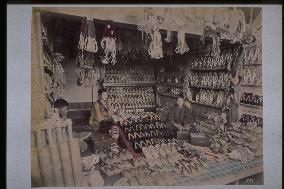
A geta (wooden clogs) shop displays different types of clogs, straw sandals, and thongs. The shop owner is sitting on the right with his wife in the centre. The man on the left may be an apprentice. The shop also sells bangasa (coarse oil-paper umbrellas).==Date:unknown, Place:unknown, Photo:unknown, (Credit:Nagasaki University Library/Kyodo News Images) [Cabinet Number85‐45‐0]

  •  
A geta clog shop

A geta clog shop

A geta clog shop==Date:unknown, Place:unknown, Photo:unknown, (Credit:Nagasaki University Library/Kyodo News Images)

  •  
Samurai warriors

Samurai warriors

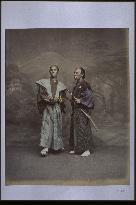
This photograph of two samurai comes from the album Views & Costumes by Stillfried & Andersen. The backdrop belongs to Stillfried's studio. Both samurai are wearing official hakama trousers and vests with family crests. The man on the left is wearing high geta clogs for rainy weather.==Date:unknown, Place:unknown, Photo:R. Stillfried, (Credit:Nagasaki University Library/Kyodo News Images) [Cabinet Number78‐70‐0]

  •  
A pregnant mother

A pregnant mother

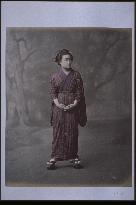
This is one of the photographs in the album by Stillfried and Andersen. A pregnant woman wearing everyday clothes and tall geta clogs poses in front of a backdrop. The woman does not seem to be a professional model. Taken in 1868.==Date:unknown, Place:unknown, Photo:R. Stillfried, (Credit:Nagasaki University Library/Kyodo News Images) [Cabinet Number78‐61‐0]

  •  
A teahouse serving dango (dumplings)

A teahouse serving dango (dumplings)

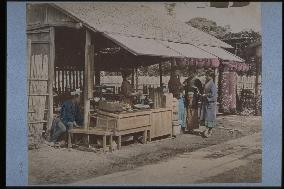
The woman has her kimono sleeves pulled up with a cord across the back. She is wearing an apron. At the store front there are long, round lanterns with the store's name written on them. The customer on the left has a modern hairstyle. The men standing are wearing haori jackets and hakama trousers with high geta clogs.==Date:unknown, Place:unknown, Photo:R. Stillfried, (Credit:Nagasaki University Library/Kyodo News Images) [Cabinet Number76‐41‐0]

  •  
Two men

Two men

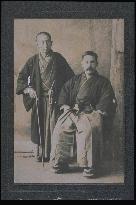
Two middle-aged men pose in a photograph studio. The man standing holds a stick in his hand, while the man sitting wears geta clogs. Taken in 1905. The words Teramachi Sanjo Kitae-iru written on the lower right indicate that it was taken at the Tsubameya Studio (Teramachi Sanjo-ue) run by Imamoto Yujiro.==Date:1905, Place:Kyoto, Photo:unknown, (Credit:Nagasaki University Library/Kyodo News Images) [Cabinet Number72‐234‐0]

  •  
A master and his attendants

A master and his attendants

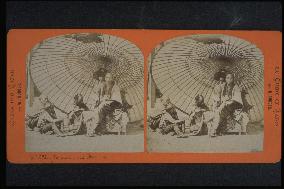
This is a stereograph designed by Wilhelm Burger for the French market entitled China and Japan. A master with one of his geta clogs removed relaxes under a huge umbrella. His servants sit on the ground waiting for him.==Date:unknown, Place:unknown, Photo:Wilhelm Burger, (Credit:Nagasaki University Library/Kyodo News Images) [Cabinet Number70‐23‐0]

  •  
A woman carrying a child on her back

A woman carrying a child on her back

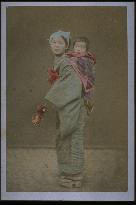
A woman is carrying a baby on her back, and she has a hand towel on her head. She is holding a denden daiko to pacify the baby. She is wearing komachi geta clogs.==Date:unknown, Place:unknown, Photo:unknown, (Credit:Nagasaki University Library/Kyodo News Images) [Cabinet Number64‐2‐0]

  •  
A geta clog craftsman

A geta clog craftsman

A customer is choosing footwear in a geta (wooden clogs) shop, with the shop owner and his apprentice on the right. Many clogs, straw sandals, and thongs are displayed on the shelves inside the shop. On the right side of the shop is a pile of raw materials used to make clogs.==Date:unknown, Place:unknown, Photo:unknown, (Credit:Nagasaki University Library/Kyodo News Images) [Cabinet Number51‐3‐0]

  •  
Disciplinant blowing a trumpet shell

Disciplinant blowing a trumpet shell

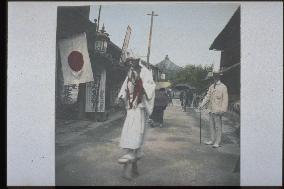
An ascetic wearing high geta clogs blows a triton while walking eastward on the old Hanaya-machi Street. A Caucasian man wearing white clothes is watching him with interest. This is the busy Nishihonganji Temple quarter with advertisements, lanterns, gas lights at shop fronts, and Buddhist accessory shops. The Kyozo (Sutra Repository) of Nishihonganji Temple is visible over Horikawa River through the foliage.==Date:unknown, Place:Kyoto, Photo:unknown, (Credit:Nagasaki University Library/Kyodo News Images) [Cabinet Number46‐112‐0]

  •  
A geta clog craftsman

A geta clog craftsman

The geta (Japanese clogs) have a long history, going back to the Yayoi era. But they became widely popular only in the Edo era. During the reign of the Shogun Yoshimune, the sanmaiba geta became the footwear for prostitutes. Red high-heeled pokkuri (sandals) became a trend among young girls, and geta became an important fashion item. When Japanese women dressed mainly in kimono, geta craftsmen had a variety of geta in their shops.==Date:unknown, Place:unknown, Photo:unknown, (Credit:Nagasaki University Library/Kyodo News Images) [Cabinet Number15‐5‐0]

  •  
Competition held for piling 'geta' wooden clogs

Competition held for piling 'geta' wooden clogs

YONAGO, Japan - Participants pile up "geta" wooden clogs in Sakaiminato, Tottori Prefecture, on Nov. 9, 2014, during a competition to heap up the signature footwear of a main character in the popular comic series "GeGeGe no Kitaro" authored by Shigeru Mizuki, a native of the western Japanese city. (Kyodo)

  •  
Girl competes in "geta" sandal toss competition

Girl competes in "geta" sandal toss competition

YONAGO, Japan - A girl tosses a Japanese "geta" sandal at a competition in Sakaiminato, Tottori Prefecture, western Japan, on Aug. 30, 2014. The "Gegege no Kitaro Geta Toss Competition" features "Gegege no Kitaro," a phantom boy created by comic artist Shigeru Mizuki born in the city on the Sea of Japan in 1922. (Kyodo)

  •  
A geta clog shop

A geta clog shop

A geta clog shop ==Date:unknown, Place:unknown, Photo:unknown, (Credit:Nagasaki University Library/Kyodo News Images)

  • Main
  • Top
  • Editorial
  • Creative
  • About Us
  • About ILG
  • Terms of use
  • Company
  • BEHIND
  • Price List
  • Single Plan
  • Monthly Plan
  • Services
  • Shooting
  • Rights Clearance
  • Support
  • FAQ
  • How To Buy
  • Contact Us
  • Become a Partner

© KYODO NEWS IMAGES INC

All Rights Reserved.

  • Editorial
  • Olympics
  • News
  • Sports
  • Japan
  • Tech
  • Royal
  • Disaster
  • NorthKorea
  • Old Japan
  • SNS
  • Creative
  • Food
  • Japan
  • Landscape
  • Animal
  • Popular
  • #Ukraine
  • #China
  • #coronavirus
  • #N. Korea
  • #Russia
  • #Thailand
  • #Ukraine
  • #China
  • #coronavirus
  • #N. Korea
  • #Russia
  • #Thailand
  • Food
  • Japan
  • Landscape
  • Animal
  • Olympics
  • News
  • Sports
  • Japan
  • Tech
  • Royal
  • Disaster
  • NorthKorea
  • Old Japan
  • SNS