•  
Japan-linked restaurants in Michelin's inaugural guide on Singapore

Japan-linked restaurants in Michelin's inaugural guide on Singapore

Masakazu Ishibashi (L), chef of sushi restaurant Shoukouwa, and Chen Kentaro (C), executive chef of Chinese restaurant Shisen Hanten, pose after being awarded Michelin two-star ratings in Singapore on July 21, 2016. The French tire maker released its first-ever guide on Singapore-based restaurants the same day. (Kyodo) ==Kyodo

  •  
The Tamadare Falls,Hakone

The Tamadare Falls,Hakone

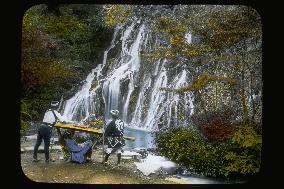
A woman and two palanquin men are watching Tamadare Falls at Hakone Yumoto. Judging from the appearance of the place, this photo was taken after 1891 when this place became Takinomae-Yuen Park by the entrepreneur Takashi Koyasu. Since it is written Ichinoyu on the hanten jacket worn by the palanquin man, it is assumed that a woman staying at the shinise (long-standing) inn Ichinoyu at Tonosawa Spa is visiting here.==Date:unknown, Place:Hakone, Photo:unknown, (Credit:Nagasaki University Library/Kyodo News Images) [Cabinet Number98‐34‐0]

  •  
A cooper

A cooper

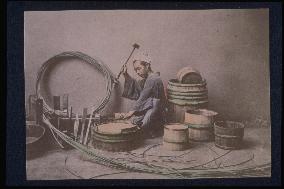
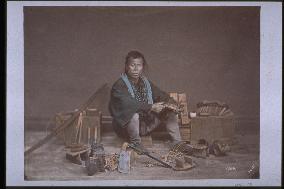
A young craftsman makes a tarai pail with a wooden hammer. He is wearing a head towel and a hanten coat. Bamboo materials twisted in circle, large and small pails, a saw, planes, hatchets and other tools are visible. This is a studio photograph.==Date:unknown, Place:unknown, Photo:unknown, (Credit:Nagasaki University Library/Kyodo News Images) [Cabinet Number96‐23‐0]

  •  
Women on jinrikishas

Women on jinrikishas

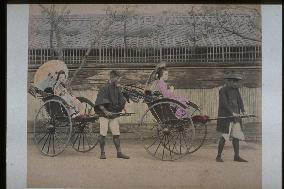
Kimono-clad women hold umbrellas on jinrikisha (rickshaws). The rickshaw man in front wears a straw hat, hanten coat, a stomach warmer, long underwear, and heavy cloth socks. The short-haired rickshaw man in the rear is similarly dressed. This was taken near the wooden fence of a large residence.==Date:unknown, Place:unknown, Photo:A. Farsari, (Credit:Nagasaki University Library/Kyodo News Images) [Cabinet Number95‐20‐0]

  •  
A woman carrying a child on her back

A woman carrying a child on her back

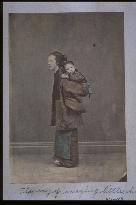
The woman with a child on her back is wearing a hanten (half-coat), a garment worn commonly by both men and women from the Edo Period. She is also wearing an apron so that her kimono will not get dirty.==Date:unknown, Place:unknown, Photo:Usui Shuzaburo, (Credit:Nagasaki University Library/Kyodo News Images) [Cabinet Number94‐49‐0]

  •  
A geta clog craftsman

A geta clog craftsman

This craftsman walks around the city offering his services in repairing wooden geta clogs, supports for clogs, and thongs. He carries his tools, like a hatchet, plane, and chisels, in a tool box hanging from a balancing pole. His hair is combed in typical craftsman's style, and he wears a hanten coat, gaiters and straw sandals. This is a studio photograph.==Date:unknown, Place:unknown, Photo:Usui Shuzaburo, (Credit:Nagasaki University Library/Kyodo News Images) [Cabinet Number94‐38‐0]

  •  
Women on jinrikishas

Women on jinrikishas

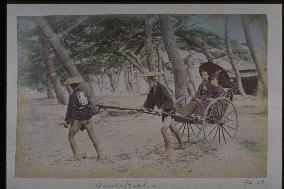
Two kimono-clad women are riding a jinrikisha (rickshaw). One of them is holding an umbrella. The rickshaw man wears a straw hat, a hanten coat, long underwear and straw sandals. The rickshaw man pulling on the left is wearing a loincloth. Many pine trees are visible in the background. This seems to have been taken on a beach.==Date:unknown, Place:Kanagawa, Photo:Kusakabe Kinbei, (Credit:Nagasaki University Library/Kyodo News Images) [Cabinet Number92‐42‐0]

  •  
Women on jinrikishas

Women on jinrikishas

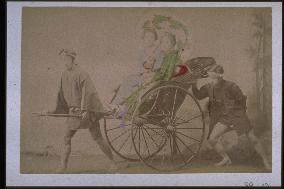
Two kimono-clad women are riding a jinrikisha (rickshaw). One of them is holding an umbrella while the other one is holding a bundle of flowers. The long haired rickshaw man in front is wearing a head towel, a hanten coat, long underwear and straw sandals. The rickshaw man in the rear is dressed in the same fashion and is pushing the cart. He is barefoot. Somethink like trees are visible in the back, but this was probably taken in a studio.==Date:unknown, Place:unknown, Photo:unknown, (Credit:Nagasaki University Library/Kyodo News Images) [Cabinet Number89‐18‐0]

  •  
Horikiri Iris Garden

Horikiri Iris Garden

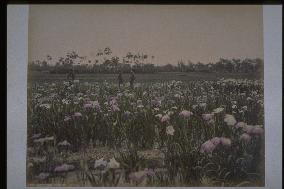
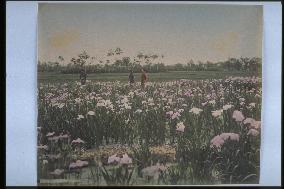
Horikiri Village of Minami Katsushika-gun was famous for its irises from the late Edo Period, and Suzuki Harunobu, Ando Hiroshige and other artists depicted then in ukiyoe prints. This photograph captures the rustic charm of the iris garden in the countryside near Edo. The two women and the man with hanten jacket may be visitors.==Date:unknown, Place:Tokyo, Photo:unknown, (Credit:Nagasaki University Library/Kyodo News Images) [Cabinet Number85‐12‐0]

  •  
Horikiri Iris Garden

Horikiri Iris Garden

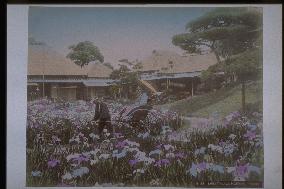
Visitors used rickshaws to tour the iris garden. The words Horitetsu Konai (Horitetsu Ground) are printed on the rickshaw man's hanten jacket. The buildings in the background appear to be, not arbors, but the residence of the garden caretaker. Since irises bloom in the rainy season, people with umbrellas are usually portrayed in these photographs.==Date:unknown, Place:Tokyo, Photo:A. Farsari, (Credit:Nagasaki University Library/Kyodo News Images) [Cabinet Number81‐11‐0]

  •  
Children and an old woman baby-sitting

Children and an old woman baby-sitting

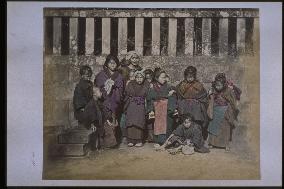
The children are wearing nenneko-hanten jackets to protect the babies from the cold. Some children are wearing socks while others are wearing straw sandals without socks.==Date:unknown, Place:unknown, Photo:R. Stillfried, (Credit:Nagasaki University Library/Kyodo News Images) [Cabinet Number78‐98‐0]

  •  
Horikiri Iris Garden

Horikiri Iris Garden

Horikiri Village of Minami Katsushika-gun was famous for its irises from the late Edo Period, and Suzuki Harunobu, Ando Hiroshige and other artists depicted then in ukiyoe prints. This photograph captures the rustic charm of the iris garden in the countryside near Edo. The two women and the man with hanten jacket may be visitors.==Date:unknown, Place:Tokyo, Photo:unknown, (Credit:Nagasaki University Library/Kyodo News Images) [Cabinet Number53‐23‐0]

  •  
A kite and a child

A kite and a child

A child is wearing a hanten jacket. Han means to bind and ten means to wear. The names of shops and other logos were dyed on the jackets. The kakudako (square Japanese kite) bore illustrations from kabuki plays and ukiyoe woodblock prints.==Date:unknown, Place:unknown, Photo:unknown, (Credit:Nagasaki University Library/Kyodo News Images) [Cabinet Number50‐12‐0]

  •  
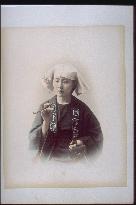
Portrait of a girl wearing a hanten

Portrait of a girl wearing a hanten

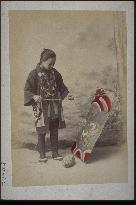
A young girl wears a coat, and she dresses like a young man holding a tobacco pipe and tobacco case. It is probably a dramatized photo in request from a customer at a photo studio.==Date:unknown, Place:unknown, Photo:Kusakabe Kinbei, (Credit:Nagasaki University Library/Kyodo News Images) [Cabinet Number40‐33‐0]

  •  
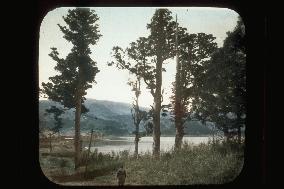
Lake Ashi

Lake Ashi

The same as the photo numbered 31-26. Which is older is unknown, but the range of the photo is wider in 31-26, so maybe it is older. In these photos, people wearing hanten appear frequently. These may be carriers who also served as models.==Date:unknown, Place:Hakone, Photo:unknown, (Credit:Nagasaki University Library/Kyodo News Images) [Cabinet Number31‐75‐0]

  •  
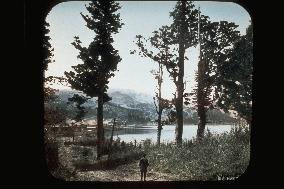
Lake Ashi

Lake Ashi

A photo of a person wearing a hanten and standing backwards on the cedar boulevard by the shores of Lake Ashino. From the telegraph pole, we know this picture was taken after 1881 when telegraphy started around Lake Ashino. The building to the left is the so-called Honjin of the Hakonejuku. This was taken from very near the ruins of the Sekisho.==Date:unknown, Place:Hakone, Photo:unknown, (Credit:Nagasaki University Library/Kyodo News Images) [Cabinet Number31‐26‐0]

  •  
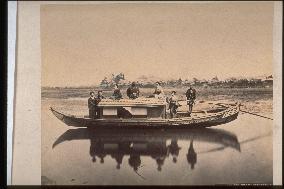
A yakatabune (a leisure boat)

A yakatabune (a leisure boat)

The English caption reads, covered boat, boat with roof . The helmsman and man in the center wear hanten (half coats), which are characteristic features of Ogawa Kazuma's photos. The five women are probably also models. In the distance is Yokohama.==Date:unknown, Place:unknown, Photo:Uchida Kuichi, (Credit:Nagasaki University Library/Kyodo News Images) [Cabinet Number18‐10‐0]

  •  
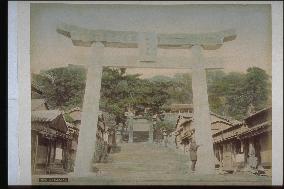
The Great Torii,Suwa Shrine

The Great Torii,Suwa Shrine

The great torii arch at Suwa Shinto Shrine in Kami-Nishiyamacho, Nagasaki City. A man wearing a hanten (short coat) has his arms around the pillar to show the size of the arch. The German caption in the bottom part of the photo reads Torii in a Shinto shrine in Nagasaki.==Date:unknown, Place:Nagasaki, Photo:Kusakabe Kinbei, (Credit:Nagasaki University Library/Kyodo News Images) [Cabinet Number1‐19‐0]

  • Main
  • Top
  • Editorial
  • Creative
  • About Us
  • About ILG
  • Terms of use
  • Company
  • BEHIND
  • Price List
  • Single Plan
  • Monthly Plan
  • Services
  • Shooting
  • Rights Clearance
  • Support
  • FAQ
  • How To Buy
  • Contact Us
  • Become a Partner

© KYODO NEWS IMAGES INC

All Rights Reserved.

  • Editorial
  • Olympics
  • News
  • Sports
  • Japan
  • Tech
  • Royal
  • Disaster
  • NorthKorea
  • Old Japan
  • SNS
  • Creative
  • Food
  • Japan
  • Landscape
  • Animal
  • Popular
  • #Ukraine
  • #Thailand
  • #coronavirus
  • #N. Korea
  • #China
  • #Russia
  • #Ukraine
  • #Thailand
  • #coronavirus
  • #N. Korea
  • #China
  • #Russia
  • Food
  • Japan
  • Landscape
  • Animal
  • Olympics
  • News
  • Sports
  • Japan
  • Tech
  • Royal
  • Disaster
  • NorthKorea
  • Old Japan
  • SNS