•  
CHINA-STONE TOOL TECHNOLOGY-EAST ASIAN HOMININS-STUDY (CN)

CHINA-STONE TOOL TECHNOLOGY-EAST ASIAN HOMININS-STUDY (CN)

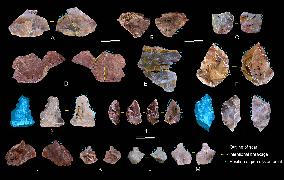
(240307) -- BEIJING, March 7, 2024 (Xinhua) -- This image provided by the Institute of Vertebrate Paleontology and Paleoanthropology (IVPP) of the Chinese Academy of Sciences shows the stone tools unearthed at Cenjiawan site in Nihewan basin, northern China. An international research team led by Chinese scientists has found that East Asian hominins had possessed advanced stone tool technology as early as 1.1 million years ago, much earlier than previously thought. TO GO WITH "Scientists reveal stone tool technology of East Asian hominins 1.1 mln years ago" (Xinhua)

  •  
SWEDEN-STOCKHOLM-2022 NOBEL PRIZE-PHYSIOLOGY OR MEDICINE

SWEDEN-STOCKHOLM-2022 NOBEL PRIZE-PHYSIOLOGY OR MEDICINE

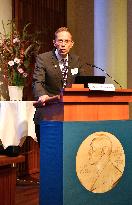
(221003) -- STOCKHOLM, Oct. 3, 2022 (Xinhua) -- Thomas Perlmann, secretary of the Nobel Committee for Physiology or Medicine, announces the winner of the 2022 Nobel Prize in Physiology or Medicine at the Karolinska Institute in Stockholm, Sweden, on Oct. 3, 2022. Swedish geneticist Svante Paabo won the 2022 Nobel Prize in Physiology or Medicine for his discoveries "concerning the genomes of extinct hominins and human evolution," the Nobel committee announced here on Monday. (Xinhua/Ren Pengfei)

  •  
SWEDEN-STOCKHOLM-2022 NOBEL PRIZE-PHYSIOLOGY OR MEDICINE

SWEDEN-STOCKHOLM-2022 NOBEL PRIZE-PHYSIOLOGY OR MEDICINE

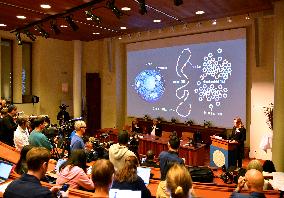
(221003) -- STOCKHOLM, Oct. 3, 2022 (Xinhua) -- The announcement of the 2022 Nobel Prize in Physiology or Medicine is held at the Karolinska Institute in Stockholm, Sweden, on Oct. 3, 2022. Swedish geneticist Svante Paabo won the 2022 Nobel Prize in Physiology or Medicine for his discoveries "concerning the genomes of extinct hominins and human evolution," the Nobel committee announced here on Monday. (Xinhua/Ren Pengfei)

  •  
SWEDEN-STOCKHOLM-2022 NOBEL PRIZE-PHYSIOLOGY OR MEDICINE

SWEDEN-STOCKHOLM-2022 NOBEL PRIZE-PHYSIOLOGY OR MEDICINE

(221003) -- STOCKHOLM, Oct. 3, 2022 (Xinhua) -- The announcement of the 2022 Nobel Prize in Physiology or Medicine is held at the Karolinska Institute in Stockholm, Sweden, on Oct. 3, 2022. Swedish geneticist Svante Paabo won the 2022 Nobel Prize in Physiology or Medicine for his discoveries "concerning the genomes of extinct hominins and human evolution," the Nobel committee announced here on Monday. (Xinhua/Ren Pengfei)

  •  
SWEDEN-STOCKHOLM-2022 NOBEL PRIZE-PHYSIOLOGY OR MEDICINE

SWEDEN-STOCKHOLM-2022 NOBEL PRIZE-PHYSIOLOGY OR MEDICINE

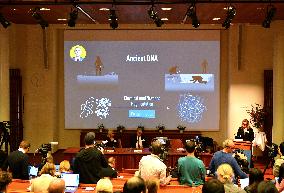
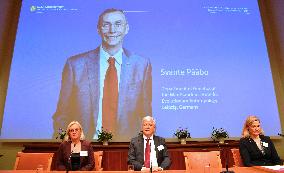
(221003) -- STOCKHOLM, Oct. 3, 2022 (Xinhua) -- The image of 2022 Nobel laureate in Physiology or Medicine, Svante Paabo, is seen on a screen at the Karolinska Institute in Stockholm, Sweden, on Oct. 3, 2022. Swedish geneticist Svante Paabo won the 2022 Nobel Prize in Physiology or Medicine for his discoveries "concerning the genomes of extinct hominins and human evolution," the Nobel committee announced here on Monday. (Xinhua/Ren Pengfei)

  •  

Sweden's Svante Paabo wins 2022 Nobel Prize in Physiology or Medicine

STORY: Sweden's Svante Paabo wins 2022 Nobel Prize in Physiology or Medicine DATELINE: Oct. 3, 2022 LENGTH: 00:01:31 LOCATION: Stockholm CATEGORY: TECHNOLOGY SHOTLIST: 1. various of press conference for Nobel Prize in Physiology or Medicine STORYLINE: Swedish geneticist Svante Paabo won the 2022 Nobel Prize in Physiology or Medicine for his discoveries "concerning the genomes of extinct hominins and human evolution," the Nobel committee announced here on Monday. "Through his pioneering research, Svante Paabo accomplished something seemingly impossible: sequencing the genome of the Neanderthal, an extinct relative of present-day humans," the committee said in a statement. "He also made the sensational discovery of a previously unknown hominin, Denisova." The scientist found that gene transfer had occurred from these now extinct hominins to Homo sapiens following the migration out of Africa around 70,000 years ago. "This ancient flow of genes to present-day humans has physiological relevance today, for ex

  •  

Israeli researchers uncover 800,000-year-old traces of fire use in Galilee region

STORY: Israeli researchers uncover 800,000-year-old traces of fire use in Galilee region DATELINE: June 16, 2022 LENGTH: 00:01:40 LOCATION: Jerusalem CATEGORY: TECHNOLOGY SHOTLIST: 1. various of the entrance of Weizmann Institute 2. various of researchers in the lab 3. various of flint artifacts 4. SOUNDBITE (English): ZANE STEPKA, PhD student, Plant and Environmental Sciences Department and lead writer 5. various of flint artifacts 6. various of researchers in the lab STORYLINE: Israeli researchers have found traces of fire use dating back at least 800,000 years ago with artificial intelligence (AI), the Weizmann Institute of Science (WIS) in central Israel said on Monday. Using advanced artificial intelligence technology they developed, WIS researchers and their colleagues discovered one of the earliest pieces of evidence for the use of fire by ancient hominins, the institute added. The evidence, published Monday in the journal PNAS, was found at Evron Quarry, an open-air archaeological site located i

  • Main
  • Top
  • Editorial
  • Creative
  • About Us
  • About ILG
  • Terms of use
  • Company
  • BEHIND
  • Price List
  • Single Plan
  • Monthly Plan
  • Services
  • Shooting
  • Rights Clearance
  • Support
  • FAQ
  • How To Buy
  • Contact Us
  • Become a Partner

© KYODO NEWS IMAGES INC

All Rights Reserved.

  • Editorial
  • Olympics
  • News
  • Sports
  • Japan
  • Tech
  • Royal
  • Disaster
  • NorthKorea
  • Old Japan
  • SNS
  • Creative
  • Food
  • Japan
  • Landscape
  • Animal
  • Popular
  • #Ukraine
  • #Russia
  • #coronavirus
  • #N. Korea
  • #China
  • #Thailand
  • #Ukraine
  • #Russia
  • #coronavirus
  • #N. Korea
  • #China
  • #Thailand
  • Food
  • Japan
  • Landscape
  • Animal
  • Olympics
  • News
  • Sports
  • Japan
  • Tech
  • Royal
  • Disaster
  • NorthKorea
  • Old Japan
  • SNS