•  
The gate of the Imperial Palace

The gate of the Imperial Palace

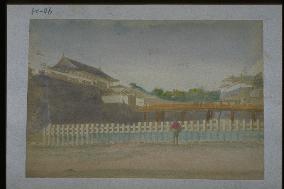
Honmaru (Dungeon) Otemon was the main gate of Edo Castle during the Edo Period, but Nishinomaru Otemon (the gate on the left) became the main gate of the Imperial Palace in the Meiji Period. Koraimon is visible at the edge of Nishinomaru Otemon in the foreground. However, the gate was removed during construction of Meiji Palace in 1888. In December of the same year, the bridge was rebuilt in stone. Taken in 1868.==Date:unknown, Place:Tokyo, Photo:unknown, (Credit:Nagasaki University Library/Kyodo News Images) [Cabinet Number90‐21‐0]

  •  
Nagoya Castle

Nagoya Castle

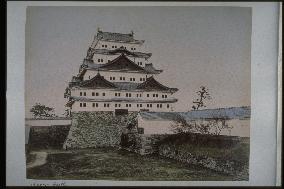
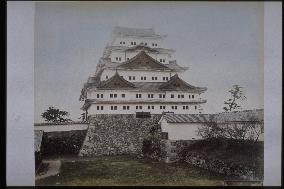
The east side of the dungeon of Nagoya Castle seen from around Higashi Ichi-no-mon (gate). The wall on the left side of the castle tower stretches to a small tower. The building slightly visible on the left is the kitchen of the Honmaru (main donjon) palace. Since the tamon wall to the right was destroyed by the Nobi Earthquake in 1891, this photograph was taken after the golden shachi (mythical carp) were returned to the castle tower top in 1878 but before the earthquake.==Date:unknown, Place:Nagoya, Photo:unknown, (Credit:Nagasaki University Library/Kyodo News Images) [Cabinet Number87‐33‐0]

  •  
Nagoya Castle

Nagoya Castle

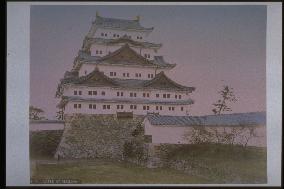
The east side of the dungeon of Nagoya Castle seen from around Higashi Ichi-no-mon (gate). The wall on the left side of the castle tower stretches to a small tower. The building slightly visible on the left is the kitchen of the Honmaru (main donjon) palace. Since the tamon wall to the right was destroyed by the Nobi Earthquake in 1891, this photograph was taken after the golden shachi (mythical carp) were returned to the castle tower top in 1878 but before the earthquake.==Date:unknown, Place:Nagoya, Photo:unknown, (Credit:Nagasaki University Library/Kyodo News Images) [Cabinet Number86‐11‐0]

  •  
Nagoya Castle

Nagoya Castle

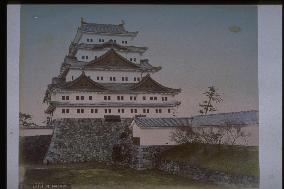
The east side of the dungeon of Nagoya Castle seen from around Higashi Ichi-no-mon (gate). The wall on the left side of the castle tower stretches to a small tower. The building slightly visible on the left is the kitchen of the Honmaru (main donjon) palace. Since the tamon wall to the right was destroyed by the Nobi Earthquake in 1891, this photograph was taken after the golden shachi (mythical carp) were returned to the castle tower top in 1878 but before the earthquake.==Date:unknown, Place:Nagoya, Photo:A. Farsari, (Credit:Nagasaki University Library/Kyodo News Images) [Cabinet Number81‐18‐0]

  •  
The Tatsumi Three-story Watchtower at Honmaru (main dungeon),Edo Castle

The Tatsumi Three-story Watchtower at Honmaru (main dungeon),Edo Castle

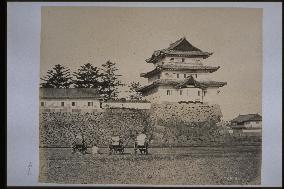
The three-story Hasuike Tatsumi watchtower with Tansu Tamon, the longest castle wall-cum-armory at Edo Castle, on the left. This photograph must have been taken before October 7, 1870, when these buildings were probably destroyed as a result of a fire in a explosives warehouse. The low camera angle makes it difficult to tell, but the Hamaguri Moat is located beyond the rickshaws. Uchi Sakurada Gate, standing since the construction of Edo Castle by Ota Dokan, is visible on the far right. The Japanese bellflower crest of the Ota family remained on the gate when the first Shogun Tokugawa Ieyasu entered the castle. As a result, the gate is also called Kikyo-mon (Bellflower Gate).==Date:unknown, Place:Tokyo, Photo:R. Stillfried, (Credit:Nagasaki University Library/Kyodo News Images) [Cabinet Number78‐33‐0]

  •  
Owari Garden

Owari Garden

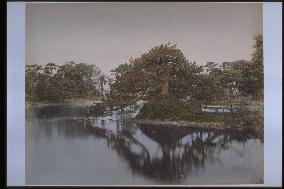
This is probably Shimo Ofuke Garden in Ofukemaru, located in the northern part of the Honmaru and Ninomaru areas of Nagoya Castle. This garden is said to have represented a sort of fairyland or utopia, consisting of 14 islands, big and small, such as Matsubara-jima and Takefuji-jima in a huge lotus pond. In 1889, it was purchased by the Department of the Army and turned into a military drill field. In 1908, part of the Ofukemaru area became an imperial villa. This is a valuable photograph because none of these scenes remain today.==Date:unknown, Place:Nagoya, Photo:R. Stillfried, (Credit:Nagasaki University Library/Kyodo News Images) [Cabinet Number77‐22‐0]

  •  
A picture of Kumamoto Castle

A picture of Kumamoto Castle

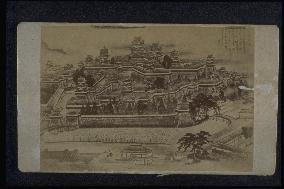
This is a bird's eye view of the honmaru (principal compound) of Kumamoto Castle, entitled Real View of Kumamoto Castle. A description is written in the upper right-hand corner. The castle burned down in 1877, just before the Seinan War, and many illustrations of this sort were made in memory of the old castle. The picture depicts the big and small donjons in the centre, the compounds to the right and left and on the lower levels, and the guard towers. The original plate is kept at Tomishige Photograph Studio, which has been in business since the early Meiji Period.==Date:unknown, Place:Kumamoto, Photo:unknown, (Credit:Nagasaki University Library/Kyodo News Images) [Cabinet Number71‐51‐0]

  •  
Nagoya Castle

Nagoya Castle

The east side of the dungeon of Nagoya Castle seen from around Higashi Ichi-no-mon (gate). The wall on the left side of the castle tower stretches to a small tower. The building slightly visible on the left is the kitchen of the Honmaru (main donjon) palace. Since the tamon wall to the right was destroyed by the Nobi Earthquake in 1891, this photograph was taken after the golden shachi (mythical carp) were returned to the castle tower top in 1878 but before the earthquake.==Date:unknown, Place:Nagoya, Photo:unknown, (Credit:Nagasaki University Library/Kyodo News Images) [Cabinet Number61‐2‐0]

  •  
The lotus moat of the Imperial Palace

The lotus moat of the Imperial Palace

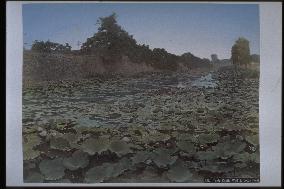
Hasuike (Lotus Pond) Moat between Honmaru and Koyozan. The height of the stone wall on the left indicates that the Honmaru Palace is on that side and therefore that this is a view of Hasuike-mon looking southeast from Shita-mon at Koyozan. Taken by Kusakabe Kinbei, probably between 1877 and 1887 (second decade of the Meiji Period).==Date:unknown, Place:Tokyo, Photo:unknown, (Credit:Nagasaki University Library/Kyodo News Images) [Cabinet Number59‐14‐0]

  •  
The south-east,three-story turret at The second corner of The imperial palace

The south-east,three-story turret at The second corner of The imperial palace

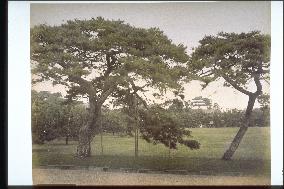
The Son three-tier turret is located in the Honmaru and Ninomaru, and the photo is that of Ninomaru. The three-tier turret seen through the pine branches has an indescribable beauty.==Date:unknown, Place:Tokyo, Photo:Ogawa Kazumasa, (Credit:Nagasaki University Library/Kyodo News Images) [Cabinet Number8‐29‐0]

  • Main
  • Top
  • Editorial
  • Creative
  • About Us
  • About ILG
  • Terms of use
  • Company
  • BEHIND
  • Price List
  • Single Plan
  • Monthly Plan
  • Services
  • Shooting
  • Rights Clearance
  • Support
  • FAQ
  • How To Buy
  • Contact Us
  • Become a Partner

© KYODO NEWS IMAGES INC

All Rights Reserved.

  • Editorial
  • Olympics
  • News
  • Sports
  • Japan
  • Tech
  • Royal
  • Disaster
  • NorthKorea
  • Old Japan
  • SNS
  • Creative
  • Food
  • Japan
  • Landscape
  • Animal
  • Popular
  • #Ukraine
  • #Russia
  • #coronavirus
  • #N. Korea
  • #China
  • #Thailand
  • #Ukraine
  • #Russia
  • #coronavirus
  • #N. Korea
  • #China
  • #Thailand
  • Food
  • Japan
  • Landscape
  • Animal
  • Olympics
  • News
  • Sports
  • Japan
  • Tech
  • Royal
  • Disaster
  • NorthKorea
  • Old Japan
  • SNS