•  
Biggest Ever Private Bathhouse Found - Pompeii

Biggest Ever Private Bathhouse Found - Pompeii

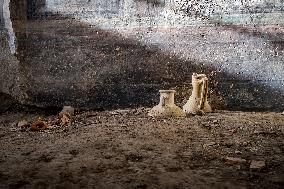
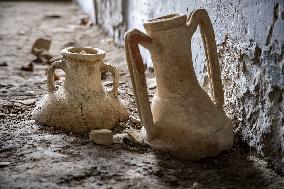
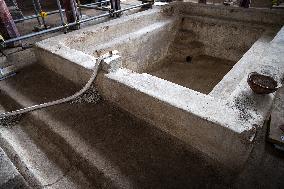
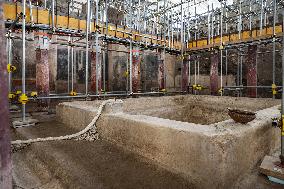
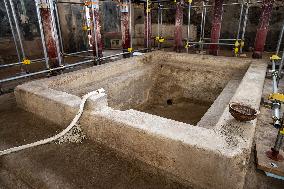
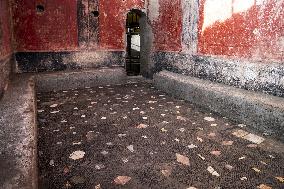
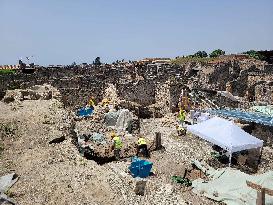
A large thermal bath complex has been uncovered on January 2025 at the ancient Roman city of Pompeii, Italy, buried by 79 AD eruption of Mount Vesuvius. Pictured: The frigidarium (cold). The private bathhouse built 2,000 years ago, is decorated with sumptuous mosaics and equipped with a series of hot, warm and cold rooms in the manner of a spa.The find was made during excavations of a domus, a private town house, in block (insula) 10 of the Regio IX area of Pompeii. The complex, which is connected to a banquet hall, is one of the largest and most sophisticated thermal baths found at a Pompeian domus. The baths, composed of a calidarium, tepidarium, frigidarium (hot, warm and cold room) and changing room (apodyterium), could accommodate up to thirty people judging by the benches present in the latter room. The archaeologists said the cold room is very impressive, composed of a peristyle, or a porticoed courtyard measuring 10 x 10 meters, at the center of which is a large pool. The members of the ruling class o

  •  
Biggest Ever Private Bathhouse Found - Pompeii

Biggest Ever Private Bathhouse Found - Pompeii

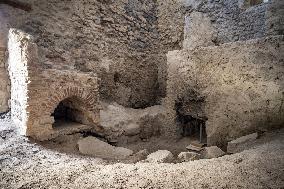
A large thermal bath complex has been uncovered on January 2025 at the ancient Roman city of Pompeii, Italy, buried by 79 AD eruption of Mount Vesuvius. Pictured: The praefurnium (the room and the furnace that ensured the heating of the hot or warm premises of the thermae). The private bathhouse built 2,000 years ago, is decorated with sumptuous mosaics and equipped with a series of hot, warm and cold rooms in the manner of a spa. The find was made during excavations of a domus, a private town house, in block (insula) 10 of the Regio IX area of Pompeii. The complex, which is connected to a banquet hall, is one of the largest and most sophisticated thermal baths found at a Pompeian domus. The baths, composed of a calidarium, tepidarium, frigidarium (hot, warm and cold room) and changing room (apodyterium), could accommodate up to thirty people judging by the benches present in the latter room. The archaeologists said the cold room is very impressive, composed of a peristyle, or a porticoed courtyard measuring

  •  
Biggest Ever Private Bathhouse Found - Pompeii

Biggest Ever Private Bathhouse Found - Pompeii

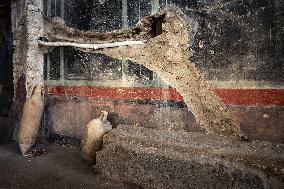
A large thermal bath complex has been uncovered on January 2025 at the ancient Roman city of Pompeii, Italy, buried by 79 AD eruption of Mount Vesuvius. Pictured: The frigidarium (cold). The private bathhouse built 2,000 years ago, is decorated with sumptuous mosaics and equipped with a series of hot, warm and cold rooms in the manner of a spa.The find was made during excavations of a domus, a private town house, in block (insula) 10 of the Regio IX area of Pompeii. The complex, which is connected to a banquet hall, is one of the largest and most sophisticated thermal baths found at a Pompeian domus. The baths, composed of a calidarium, tepidarium, frigidarium (hot, warm and cold room) and changing room (apodyterium), could accommodate up to thirty people judging by the benches present in the latter room. The archaeologists said the cold room is very impressive, composed of a peristyle, or a porticoed courtyard measuring 10 x 10 meters, at the center of which is a large pool. The members of the ruling class o

  •  
Biggest Ever Private Bathhouse Found - Pompeii

Biggest Ever Private Bathhouse Found - Pompeii

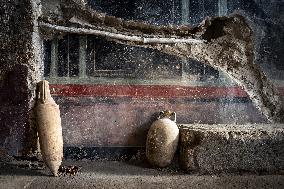
A large thermal bath complex has been uncovered on January 2025 at the ancient Roman city of Pompeii, Italy, buried by 79 AD eruption of Mount Vesuvius. Pictured: The frigidarium (cold). The private bathhouse built 2,000 years ago, is decorated with sumptuous mosaics and equipped with a series of hot, warm and cold rooms in the manner of a spa.The find was made during excavations of a domus, a private town house, in block (insula) 10 of the Regio IX area of Pompeii. The complex, which is connected to a banquet hall, is one of the largest and most sophisticated thermal baths found at a Pompeian domus. The baths, composed of a calidarium, tepidarium, frigidarium (hot, warm and cold room) and changing room (apodyterium), could accommodate up to thirty people judging by the benches present in the latter room. The archaeologists said the cold room is very impressive, composed of a peristyle, or a porticoed courtyard measuring 10 x 10 meters, at the center of which is a large pool. The members of the ruling class o

  •  
Biggest Ever Private Bathhouse Found - Pompeii

Biggest Ever Private Bathhouse Found - Pompeii

A large thermal bath complex has been uncovered on January 2025 at the ancient Roman city of Pompeii, Italy, buried by 79 AD eruption of Mount Vesuvius. Pictured: The frigidarium (cold). The private bathhouse built 2,000 years ago, is decorated with sumptuous mosaics and equipped with a series of hot, warm and cold rooms in the manner of a spa.The find was made during excavations of a domus, a private town house, in block (insula) 10 of the Regio IX area of Pompeii. The complex, which is connected to a banquet hall, is one of the largest and most sophisticated thermal baths found at a Pompeian domus. The baths, composed of a calidarium, tepidarium, frigidarium (hot, warm and cold room) and changing room (apodyterium), could accommodate up to thirty people judging by the benches present in the latter room. The archaeologists said the cold room is very impressive, composed of a peristyle, or a porticoed courtyard measuring 10 x 10 meters, at the center of which is a large pool. The members of the ruling class o

  •  
Biggest Ever Private Bathhouse Found - Pompeii

Biggest Ever Private Bathhouse Found - Pompeii

A large thermal bath complex has been uncovered on January 2025 at the ancient Roman city of Pompeii, Italy, buried by 79 AD eruption of Mount Vesuvius. Pictured: The frigidarium (cold). The private bathhouse built 2,000 years ago, is decorated with sumptuous mosaics and equipped with a series of hot, warm and cold rooms in the manner of a spa.The find was made during excavations of a domus, a private town house, in block (insula) 10 of the Regio IX area of Pompeii. The complex, which is connected to a banquet hall, is one of the largest and most sophisticated thermal baths found at a Pompeian domus. The baths, composed of a calidarium, tepidarium, frigidarium (hot, warm and cold room) and changing room (apodyterium), could accommodate up to thirty people judging by the benches present in the latter room. The archaeologists said the cold room is very impressive, composed of a peristyle, or a porticoed courtyard measuring 10 x 10 meters, at the center of which is a large pool. The members of the ruling class o

  •  
Biggest Ever Private Bathhouse Found - Pompeii

Biggest Ever Private Bathhouse Found - Pompeii

A large thermal bath complex has been uncovered on January 2025 at the ancient Roman city of Pompeii, Italy, buried by 79 AD eruption of Mount Vesuvius. Pictured: The frigidarium (cold). The private bathhouse built 2,000 years ago, is decorated with sumptuous mosaics and equipped with a series of hot, warm and cold rooms in the manner of a spa.The find was made during excavations of a domus, a private town house, in block (insula) 10 of the Regio IX area of Pompeii. The complex, which is connected to a banquet hall, is one of the largest and most sophisticated thermal baths found at a Pompeian domus. The baths, composed of a calidarium, tepidarium, frigidarium (hot, warm and cold room) and changing room (apodyterium), could accommodate up to thirty people judging by the benches present in the latter room. The archaeologists said the cold room is very impressive, composed of a peristyle, or a porticoed courtyard measuring 10 x 10 meters, at the center of which is a large pool. The members of the ruling class o

  •  
Biggest Ever Private Bathhouse Found - Pompeii

Biggest Ever Private Bathhouse Found - Pompeii

A large thermal bath complex has been uncovered on January 2025 at the ancient Roman city of Pompeii, Italy, buried by 79 AD eruption of Mount Vesuvius. Pictured: The frigidarium (cold). The private bathhouse built 2,000 years ago, is decorated with sumptuous mosaics and equipped with a series of hot, warm and cold rooms in the manner of a spa.The find was made during excavations of a domus, a private town house, in block (insula) 10 of the Regio IX area of Pompeii. The complex, which is connected to a banquet hall, is one of the largest and most sophisticated thermal baths found at a Pompeian domus. The baths, composed of a calidarium, tepidarium, frigidarium (hot, warm and cold room) and changing room (apodyterium), could accommodate up to thirty people judging by the benches present in the latter room. The archaeologists said the cold room is very impressive, composed of a peristyle, or a porticoed courtyard measuring 10 x 10 meters, at the center of which is a large pool. The members of the ruling class o

  •  
Biggest Ever Private Bathhouse Found - Pompeii

Biggest Ever Private Bathhouse Found - Pompeii

A large thermal bath complex has been uncovered on January 2025 at the ancient Roman city of Pompeii, Italy, buried by 79 AD eruption of Mount Vesuvius. Pictured: The apodyterium (the changing room). The private bathhouse built 2,000 years ago, is decorated with sumptuous mosaics and equipped with a series of hot, warm and cold rooms in the manner of a spa.The find was made during excavations of a domus, a private town house, in block (insula) 10 of the Regio IX area of Pompeii. The complex, which is connected to a banquet hall, is one of the largest and most sophisticated thermal baths found at a Pompeian domus. The baths, composed of a calidarium, tepidarium, frigidarium (hot, warm and cold room) and changing room (apodyterium), could accommodate up to thirty people judging by the benches present in the latter room. The archaeologists said the cold room is very impressive, composed of a peristyle, or a porticoed courtyard measuring 10 x 10 meters, at the center of which is a large pool. The members of the r

  •  
Pompeii  - Discovery Of A Still Life Painting With Pizza Ancestor

Pompeii - Discovery Of A Still Life Painting With Pizza Ancestor

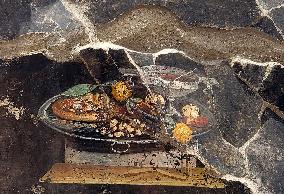
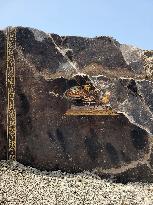
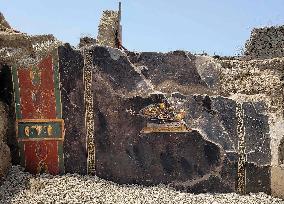
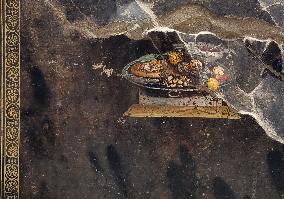
Discovery of a still life from the new excavations in Pompeii, Italy on June 2023. It looks like a pizza, on this Pompeian painting from 2000 years ago, but obviously it can't be, strictly speaking, given that some of the most characteristic ingredients were missing, namely tomatoes and mozzarella. However, as shown by an initial iconographic analysis of a fresco with still life, which has recently emerged as part of the new excavations in insula 10 of Regio IX in Pompeii, what was represented on the wall of an ancient Pompeian house could be a distant ancestor of the modern dish elevated to a World Heritage Site in 2017 as the ‘traditional art of the Neapolitan pizza maker. As the archaeologists of the Archaeological Park of Pompeii explain, it is assumed that next to a goblet of wine, placed on a silver tray, a flat focaccia is depicted which serves as a support for various fruits (identifiable a pomegranate and perhaps a date) , seasoned with spices or perhaps rather with a type of pesto (moretum in Latin)

  •  
Pompeii  - Discovery Of A Still Life Painting With Pizza Ancestor

Pompeii - Discovery Of A Still Life Painting With Pizza Ancestor

Discovery of a still life from the new excavations in Pompeii, Italy on June 2023. It looks like a pizza, on this Pompeian painting from 2000 years ago, but obviously it can't be, strictly speaking, given that some of the most characteristic ingredients were missing, namely tomatoes and mozzarella. However, as shown by an initial iconographic analysis of a fresco with still life, which has recently emerged as part of the new excavations in insula 10 of Regio IX in Pompeii, what was represented on the wall of an ancient Pompeian house could be a distant ancestor of the modern dish elevated to a World Heritage Site in 2017 as the ‘traditional art of the Neapolitan pizza maker. As the archaeologists of the Archaeological Park of Pompeii explain, it is assumed that next to a goblet of wine, placed on a silver tray, a flat focaccia is depicted which serves as a support for various fruits (identifiable a pomegranate and perhaps a date) , seasoned with spices or perhaps rather with a type of pesto (moretum in Latin)

  •  
Pompeii  - Discovery Of A Still Life Painting With Pizza Ancestor

Pompeii - Discovery Of A Still Life Painting With Pizza Ancestor

Discovery of a still life from the new excavations in Pompeii, Italy on June 2023. It looks like a pizza, on this Pompeian painting from 2000 years ago, but obviously it can't be, strictly speaking, given that some of the most characteristic ingredients were missing, namely tomatoes and mozzarella. However, as shown by an initial iconographic analysis of a fresco with still life, which has recently emerged as part of the new excavations in insula 10 of Regio IX in Pompeii, what was represented on the wall of an ancient Pompeian house could be a distant ancestor of the modern dish elevated to a World Heritage Site in 2017 as the ‘traditional art of the Neapolitan pizza maker. As the archaeologists of the Archaeological Park of Pompeii explain, it is assumed that next to a goblet of wine, placed on a silver tray, a flat focaccia is depicted which serves as a support for various fruits (identifiable a pomegranate and perhaps a date) , seasoned with spices or perhaps rather with a type of pesto (moretum in Latin)

  •  
Pompeii  - Discovery Of A Still Life Painting With Pizza Ancestor

Pompeii - Discovery Of A Still Life Painting With Pizza Ancestor

Discovery of a still life from the new excavations in Pompeii, Italy on June 2023. It looks like a pizza, on this Pompeian painting from 2000 years ago, but obviously it can't be, strictly speaking, given that some of the most characteristic ingredients were missing, namely tomatoes and mozzarella. However, as shown by an initial iconographic analysis of a fresco with still life, which has recently emerged as part of the new excavations in insula 10 of Regio IX in Pompeii, what was represented on the wall of an ancient Pompeian house could be a distant ancestor of the modern dish elevated to a World Heritage Site in 2017 as the ‘traditional art of the Neapolitan pizza maker. As the archaeologists of the Archaeological Park of Pompeii explain, it is assumed that next to a goblet of wine, placed on a silver tray, a flat focaccia is depicted which serves as a support for various fruits (identifiable a pomegranate and perhaps a date) , seasoned with spices or perhaps rather with a type of pesto (moretum in Latin)

  •  
Pompeii  - Discovery Of A Still Life Painting With Pizza Ancestor

Pompeii - Discovery Of A Still Life Painting With Pizza Ancestor

Discovery of a still life from the new excavations in Pompeii, Italy on June 2023. It looks like a pizza, on this Pompeian painting from 2000 years ago, but obviously it can't be, strictly speaking, given that some of the most characteristic ingredients were missing, namely tomatoes and mozzarella. However, as shown by an initial iconographic analysis of a fresco with still life, which has recently emerged as part of the new excavations in insula 10 of Regio IX in Pompeii, what was represented on the wall of an ancient Pompeian house could be a distant ancestor of the modern dish elevated to a World Heritage Site in 2017 as the ‘traditional art of the Neapolitan pizza maker. As the archaeologists of the Archaeological Park of Pompeii explain, it is assumed that next to a goblet of wine, placed on a silver tray, a flat focaccia is depicted which serves as a support for various fruits (identifiable a pomegranate and perhaps a date) , seasoned with spices or perhaps rather with a type of pesto (moretum in Latin)

  •  
Archaeologists Discover 2 New Skeletons At Pompeii

Archaeologists Discover 2 New Skeletons At Pompeii

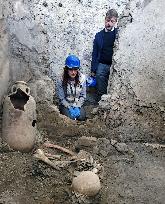
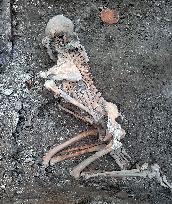
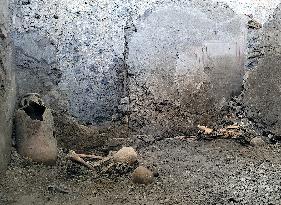
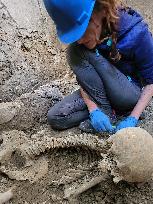
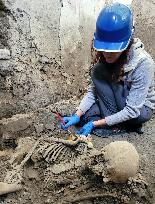
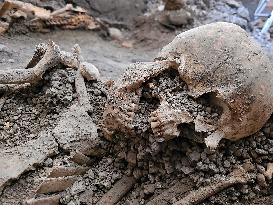
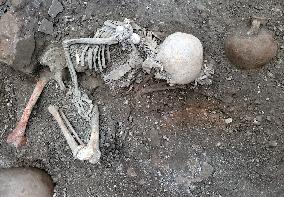
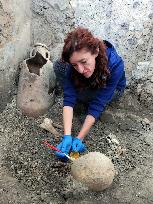
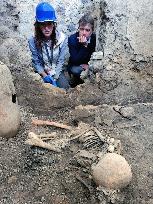
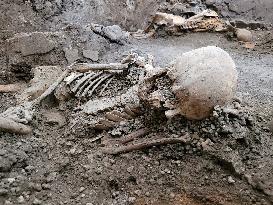
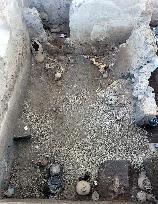
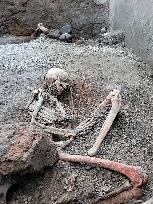
Archaeologists have discovered two skeletons in Pompeii, Italy on May 16, 2023 that they believe were men who died when a wall collapsed on them during the powerful earthquakes that accompanied the eruption of Mount Vesuvius in AD79. The skeletons were discovered at the excavation site known as the Insula dei Casti Amanti (Insula of the Chaste Lovers). According to Gabriel Zuchtriegel (Right), the Director of the Pompeii Archaeological Park, the two were men working in an area that was not a luxurious part of Pompeii, possibly involved in building projects using plaster and amphorae filled with water. He said that the bones show various fractures and are mixed with pieces of the wall that crumbled on them. Bone fractures indicate that the men probably died as a result of multiple injuries sustained as the building they sought refuge in caved in because of an earthquake that struck during the early stage of the volcanic eruption. One of the victims is thought to have raised his arm in an attempt to protect him

  •  
Archaeologists Discover 2 New Skeletons At Pompeii

Archaeologists Discover 2 New Skeletons At Pompeii

Archaeologists have discovered two skeletons in Pompeii, Italy on May 16, 2023 that they believe were men who died when a wall collapsed on them during the powerful earthquakes that accompanied the eruption of Mount Vesuvius in AD79. The skeletons were discovered at the excavation site known as the Insula dei Casti Amanti (Insula of the Chaste Lovers). According to Gabriel Zuchtriegel, the Director of the Pompeii Archaeological Park, the two were men working in an area that was not a luxurious part of Pompeii, possibly involved in building projects using plaster and amphorae filled with water. He said that the bones show various fractures and are mixed with pieces of the wall that crumbled on them. Bone fractures indicate that the men probably died as a result of multiple injuries sustained as the building they sought refuge in caved in because of an earthquake that struck during the early stage of the volcanic eruption. One of the victims is thought to have raised his arm in an attempt to protect himself fro

  •  
Archaeologists Discover 2 New Skeletons At Pompeii

Archaeologists Discover 2 New Skeletons At Pompeii

Archaeologists have discovered two skeletons in Pompeii, Italy on May 16, 2023 that they believe were men who died when a wall collapsed on them during the powerful earthquakes that accompanied the eruption of Mount Vesuvius in AD79. The skeletons were discovered at the excavation site known as the Insula dei Casti Amanti (Insula of the Chaste Lovers). According to Gabriel Zuchtriegel, the Director of the Pompeii Archaeological Park, the two were men working in an area that was not a luxurious part of Pompeii, possibly involved in building projects using plaster and amphorae filled with water. He said that the bones show various fractures and are mixed with pieces of the wall that crumbled on them. Bone fractures indicate that the men probably died as a result of multiple injuries sustained as the building they sought refuge in caved in because of an earthquake that struck during the early stage of the volcanic eruption. One of the victims is thought to have raised his arm in an attempt to protect himself fro

  •  
Archaeologists Discover 2 New Skeletons At Pompeii

Archaeologists Discover 2 New Skeletons At Pompeii

Archaeologists have discovered two skeletons in Pompeii, Italy on May 16, 2023 that they believe were men who died when a wall collapsed on them during the powerful earthquakes that accompanied the eruption of Mount Vesuvius in AD79. The skeletons were discovered at the excavation site known as the Insula dei Casti Amanti (Insula of the Chaste Lovers). According to Gabriel Zuchtriegel, the Director of the Pompeii Archaeological Park, the two were men working in an area that was not a luxurious part of Pompeii, possibly involved in building projects using plaster and amphorae filled with water. He said that the bones show various fractures and are mixed with pieces of the wall that crumbled on them. Bone fractures indicate that the men probably died as a result of multiple injuries sustained as the building they sought refuge in caved in because of an earthquake that struck during the early stage of the volcanic eruption. One of the victims is thought to have raised his arm in an attempt to protect himself fro

  •  
Archaeologists Discover 2 New Skeletons At Pompeii

Archaeologists Discover 2 New Skeletons At Pompeii

Archaeologists have discovered two skeletons in Pompeii, Italy on May 16, 2023 that they believe were men who died when a wall collapsed on them during the powerful earthquakes that accompanied the eruption of Mount Vesuvius in AD79. The skeletons were discovered at the excavation site known as the Insula dei Casti Amanti (Insula of the Chaste Lovers). According to Gabriel Zuchtriegel, the Director of the Pompeii Archaeological Park, the two were men working in an area that was not a luxurious part of Pompeii, possibly involved in building projects using plaster and amphorae filled with water. He said that the bones show various fractures and are mixed with pieces of the wall that crumbled on them. Bone fractures indicate that the men probably died as a result of multiple injuries sustained as the building they sought refuge in caved in because of an earthquake that struck during the early stage of the volcanic eruption. One of the victims is thought to have raised his arm in an attempt to protect himself fro

  •  
Archaeologists Discover 2 New Skeletons At Pompeii

Archaeologists Discover 2 New Skeletons At Pompeii

Archaeologists have discovered two skeletons in Pompeii, Italy on May 16, 2023 that they believe were men who died when a wall collapsed on them during the powerful earthquakes that accompanied the eruption of Mount Vesuvius in AD79. The skeletons were discovered at the excavation site known as the Insula dei Casti Amanti (Insula of the Chaste Lovers). According to Gabriel Zuchtriegel, the Director of the Pompeii Archaeological Park, the two were men working in an area that was not a luxurious part of Pompeii, possibly involved in building projects using plaster and amphorae filled with water. He said that the bones show various fractures and are mixed with pieces of the wall that crumbled on them. Bone fractures indicate that the men probably died as a result of multiple injuries sustained as the building they sought refuge in caved in because of an earthquake that struck during the early stage of the volcanic eruption. One of the victims is thought to have raised his arm in an attempt to protect himself fro

  •  
Archaeologists Discover 2 New Skeletons At Pompeii

Archaeologists Discover 2 New Skeletons At Pompeii

Archaeologists have discovered two skeletons in Pompeii, Italy on May 16, 2023 that they believe were men who died when a wall collapsed on them during the powerful earthquakes that accompanied the eruption of Mount Vesuvius in AD79. The skeletons were discovered at the excavation site known as the Insula dei Casti Amanti (Insula of the Chaste Lovers). According to Gabriel Zuchtriegel, the Director of the Pompeii Archaeological Park, the two were men working in an area that was not a luxurious part of Pompeii, possibly involved in building projects using plaster and amphorae filled with water. He said that the bones show various fractures and are mixed with pieces of the wall that crumbled on them. Bone fractures indicate that the men probably died as a result of multiple injuries sustained as the building they sought refuge in caved in because of an earthquake that struck during the early stage of the volcanic eruption. One of the victims is thought to have raised his arm in an attempt to protect himself fro

  •  
Archaeologists Discover 2 New Skeletons At Pompeii

Archaeologists Discover 2 New Skeletons At Pompeii

Archaeologists have discovered two skeletons in Pompeii, Italy on May 16, 2023 that they believe were men who died when a wall collapsed on them during the powerful earthquakes that accompanied the eruption of Mount Vesuvius in AD79. The skeletons were discovered at the excavation site known as the Insula dei Casti Amanti (Insula of the Chaste Lovers). According to Gabriel Zuchtriegel, the Director of the Pompeii Archaeological Park, the two were men working in an area that was not a luxurious part of Pompeii, possibly involved in building projects using plaster and amphorae filled with water. He said that the bones show various fractures and are mixed with pieces of the wall that crumbled on them. Bone fractures indicate that the men probably died as a result of multiple injuries sustained as the building they sought refuge in caved in because of an earthquake that struck during the early stage of the volcanic eruption. One of the victims is thought to have raised his arm in an attempt to protect himself fro

  •  
Archaeologists Discover 2 New Skeletons At Pompeii

Archaeologists Discover 2 New Skeletons At Pompeii

Archaeologists have discovered two skeletons in Pompeii, Italy on May 16, 2023 that they believe were men who died when a wall collapsed on them during the powerful earthquakes that accompanied the eruption of Mount Vesuvius in AD79. The skeletons were discovered at the excavation site known as the Insula dei Casti Amanti (Insula of the Chaste Lovers). According to Gabriel Zuchtriegel (Right), the Director of the Pompeii Archaeological Park, the two were men working in an area that was not a luxurious part of Pompeii, possibly involved in building projects using plaster and amphorae filled with water. He said that the bones show various fractures and are mixed with pieces of the wall that crumbled on them. Bone fractures indicate that the men probably died as a result of multiple injuries sustained as the building they sought refuge in caved in because of an earthquake that struck during the early stage of the volcanic eruption. One of the victims is thought to have raised his arm in an attempt to protect him

  •  
Archaeologists Discover 2 New Skeletons At Pompeii

Archaeologists Discover 2 New Skeletons At Pompeii

Archaeologists have discovered two skeletons in Pompeii, Italy on May 16, 2023 that they believe were men who died when a wall collapsed on them during the powerful earthquakes that accompanied the eruption of Mount Vesuvius in AD79. The skeletons were discovered at the excavation site known as the Insula dei Casti Amanti (Insula of the Chaste Lovers). According to Gabriel Zuchtriegel, the Director of the Pompeii Archaeological Park, the two were men working in an area that was not a luxurious part of Pompeii, possibly involved in building projects using plaster and amphorae filled with water. He said that the bones show various fractures and are mixed with pieces of the wall that crumbled on them. Bone fractures indicate that the men probably died as a result of multiple injuries sustained as the building they sought refuge in caved in because of an earthquake that struck during the early stage of the volcanic eruption. One of the victims is thought to have raised his arm in an attempt to protect himself fro

  •  
Archaeologists Discover 2 New Skeletons At Pompeii

Archaeologists Discover 2 New Skeletons At Pompeii

Archaeologists have discovered two skeletons in Pompeii, Italy on May 16, 2023 that they believe were men who died when a wall collapsed on them during the powerful earthquakes that accompanied the eruption of Mount Vesuvius in AD79. The skeletons were discovered at the excavation site known as the Insula dei Casti Amanti (Insula of the Chaste Lovers). According to Gabriel Zuchtriegel, the Director of the Pompeii Archaeological Park, the two were men working in an area that was not a luxurious part of Pompeii, possibly involved in building projects using plaster and amphorae filled with water. He said that the bones show various fractures and are mixed with pieces of the wall that crumbled on them. Bone fractures indicate that the men probably died as a result of multiple injuries sustained as the building they sought refuge in caved in because of an earthquake that struck during the early stage of the volcanic eruption. One of the victims is thought to have raised his arm in an attempt to protect himself fro

  •  
Archaeologists Discover 2 New Skeletons At Pompeii

Archaeologists Discover 2 New Skeletons At Pompeii

Archaeologists have discovered two skeletons in Pompeii, Italy on May 16, 2023 that they believe were men who died when a wall collapsed on them during the powerful earthquakes that accompanied the eruption of Mount Vesuvius in AD79. The skeletons were discovered at the excavation site known as the Insula dei Casti Amanti (Insula of the Chaste Lovers). According to Gabriel Zuchtriegel, the Director of the Pompeii Archaeological Park, the two were men working in an area that was not a luxurious part of Pompeii, possibly involved in building projects using plaster and amphorae filled with water. He said that the bones show various fractures and are mixed with pieces of the wall that crumbled on them. Bone fractures indicate that the men probably died as a result of multiple injuries sustained as the building they sought refuge in caved in because of an earthquake that struck during the early stage of the volcanic eruption. One of the victims is thought to have raised his arm in an attempt to protect himself fro

  • Main
  • Top
  • Editorial
  • Creative
  • About Us
  • About ILG
  • Terms of use
  • Company
  • BEHIND
  • Price List
  • Single Plan
  • Monthly Plan
  • Services
  • Shooting
  • Rights Clearance
  • Support
  • FAQ
  • How To Buy
  • Contact Us
  • Become a Partner

© KYODO NEWS IMAGES INC

All Rights Reserved.

  • Editorial
  • Olympics
  • News
  • Sports
  • Japan
  • Tech
  • Royal
  • Disaster
  • NorthKorea
  • Old Japan
  • SNS
  • Creative
  • Food
  • Japan
  • Landscape
  • Animal
  • Popular
  • #Ukraine
  • #Russia
  • #coronavirus
  • #N. Korea
  • #Thailand
  • #China
  • #Ukraine
  • #Russia
  • #coronavirus
  • #N. Korea
  • #Thailand
  • #China
  • Food
  • Japan
  • Landscape
  • Animal
  • Olympics
  • News
  • Sports
  • Japan
  • Tech
  • Royal
  • Disaster
  • NorthKorea
  • Old Japan
  • SNS