•  
Webb Reveals New Structures Within Iconic Supernova

Webb Reveals New Structures Within Iconic Supernova

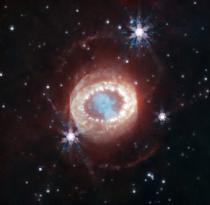
Handout - Webb’s NIRCam (Near-Infrared Camera) captured this detailed image of SN 1987A (Supernova 1987A). At the center, material ejected from the supernova forms a keyhole shape. Just to its left and right are faint crescents newly discovered by Webb. Beyond them an equatorial ring, formed from material ejected tens of thousands of years before the supernova explosion, contains bright hot spots. Exterior to that is diffuse emission and two faint outer rings. This image reveals a central structure like a keyhole. This center is packed with clumpy gas and dust ejected by the supernova explosion. The dust is so dense that even near-infrared light that Webb detects can’t penetrate it, shaping the dark “hole” in the keyhole. Despite the decades of study since the supernova’s initial discovery, there are several mysteries that remain, particularly surrounding the neutron star that should have been formed in the aftermath of the supernova explosion. August 31, 2023. Photo by NASA, ESA, CSA, M. Matsuura (Cardiff Un

  •  
Slope found in Itsukahara tumulus

Slope found in Itsukahara tumulus

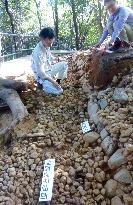
KYOTO, Japan - A slope at Itsukahara tumulus (late 3rd century, keyhole-shaped tumulus) in Muko, Kyoto Prefecture, western Japan, is shown on Oct. 16, 2014. Muko City Center for Archaeological Operations announced that the slope was arranged in a similar manner to the Hashihaka tumulus in Sakurai, Nara Prefecture. Some say Hashihaka is the tomb of Queen Himiko.

  •  
Stone chamber of ancient tomb in early Yamato dynasty unveiled

Stone chamber of ancient tomb in early Yamato dynasty unveiled

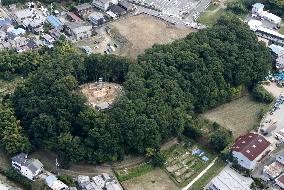
SAKURAI, Japan - Photo taken Oct. 22, 2009, shows the Sakurai Chausu-yama tomb mound near Japan's former capital of Nara. A red-colored stone chamber was excavated from the 200-meter-long keyhole-shaped tomb mound. The site is believed to be a nobleman's tomb from the early years of the Yamato dynasty, which ruled major parts of Japan from the third to seventh centuries.

  •  
Imashirozuka Tomb believed to have been emperor's grave

Imashirozuka Tomb believed to have been emperor's grave

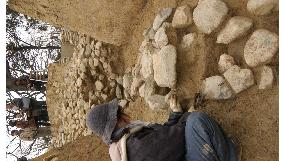
OSAKA, Japan - What looks like a drainage pipe-like system features a large keyhole-shaped tomb mound in Takatsuki, Osaka Prefecture. Tha Takatsuki education board said on Feb. 17 that the tomb, apparently built in the early 6th century, is believed to be the grave of an emperor, judging by the sophisticated method used to protect burial accessories. The drainage system that prevented water from building up in its chamber and damaging burial accessories, it said.

  •  
Imashirozuka Tomb believed to have been emperor's grave

Imashirozuka Tomb believed to have been emperor's grave

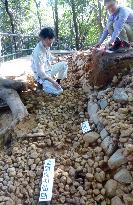
OSAKA, Japan - What looks like a drainage pipe-like system features a large keyhole-shaped tomb mound in Takatsuki, Osaka Prefecture. Tha Takatsuki education board said on Feb. 17 that the tomb, apparently built in the early 6th century, is believed to be the grave of an emperor, judging by the sophisticated method used to protect burial accessories. The drainage system that prevented water from building up in its chamber and damaging burial accessories, it said. (Kyodo)

  •  
BROADWAY THRU A KEYHOLE

BROADWAY THRU A KEYHOLE

BROADWAY THRU A KEYHOLE DIRECTED BY LOWELL SHERMAN Portrait of CONSTANCE CUMMINGS Date: 1933

  •  
Stone chamber of ancient tomb in early Yamato dynasty unveiled

Stone chamber of ancient tomb in early Yamato dynasty unveiled

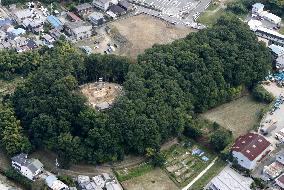
SAKURAI, Japan - Photo taken Oct. 22, 2009, shows the Sakurai Chausu-yama tomb mound near Japan's former capital of Nara. A red-colored stone chamber was excavated from the 200-meter-long keyhole-shaped tomb mound. The site is believed to be a nobleman's tomb from the early years of the Yamato dynasty, which ruled major parts of Japan from the third to seventh centuries. (Kyodo)

  •  
Slope found in Itsukahara tumulus

Slope found in Itsukahara tumulus

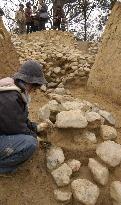
KYOTO, Japan - A slope at Itsukahara tumulus (late 3rd century, keyhole-shaped tumulus) in Muko, Kyoto Prefecture, western Japan, is shown on Oct. 16, 2014. Muko City Center for Archaeological Operations announced that the slope was arranged in a similar manner to the Hashihaka tumulus in Sakurai, Nara Prefecture. Some say Hashihaka is the tomb of Queen Himiko. (Kyodo)

  •  
Ancient Japanese tombs added to UNESCO World Heritage list

Ancient Japanese tombs added to UNESCO World Heritage list

Osaka Gov. Hirofumi Yoshimura meets the press in Baku, Azerbaijan, on July 6, 2019, after UNESCO decided earlier in the day there to add two tumulus clusters in Osaka Prefecture to the World Heritage list, including the country's largest keyhole-shaped mound named after Emperor Nintoku. (Kyodo) ==Kyodo

  •  
Ancient Japanese tombs added to UNESCO World Heritage list

Ancient Japanese tombs added to UNESCO World Heritage list

Osaka Gov. Hirofumi Yoshimura (C) celebrates in Baku, Azerbaijan, on July 6, 2019, after UNESCO decided earlier in the day there to add two tumulus clusters in Osaka Prefecture to the World Heritage list, including the country's largest keyhole-shaped mound named after Emperor Nintoku. (Kyodo) ==Kyodo

  •  
Ancient Japanese tombs added to UNESCO World Heritage list

Ancient Japanese tombs added to UNESCO World Heritage list

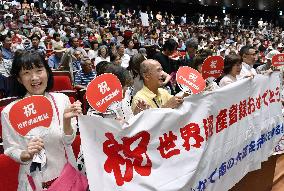
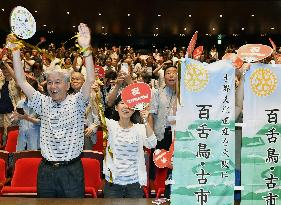
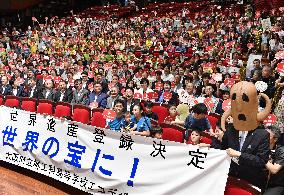
People in the western Japan city of Sakai celebrate on July 6, 2019, after UNESCO decided earlier in the day to add two local tumulus clusters to the World Heritage list, including the country's largest keyhole-shaped mound named after Emperor Nintoku. (Kyodo) ==Kyodo

  •  
Ancient Japanese tombs added to UNESCO World Heritage list

Ancient Japanese tombs added to UNESCO World Heritage list

People in the western Japan city of Sakai celebrate on July 6, 2019, after UNESCO decided earlier in the day to add two local tumulus clusters to the World Heritage list, including the country's largest keyhole-shaped mound named after Emperor Nintoku. (Kyodo) ==Kyodo

  •  
Ancient Japanese tombs added to UNESCO World Heritage list

Ancient Japanese tombs added to UNESCO World Heritage list

People in the western Japan city of Sakai celebrate on July 6, 2019, after UNESCO decided earlier in the day to add two local tumulus clusters to the World Heritage list, including the country's largest keyhole-shaped mound named after Emperor Nintoku. (Kyodo) ==Kyodo

  •  
Ancient Japanese tombs added to UNESCO World Heritage list

Ancient Japanese tombs added to UNESCO World Heritage list

People in the western Japan city of Sakai celebrate on July 6, 2019, after UNESCO decided earlier in the day to add two local tumulus clusters to the World Heritage list, including the country's largest keyhole-shaped mound named after Emperor Nintoku. (Kyodo) ==Kyodo

  •  
Ancient Japanese tombs added to UNESCO World Heritage list

Ancient Japanese tombs added to UNESCO World Heritage list

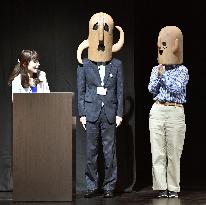
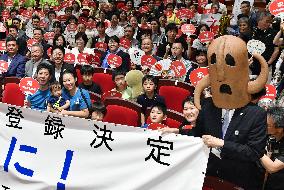
A Sakai city official (C) wearing a "haniwa" -- a clay figure produced during Japan's Kofun period in the 3rd to 6th centuries to decorate tombs for ritual use -- celebrates in the western Japan city on July 6, 2019, after UNESCO decided earlier in the day to add two local tumulus clusters to the World Heritage list, including the country's largest keyhole-shaped mound named after Emperor Nintoku. (Kyodo) ==Kyodo

  •  
Ancient Japanese tombs added to UNESCO World Heritage list

Ancient Japanese tombs added to UNESCO World Heritage list

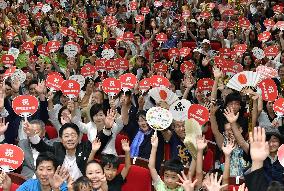
A Sakai city official wearing a "haniwa" -- a clay figure produced during Japan's Kofun period in the 3rd to 6th centuries to decorate tombs for ritual use -- and people in the western Japan city celebrate on July 6, 2019, after UNESCO decided earlier in the day to add two local tumulus clusters to the World Heritage list, including the country's largest keyhole-shaped mound named after Emperor Nintoku. (Kyodo) ==Kyodo

  •  
Ancient Japanese tombs added to UNESCO World Heritage list

Ancient Japanese tombs added to UNESCO World Heritage list

A Sakai city official wearing a "haniwa" -- a clay figure produced during Japan's Kofun period in the 3rd to 6th centuries to decorate tombs for ritual use -- and people in the western Japan city celebrate on July 6, 2019, after UNESCO decided earlier in the day to add two local tumulus clusters to the World Heritage list, including the country's largest keyhole-shaped mound named after Emperor Nintoku. (Kyodo) ==Kyodo

  •  
Japan's largest mounded tomb to become world heritage site

Japan's largest mounded tomb to become world heritage site

Cultural Affairs Agency official Mariko Kobayashi meets the press in Tokyo in the early hours of May 14, 2019, following a UNESCO advisory panel's recommendation that two ancient tumulus clusters in western Japan, including the country's largest keyhole-shaped mound named after an emperor, be added to the World Cultural Heritage list. The listing is expected to be approved at a meeting in Azerbaijan from June 30 to July 10 of the World Heritage Committee of the U.N. Educational, Scientific and Cultural Organization. (Kyodo) ==Kyodo

  • Main
  • Top
  • Editorial
  • Creative
  • About Us
  • About ILG
  • Terms of use
  • Company
  • BEHIND
  • Price List
  • Single Plan
  • Monthly Plan
  • Services
  • Shooting
  • Rights Clearance
  • Support
  • FAQ
  • How To Buy
  • Contact Us
  • Become a Partner

© KYODO NEWS IMAGES INC

All Rights Reserved.

  • Editorial
  • Olympics
  • News
  • Sports
  • Japan
  • Tech
  • Royal
  • Disaster
  • NorthKorea
  • Old Japan
  • SNS
  • Creative
  • Food
  • Japan
  • Landscape
  • Animal
  • Popular
  • #Ukraine
  • #Russia
  • #coronavirus
  • #N. Korea
  • #Thailand
  • #China
  • #Ukraine
  • #Russia
  • #coronavirus
  • #N. Korea
  • #Thailand
  • #China
  • Food
  • Japan
  • Landscape
  • Animal
  • Olympics
  • News
  • Sports
  • Japan
  • Tech
  • Royal
  • Disaster
  • NorthKorea
  • Old Japan
  • SNS