•  
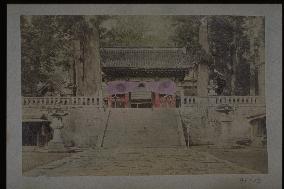
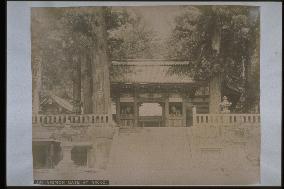
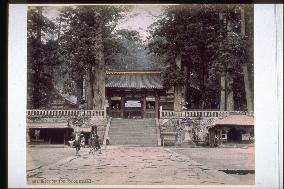
The front entrance to Toshogu Shrine,Nikko

The front entrance to Toshogu Shrine,Nikko

This gate was called Niomon because statues of the Nio guardian deities were placed there until 1871, when Shinto and Buddhism were officially separated and the statues were transferred to Taiyuin Mausoleum. Subsequently, the gate was called Omotemon (Front Gate). The chrysanthemum banner hanging at the gate hides the komainu (guardian dogs), if they are in fact there.==Date:unknown, Place:Nikko, Photo:unknown, (Credit:Nagasaki University Library/Kyodo News Images) [Cabinet Number91‐25‐0]

  •  
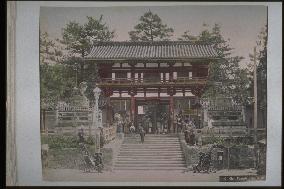
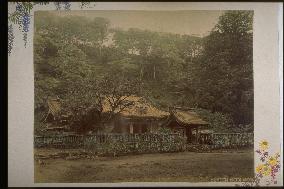
The Sanmon Gate of Yasaka Shrine,Gion,Kyoto

The Sanmon Gate of Yasaka Shrine,Gion,Kyoto

View of the western romon gate of Yasaka Shinto Shrine. Statues of komainu (guardian dogs) stand on both sides of the gate. Rickshaw drivers are relaxing while women and children stand in front of the stone walls and gate. A gaslight and electric pole are visible near the stone walls. The gate roof was covered with hinoki tree bark in 1497 and re-covered with roof tiles during the Eiroku Period (1558-1570). The gate in the picture is painted red, with a kirizuma style roof and roof tiles. There are statues of two ministers within the shrine grounds.==Date:unknown, Place:Kyoto, Photo:unknown, (Credit:Nagasaki University Library/Kyodo News Images) [Cabinet Number87‐37‐0]

  •  
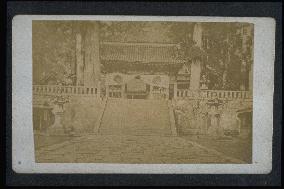
The front entrance to Toshogu Shrine,Nikko

The front entrance to Toshogu Shrine,Nikko

This gate was called Niomon because statues of the Nio guardian deities were placed there until 1871, when Shinto and Buddhism were officially separated and the statues were transferred to Taiyuin Mausoleum. Subsequently, the gate was called Omotemon (Front Gate). The chrysanthemum banner hanging at the gate hides the komainu (guardian dogs), if they are in fact there.==Date:unknown, Place:Nikko, Photo:unknown, (Credit:Nagasaki University Library/Kyodo News Images) [Cabinet Number71‐19‐0]

  •  
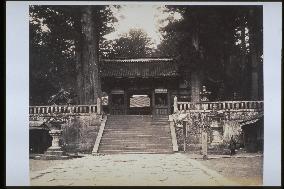
The front entrance to Toshogu Shrine,Nikko

The front entrance to Toshogu Shrine,Nikko

This gate was called Niomon because statues of the Nio guardian deities were placed there until 1871, when Shinto and Buddhism were officially separated and the statues were transferred to Taiyuin Mausoleum. Subsequently, the gate was called Omotemon (Front Gate). Until the Nio statues were returned in 1897, the komainu (guardian dogs), previously in the back, were placed in front as seen in this photograph.==Date:unknown, Place:Nikko, Photo:Ogawa Kazumasa, (Credit:Nagasaki University Library/Kyodo News Images) [Cabinet Number67‐43‐0]

  •  
The front entrance to Toshogu Shrine,Nikko

The front entrance to Toshogu Shrine,Nikko

This gate was called Niomon after the statues of Nio guardians placed here until 1871, when Shintoism and Buddhism were separated. After the statues were transferred to Taiyuin, the gate came to be called Omotemon (Front Gate). Before 1897, when the Nio statues were re-installed, the komainu (guardian dogs), formerly at the back, were placed in front as shown here.==Date:unknown, Place:Nikko, Photo:unknown, (Credit:Nagasaki University Library/Kyodo News Images) [Cabinet Number54‐22‐0]

  •  
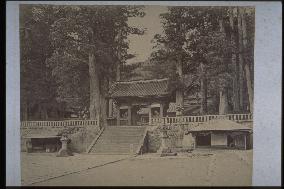
The front entrance to Toshogu Shrine,Nikko

The front entrance to Toshogu Shrine,Nikko

Omotemon is viewed from the open space in front of the five-story pagoda. This gate was called Niomon because statues of the Nio guardian deities were placed there until 1871, when Shinto and Buddhism were officially separated and the statues were transferred to Taiyuin Mausoleum. Subsequently, the gate was called Omotemon (Front Gate). Until the Nio statues were returned in 1897, the komainu (guardian dogs), previously in the back, were placed in front as seen in this photograph.==Date:unknown, Place:Nikko, Photo:unknown, (Credit:Nagasaki University Library/Kyodo News Images) [Cabinet Number53‐30‐0]

  •  
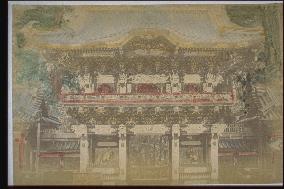
The Yomeimon Gate,Toshogu Shrine,Nikko

The Yomeimon Gate,Toshogu Shrine,Nikko

The Yomei Gate from the worship hall side of Toshogu. The upper tier of the gate is covered with dragon carvings and the lower tier with Chinese lion carvings. The peony carvings on the right and left panels are magnificent. To the right and left walls are amainu (lions) and komainu (Korean dogs). On the right edge is a mikoshi hut with a drop curtain.==Date:unknown, Place:Nikko, Photo:unknown, (Credit:Nagasaki University Library/Kyodo News Images) [Cabinet Number12‐7‐0]

  •  
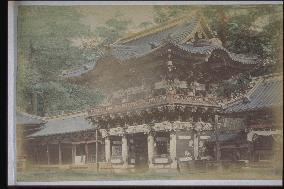
The Yomeimon Gate,Toshogu Shrine,Nikko

The Yomeimon Gate,Toshogu Shrine,Nikko

The Yomei Gate from the worship hall side of Toshogu. The upper tier of the gate is covered with dragon carvings and the lower tier with Chinese lion carvings. It is supported by twelve white pillars. To the right and left walls are Amainu (lions) and Komainu (Korean dogs). One of the inner pillars of the gate has a decorated pattern upside down to avoid bad luck. The colouring is rough.==Date:unknown, Place:Nikko, Photo:unknown, (Credit:Nagasaki University Library/Kyodo News Images) [Cabinet Number12‐3‐0]

  •  
The front entrance to Toshogu Shrine,Nikko

The front entrance to Toshogu Shrine,Nikko

Going through the Ichino Torii from the Omote Sando (front approach), visitors see the red painted Toshogu front gate above the stone steps. At present, the Nio statue is placed to the left and right of the front, and Komainu (Korean dog) to the right and left of the rear. The front is done in the style of a temple, and the back in the style of a shrine. Under the Shintoism Buddhism division order issued in 1871, the front statue of Nio was moved to the back of Niomon of Daiyuin, and for a time the Komainu were placed in the front. The caption says Ichinomon instead of Niomon.==Date:4th - 30th year of Meiji, Place:Nikko, Photo:Ogawa Kazumasa, (Credit:Nagasaki University Library/Kyodo News Images) [Cabinet Number6‐26‐0]

  •  
Hakone Shrine

Hakone Shrine

Hakone Shinto Shrine was the centre of worship as the Hakone Gongen. Especially in the middle ages, it was revered by Kamakura Shoguns such as Minamoto Yoritomo, and it is the setting of the Tale of Soga. This picture was taken before 1896, because the Komainu (Korean style dogs) and the pines planted by Emperor Meiji are not seen.==Date:unknown, Place:Hakone, Photo:Ogawa Kazumasa, (Credit:Nagasaki University Library/Kyodo News Images) [Cabinet Number5‐24‐0]

  • Main
  • Top
  • Editorial
  • Creative
  • About Us
  • About ILG
  • Terms of use
  • Company
  • BEHIND
  • Price List
  • Single Plan
  • Monthly Plan
  • Services
  • Shooting
  • Rights Clearance
  • Support
  • FAQ
  • How To Buy
  • Contact Us
  • Become a Partner

© KYODO NEWS IMAGES INC

All Rights Reserved.

  • Editorial
  • Olympics
  • News
  • Sports
  • Japan
  • Tech
  • Royal
  • Disaster
  • NorthKorea
  • Old Japan
  • SNS
  • Creative
  • Food
  • Japan
  • Landscape
  • Animal
  • Popular
  • #Ukraine
  • #Russia
  • #coronavirus
  • #N. Korea
  • #Thailand
  • #China
  • #Ukraine
  • #Russia
  • #coronavirus
  • #N. Korea
  • #Thailand
  • #China
  • Food
  • Japan
  • Landscape
  • Animal
  • Olympics
  • News
  • Sports
  • Japan
  • Tech
  • Royal
  • Disaster
  • NorthKorea
  • Old Japan
  • SNS