•  
Grandma'S Boy (2006)

Grandma'S Boy (2006)

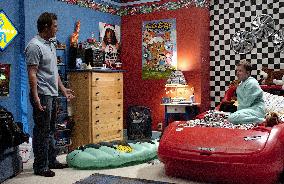
Allen Covert & Nick Swardson Characters: Alex & Jeff Film: Grandma'S Boy (USA 2006) Director: Nicholaus Goossen 06 January 2006 1520 Alex (Allen Covert) can

  •  
Bamboo groove at Gojozaka Slope

Bamboo groove at Gojozaka Slope

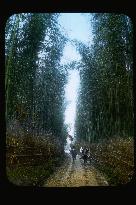
A rickshaw driver and a pedestrian pass each other in the bamboo grove at Gojo Slope. Bamboo fencing made of bamboo grass tied to bamboo poles prevents the bamboo from encroaching on the path. The path is narrow and rickshaws can barely pass each other. Taken prior to 1909, when the slope was expanded to a width of 7.2 meters.==Date:unknown, Place:Kyoto, Photo:unknown, (Credit:Nagasaki University Library/Kyodo News Images) [Cabinet Number98‐42‐0]

  •  
Bamboo groove at Gojozaka Slope

Bamboo groove at Gojozaka Slope

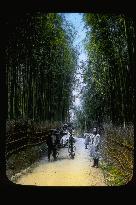
A girl in yukata (summer kimono) sits on a rickshaw. A man with a janome umbrella stands beside her. Bamboo fencing made of bamboo grass tied to bamboo poles prevents the bamboo from encroaching on the path. The path is narrow and rickshaws can barely pass each other. Taken prior to 1909, when the slope was expanded to a width of 7.2 meters.==Date:unknown, Place:Kyoto, Photo:unknown, (Credit:Nagasaki University Library/Kyodo News Images) [Cabinet Number98‐39‐0]

  •  
Taiko-bashi (drum) Bridge at Kameido Shrine

Taiko-bashi (drum) Bridge at Kameido Shrine

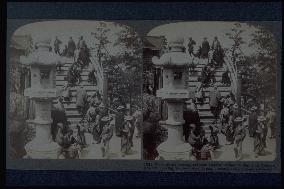
Stereograph published in 1904. Although the bridge is the same as in photographs #5001and #2215, the stone lantern in the foreground is larger. Gentlemen wearing Western-style suits and hats are visible among the worshippers, a sign of the times. Frequently a notice was posted on the parapets urging the elderly, ladies and children not to cross the bridge because of the danger (from Saishin Tokyo Hanjoki published in 1903).==Date:1904, Place:Tokyo, Photo:Underwood, (Credit:Nagasaki University Library/Kyodo News Images) [Cabinet Number97‐66‐0]

  •  
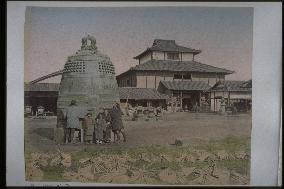
The Great Bell, Hokoji Temple

The Great Bell, Hokoji Temple

The big bell of Hokoji Temple placed on stone blocks is viewed from the southwest. Two men are trying to wrap their arms around the bell, while three children stand between them. Frames for fans are drying in the foreground. The big bell was made at the time of the reconstruction of the temple by Toyotomi Hideyori in 1614. It is said to have been 4.5m high, 2.8m in diameter, 28cm thick and about 8.3 tons in weight. The two-story Buddha Hall in the photograph burnt down in 1973.==Date:unknown, Place:Kyoto, Photo:unknown, (Credit:Nagasaki University Library/Kyodo News Images) [Cabinet Number87‐41‐0]

  •  
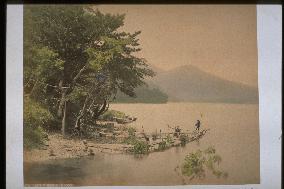
Lake Chuzenji

Lake Chuzenji

The southern shore of Lake Chuzenji is viewed from Ojiri Bridge. Going south through the foliage on the left, the visitor reaches Azegata, the ferry port, and from there proceeds to Ashio, a well known copper mine. Tozawa, where Sir Ernest Satow built his villa, is located over the cape in the centre of the photograph.==Date:unknown, Place:Nikko, Photo:unknown, (Credit:Nagasaki University Library/Kyodo News Images) [Cabinet Number85‐2‐0]

  •  
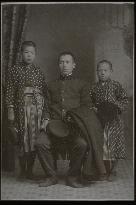
A boy and his younger brothers

A boy and his younger brothers

An older brother in a uniform with a stand-up collar poses with his two younger brothers, whose uniforms indicate that they are in primary school. The older boy could be a university student. His uniform and the coat he is holding seem to be new. Interestingly, the faces of the two older brothers are set in firm expressions, while the lips of the youngest boy betray a subtle smile.==Date:unknown, Place:Tokyo, Photo:unknown, (Credit:Nagasaki University Library/Kyodo News Images) [Cabinet Number72‐111‐0]

  •  
Golden Gate Lake

Golden Gate Lake

In reality, there is no lake called Golden Gate Lake. Judging from the scenery, it is definitely not in Tokyo. The dressed-up children in the centre, adults around them, and the well-maintained promenade around the water suggest that it is an upscale resort. However, the exact location is unknown.==Date:unknown, Place:Tokyo, Photo:unknown, (Credit:Nagasaki University Library/Kyodo News Images) [Cabinet Number72‐85‐0]

  •  
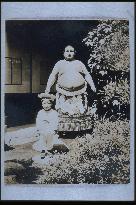
Yokozuna Hitachiyama and children

Yokozuna Hitachiyama and children

The 19th yokozuna (grand champion of sumo wrestling) Hitachiyama (1878-1922) poses with a child. A native of Mito (Ibaragi Prefecture), he joined with 2nd generation Umegatani (1878-1927) in welcoming in the golden years of sumo in the late Meiji and Taisho Periods. He retired in 1914 and took the elder's name Dewanoumi.==Date:unknown, Place:unknown, Photo:unknown, (Credit:Nagasaki University Library/Kyodo News Images) [Cabinet Number69‐19‐0]

  •  
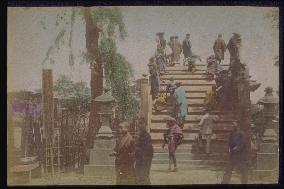
Taiko-bashi (Drum) Bridge at Kameido Shrine

Taiko-bashi (Drum) Bridge at Kameido Shrine

The steep inclination of Taiko Bridge made it hard to cross, but these people seem to be enjoying themselves. The inclination of the bridge shown in a photograph from the early Meiji Period is gentler. There is also a photograph of the bridge taken in 1890-92 when it was in such a bad state that people were not allowed to cross it. The bridge shown here was apparently built soon after that time, which means that this photograph was taken after 1892.==Date:unknown, Place:Tokyo, Photo:Tamamura Kozaburo, (Credit:Nagasaki University Library/Kyodo News Images) [Cabinet Number48‐67‐0]

  •  
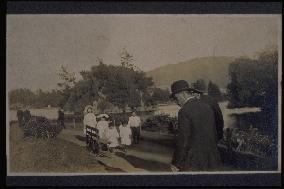
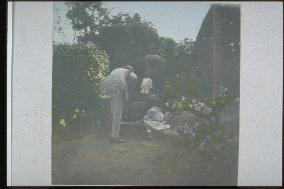
Father and children of a foreign family

Father and children of a foreign family

A foreign man and children relax in a garden with many flowers and trees. The girls wear white blouses and skirts. The man wears a hat and holds a cane in his right hand while leaning forward. The pole on the right may be an electric pole.==Date:unknown, Place:Kyoto, Photo:unknown, (Credit:Nagasaki University Library/Kyodo News Images) [Cabinet Number46‐116‐0]

  •  
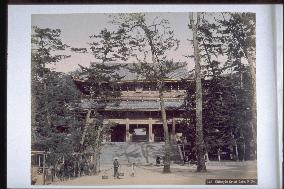
The Sanmon Gate of Chion-in Temple

The Sanmon Gate of Chion-in Temple

The western side of Chion-in Temple Sanmon Gate is seen looking east. There are three rickshaws parked in front, a vendor, and a child. This is the largest gate of its kind in Japan, with five bays and three entrances. Built in two-story irimoya style, it has a tiled roof and was erected in 1619 by the second shogun Tokugawa Ietada. The word Kachozan on the tablet at the front of the gate is said to be the calligraphy of Emperor Reigen (1654-1732).==Date:unknown, Place:Kyoto, Photo:unknown, (Credit:Nagasaki University Library/Kyodo News Images) [Cabinet Number42‐22‐0]

  • Main
  • Top
  • Editorial
  • Creative
  • About Us
  • About ILG
  • Terms of use
  • Company
  • BEHIND
  • Price List
  • Single Plan
  • Monthly Plan
  • Services
  • Shooting
  • Rights Clearance
  • Support
  • FAQ
  • How To Buy
  • Contact Us
  • Become a Partner

© KYODO NEWS IMAGES INC

All Rights Reserved.

  • Editorial
  • Olympics
  • News
  • Sports
  • Japan
  • Tech
  • Royal
  • Disaster
  • NorthKorea
  • Old Japan
  • SNS
  • Creative
  • Food
  • Japan
  • Landscape
  • Animal
  • Popular
  • #Ukraine
  • #Russia
  • #coronavirus
  • #N. Korea
  • #China
  • #Thailand
  • #Ukraine
  • #Russia
  • #coronavirus
  • #N. Korea
  • #China
  • #Thailand
  • Food
  • Japan
  • Landscape
  • Animal
  • Olympics
  • News
  • Sports
  • Japan
  • Tech
  • Royal
  • Disaster
  • NorthKorea
  • Old Japan
  • SNS