•  
James Webb Telescope Finds Most Distant Known Galaxy

James Webb Telescope Finds Most Distant Known Galaxy

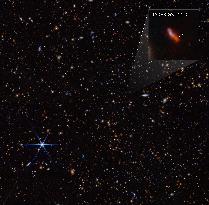
Handout infrared image from NASA’s James Webb Space Telescope (also called Webb or JWST) was taken by the NIRCam (Near-Infrared Camera) for the JWST Advanced Deep Extragalactic Survey, or JADES, program. The NIRCam data was used to determine which galaxies to study further with spectroscopic observations. One such galaxy, JADES-GS-z14-0 (shown in the pullout), was determined to be at a redshift of 14.32 (+0.08/-0.20), making it the current record-holder for the most distant known galaxy. This corresponds to a time less than 300 million years after the big bang. In the background image, blue represents light at 0.9, 1.15, and 1.5 microns (filters F090W + F115W + F150W), green is 2.0 and 2.77 microns (F200W + F277W), and red is 3.56, 4.1, and 4.44 microns (F356W + F410M + F444W). The pullout image shows light at 0.9 and 1.15 microns (F090W + F115W) as blue, 1.5 and 2.0 microns (F150W + F200W) as green, and 2.77 microns (F277W) as red. Photo by Nasa via ABACAPRESS.COM

  •  
Saturn Captured By James Webb Space Telescope

Saturn Captured By James Webb Space Telescope

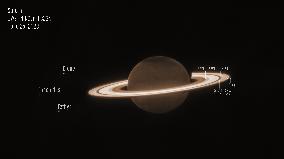
This image shows Saturn and some of its moons, captured by the James Webb Space Telescope’s (JWST) NIRCam instrument on June 25, 2023. In this monochrome image, NIRCam filter F323N (3.23 microns) was color mapped with an orange hue. JWST turned to the ringed world Saturn in June 2023 to conduct a deep search for new ring structure and faint moons. Saturn itself appears to extremely dark at the infrared wavelengths sensed by JWST’s Near-Infrared Camera (NIRCam), as methane gas absorbs almost all of the sunlight falling on the atmosphere. However, the icy rings stay relatively bright, leading to the unusual appearance of Saturn in the JWST image. Several very deep Saturn exposures taken together with this image were designed to test JWST’s capacity to detect faint moons around the planet and its bright rings. Any newly discovered moons would be important dynamical tracers of the current Saturn system as well as its past history. This context image clearly shows details within the ring system, along with many of

  •  
Saturn Captured By James Webb Space Telescope

Saturn Captured By James Webb Space Telescope

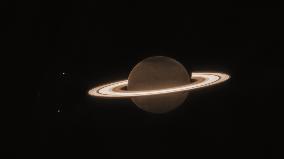
This image shows Saturn and some of its moons, captured by the James Webb Space Telescope’s (JWST) NIRCam instrument on June 25, 2023. In this monochrome image, NIRCam filter F323N (3.23 microns) was color mapped with an orange hue. JWST turned to the ringed world Saturn in June 2023 to conduct a deep search for new ring structure and faint moons. Saturn itself appears to extremely dark at the infrared wavelengths sensed by JWST’s Near-Infrared Camera (NIRCam), as methane gas absorbs almost all of the sunlight falling on the atmosphere. However, the icy rings stay relatively bright, leading to the unusual appearance of Saturn in the JWST image. Several very deep Saturn exposures taken together with this image were designed to test JWST’s capacity to detect faint moons around the planet and its bright rings. Any newly discovered moons would be important dynamical tracers of the current Saturn system as well as its past history. This context image clearly shows details within the ring system, along with many of

  •  
Air pollution continues in Beijing

Air pollution continues in Beijing

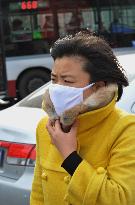
BEIJING, China - A woman wears a mask as she walks in China's capital on Jan. 5, 2015, although the Beijing Municipal Environmental Protection Bureau unveiled the previous day that levels of PM2.5, airborne particles smaller than 2.5 microns in diameter and a major air pollutant, declined in 2014 by 4 percent from 2013.

  •  

Fish found off Mumbai coast may contain microplastics

STORY: Fish found off Mumbai coast may contain microplastics DATELINE: March 11, 2022 LENGTH: 00:02:25 LOCATION: MUMBAI, India CATEGORY: ENVIRONMENT SHOTLIST: 1. various of the Mumbai beach 2. SOUNDBITE (Hindi): CHETAN KOLI, Fisherman STORYLINE: The Central Institute of Fisheries Education (CIFE) in India has found an abundant variety of microplastics in the gastrointestinal (GI) tracts and gills of croaker fish netted off Mumbai's coast. The research, based on a survey done along Mumbai's coastline, was recently published in the renowned Elsevier journal. It found that the GI tract and the gills of the fish had microplastics less than 100 microns in size. The study had sought to establish the intensity of microplastic pollution in demersal species or bottom-feeders found in the northeastern coastal waters of the Arabian Sea. The microplastics found in the fish tissue were predominantly black and blue in color and posed a carcinogenic risk to consumers and organisms in the food chain. Reacting to the

  •  
PM2.5 level up in Fukuoka, other Kyushu cities

PM2.5 level up in Fukuoka, other Kyushu cities

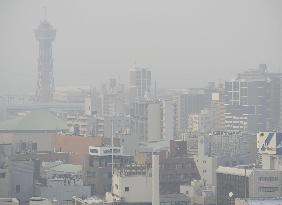
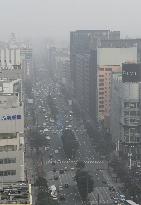
Photo taken Jan. 4, 2016, shows haze in the southwestern Japanese city of Fukuoka, where the atmospheric level of PM2.5, harmful particles that are smaller than 2.5 microns in diameter, increased. The level also rose in other cities in the Kyushu region. (Kyodo) ==Kyodo

  •  
PM2.5 level up in Fukuoka, other Kyushu cities

PM2.5 level up in Fukuoka, other Kyushu cities

Photo taken Jan. 4, 2016, shows haze in the southwestern Japanese city of Fukuoka, where the atmospheric level of PM2.5, harmful particles that are smaller than 2.5 microns in diameter, increased. The level also rose in other cities in the Kyushu region. (Kyodo) ==Kyodo

  •  
Air pollution in Beijing

Air pollution in Beijing

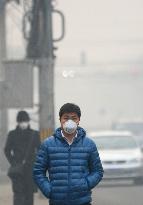
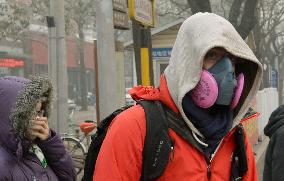
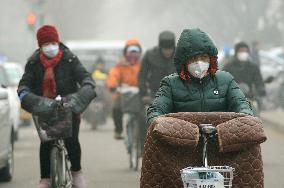
People wear masks in Beijing on Nov. 30, 2015, as the density level of harmful PM2.5 -- fine particles 2.5 microns in diameter or smaller -- increased. The air pollution expanded to cover wide areas of the Chinese capital. (Kyodo) ==Kyodo

  •  
Air pollution in Beijing

Air pollution in Beijing

People wear masks in Beijing on Nov. 30, 2015, as the density level of harmful PM2.5 -- fine particles 2.5 microns in diameter or smaller -- increased. The air pollution expanded to cover wide areas of the Chinese capital. (Kyodo) ==Kyodo

  •  
Air pollution in Beijing

Air pollution in Beijing

People wear masks in Beijing on Nov. 30, 2015, as the density level of harmful PM2.5 -- fine particles 2.5 microns in diameter or smaller -- increased. The air pollution expanded to cover wide areas of the Chinese capital. (Kyodo) ==Kyodo

  •  
Japan, China environment ministers discuss air pollution, other issues

Japan, China environment ministers discuss air pollution, other issues

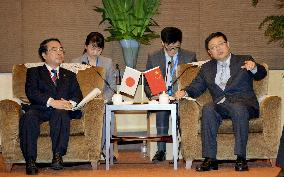
Japanese Environment Minister Yoshio Mochizuki (L) talks with his Chinese counterpart Chen Jining in Shanghai on April 29, 2015, the first such ministerial meeting in about three years. At the meeting, held on the sidelines of a trilateral meeting involving South Korea, they agreed to jointly tackle the prevention of high levels of the pollutant PM2.5 -- harmful particles in the air with a diameter of less than 2.5 microns. (Kyodo) ==Kyodo

  •  
Beijing citizens ride bicycles under heavy smog

Beijing citizens ride bicycles under heavy smog

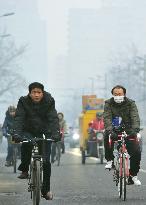
Citizens ride bicycles in Beijing, shrouded in heavy smog containing pollutants such as fine particulate matter up to 2.5 microns in diameter (PM2.5), on Jan. 26, 2015. (Kyodo) ==Kyodo

  • Main
  • Top
  • Editorial
  • Creative
  • About Us
  • About ILG
  • Terms of use
  • Company
  • BEHIND
  • Price List
  • Single Plan
  • Monthly Plan
  • Services
  • Shooting
  • Rights Clearance
  • Support
  • FAQ
  • How To Buy
  • Contact Us
  • Become a Partner

© KYODO NEWS IMAGES INC

All Rights Reserved.

  • Editorial
  • Olympics
  • News
  • Sports
  • Japan
  • Tech
  • Royal
  • Disaster
  • NorthKorea
  • Old Japan
  • SNS
  • Creative
  • Food
  • Japan
  • Landscape
  • Animal
  • Popular
  • #Ukraine
  • #China
  • #coronavirus
  • #N. Korea
  • #Thailand
  • #Russia
  • #Ukraine
  • #China
  • #coronavirus
  • #N. Korea
  • #Thailand
  • #Russia
  • Food
  • Japan
  • Landscape
  • Animal
  • Olympics
  • News
  • Sports
  • Japan
  • Tech
  • Royal
  • Disaster
  • NorthKorea
  • Old Japan
  • SNS