•  
A-bomb survivor publishes book, warns of radiation damage

A-bomb survivor publishes book, warns of radiation damage

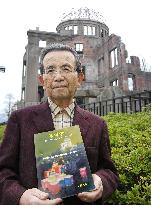
HIROSHIMA, Japan - Mitsuo Kodama, who survived the 1945 U.S. atomic bombing of Hiroshima from within a 1-kilometer radius from the hypocenter and was exposed to an extremely high dosage of approximately 4,600 millisieverts of radiation, poses in front of the Atomic Dome in Hiroshima with his book "Hibakusha, Hiroshima karano Message" (Hibakusha, Message from Hiroshima) on March 25, 2014.

  •  
New evacuation spots near Fukushima plant

New evacuation spots near Fukushima plant

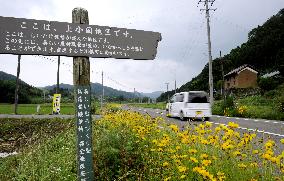
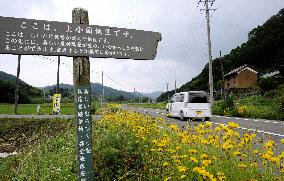
DATE, Japan - Photo shows an area where radiation could potentially exceed the yardstick of 20 millisieverts per year in Date, Fukushima Prefecture, on June 16, 2011. The government has decided to designate ''hot spots'' near the Fukushima Daiichi nuclear power plant from which residents will be recommended to evacuate with government assistance due to possible high radiation levels beyond the internationally recommended standard.

  •  
2 workers may have exceeded radiation exposure limit

2 workers may have exceeded radiation exposure limit

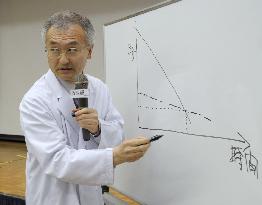
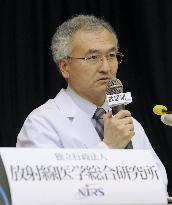
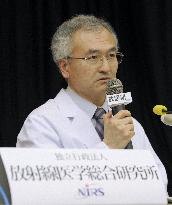
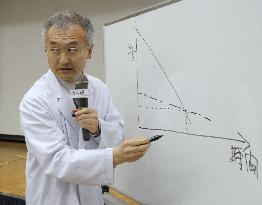
CHIBA, Japan - Makoto Akashi, executive director of the National Institute of Radiological Sciences, speaks in a press conference at the institute in the city of Chiba on May 30, 2011. Two Tokyo Electric Power Co. employees working at the crisis-hit Fukushima Daiichi nuclear power plant underwent health checks at the institute after it was found that they may have been exposed to radiation exceeding the maximum limit of 250 millisieverts.

  •  
2 workers may have exceeded radiation exposure limit

2 workers may have exceeded radiation exposure limit

CHIBA, Japan - Makoto Akashi, executive director of the National Institute of Radiological Sciences, speaks in a press conference at the institute in the city of Chiba on May 30, 2011. Two Tokyo Electric Power Co. employees working at the crisis-hit Fukushima Daiichi nuclear power plant underwent health checks at the institute after it was found that they may have been exposed to radiation exceeding the maximum limit of 250 millisieverts.

  •  
Fukushima parents protest

Fukushima parents protest

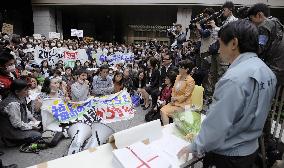
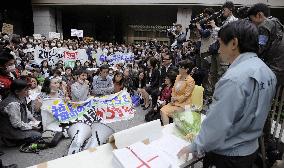
TOKYO, Japan - Parents from Fukushima Prefecture protest the Japanese government's safety standards on radiation levels at elementary and middle schools in the nuclear disaster-stricken prefecture as they visited the education ministry in Tokyo on May 23, 2011. On the right is an official of the ministry. The parents demanded the government retract its stance that it is safe for schoolchildren to use school playgrounds as long as the dose they are exposed to does not exceed 20 millisieverts over a year following the nuclear crisis at the Fukushima Daiichi nuclear power station.

  •  
Fukushima parents protest

Fukushima parents protest

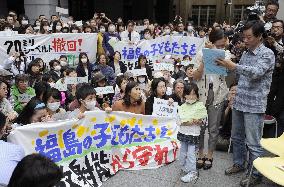
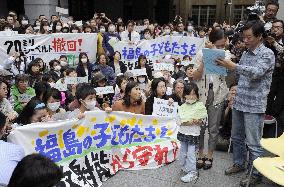
TOKYO, Japan - Parents and their children from Fukushima Prefecture protest the Japanese government's safety standards on radiation levels at elementary and middle schools in the nuclear disaster-stricken prefecture as they visited the education ministry in Tokyo on May 23, 2011. The parents demanded the government retract its stance that it is safe for schoolchildren to use school playgrounds as long as the dose they are exposed to does not exceed 20 millisieverts over a year following the nuclear crisis at the Fukushima Daiichi nuclear power station.

  •  
Radioactive debris at Fukushima plant

Radioactive debris at Fukushima plant

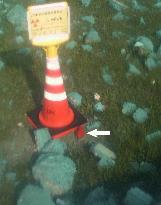
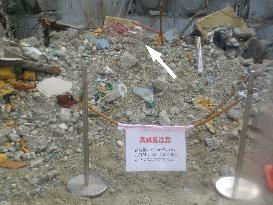
TOKYO, Japan - An arrow shows a concrete fragment with radiation measurements of 950 millisieverts per hour in a location west of the building housing the No. 3 reactor of the Fukushima Daiichi Nuclear Power Station in Fukushima Prefecture in this handout photo taken on June 4, 2011. (Photo courtesy of Tokyo Electric Power Co.) (Kyodo)

  •  
Fukushima's No. 1 reactor radiation up to 4,000 millisieverts

Fukushima's No. 1 reactor radiation up to 4,000 millisieverts

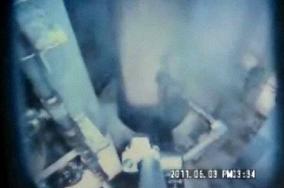
TOKYO, Japan - In this image taken from a handout video dated June 3, 2011, steam is seen rising from the opening in the floor for a pipe that runs through the building of the No. 1 reactor of Fukushima Daiichi Nuclear Power Station in Fukushima Prefecture. Tokyo Electric Power Co., the operator of the plant, said June 4 it detected radiation of up to 4,000 millisieverts per hour, the largest reading detected in the air at the troubled plant. (Photo provided by Tokyo Electric Power Co.) (Kyodo)

  •  
Fukushima's No. 1 reactor radiation up to 4,000 millisieverts

Fukushima's No. 1 reactor radiation up to 4,000 millisieverts

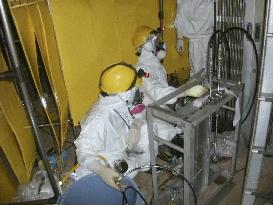
TOKYO, Japan - In this handout photo, workers at Fukushima Daiichi Nuclear Power Station set up a pressure indicator at the building of the plant's No.1 reactor on June 3, 2011, in Fukushima Prefecture. Tokyo Electric Power Co., the operator of the plant, said June 4 it detected radiation of up to 4,000 millisieverts per hour, the largest reading detected in the air at the troubled plant. (Photo provided by Tokyo Electric Power Co.) (Kyodo)

  •  
Radioactive water in reactor building

Radioactive water in reactor building

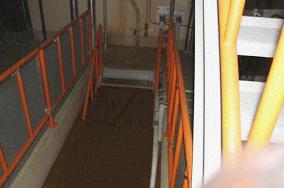
TOKYO, Japan - Handout photo taken June 21, 2011, shows an area near a staircase in the No. 2 reactor building at the Fukushima Daiichi nuclear power plant, where a radiation level of 430 millisieverts per hour has been measured. Tokyo Electric Power Co., operator of the plant in Fukushima Prefecture, said on June 22 that water 6.1 meters deep has accumulated in the basement of the building. (Photo provided by Tokyo Electric Power Co.) (Kyodo)

  •  
New evacuation spots near Fukushima plant

New evacuation spots near Fukushima plant

DATE, Japan - Photo shows an area where radiation could potentially exceed the yardstick of 20 millisieverts per year in Date, Fukushima Prefecture, on June 16, 2011. The government has decided to designate ''hot spots'' near the Fukushima Daiichi nuclear power plant from which residents will be recommended to evacuate with government assistance due to possible high radiation levels beyond the internationally recommended standard. (Kyodo)

  •  
2 workers may have exceeded radiation exposure limit

2 workers may have exceeded radiation exposure limit

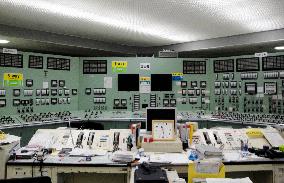
TOKYO, Japan - Handout photo taken on March 22, 2011, shows the control room of the No. 3 reactor at the Fukushima Daiichi Nuclear Power Station in Fukushima Prefecture. Tokyo Electric Power Co. said May 30 that two of its employees who worked at the plant, including in the control room, may have been exposed to radiation exceeding the maximum limit of 250 millisieverts. (Photo courtesy of Tokyo Electric Power Co.) (Kyodo)

  •  
2 workers may have exceeded radiation exposure limit

2 workers may have exceeded radiation exposure limit

CHIBA, Japan - Makoto Akashi, executive director of the National Institute of Radiological Sciences, speaks in a press conference at the institute in the city of Chiba on May 30, 2011. Two Tokyo Electric Power Co. employees working at the crisis-hit Fukushima Daiichi nuclear power plant underwent health checks at the institute after it was found that they may have been exposed to radiation exceeding the maximum limit of 250 millisieverts. (Kyodo)

  •  
2 workers may have exceeded radiation exposure limit

2 workers may have exceeded radiation exposure limit

CHIBA, Japan - Makoto Akashi, executive director of the National Institute of Radiological Sciences, speaks in a press conference at the institute in the city of Chiba on May 30, 2011. Two Tokyo Electric Power Co. employees working at the crisis-hit Fukushima Daiichi nuclear power plant underwent health checks at the institute after it was found that they may have been exposed to radiation exceeding the maximum limit of 250 millisieverts. (Kyodo)

  •  
Fukushima parents protest

Fukushima parents protest

TOKYO, Japan - Parents and their children from Fukushima Prefecture protest the Japanese government's safety standards on radiation levels at elementary and middle schools in the nuclear disaster-stricken prefecture as they visited the education ministry in Tokyo on May 23, 2011. The parents demanded the government retract its stance that it is safe for schoolchildren to use school playgrounds as long as the dose they are exposed to does not exceed 20 millisieverts over a year following the nuclear crisis at the Fukushima Daiichi nuclear power station. (Kyodo)

  •  
Fukushima parents protest

Fukushima parents protest

TOKYO, Japan - Parents from Fukushima Prefecture protest the Japanese government's safety standards on radiation levels at elementary and middle schools in the nuclear disaster-stricken prefecture as they visited the education ministry in Tokyo on May 23, 2011. On the right is an official of the ministry. The parents demanded the government retract its stance that it is safe for schoolchildren to use school playgrounds as long as the dose they are exposed to does not exceed 20 millisieverts over a year following the nuclear crisis at the Fukushima Daiichi nuclear power station. (Kyodo)

  •  
Highly radioactive rubble at Fukushima plant

Highly radioactive rubble at Fukushima plant

TOKYO, Japan - An arrow indicates rubble containing extremely high levels of radiation -- 1,000 millisieverts per hour -- found on May 21, 2011, south of the building housing the No. 3 reactor of the Fukushima Daiichi Nuclear Power Station in Fukushima Prefecture. (Photo courtesy of Tokyo Electric Power Co.) (Kyodo)

  •  
High radiation at Fukushima plant

High radiation at Fukushima plant

TOKYO, Japan - Supplied photo taken by the remotely operated robot Quince 2 shows the area around the lid (back) of the containment vessel of the No. 2 reactor at the Fukushima Daiichi nuclear power plant in Fukushima Prefecture. The Japan-made robot has detected high radiation levels of up to 220 millisieverts per hour around the lid, plant operator Tokyo Electric Power Co. said on Feb. 28, 2012. (Photo courtesy of Tokyo Electric Power Co.)(Kyodo)

  • Main
  • Top
  • Editorial
  • Creative
  • About Us
  • About ILG
  • Terms of use
  • Company
  • BEHIND
  • Price List
  • Single Plan
  • Monthly Plan
  • Services
  • Shooting
  • Rights Clearance
  • Support
  • FAQ
  • How To Buy
  • Contact Us
  • Become a Partner

© KYODO NEWS IMAGES INC

All Rights Reserved.

  • Editorial
  • Olympics
  • News
  • Sports
  • Japan
  • Tech
  • Royal
  • Disaster
  • NorthKorea
  • Old Japan
  • SNS
  • Creative
  • Food
  • Japan
  • Landscape
  • Animal
  • Popular
  • #Ukraine
  • #Thailand
  • #coronavirus
  • #N. Korea
  • #China
  • #Russia
  • #Ukraine
  • #Thailand
  • #coronavirus
  • #N. Korea
  • #China
  • #Russia
  • Food
  • Japan
  • Landscape
  • Animal
  • Olympics
  • News
  • Sports
  • Japan
  • Tech
  • Royal
  • Disaster
  • NorthKorea
  • Old Japan
  • SNS