•  
World's Largest Neutrino Observatory - China

World's Largest Neutrino Observatory - China

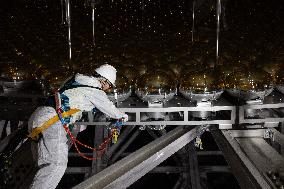
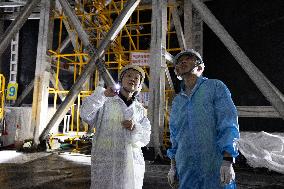
Qin Zhonghua works at the construction site of the Jiangmen Underground Neutrino Observatory (JUNO) in Jiangmen, south China's Guangdong Province, Oct. 9, 2024. China has constructed the world's largest transparent spherical detector 700 meters underground to capture elusive neutrinos, often dubbed "ghost particles," to unravel the secrets of the infinitesimally small and the infinitely vast in the universe. The 12-story-tall acrylic sphere with a diameter of 35.4 meters, buried deep in a granite layer of a hill in Kaiping, Jiangmen City in south China's Guangdong Province, is the core part of JUNO, a gigantic and complex scientific facility. The construction of the challenging project, launched by the Chinese Academy of Sciences (CAS) and the Guangdong government in 2015, has entered the final stage. Installation of the entire device is expected to be completed by the end of November, and the full operation of the facility is scheduled for August 2025, according to the Institute of High Energy Physics (IHEP)

  •  
World's Largest Neutrino Observatory - China

World's Largest Neutrino Observatory - China

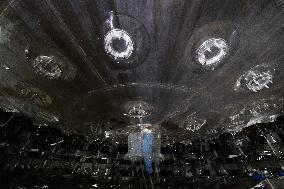
A staff member works beside the water tank of the central detector of the Jiangmen Underground Neutrino Observatory (JUNO) in Jiangmen, south China's Guangdong Province, Oct. 9, 2024. China has constructed the world's largest transparent spherical detector 700 meters underground to capture elusive neutrinos, often dubbed "ghost particles," to unravel the secrets of the infinitesimally small and the infinitely vast in the universe. The 12-story-tall acrylic sphere with a diameter of 35.4 meters, buried deep in a granite layer of a hill in Kaiping, Jiangmen City in south China's Guangdong Province, is the core part of JUNO, a gigantic and complex scientific facility. The construction of the challenging project, launched by the Chinese Academy of Sciences (CAS) and the Guangdong government in 2015, has entered the final stage. Installation of the entire device is expected to be completed by the end of November, and the full operation of the facility is scheduled for August 2025, according to the Institute of Hig

  •  
World's Largest Neutrino Observatory - China

World's Largest Neutrino Observatory - China

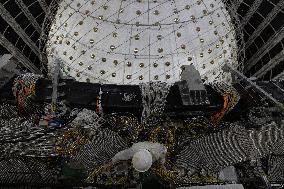
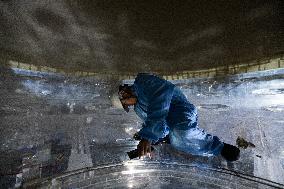
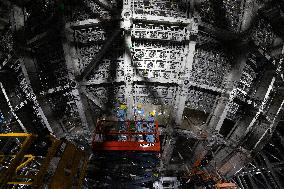
A staff member inspects the acrylic sphere inside the central detector of the Jiangmen Underground Neutrino Observatory (JUNO) in Jiangmen, south China's Guangdong Province, Oct. 9, 2024. China has constructed the world's largest transparent spherical detector 700 meters underground to capture elusive neutrinos, often dubbed "ghost particles," to unravel the secrets of the infinitesimally small and the infinitely vast in the universe. The 12-story-tall acrylic sphere with a diameter of 35.4 meters, buried deep in a granite layer of a hill in Kaiping, Jiangmen City in south China's Guangdong Province, is the core part of JUNO, a gigantic and complex scientific facility. The construction of the challenging project, launched by the Chinese Academy of Sciences (CAS) and the Guangdong government in 2015, has entered the final stage. Installation of the entire device is expected to be completed by the end of November, and the full operation of the facility is scheduled for August 2025, according to the Institute of

  •  
World's Largest Neutrino Observatory - China

World's Largest Neutrino Observatory - China

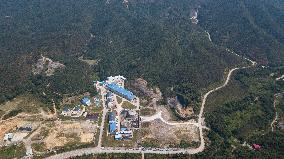
An aerial drone photo shows ground facilities of the Jiangmen Underground Neutrino Observatory (JUNO) in Jiangmen, south China's Guangdong Province, Oct. 10, 2024. China has constructed the world's largest transparent spherical detector 700 meters underground to capture elusive neutrinos, often dubbed "ghost particles," to unravel the secrets of the infinitesimally small and the infinitely vast in the universe. The 12-story-tall acrylic sphere with a diameter of 35.4 meters, buried deep in a granite layer of a hill in Kaiping, Jiangmen City in south China's Guangdong Province, is the core part of JUNO, a gigantic and complex scientific facility. The construction of the challenging project, launched by the Chinese Academy of Sciences (CAS) and the Guangdong government in 2015, has entered the final stage. Installation of the entire device is expected to be completed by the end of November, and the full operation of the facility is scheduled for August 2025, according to the Institute of High Energy Physics (IH

  •  
World's Largest Neutrino Observatory - China

World's Largest Neutrino Observatory - China

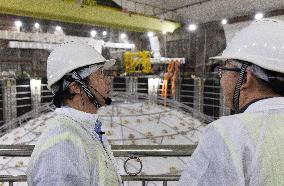
Wang Yifang (L), chief scientist of the Jiangmen Underground Neutrino Observatory (JUNO) and head of the Institute of High Energy Physics (IHEP) of the CAS, talks with his colleague at an experiment hall in Jiangmen, south China's Guangdong Province, Oct. 10, 2024. China has constructed the world's largest transparent spherical detector 700 meters underground to capture elusive neutrinos, often dubbed "ghost particles," to unravel the secrets of the infinitesimally small and the infinitely vast in the universe. The 12-story-tall acrylic sphere with a diameter of 35.4 meters, buried deep in a granite layer of a hill in Kaiping, Jiangmen City in south China's Guangdong Province, is the core part of JUNO, a gigantic and complex scientific facility. The construction of the challenging project, launched by the Chinese Academy of Sciences (CAS) and the Guangdong government in 2015, has entered the final stage. Installation of the entire device is expected to be completed by the end of November, and the full operati

  •  
World's Largest Neutrino Observatory - China

World's Largest Neutrino Observatory - China

Ma Xiaoyan (L) talks with a staff member at the bottom of the water tank of the central detector of the Jiangmen Underground Neutrino Observatory (JUNO) in Jiangmen, south China's Guangdong Province, Oct. 10, 2024. China has constructed the world's largest transparent spherical detector 700 meters underground to capture elusive neutrinos, often dubbed "ghost particles," to unravel the secrets of the infinitesimally small and the infinitely vast in the universe. The 12-story-tall acrylic sphere with a diameter of 35.4 meters, buried deep in a granite layer of a hill in Kaiping, Jiangmen City in south China's Guangdong Province, is the core part of JUNO, a gigantic and complex scientific facility. The construction of the challenging project, launched by the Chinese Academy of Sciences (CAS) and the Guangdong government in 2015, has entered the final stage. Installation of the entire device is expected to be completed by the end of November, and the full operation of the facility is scheduled for August 2025, ac

  •  
World's Largest Neutrino Observatory - China

World's Largest Neutrino Observatory - China

A staff member inspects the acrylic sphere inside the central detector of the Jiangmen Underground Neutrino Observatory (JUNO) in Jiangmen, south China's Guangdong Province, Oct. 9, 2024. China has constructed the world's largest transparent spherical detector 700 meters underground to capture elusive neutrinos, often dubbed "ghost particles," to unravel the secrets of the infinitesimally small and the infinitely vast in the universe. The 12-story-tall acrylic sphere with a diameter of 35.4 meters, buried deep in a granite layer of a hill in Kaiping, Jiangmen City in south China's Guangdong Province, is the core part of JUNO, a gigantic and complex scientific facility. The construction of the challenging project, launched by the Chinese Academy of Sciences (CAS) and the Guangdong government in 2015, has entered the final stage. Installation of the entire device is expected to be completed by the end of November, and the full operation of the facility is scheduled for August 2025, according to the Institute of

  •  
World's Largest Neutrino Observatory - China

World's Largest Neutrino Observatory - China

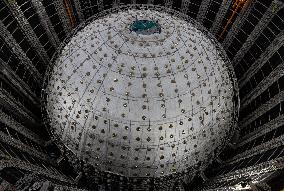
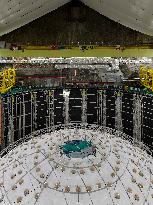
This photo shows the central detector of the Jiangmen Underground Neutrino Observatory (JUNO) under construction in Jiangmen, south China's Guangdong Province, Oct. 9, 2024. China has constructed the world's largest transparent spherical detector 700 meters underground to capture elusive neutrinos, often dubbed "ghost particles," to unravel the secrets of the infinitesimally small and the infinitely vast in the universe. The 12-story-tall acrylic sphere with a diameter of 35.4 meters, buried deep in a granite layer of a hill in Kaiping, Jiangmen City in south China's Guangdong Province, is the core part of JUNO, a gigantic and complex scientific facility. The construction of the challenging project, launched by the Chinese Academy of Sciences (CAS) and the Guangdong government in 2015, has entered the final stage. Installation of the entire device is expected to be completed by the end of November, and the full operation of the facility is scheduled for August 2025, according to the Institute of High Energy P

  •  
World's Largest Neutrino Observatory - China

World's Largest Neutrino Observatory - China

Staff members clean parts of the central detector of the Jiangmen Underground Neutrino Observatory (JUNO) in Jiangmen, south China's Guangdong Province, Oct. 10, 2024. China has constructed the world's largest transparent spherical detector 700 meters underground to capture elusive neutrinos, often dubbed "ghost particles," to unravel the secrets of the infinitesimally small and the infinitely vast in the universe. The 12-story-tall acrylic sphere with a diameter of 35.4 meters, buried deep in a granite layer of a hill in Kaiping, Jiangmen City in south China's Guangdong Province, is the core part of JUNO, a gigantic and complex scientific facility. The construction of the challenging project, launched by the Chinese Academy of Sciences (CAS) and the Guangdong government in 2015, has entered the final stage. Installation of the entire device is expected to be completed by the end of November, and the full operation of the facility is scheduled for August 2025, according to the Institute of High Energy Physics

  •  
World's Largest Neutrino Observatory - China

World's Largest Neutrino Observatory - China

This photo shows the central detector of the Jiangmen Underground Neutrino Observatory (JUNO) under construction in Jiangmen, south China's Guangdong Province, Oct. 9, 2024. China has constructed the world's largest transparent spherical detector 700 meters underground to capture elusive neutrinos, often dubbed "ghost particles," to unravel the secrets of the infinitesimally small and the infinitely vast in the universe. The 12-story-tall acrylic sphere with a diameter of 35.4 meters, buried deep in a granite layer of a hill in Kaiping, Jiangmen City in south China's Guangdong Province, is the core part of JUNO, a gigantic and complex scientific facility. The construction of the challenging project, launched by the Chinese Academy of Sciences (CAS) and the Guangdong government in 2015, has entered the final stage. Installation of the entire device is expected to be completed by the end of November, and the full operation of the facility is scheduled for August 2025, according to the Institute of High Energy P

  •  
World's Largest Neutrino Observatory - China

World's Largest Neutrino Observatory - China

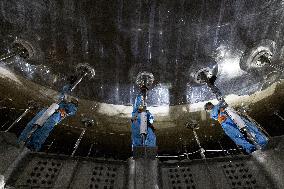
Staff members install photo-multiplier tubes of the central detector of the Jiangmen Underground Neutrino Observatory (JUNO) in Jiangmen, south China's Guangdong Province, Oct. 10, 2024. China has constructed the world's largest transparent spherical detector 700 meters underground to capture elusive neutrinos, often dubbed "ghost particles," to unravel the secrets of the infinitesimally small and the infinitely vast in the universe. The 12-story-tall acrylic sphere with a diameter of 35.4 meters, buried deep in a granite layer of a hill in Kaiping, Jiangmen City in south China's Guangdong Province, is the core part of JUNO, a gigantic and complex scientific facility. The construction of the challenging project, launched by the Chinese Academy of Sciences (CAS) and the Guangdong government in 2015, has entered the final stage. Installation of the entire device is expected to be completed by the end of November, and the full operation of the facility is scheduled for August 2025, according to the Institute of

  •  

UNDERGROUND SPACE OBSERVATORY

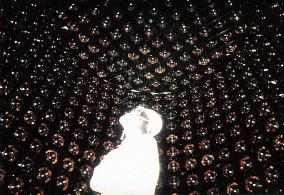
UNDERGROUND SPACE OBSERVATORY,Concerts, pianos, Super-Kamiokande, neutrinos, elementary particles, research facilities 1000 meters below Kamioka=Date:1994, Place:Kamioka Mine, Hida City, Gifu Prefecture,JAPAN

  •  
'Faster-than-light' claim for subatomic particles withdrawn

'Faster-than-light' claim for subatomic particles withdrawn

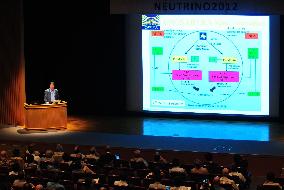
KYOTO, Japan - A researcher of the international team OPERA gives a presentation of verification experiments at an international conference in Kyoto on June 8, 2012. The research group retracted its claim that subatomic particles known as neutrinos travel faster than the speed of light, following its own verification experiment in May which did not support the assertion.

  •  
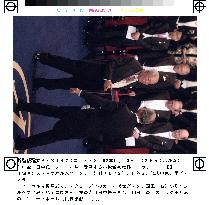
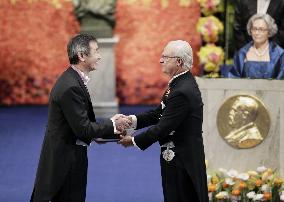
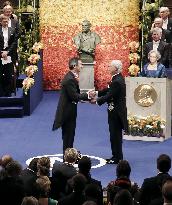
(1) Koshiba, Tanaka receive Nobel prizes at awards ceremony

(1) Koshiba, Tanaka receive Nobel prizes at awards ceremony

STOCKHOLM, Sweden - Japan's Masatoshi Koshiba, co-winner of the 2002 Nobel Prize in Physics, receives his Nobel medal from King Carl XVI Gustaf at a ceremony in Stockholm on Dec. 10. Koshiba, 76, professor emeritus at the University of Tokyo, was honored for his contribution to confirming the existence of cosmic neutrinos by developing and using a gigantic underground detector called Kamiokande in Kamioka, Gifu Prefecture.

  •  
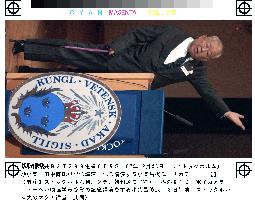
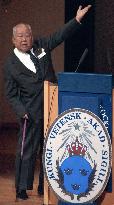
Koshiba gives speech ahead of Nobel event

Koshiba gives speech ahead of Nobel event

STOCKHOLM, Sweden - Masatoshi Koshiba, co-winner of the 2002 Nobel Prize in Physics, gives a speech Dec. 8 at Stockholm University ahead of a Nobel awards ceremony Dec. 10. The 76-year-old University of Tokyo professor emeritus stressed he was able to detect cosmic neutrinos, for which he was honored, because he was well prepared.

  •  
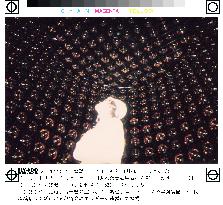
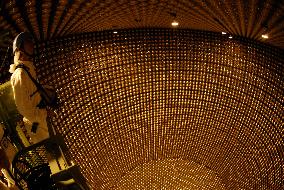
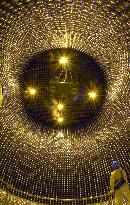
Neutrino test tank shown to press

Neutrino test tank shown to press

The photo shows a huge tank-shaped facility designed to detect neutrinos which physicists say pass through all substances. The test facility equipped with 680 lenses attached to the ceiling was shown to the press Monday Nov. 9 at the Education Ministry's High Energy Accelerator Research Organization in Tukuba, Ibaraki Prefecture.

  •  

Major neutrino lab being built underground in Guangdong, China

STORY: Major neutrino lab being built underground in Guangdong, China DATELINE: Sept. 23, 2022 LENGTH: 00:00:46 LOCATION: JIANGMEN, China CATEGORY: SCIENCE SHOTLIST: 1. various of tunnels 2. various of the Jiangmen Underground Neutrino Observatory 3. SOUNDBITE (Chinese): HE MIAO, Researcher at the Institute of High Energy Physics, Chinese Academy of Sciences 4. various of scaffolding 5. various of construction process STORYLINE: A major neutrino experiment project is being built 700 meters underground in Jiangmen City, China's Guangdong Province. Neutrinos are believed to be important for shedding light on some of the mysteries of the universe. They are among the most abundant - and least understood - fundamental particles. To figure out how they work, their mass must be established. SOUNDBITE (Chinese): HE MIAO, Researcher at the Institute of High Energy Physics, Chinese Academy of Sciences "We put the experimental hall 700 meters underground because there are strong cosmic rays on the ground, which w

  •  
Koshiba gives speech ahead of Nobel event

Koshiba gives speech ahead of Nobel event

STOCKHOLM, Sweden - Masatoshi Koshiba, co-winner of the 2002 Nobel Prize in Physics, gives a speech Dec. 8 at Stockholm University ahead of a Nobel awards ceremony Dec. 10. The 76-year-old University of Tokyo professor emeritus stressed he was able to detect cosmic neutrinos, for which he was honored, because he was well prepared. (Kyodo)

  •  
Two Japanese scientists receive Nobel prize

Two Japanese scientists receive Nobel prize

Takaaki Kajita of Japan receives a medal and diploma for his Nobel Prize in Physics from Swedish King Carl XVI Gustaf at the award ceremony in Stockholm on Dec. 10, 2015. Kajita has discovered neutrino oscillations demonstrating that neutrinos have mass. (Pool photo by Kyodo News)(Kyodo) ==Kyodo

  •  
Two Japanese scientists receive Nobel prize

Two Japanese scientists receive Nobel prize

Takaaki Kajita of Japan receives a medal and diploma for his Nobel Prize in Physics from Swedish King Carl XVI Gustaf at the award ceremony in Stockholm on Dec. 10, 2015. Kajita has discovered neutrino oscillations demonstrating that neutrinos have mass. (Pool photo by Kyodo News)(Kyodo) ==Kyodo

  •  
Super-Kamiokande neutrino observatory in Japan

Super-Kamiokande neutrino observatory in Japan

File photo taken in April 2006 shows the Super-Kamiokande neutrino observatory 1,000 meters underground in Gifu Prefecture, central Japan. University of Tokyo professor Takaaki Kajita won the 2015 Nobel Prize in Physics along with Canada's Arthur McDonald for their discovery of neutrino oscillations demonstrating that neutrinos have mass. (Kyodo) ==Kyodo

  •  
Super-Kamiokande neutrino observatory in Japan

Super-Kamiokande neutrino observatory in Japan

File photo taken in April 2006 shows the Super-Kamiokande neutrino observatory 1,000 meters underground in the central Japan prefecture of Gifu. Takaaki Kajita, a professor at the University of Tokyo, won the 2015 Nobel Prize in Physics along with Canada's Arthur McDonald for their discovery of neutrino oscillations demonstrating that neutrinos have mass. (Kyodo) ==Kyodo

  •  
Japan's Kajita shares Nobel Prize in Physics with Canada's McDonald

Japan's Kajita shares Nobel Prize in Physics with Canada's McDonald

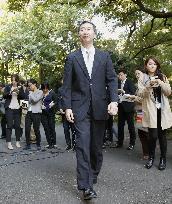
Japanese scientist Takaaki Kajita arrives at the University of Tokyo on Oct. 7, 2015, a day after he received the Nobel Prize in Physics along with Canada's Arthur McDonald for their discovery of neutrino oscillations demonstrating that neutrinos have mass. (Kyodo) ==Kyodo

  •  
Japan's Kajita shares Nobel Prize in Physics with Canada's McDonald

Japan's Kajita shares Nobel Prize in Physics with Canada's McDonald

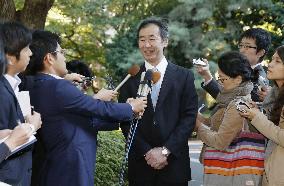
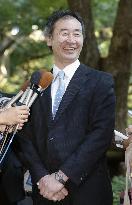
Japanese scientist Takaaki Kajita meets with reporters at the University of Tokyo on Oct. 7, 2015, a day after he received the Nobel Prize in Physics along with Canada's Arthur McDonald for their discovery of neutrino oscillations demonstrating that neutrinos have mass. (Kyodo) ==Kyodo

  •  
Japan's Kajita shares Nobel Prize in Physics with Canada's McDonald

Japan's Kajita shares Nobel Prize in Physics with Canada's McDonald

Japanese scientist Takaaki Kajita meets with reporters at the University of Tokyo on Oct. 7, 2015, a day after he received the Nobel Prize in Physics along with Canada's Arthur McDonald for their discovery of neutrino oscillations demonstrating that neutrinos have mass. (Kyodo) ==Kyodo

  •  
Japan's Kajita shares Nobel Prize in Physics with Canada's McDonald

Japan's Kajita shares Nobel Prize in Physics with Canada's McDonald

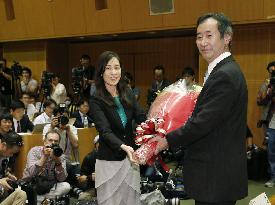
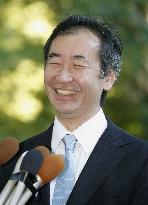
Japanese scientist Takaaki Kajita (R) receives flowers during a press conference on Oct. 6, 2015, at the University of Tokyo, as he won the Nobel Prize in Physics along with Canada's Arthur McDonald for their discovery of neutrino oscillations demonstrating that neutrinos have mass. (Kyodo) ==Kyodo

  •  
Japan's Kajita shares Nobel Prize in Physics with Canada's McDonald

Japan's Kajita shares Nobel Prize in Physics with Canada's McDonald

Japanese scientist Takaaki Kajita meets with reporters at the University of Tokyo on Oct. 7, 2015, a day after he received the Nobel Prize in Physics along with Canada's Arthur McDonald for their discovery of neutrino oscillations demonstrating that neutrinos have mass. (Kyodo) ==Kyodo

  •  
Expert explains work at facility linked to Nobel physics prize

Expert explains work at facility linked to Nobel physics prize

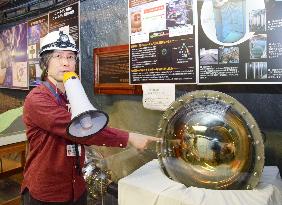
Yoshinari Hayato, associate professor at the University of Tokyo's Institute for Cosmic Ray Research, shows one of the photomultiplier tubes at Super-Kamiokande, the world's largest underground neutrino detector facility, in Hida, Gifu Prefecture, central Japan, on Oct. 9, 2015. The detector was instrumental in research by Japanese scientist Takaaki Kajita, who was named a co-recipient of the Nobel Prize in Physics on Oct. 6 "for the discovery of neutrino oscillations, which shows that neutrinos have mass." (Kyodo) ==Kyodo

  •  
Expert explains work at facility linked to Nobel physics prize

Expert explains work at facility linked to Nobel physics prize

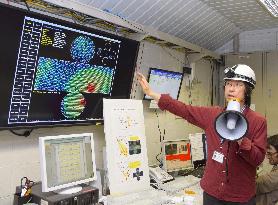
Yoshinari Hayato, associate professor at the University of Tokyo's Institute for Cosmic Ray Research, explains work in the control room at Super-Kamiokande, the world's largest underground neutrino detector facility, in Hida, Gifu Prefecture, central Japan, on Oct. 9, 2015. The detector was instrumental in research by Japanese scientist Takaaki Kajita, who was named a co-recipient of the Nobel Prize in Physics on Oct. 6 "for the discovery of neutrino oscillations, which shows that neutrinos have mass." (Kyodo) ==Kyodo

  •  
(1) Koshiba, Tanaka receive Nobel prizes at awards ceremony

(1) Koshiba, Tanaka receive Nobel prizes at awards ceremony

STOCKHOLM, Sweden - Japan's Masatoshi Koshiba, co-winner of the 2002 Nobel Prize in Physics, receives his Nobel medal from King Carl XVI Gustaf at a ceremony in Stockholm on Dec. 10. Koshiba, 76, professor emeritus at the University of Tokyo, was honored for his contribution to confirming the existence of cosmic neutrinos by developing and using a gigantic underground detector called Kamiokande in Kamioka, Gifu Prefecture. (Kyodo)

  •  
Japanese, U.S. physicists to share Israel's Wolf Prize

Japanese, U.S. physicists to share Israel's Wolf Prize

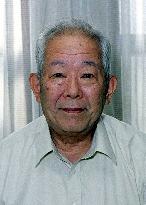
TOKYO, Japan - Masatoshi Koshiba, professor emeritus at the University of Tokyo who will share the 2000 Wolf Prize in physics with a U.S. scientist, is shown in a file photo. The Israel-based Wolf Foundation said on Jan. 18 Koshiba, 73, and Raymond Davis Jr., 85, a professor at the University of Pennsylvania, will share the 100,000 dollar prize, to be presented in Jerusalem in May. Koshiba has led a series of experiments on neutrinos, using the Kamiokande and Super-Kamiokande detectors in the town of Kamioka, Gifu Prefecture, to study the subatomic particles emitted by supernovas.

  •  
Neutrino test tank shown to press

Neutrino test tank shown to press

The photo shows a huge tank-shaped facility designed to detect neutrinos which physicists say pass through all substances. The test facility equipped with 680 lenses attached to the ceiling was shown to the press Monday Nov. 9 at the Education Ministry's High Energy Accelerator Research Organization in Tukuba, Ibaraki Prefecture. ==Kyodo

  •  
Study shows neutrinos possess m

Study shows neutrinos possess m

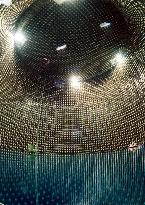
A team of Japanese and U.S. scientists have found evidence showing for the first time that neutrinos -- tiny, electrically neutral, subatomic particles -- possess mass, contradicting the standard theory of particle physics. The Super-Kamiokande group made the finding by using a 50,000-ton tank (in the photo) of highly purified water located about 1,000 meters underground in the Kamioka Mine in Gifu Prefecture, central Japan. ==Kyodo

  • Main
  • Top
  • Editorial
  • Creative
  • About Us
  • About ILG
  • Terms of use
  • Company
  • BEHIND
  • Price List
  • Single Plan
  • Monthly Plan
  • Services
  • Shooting
  • Rights Clearance
  • Support
  • FAQ
  • How To Buy
  • Contact Us
  • Become a Partner

© KYODO NEWS IMAGES INC

All Rights Reserved.

  • Editorial
  • Olympics
  • News
  • Sports
  • Japan
  • Tech
  • Royal
  • Disaster
  • NorthKorea
  • Old Japan
  • SNS
  • Creative
  • Food
  • Japan
  • Landscape
  • Animal
  • Popular
  • #Ukraine
  • #Russia
  • #coronavirus
  • #N. Korea
  • #China
  • #Thailand
  • #Ukraine
  • #Russia
  • #coronavirus
  • #N. Korea
  • #China
  • #Thailand
  • Food
  • Japan
  • Landscape
  • Animal
  • Olympics
  • News
  • Sports
  • Japan
  • Tech
  • Royal
  • Disaster
  • NorthKorea
  • Old Japan
  • SNS