•  
Pope Leo XIV Visits Vatican’s Astronomical Observatory - Ital

Pope Leo XIV Visits Vatican’s Astronomical Observatory - Ital

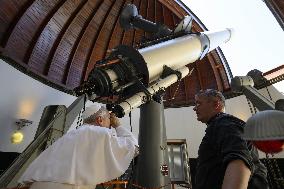
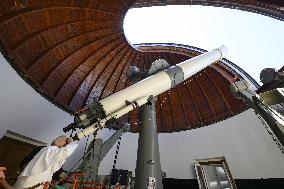
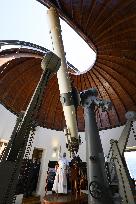
Pope Leo XIV visits the Vatican’s Astronomical Observatory (or Specola Vaticana) in Castel Gandolfo, near Rome, Italy, where he is on holidays on July 20, 2025. The Specola Vaticana can be considered one of the oldest astronomical observatories in the world. Its origins date back to the second half of the 16th century, when Pope Gregory XIII had the Tower of Winds built in the Vatican in 1578, and invited Jesuit astronomers and mathematicians of the Roman College to prepare a reform of the calendar, which had been promulgated in 1582. Since then, with significant continuity, the Holy See has never stopped showing an interest in and supporting astronomical research. Pius XI thus ordered that the Specola be transferred to his summer residence at Castel Gandolfo on the Alban Hills, some 25 kilometres south of Rome. In that environment so rich in history, a modern Observatory was re-founded and entrusted to Jesuits in 1935. It was equipped with three new telescopes and a laboratory for astrophysics, capable of sp

  •  
Pope Leo XIV Visits Vatican’s Astronomical Observatory - Ital

Pope Leo XIV Visits Vatican’s Astronomical Observatory - Ital

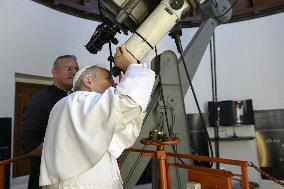
Pope Leo XIV visits the Vatican’s Astronomical Observatory (or Specola Vaticana) in Castel Gandolfo, near Rome, Italy, where he is on holidays on July 20, 2025. The Specola Vaticana can be considered one of the oldest astronomical observatories in the world. Its origins date back to the second half of the 16th century, when Pope Gregory XIII had the Tower of Winds built in the Vatican in 1578, and invited Jesuit astronomers and mathematicians of the Roman College to prepare a reform of the calendar, which had been promulgated in 1582. Since then, with significant continuity, the Holy See has never stopped showing an interest in and supporting astronomical research. Pius XI thus ordered that the Specola be transferred to his summer residence at Castel Gandolfo on the Alban Hills, some 25 kilometres south of Rome. In that environment so rich in history, a modern Observatory was re-founded and entrusted to Jesuits in 1935. It was equipped with three new telescopes and a laboratory for astrophysics, capable of sp

  •  
Pope Leo XIV Visits Vatican’s Astronomical Observatory - Ital

Pope Leo XIV Visits Vatican’s Astronomical Observatory - Ital

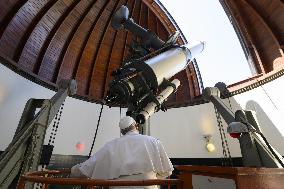
Pope Leo XIV visits the Vatican’s Astronomical Observatory (or Specola Vaticana) in Castel Gandolfo, near Rome, Italy, where he is on holidays on July 20, 2025. The Specola Vaticana can be considered one of the oldest astronomical observatories in the world. Its origins date back to the second half of the 16th century, when Pope Gregory XIII had the Tower of Winds built in the Vatican in 1578, and invited Jesuit astronomers and mathematicians of the Roman College to prepare a reform of the calendar, which had been promulgated in 1582. Since then, with significant continuity, the Holy See has never stopped showing an interest in and supporting astronomical research. Pius XI thus ordered that the Specola be transferred to his summer residence at Castel Gandolfo on the Alban Hills, some 25 kilometres south of Rome. In that environment so rich in history, a modern Observatory was re-founded and entrusted to Jesuits in 1935. It was equipped with three new telescopes and a laboratory for astrophysics, capable of sp

  •  
Pope Leo XIV Visits Vatican’s Astronomical Observatory - Ital

Pope Leo XIV Visits Vatican’s Astronomical Observatory - Ital

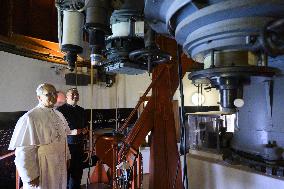
Pope Leo XIV visits the Vatican’s Astronomical Observatory (or Specola Vaticana) in Castel Gandolfo, near Rome, Italy, where he is on holidays on July 20, 2025. The Specola Vaticana can be considered one of the oldest astronomical observatories in the world. Its origins date back to the second half of the 16th century, when Pope Gregory XIII had the Tower of Winds built in the Vatican in 1578, and invited Jesuit astronomers and mathematicians of the Roman College to prepare a reform of the calendar, which had been promulgated in 1582. Since then, with significant continuity, the Holy See has never stopped showing an interest in and supporting astronomical research. Pius XI thus ordered that the Specola be transferred to his summer residence at Castel Gandolfo on the Alban Hills, some 25 kilometres south of Rome. In that environment so rich in history, a modern Observatory was re-founded and entrusted to Jesuits in 1935. It was equipped with three new telescopes and a laboratory for astrophysics, capable of sp

  •  
Pope Leo XIV Visits Vatican’s Astronomical Observatory - Ital

Pope Leo XIV Visits Vatican’s Astronomical Observatory - Ital

Pope Leo XIV visits the Vatican’s Astronomical Observatory (or Specola Vaticana) in Castel Gandolfo, near Rome, Italy, where he is on holidays on July 20, 2025. The Specola Vaticana can be considered one of the oldest astronomical observatories in the world. Its origins date back to the second half of the 16th century, when Pope Gregory XIII had the Tower of Winds built in the Vatican in 1578, and invited Jesuit astronomers and mathematicians of the Roman College to prepare a reform of the calendar, which had been promulgated in 1582. Since then, with significant continuity, the Holy See has never stopped showing an interest in and supporting astronomical research. Pius XI thus ordered that the Specola be transferred to his summer residence at Castel Gandolfo on the Alban Hills, some 25 kilometres south of Rome. In that environment so rich in history, a modern Observatory was re-founded and entrusted to Jesuits in 1935. It was equipped with three new telescopes and a laboratory for astrophysics, capable of sp

  •  
Pope Leo XIV Visits Vatican’s Astronomical Observatory - Ital

Pope Leo XIV Visits Vatican’s Astronomical Observatory - Ital

Pope Leo XIV visits the Vatican’s Astronomical Observatory (or Specola Vaticana) in Castel Gandolfo, near Rome, Italy, where he is on holidays on July 20, 2025. The Specola Vaticana can be considered one of the oldest astronomical observatories in the world. Its origins date back to the second half of the 16th century, when Pope Gregory XIII had the Tower of Winds built in the Vatican in 1578, and invited Jesuit astronomers and mathematicians of the Roman College to prepare a reform of the calendar, which had been promulgated in 1582. Since then, with significant continuity, the Holy See has never stopped showing an interest in and supporting astronomical research. Pius XI thus ordered that the Specola be transferred to his summer residence at Castel Gandolfo on the Alban Hills, some 25 kilometres south of Rome. In that environment so rich in history, a modern Observatory was re-founded and entrusted to Jesuits in 1935. It was equipped with three new telescopes and a laboratory for astrophysics, capable of sp

  •  
Pope Leo XIV Visits Vatican’s Astronomical Observatory - Ital

Pope Leo XIV Visits Vatican’s Astronomical Observatory - Ital

Pope Leo XIV visits the Vatican’s Astronomical Observatory (or Specola Vaticana) in Castel Gandolfo, near Rome, Italy, where he is on holidays on July 20, 2025. The Specola Vaticana can be considered one of the oldest astronomical observatories in the world. Its origins date back to the second half of the 16th century, when Pope Gregory XIII had the Tower of Winds built in the Vatican in 1578, and invited Jesuit astronomers and mathematicians of the Roman College to prepare a reform of the calendar, which had been promulgated in 1582. Since then, with significant continuity, the Holy See has never stopped showing an interest in and supporting astronomical research. Pius XI thus ordered that the Specola be transferred to his summer residence at Castel Gandolfo on the Alban Hills, some 25 kilometres south of Rome. In that environment so rich in history, a modern Observatory was re-founded and entrusted to Jesuits in 1935. It was equipped with three new telescopes and a laboratory for astrophysics, capable of sp

  •  
FAST Telescope Under Maintenance - China

FAST Telescope Under Maintenance - China

A panoramic drone photo taken on September 25, 2024 shows China's Five-hundred-meter Aperture Spherical Radio Telescope (FAST) under maintenance in southwest China's Guizhou Province. FAST, the world's largest filled-aperture and most sensitive radio telescope, has identified more than 1,000 new pulsars, its operator said on Tuesday. The number of new pulsars discovered by FAST has surpassed that of all foreign telescopes combined during the same period, according to the National Astronomical Observatories under the Chinese Academy of Sciences.Photo by Ou Dongqu/Xinhua/ABACAPRESS.COM

  •  
FAST Telescope Under Maintenance - China

FAST Telescope Under Maintenance - China

An aerial drone photo taken on September 25, 2024 shows China's Five-hundred-meter Aperture Spherical Radio Telescope (FAST) under maintenance in southwest China's Guizhou Province. FAST, the world's largest filled-aperture and most sensitive radio telescope, has identified more than 1,000 new pulsars, its operator said on Tuesday. The number of new pulsars discovered by FAST has surpassed that of all foreign telescopes combined during the same period, according to the National Astronomical Observatories under the Chinese Academy of Sciences.Photo by Ou Dongqu/Xinhua/ABACAPRESS.COM

  •  
FAST Telescope Under Maintenance - China

FAST Telescope Under Maintenance - China

A panoramic drone photo taken on September 25, 2024 shows China's Five-hundred-meter Aperture Spherical Radio Telescope (FAST) under maintenance in southwest China's Guizhou Province. FAST, the world's largest filled-aperture and most sensitive radio telescope, has identified more than 1,000 new pulsars, its operator said on Tuesday. The number of new pulsars discovered by FAST has surpassed that of all foreign telescopes combined during the same period, according to the National Astronomical Observatories under the Chinese Academy of Sciences.Photo by Ou Dongqu/Xinhua/ABACAPRESS.COM

  •  
Starry Sky In Ngari Prefecture - China

Starry Sky In Ngari Prefecture - China

This undated photo provided by the Ngari Observatory of the National Astronomical Observatories of the Chinese Academy of Sciences (NAOC) shows the sky in Ngari Prefecture, southwest China's Xizang Autonomous Region. Photo by Xinhua/ABACAPRESS.COM

  •  
500m Aperture Spherical Radio Telescope Construction - China

500m Aperture Spherical Radio Telescope Construction - China

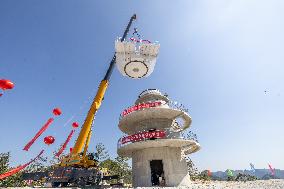
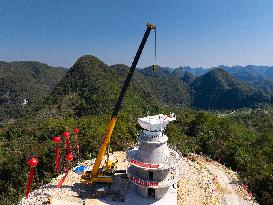
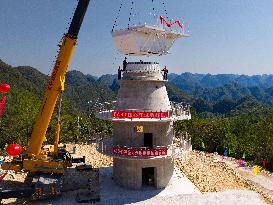
An aerial drone photo taken on September 25, 2024 shows the groundbreaking ceremony for the construction of the Core Array of China's Five-hundred-meter Aperture Spherical Radio Telescope (FAST) in southwest China's Guizhou Province. The construction of the Core Array of China's Five-hundred-meter Aperture Spherical Radio Telescope (FAST) started Wednesday, highlighting China's growing potential in global radio astronomy research. As a proposed extension of FAST, the Core Array integrates 24 secondary 40-meter antennas implanted within 5 kilometers of the FAST site, said Jiang Peng, deputy director of the National Astronomical Observatories under the Chinese Academy of Sciences. The Chinese-designed array will combine the unprecedented sensitivity of FAST with a high angular resolution, thereby exceeding the capabilities at similar frequencies of next-generation arrays in the world. The FAST Core Array is estimated to be completed and put into operation in 2027. (Photo by Liu Xu/Xinhua/ABACAPRESS.COM

  •  
500m Aperture Spherical Radio Telescope Construction - China

500m Aperture Spherical Radio Telescope Construction - China

This undated simulated diagram shows the Core Array of China's Five-hundred-meter Aperture Spherical Radio Telescope (FAST) upon completion in southwest China's Guizhou Province. The construction of the Core Array of China's Five-hundred-meter Aperture Spherical Radio Telescope (FAST) started Wednesday, highlighting China's growing potential in global radio astronomy research. As a proposed extension of FAST, the Core Array integrates 24 secondary 40-meter antennas implanted within 5 kilometers of the FAST site, said Jiang Peng, deputy director of the National Astronomical Observatories under the Chinese Academy of Sciences. The Chinese-designed array will combine the unprecedented sensitivity of FAST with a high angular resolution, thereby exceeding the capabilities at similar frequencies of next-generation arrays in the world. The FAST Core Array is estimated to be completed and put into operation in 2027. Photo by Xinhua/ABACAPRESS.COM

  •  
500m Aperture Spherical Radio Telescope Construction - China

500m Aperture Spherical Radio Telescope Construction - China

This photo taken on September 25, 2024 shows the first test prototype of the Core Array of China's Five-hundred-meter Aperture Spherical Radio Telescope (FAST) being installed in southwest China's Guizhou Province. The construction of the Core Array of China's Five-hundred-meter Aperture Spherical Radio Telescope (FAST) started Wednesday, highlighting China's growing potential in global radio astronomy research. As a proposed extension of FAST, the Core Array integrates 24 secondary 40-meter antennas implanted within 5 kilometers of the FAST site, said Jiang Peng, deputy director of the National Astronomical Observatories under the Chinese Academy of Sciences. The Chinese-designed array will combine the unprecedented sensitivity of FAST with a high angular resolution, thereby exceeding the capabilities at similar frequencies of next-generation arrays in the world. The FAST Core Array is estimated to be completed and put into operation in 2027. Photo by Ou Dongqu/Xinhua/ABACAPRESS.COM

  •  
500m Aperture Spherical Radio Telescope Construction - China

500m Aperture Spherical Radio Telescope Construction - China

An aerial drone photo taken on September 25, 2024 shows the first test prototype of the Core Array of China's Five-hundred-meter Aperture Spherical Radio Telescope (FAST) being installed in southwest China's Guizhou Province. The construction of the Core Array of China's Five-hundred-meter Aperture Spherical Radio Telescope (FAST) started Wednesday, highlighting China's growing potential in global radio astronomy research. As a proposed extension of FAST, the Core Array integrates 24 secondary 40-meter antennas implanted within 5 kilometers of the FAST site, said Jiang Peng, deputy director of the National Astronomical Observatories under the Chinese Academy of Sciences. The Chinese-designed array will combine the unprecedented sensitivity of FAST with a high angular resolution, thereby exceeding the capabilities at similar frequencies of next-generation arrays in the world. The FAST Core Array is estimated to be completed and put into operation in 2027. (Photo by Liu Xu/Xinhua/ABACAPRESS.COM

  •  
500m Aperture Spherical Radio Telescope Construction - China

500m Aperture Spherical Radio Telescope Construction - China

An aerial drone photo taken on September 25, 2024 shows the newly installed first test prototype (up, R) of the Core Array of China's Five-hundred-meter Aperture Spherical Radio Telescope (FAST) and the FAST (up, L) in southwest China's Guizhou Province. The construction of the Core Array of China's Five-hundred-meter Aperture Spherical Radio Telescope (FAST) started Wednesday, highlighting China's growing potential in global radio astronomy research. As a proposed extension of FAST, the Core Array integrates 24 secondary 40-meter antennas implanted within 5 kilometers of the FAST site, said Jiang Peng, deputy director of the National Astronomical Observatories under the Chinese Academy of Sciences. The Chinese-designed array will combine the unprecedented sensitivity of FAST with a high angular resolution, thereby exceeding the capabilities at similar frequencies of next-generation arrays in the world. The FAST Core Array is estimated to be completed and put into operation in 2027. (Photo by Liu Xu/Xinhua/AB

  •  
500m Aperture Spherical Radio Telescope Construction - China

500m Aperture Spherical Radio Telescope Construction - China

An aerial panoramic photo taken on September 25, 2024 shows the first test prototype of the Core Array of China's Five-hundred-meter Aperture Spherical Radio Telescope (FAST) being installed in southwest China's Guizhou Province. The construction of the Core Array of China's Five-hundred-meter Aperture Spherical Radio Telescope (FAST) started Wednesday, highlighting China's growing potential in global radio astronomy research. As a proposed extension of FAST, the Core Array integrates 24 secondary 40-meter antennas implanted within 5 kilometers of the FAST site, said Jiang Peng, deputy director of the National Astronomical Observatories under the Chinese Academy of Sciences. The Chinese-designed array will combine the unprecedented sensitivity of FAST with a high angular resolution, thereby exceeding the capabilities at similar frequencies of next-generation arrays in the world. The FAST Core Array is estimated to be completed and put into operation in 2027. Photo by Ou Dongqu/Xinhua/ABACAPRESS.COM

  •  
500m Aperture Spherical Radio Telescope Construction - China

500m Aperture Spherical Radio Telescope Construction - China

An aerial drone photo taken on September 25, 2024 shows the first test prototype of the Core Array of China's Five-hundred-meter Aperture Spherical Radio Telescope (FAST) being installed in southwest China's Guizhou Province. The construction of the Core Array of China's Five-hundred-meter Aperture Spherical Radio Telescope (FAST) started Wednesday, highlighting China's growing potential in global radio astronomy research. As a proposed extension of FAST, the Core Array integrates 24 secondary 40-meter antennas implanted within 5 kilometers of the FAST site, said Jiang Peng, deputy director of the National Astronomical Observatories under the Chinese Academy of Sciences. The Chinese-designed array will combine the unprecedented sensitivity of FAST with a high angular resolution, thereby exceeding the capabilities at similar frequencies of next-generation arrays in the world. The FAST Core Array is estimated to be completed and put into operation in 2027. Photo by Ou Dongqu/Xinhua/ABACAPRESS.COM

  •  
500m Aperture Spherical Radio Telescope Construction - China

500m Aperture Spherical Radio Telescope Construction - China

An aerial drone photo taken on September 25, 2024 shows the first test prototype of the Core Array of China's Five-hundred-meter Aperture Spherical Radio Telescope (FAST) being installed in southwest China's Guizhou Province. The construction of the Core Array of China's Five-hundred-meter Aperture Spherical Radio Telescope (FAST) started Wednesday, highlighting China's growing potential in global radio astronomy research. As a proposed extension of FAST, the Core Array integrates 24 secondary 40-meter antennas implanted within 5 kilometers of the FAST site, said Jiang Peng, deputy director of the National Astronomical Observatories under the Chinese Academy of Sciences. The Chinese-designed array will combine the unprecedented sensitivity of FAST with a high angular resolution, thereby exceeding the capabilities at similar frequencies of next-generation arrays in the world. The FAST Core Array is estimated to be completed and put into operation in 2027. (Photo by Liu Xu/Xinhua/ABACAPRESS.COM

  •  
500m Aperture Spherical Radio Telescope Construction - China

500m Aperture Spherical Radio Telescope Construction - China

An aerial drone photo taken on September 25, 2024 shows the groundbreaking ceremony for the construction of the Core Array of China's Five-hundred-meter Aperture Spherical Radio Telescope (FAST) in southwest China's Guizhou Province. The construction of the Core Array of China's Five-hundred-meter Aperture Spherical Radio Telescope (FAST) started Wednesday, highlighting China's growing potential in global radio astronomy research. As a proposed extension of FAST, the Core Array integrates 24 secondary 40-meter antennas implanted within 5 kilometers of the FAST site, said Jiang Peng, deputy director of the National Astronomical Observatories under the Chinese Academy of Sciences. The Chinese-designed array will combine the unprecedented sensitivity of FAST with a high angular resolution, thereby exceeding the capabilities at similar frequencies of next-generation arrays in the world. The FAST Core Array is estimated to be completed and put into operation in 2027. (Photo by Liu Xu/Xinhua/ABACAPRESS.COM

  •  
500m Aperture Spherical Radio Telescope Construction - China

500m Aperture Spherical Radio Telescope Construction - China

An aerial drone photo taken on September 25, 2024 shows China's Five-hundred-meter Aperture Spherical Radio Telescope (FAST) under maintenance in southwest China's Guizhou Province. The construction of the Core Array of China's Five-hundred-meter Aperture Spherical Radio Telescope (FAST) started Wednesday, highlighting China's growing potential in global radio astronomy research. As a proposed extension of FAST, the Core Array integrates 24 secondary 40-meter antennas implanted within 5 kilometers of the FAST site, said Jiang Peng, deputy director of the National Astronomical Observatories under the Chinese Academy of Sciences. The Chinese-designed array will combine the unprecedented sensitivity of FAST with a high angular resolution, thereby exceeding the capabilities at similar frequencies of next-generation arrays in the world. The FAST Core Array is estimated to be completed and put into operation in 2027. (Photo by Liu Xu/Xinhua/ABACAPRESS.COM

  •  
500m Aperture Spherical Radio Telescope Construction - China

500m Aperture Spherical Radio Telescope Construction - China

An aerial drone photo taken on September 25, 2024 shows the first test prototype of the Core Array of China's Five-hundred-meter Aperture Spherical Radio Telescope (FAST) being installed in southwest China's Guizhou Province. The construction of the Core Array of China's Five-hundred-meter Aperture Spherical Radio Telescope (FAST) started Wednesday, highlighting China's growing potential in global radio astronomy research. As a proposed extension of FAST, the Core Array integrates 24 secondary 40-meter antennas implanted within 5 kilometers of the FAST site, said Jiang Peng, deputy director of the National Astronomical Observatories under the Chinese Academy of Sciences. The Chinese-designed array will combine the unprecedented sensitivity of FAST with a high angular resolution, thereby exceeding the capabilities at similar frequencies of next-generation arrays in the world. The FAST Core Array is estimated to be completed and put into operation in 2027. (Photo by Liu Xu/Xinhua/ABACAPRESS.COM

  •  
500m Aperture Spherical Radio Telescope Construction - China

500m Aperture Spherical Radio Telescope Construction - China

An aerial drone photo taken on September 25, 2024 shows China's Five-hundred-meter Aperture Spherical Radio Telescope (FAST) under maintenance in southwest China's Guizhou Province. The construction of the Core Array of China's Five-hundred-meter Aperture Spherical Radio Telescope (FAST) started Wednesday, highlighting China's growing potential in global radio astronomy research. As a proposed extension of FAST, the Core Array integrates 24 secondary 40-meter antennas implanted within 5 kilometers of the FAST site, said Jiang Peng, deputy director of the National Astronomical Observatories under the Chinese Academy of Sciences. The Chinese-designed array will combine the unprecedented sensitivity of FAST with a high angular resolution, thereby exceeding the capabilities at similar frequencies of next-generation arrays in the world. The FAST Core Array is estimated to be completed and put into operation in 2027. (Photo by Liu Xu/Xinhua/ABACAPRESS.COM

  •  
500m Aperture Spherical Radio Telescope Construction - China

500m Aperture Spherical Radio Telescope Construction - China

A drone photo taken on September 25, 2024 shows the first test prototype of the Core Array of China's Five-hundred-meter Aperture Spherical Radio Telescope (FAST) being installed in southwest China's Guizhou Province. The construction of the Core Array of China's Five-hundred-meter Aperture Spherical Radio Telescope (FAST) started Wednesday, highlighting China's growing potential in global radio astronomy research. As a proposed extension of FAST, the Core Array integrates 24 secondary 40-meter antennas implanted within 5 kilometers of the FAST site, said Jiang Peng, deputy director of the National Astronomical Observatories under the Chinese Academy of Sciences. The Chinese-designed array will combine the unprecedented sensitivity of FAST with a high angular resolution, thereby exceeding the capabilities at similar frequencies of next-generation arrays in the world. The FAST Core Array is estimated to be completed and put into operation in 2027. (Photo by Liu Xu/Xinhua/ABACAPRESS.COM

  •  
500m Aperture Spherical Radio Telescope Construction - China

500m Aperture Spherical Radio Telescope Construction - China

A drone photo taken on September 24, 2024 shows the first test prototype of the Core Array of China's Five-hundred-meter Aperture Spherical Radio Telescope (FAST) waiting to be installed in southwest China's Guizhou Province. The construction of the Core Array of China's Five-hundred-meter Aperture Spherical Radio Telescope (FAST) started Wednesday, highlighting China's growing potential in global radio astronomy research. As a proposed extension of FAST, the Core Array integrates 24 secondary 40-meter antennas implanted within 5 kilometers of the FAST site, said Jiang Peng, deputy director of the National Astronomical Observatories under the Chinese Academy of Sciences. The Chinese-designed array will combine the unprecedented sensitivity of FAST with a high angular resolution, thereby exceeding the capabilities at similar frequencies of next-generation arrays in the world. The FAST Core Array is estimated to be completed and put into operation in 2027. (Photo by Liu Xu/Xinhua/ABACAPRESS.COM

  •  
(EyesonSci)CHINA-BEIJING-CHANG'E-6-LUNAR SAMPLES (CN)

(EyesonSci)CHINA-BEIJING-CHANG'E-6-LUNAR SAMPLES (CN)

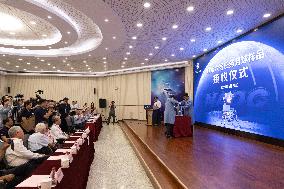
(240628) -- BEIJING, June 28, 2024 Photo by Xinhua/ABACAPRESS.COM) -- Ding Chibiao (L), vice president of the Chinese Academy of Sciences (CAS), issues a responsibility letter to Liu Jifeng, director of the National Astronomical Observatories, in Beijing, capital of China, June 28, 2024. A ceremony was held on Friday at the National Astronomical Observatories under the CAS to receive the lunar samples collected by China's Chang'e-6 probe. China's Chang'e-6 mission collected 1,935.3 grams of samples from the moon's far side, the China National Space Administration announced on Friday. Photo by Xinhua/ABACAPRESS.COM/Jin Liwang)

  •  
(EyesonSci)CHINA-BEIJING-CHANG'E-6-LUNAR SAMPLES (CN)

(EyesonSci)CHINA-BEIJING-CHANG'E-6-LUNAR SAMPLES (CN)

(240628) -- BEIJING, June 28, 2024 Photo by Xinhua/ABACAPRESS.COM) -- Staff members transfer Chang'e-6 lunar samples to the lunar and deep space exploration laboratory of the Chinese Academy of Sciences (CAS) in Beijing, capital of China, June 28, 2024. A ceremony was held on Friday at the National Astronomical Observatories under the CAS to receive the lunar samples collected by China's Chang'e-6 probe. China's Chang'e-6 mission collected 1,935.3 grams of samples from the moon's far side, the China National Space Administration announced on Friday. Photo by Xinhua/ABACAPRESS.COM/Jin Liwang)

  •  
(EyesonSci)CHINA-BEIJING-CHANG'E-6-LUNAR SAMPLES (CN)

(EyesonSci)CHINA-BEIJING-CHANG'E-6-LUNAR SAMPLES (CN)

(240628) -- BEIJING, June 28, 2024 Photo by Xinhua/ABACAPRESS.COM) -- This photo taken on June 28, 2024 shows the container of Chang'e-6 lunar samples at the National Astronomical Observatories under the Chinese Academy of Sciences (CAS) in Beijing, capital of China. A ceremony was held on Friday at the National Astronomical Observatories under the CAS to receive the lunar samples collected by China's Chang'e-6 probe. China's Chang'e-6 mission collected 1,935.3 grams of samples from the moon's far side, the China National Space Administration announced on Friday. Photo by Xinhua/ABACAPRESS.COM/Jin Liwang)

  •  
(EyesonSci)CHINA-BEIJING-CHANG'E-6-LUNAR SAMPLES (CN)

(EyesonSci)CHINA-BEIJING-CHANG'E-6-LUNAR SAMPLES (CN)

(240628) -- BEIJING, June 28, 2024 Photo by Xinhua/ABACAPRESS.COM) -- Staff members transfer Chang'e-6 lunar samples to the lunar and deep space exploration laboratory of the Chinese Academy of Sciences (CAS) in Beijing, capital of China, June 28, 2024. A ceremony was held on Friday at the National Astronomical Observatories under the CAS to receive the lunar samples collected by China's Chang'e-6 probe. China's Chang'e-6 mission collected 1,935.3 grams of samples from the moon's far side, the China National Space Administration announced on Friday. Photo by Xinhua/ABACAPRESS.COM/Jin Liwang)

  •  
(EyesonSci)CHINA-BEIJING-CHANG'E-6-LUNAR SAMPLES (CN)

(EyesonSci)CHINA-BEIJING-CHANG'E-6-LUNAR SAMPLES (CN)

(240628) -- BEIJING, June 28, 2024 Photo by Xinhua/ABACAPRESS.COM) -- Staff members place the container of Chang'e-6 lunar samples at the National Astronomical Observatories under the Chinese Academy of Sciences (CAS) in Beijing, capital of China, June 28, 2024. A ceremony was held on Friday at the National Astronomical Observatories under the CAS to receive the lunar samples collected by China's Chang'e-6 probe. China's Chang'e-6 mission collected 1,935.3 grams of samples from the moon's far side, the China National Space Administration announced on Friday. Photo by Xinhua/ABACAPRESS.COM/Jin Liwang)

  •  
(EyesonSci)CHINA-BEIJING-CHANG'E-6-LUNAR SAMPLES (CN)

(EyesonSci)CHINA-BEIJING-CHANG'E-6-LUNAR SAMPLES (CN)

(240628) -- BEIJING, June 28, 2024 Photo by Xinhua/ABACAPRESS.COM) -- A reception ceremony for Chang'e-6 lunar samples is held at the National Astronomical Observatories under the Chinese Academy of Sciences (CAS) in Beijing, capital of China, June 28, 2024. A ceremony was held on Friday at the National Astronomical Observatories under the CAS to receive the lunar samples collected by China's Chang'e-6 probe. China's Chang'e-6 mission collected 1,935.3 grams of samples from the moon's far side, the China National Space Administration announced on Friday. Photo by Xinhua/ABACAPRESS.COM/Jin Liwang)

  •  

Tracing climate change on roof of world

STORY: Tracing climate change on roof of world SHOOTING TIME: March 17, 2024/File DATELINE: May 14, 2024 LENGTH: 00:01:06 LOCATION: XINING, China CATEGORY: ENVIRONMENT SHOTLIST: 1. various of the observatory 2. SOUNDBTIE (Chinese): WANG JIANQIONG, Deputy director of China Global Atmosphere Watch Baseline Observatory 3. various of the observatory STORYLINE: The China Global Atmosphere Watch Baseline Observatory stands on China's Qinghai-Xizang plateau, where it has been in operation for 30 years. It is one of 32 global baseline observatories established by the World Meteorological Organization. Standing more than 3,800 meters above sea level on Waliguan mountain, it's the world's highest of its kind. Deputy director Wang Jianqiong has been working at the observatory since 2003. SOUNDBTIE (Chinese): WANG JIANQIONG, Deputy director of China Global Atmosphere Watch Baseline Observatory "Over the past 30 years, generations of meteorologists have accumulated a large amount of atmospheric composition observat

  •  
[GRAPHICS] "China Sky Eye" Has Identified More Than 900 New Pulsars

[GRAPHICS] "China Sky Eye" Has Identified More Than 900 New Pulsars

(240417) -- BEIJING, April 17, 2024 (Xinhua) -- China's Five-hundred-meter Aperture Spherical Radio Telescope (FAST), also dubbed the "China Sky Eye," has identified more than 900 new pulsars since its launch in 2016, according to the FAST Operation and Development Center of the National Astronomical Observatories under the Chinese Academy of Sciences (NAOC) on Wednesday. (Xinhua/Liu Xu, Lu Yuhan)

  •  
Xinhua Headlines: China's gigantic telescope embraces int'l exchanges, innovative development

Xinhua Headlines: China's gigantic telescope embraces int'l exchanges, innovative development

(240417) -- GUIYANG, April 17, 2024 (Xinhua) -- Jiang Peng, chief engineer of China's Five-hundred-meter Aperture Spherical Radio Telescope (FAST) with the National Astronomical Observatories of China (NAOC) of the Chinese Academy of Sciences, checks equipment operation at the control room of the FAST in Pingtang County, southwest China's Guizhou Province, March 20, 2024. (Xinhua/Liu Xu)

  •  

China's gigantic telescope detects over 900 new pulsars

STORY: China's gigantic telescope detects over 900 new pulsars SHOOTING TIME: recent footages DATELINE: April 17, 2024 LENGTH: 00:02:11 LOCATION: GUIYANG, China CATEGORY: SCIENCE SHOTLIST: 1. various of the Five-hundred-meter Aperture Spherical Radio Telescope (FAST) 2. SOUNDBITE 1 (Chinese): HAN JINLIN, Scientist with the National Astronomical Observatories under the Chinese Academy of Sciences (NAOC) 3. various of the Five-hundred-meter Aperture Spherical Radio Telescope (FAST) 4. SOUNDBITE 2 (Chinese): JIANG PENG, Chief engineer of the FAST STORYLINE: China's Five-hundred-meter Aperture Spherical Radio Telescope (FAST), the world's largest single-dish radio telescope, has identified more than 900 new pulsars since its launch in 2016, its operator said Wednesday. Pulsars, or fast-spinning neutron stars, originate from the imploded cores of massive dying stars through supernova explosions. Pulsar observation is an important task for FAST, which can be used to confirm the existence of gravitational radia

  •  

China's FAST telescope finds key evidence for nanohertz gravitational waves

STORY: China's FAST telescope finds key evidence for nanohertz gravitational waves DATELINE: June 29, 2023 LENGTH: 00:01:42 LOCATION: GUIYANG, China CATEGORY: TECHNOLOGY SHOTLIST: 1. various of FAST telescope 2. various of scientists and their research work with FAST telescope 3. various of images caught by FAST telescope STORYLINE: China's FAST telescope has found key evidence for the existence of nanohertz gravitational waves. The research, conducted by scientists from the National Astronomical Observatories of the Chinese Academy of Sciences (NAOC) and other institutes, was published in the journal Research in Astronomy and Astrophysics Thursday. Gravitational waves are the "ripples" produced by massive objects such as black holes as they rapidly move through the fabric of spacetime. The scientists monitored 57 millisecond pulsars with regular cadence for 41 months by taking advantage of the high sensitivity of FAST. Eventually, they found key evidence for quadrupole correlation signatures compatibl

  •  
(EyesonSci)CHINA-GUIZHOU-FAST-TELESCOPE-BINARY PULSAR-DETECTION (CN)

(EyesonSci)CHINA-GUIZHOU-FAST-TELESCOPE-BINARY PULSAR-DETECTION (CN)

(230623) -- PINGTANG, June 23, 2023 (Xinhua) -- This aerial photo taken on June 22, 2023 shows China's Five-hundred-meter Aperture Spherical Radio Telescope (FAST) under maintenance in southwest China's Guizhou Province. China's FAST telescope identified a binary pulsar with an orbital period of 53.3 minutes, the shortest known period for a pulsar binary system. The research, mainly conducted by a team led by scientists from the National Astronomical Observatories of the Chinese Academy of Sciences (NAOC), was published in the journal Nature Wednesday. (Xinhua/Ou Dongqu)

  •  
(EyesonSci)CHINA-GUIZHOU-FAST-TELESCOPE-BINARY PULSAR-DETECTION (CN)

(EyesonSci)CHINA-GUIZHOU-FAST-TELESCOPE-BINARY PULSAR-DETECTION (CN)

(230623) -- PINGTANG, June 23, 2023 (Xinhua) -- This photo taken on June 22, 2023 shows the feed cabin of China's Five-hundred-meter Aperture Spherical Radio Telescope (FAST) under maintenance in southwest China's Guizhou Province. China's FAST telescope identified a binary pulsar with an orbital period of 53.3 minutes, the shortest known period for a pulsar binary system. The research, mainly conducted by a team led by scientists from the National Astronomical Observatories of the Chinese Academy of Sciences (NAOC), was published in the journal Nature Wednesday. (Xinhua/Ou Dongqu)

  •  
(EyesonSci)CHINA-GUIZHOU-FAST-TELESCOPE-BINARY PULSAR-DETECTION (CN)

(EyesonSci)CHINA-GUIZHOU-FAST-TELESCOPE-BINARY PULSAR-DETECTION (CN)

(230623) -- PINGTANG, June 23, 2023 (Xinhua) -- This aerial photo taken on June 22, 2023 shows China's Five-hundred-meter Aperture Spherical Radio Telescope (FAST) under maintenance in southwest China's Guizhou Province. China's FAST telescope identified a binary pulsar with an orbital period of 53.3 minutes, the shortest known period for a pulsar binary system. The research, mainly conducted by a team led by scientists from the National Astronomical Observatories of the Chinese Academy of Sciences (NAOC), was published in the journal Nature Wednesday. (Xinhua/Ou Dongqu)

  •  
(EyesonSci)CHINA-GUIZHOU-FAST-TELESCOPE-BINARY PULSAR-DETECTION (CN)

(EyesonSci)CHINA-GUIZHOU-FAST-TELESCOPE-BINARY PULSAR-DETECTION (CN)

(230623) -- PINGTANG, June 23, 2023 (Xinhua) -- This aerial photo taken on June 22, 2023 shows China's Five-hundred-meter Aperture Spherical Radio Telescope (FAST) under maintenance in southwest China's Guizhou Province. China's FAST telescope identified a binary pulsar with an orbital period of 53.3 minutes, the shortest known period for a pulsar binary system. The research, mainly conducted by a team led by scientists from the National Astronomical Observatories of the Chinese Academy of Sciences (NAOC), was published in the journal Nature Wednesday. (Xinhua/Ou Dongqu)

  •  
(EyesonSci)CHINA-GUIZHOU-FAST-TELESCOPE-BINARY PULSAR-DETECTION (CN)

(EyesonSci)CHINA-GUIZHOU-FAST-TELESCOPE-BINARY PULSAR-DETECTION (CN)

(230623) -- PINGTANG, June 23, 2023 (Xinhua) -- This aerial panoramic photo taken on June 22, 2023 shows China's Five-hundred-meter Aperture Spherical Radio Telescope (FAST) under maintenance in southwest China's Guizhou Province. China's FAST telescope identified a binary pulsar with an orbital period of 53.3 minutes, the shortest known period for a pulsar binary system. The research, mainly conducted by a team led by scientists from the National Astronomical Observatories of the Chinese Academy of Sciences (NAOC), was published in the journal Nature Wednesday. (Xinhua/Ou Dongqu)

  •  
(EyesonSci)CHINA-GUIZHOU-FAST-TELESCOPE-BINARY PULSAR-DETECTION (CN)

(EyesonSci)CHINA-GUIZHOU-FAST-TELESCOPE-BINARY PULSAR-DETECTION (CN)

(230623) -- PINGTANG, June 23, 2023 (Xinhua) -- This photo taken with a fish-eye lens on June 22, 2023 shows China's Five-hundred-meter Aperture Spherical Radio Telescope (FAST) under maintenance in southwest China's Guizhou Province. China's FAST telescope identified a binary pulsar with an orbital period of 53.3 minutes, the shortest known period for a pulsar binary system. The research, mainly conducted by a team led by scientists from the National Astronomical Observatories of the Chinese Academy of Sciences (NAOC), was published in the journal Nature Wednesday. (Xinhua/Ou Dongqu)

  •  
(EyesonSci)CHINA-GUIZHOU-FAST-TELESCOPE-BINARY PULSAR-DETECTION (CN)

(EyesonSci)CHINA-GUIZHOU-FAST-TELESCOPE-BINARY PULSAR-DETECTION (CN)

(230623) -- PINGTANG, June 23, 2023 (Xinhua) -- This aerial photo taken on June 22, 2023 shows China's Five-hundred-meter Aperture Spherical Radio Telescope (FAST) under maintenance in southwest China's Guizhou Province. China's FAST telescope identified a binary pulsar with an orbital period of 53.3 minutes, the shortest known period for a pulsar binary system. The research, mainly conducted by a team led by scientists from the National Astronomical Observatories of the Chinese Academy of Sciences (NAOC), was published in the journal Nature Wednesday. (Xinhua/Ou Dongqu)

  •  
(EyesonSci)CHINA-GUIZHOU-FAST-TELESCOPE-BINARY PULSAR-DETECTION (CN)

(EyesonSci)CHINA-GUIZHOU-FAST-TELESCOPE-BINARY PULSAR-DETECTION (CN)

(230623) -- PINGTANG, June 23, 2023 (Xinhua) -- This aerial photo taken on June 22, 2023 shows China's Five-hundred-meter Aperture Spherical Radio Telescope (FAST) under maintenance in southwest China's Guizhou Province. China's FAST telescope identified a binary pulsar with an orbital period of 53.3 minutes, the shortest known period for a pulsar binary system. The research, mainly conducted by a team led by scientists from the National Astronomical Observatories of the Chinese Academy of Sciences (NAOC), was published in the journal Nature Wednesday. (Xinhua/Ou Dongqu)

  •  
(EyesonSci)CHINA-GUIZHOU-FAST-TELESCOPE-BINARY PULSAR-DETECTION (CN)

(EyesonSci)CHINA-GUIZHOU-FAST-TELESCOPE-BINARY PULSAR-DETECTION (CN)

(230623) -- PINGTANG, June 23, 2023 (Xinhua) -- This aerial photo taken on June 22, 2023 shows China's Five-hundred-meter Aperture Spherical Radio Telescope (FAST) under maintenance in southwest China's Guizhou Province. China's FAST telescope identified a binary pulsar with an orbital period of 53.3 minutes, the shortest known period for a pulsar binary system. The research, mainly conducted by a team led by scientists from the National Astronomical Observatories of the Chinese Academy of Sciences (NAOC), was published in the journal Nature Wednesday. (Xinhua/Ou Dongqu)

  •  
(EyesonSci)CHINA-GUIZHOU-FAST-TELESCOPE-BINARY PULSAR-DETECTION (CN)

(EyesonSci)CHINA-GUIZHOU-FAST-TELESCOPE-BINARY PULSAR-DETECTION (CN)

(230623) -- PINGTANG, June 23, 2023 (Xinhua) -- This aerial photo taken on June 22, 2023 shows China's Five-hundred-meter Aperture Spherical Radio Telescope (FAST) under maintenance in southwest China's Guizhou Province. China's FAST telescope identified a binary pulsar with an orbital period of 53.3 minutes, the shortest known period for a pulsar binary system. The research, mainly conducted by a team led by scientists from the National Astronomical Observatories of the Chinese Academy of Sciences (NAOC), was published in the journal Nature Wednesday. (Xinhua/Ou Dongqu)

  •  
(EyesonSci)CHINA-GUIZHOU-FAST-TELESCOPE-BINARY PULSAR-DETECTION (CN)

(EyesonSci)CHINA-GUIZHOU-FAST-TELESCOPE-BINARY PULSAR-DETECTION (CN)

(230623) -- PINGTANG, June 23, 2023 (Xinhua) -- This aerial photo taken on June 22, 2023 shows China's Five-hundred-meter Aperture Spherical Radio Telescope (FAST) under maintenance in southwest China's Guizhou Province. China's FAST telescope identified a binary pulsar with an orbital period of 53.3 minutes, the shortest known period for a pulsar binary system. The research, mainly conducted by a team led by scientists from the National Astronomical Observatories of the Chinese Academy of Sciences (NAOC), was published in the journal Nature Wednesday. (Xinhua/Ou Dongqu)

  •  
(EyesonSci)CHINA-GUIZHOU-FAST-TELESCOPE-BINARY PULSAR-DETECTION (CN)

(EyesonSci)CHINA-GUIZHOU-FAST-TELESCOPE-BINARY PULSAR-DETECTION (CN)

(230623) -- PINGTANG, June 23, 2023 (Xinhua) -- This aerial photo taken on June 22, 2023 shows China's Five-hundred-meter Aperture Spherical Radio Telescope (FAST) under maintenance in southwest China's Guizhou Province. China's FAST telescope identified a binary pulsar with an orbital period of 53.3 minutes, the shortest known period for a pulsar binary system. The research, mainly conducted by a team led by scientists from the National Astronomical Observatories of the Chinese Academy of Sciences (NAOC), was published in the journal Nature Wednesday. (Xinhua/Ou Dongqu)

  •  
(EyesonSci)CHINA-GUIZHOU-FAST-TELESCOPE-BINARY PULSAR-DETECTION (CN)

(EyesonSci)CHINA-GUIZHOU-FAST-TELESCOPE-BINARY PULSAR-DETECTION (CN)

(230623) -- PINGTANG, June 23, 2023 (Xinhua) -- This aerial photo taken on June 22, 2023 shows China's Five-hundred-meter Aperture Spherical Radio Telescope (FAST) under maintenance in southwest China's Guizhou Province. China's FAST telescope identified a binary pulsar with an orbital period of 53.3 minutes, the shortest known period for a pulsar binary system. The research, mainly conducted by a team led by scientists from the National Astronomical Observatories of the Chinese Academy of Sciences (NAOC), was published in the journal Nature Wednesday. (Xinhua/Ou Dongqu)

  •  
(EyesonSci)CHINA-GUIZHOU-FAST-TELESCOPE-BINARY PULSAR-DETECTION (CN)

(EyesonSci)CHINA-GUIZHOU-FAST-TELESCOPE-BINARY PULSAR-DETECTION (CN)

(230623) -- PINGTANG, June 23, 2023 (Xinhua) -- A staff member performs a regular maintenance operation on China's Five-hundred-meter Aperture Spherical Radio Telescope (FAST) in southwest China's Guizhou Province, June 22, 2023. China's FAST telescope identified a binary pulsar with an orbital period of 53.3 minutes, the shortest known period for a pulsar binary system. The research, mainly conducted by a team led by scientists from the National Astronomical Observatories of the Chinese Academy of Sciences (NAOC), was published in the journal Nature Wednesday. (Xinhua/Ou Dongqu)

  • Main
  • Top
  • Editorial
  • Creative
  • About Us
  • About ILG
  • Terms of use
  • Company
  • BEHIND
  • Price List
  • Single Plan
  • Monthly Plan
  • Services
  • Shooting
  • Rights Clearance
  • Support
  • FAQ
  • How To Buy
  • Contact Us
  • Become a Partner

© KYODO NEWS IMAGES INC

All Rights Reserved.

  • Editorial
  • Olympics
  • News
  • Sports
  • Japan
  • Tech
  • Royal
  • Disaster
  • NorthKorea
  • Old Japan
  • SNS
  • Creative
  • Food
  • Japan
  • Landscape
  • Animal
  • Popular
  • #Ukraine
  • #China
  • #coronavirus
  • #N. Korea
  • #Russia
  • #Thailand
  • #Ukraine
  • #China
  • #coronavirus
  • #N. Korea
  • #Russia
  • #Thailand
  • Food
  • Japan
  • Landscape
  • Animal
  • Olympics
  • News
  • Sports
  • Japan
  • Tech
  • Royal
  • Disaster
  • NorthKorea
  • Old Japan
  • SNS